Deutsche Bank (Germany)

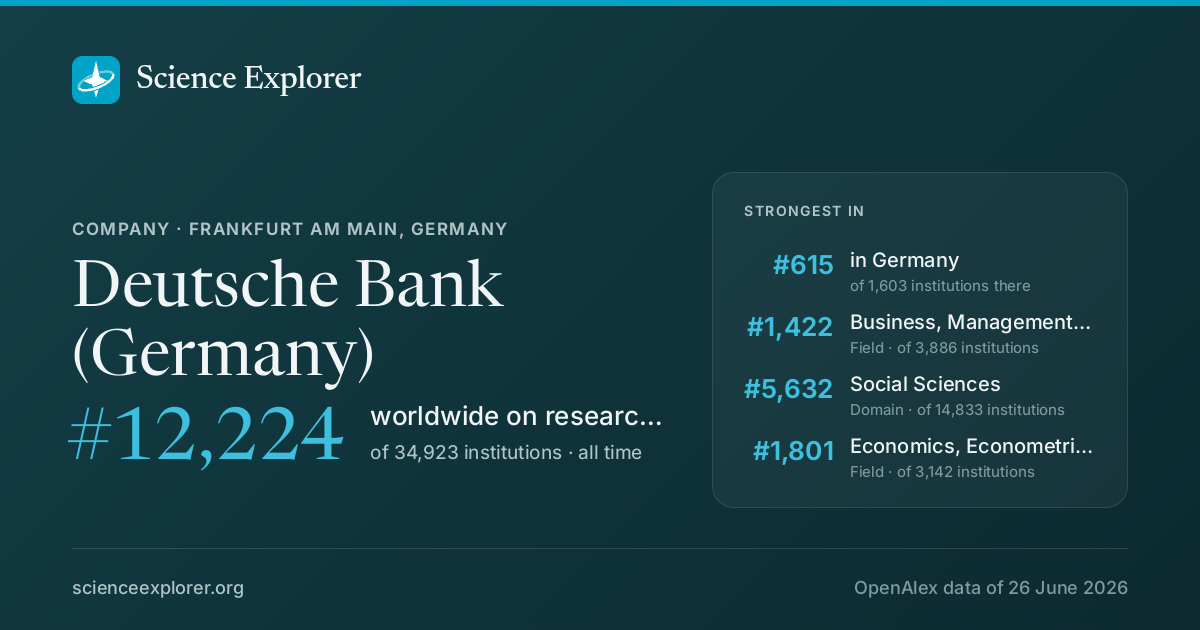
In research, Deutsche Bank (Germany) stands highest in Business, Management and Accounting (#1,422 of 3,886 worldwide), Social Sciences (#5,632 of 14,833 worldwide) and Economics, Econometrics and Finance (#1,801 of 3,142 worldwide), over all time.
- World rank, all time
- #12,224 of 34,923
- Rank in Germany
- #615 of 1,603
- Research works
- 760 ▼ 36% vs 2018-21
- Citations
- 7.3k 9.6 per fractional work
- Top-10% rate
- 9.1% all institutions 10.0%
- vs its own fields
- 0.90× 1.00× is exactly expected
- Open access
- 27% world 40%
- International
- 15% world 18%
What is Deutsche Bank (Germany) known for in research?
The fields where it stands highest, over all time, ranked among every institution above the floor in each field.
| Field | World rank | Where that sits | Top-10% rate | Works |
|---|---|---|---|---|
| Business, Management and AccountingField | #1,422 of 3,886 | 6.7% | 231 | |
| Social SciencesDomain | #5,632 of 14,833 | 5.9% | 611 | |
| Economics, Econometrics and FinanceField | #1,801 of 3,142 | 5.1% | 256 | |
| Strategy and ManagementSubfield | #871 of 1,410 | 8.0% | 131 | |
| FinanceSubfield | #524 of 663 | 3.4% | 135 |
Each strip is that field's whole ranked pool, with the notch where Deutsche Bank (Germany) sits in it, in the colour of the band that rank falls in. The track under the rate is the rate itself: it carries no average mark, because the average differs by field (from about 6% in Dentistry to 21% in Economics).
Which fields of science does Deutsche Bank (Germany) work in?
In 2022-now, 77% of research at Deutsche Bank (Germany) is in Social Sciences, 17% in Physical Sciences. Its largest fields are Business, Management and Accounting (28%), Social Sciences (19%), Arts and Humanities (14%). It does 2.7× the world's share of Social Sciences.
Each ring splits the one inside it: the four domains of science, their fields, their subfields. Size is fractional works in 2022-now. Every slice is a page; the interactive view zooms down to single topics and colours each by how much more of it this institution does than the world.
Its 4 domains and 20 fields, with their numbers
- Social Sciences4376.9%
- Business, Management and Accounting1527.6%
- Social Sciences1018.8%
- Arts and Humanities813.7%
- Economics, Econometrics and Finance610.7%
- Decision Sciences34.8%
- Psychology11.2%
- Physical Sciences1017.5%
- Computer Science712.6%
- Engineering22.8%
- Mathematics00.6%
- Energy00.5%
- Physics and Astronomy00.4%
- Earth and Planetary Sciences00.3%
- Environmental Science00.2%
- Health Sciences24.2%
- Medicine22.9%
- Health Professions00.8%
- Dentistry00.3%
- Nursing00.1%
- Life Sciences11.5%
Field profile
Location quotient across every field it publishes in: outside the ring is more than an institution of this size would be expected to publish, inside it is less.
Rings at 0.5×, 1× and 2×. Widest outward: Business, Management and Accounting, 8.6×. Every wedge is a field page.
All 20 fields, with their numbers
- Business, Management and Accounting8.56×15 works
- Economics, Econometrics and Finance5.00×6 works
- Decision Sciences4.97×3 works
- Arts and Humanities4.75×8 works
- Computer Science1.62×7 works
- Social Sciences1.49×10 works
- Neuroscience0.74×1 works
- Dentistry0.69×0 works
- Energy0.54×0 works
- Mathematics0.51×0 works
- Psychology0.39×1 works
- Health Professions0.32×0 works
- Nursing0.31×0 works
- Earth and Planetary Sciences0.20×0 works
- Engineering0.19×2 works
- Physics and Astronomy0.18×0 works
- Medicine0.15×2 works
- Environmental Science0.05×0 works
- Biochemistry, Genetics and Molecular Biology0.04×0 works
- Agricultural and Biological Sciences0.01×0 works
- Business, Management and Accounting 8.6×
- Economics, Econometrics and Finance 5.0×
- Decision Sciences 5.0×
- Arts and Humanities 4.8×
- Computer Science 1.6×
- Social Sciences 1.5×
- Neuroscience 0.7×
- Dentistry 0.7×
- Energy 0.5×
- Mathematics 0.5×
- Psychology 0.4×
- Health Professions 0.3×
- Nursing 0.3×
- Earth and Planetary Sciences 0.2×
- Engineering 0.2×
- Physics and Astronomy 0.2×
- Medicine 0.1×
- Environmental Science 0.1×
- Biochemistry, Genetics and Molecular Biology 0.0×
- Agricultural and Biological Sciences 0.0×
Who are the top researchers at Deutsche Bank (Germany)?
Ranked on the quality score, Josef Ackermann, Dietmar Hornung and Ingo Rollwagen lead among researchers whose main affiliation is Deutsche Bank (Germany).
- 1
Josef Ackermann
 Germany · #2,363,246 worldwide
160 citations · 19 works
- 2
Dietmar Hornung
Germany · #2,488,230 worldwide
112 citations · 20 works
- 3
Ingo Rollwagen
Germany · #2,501,560 worldwide
247 citations · 29 works
- 4
Oliver P. Pfeil
Germany · #2,565,853 worldwide
36 citations · 30 works
- 5
Heinz Dietrich Fischer
Germany · #2,588,599 worldwide
92 citations · 41 works
- 6
Igor Schnakenburg
Germany · #2,603,761 worldwide
246 citations · 24 works
- 7
Judith Wittig
Germany · #2,743,340 worldwide
26 citations · 26 works
- 8
Jürgen Krumnow
Germany · #2,781,277 worldwide
59 citations · 61 works
- 9
Hermann-Josef Lamberti
Germany · #2,828,335 worldwide
135 citations · 18 works
- 10
Holde
Germany · #2,890,672 worldwide
4 citations · 16 works
Which keywords describe research at Deutsche Bank (Germany)?
By fractional works in 2022-now, weighted toward what it does more of than the world: Artificial Intelligence, Big Data, Digital Transformation, Investment Decisions, Social Capital, Customer Experience, Corporate Governance and Sustainable Development.
- Financial Constraints
- Data Integration
- Organizational Economics
- Digital Rights
- Support Vector Machines
- Digital Capital
- Monetary Policy
- Innovation Policy
- German as a Foreign Language
- Governance
- Cultural Studies
- Language Variation
- Fintech
- Crowdfunding
- Mobile Health
- Business Models
- Corporate Governance
- Social Capital
- Investment Decisions
- Big Data
- Artificial Intelligence
- Digital Transformation
- Sustainable Development
- Customer Experience
- Entrepreneurship
- E-commerce
- Technology Innovation
- Discourse Analysis
- Internet of Things
- Innovation
- Financial Crisis
- Security
- Information Technology
- Language Learning
- Cybersecurity
- Value Chains
- Data Protection
- Distributed Systems
- Technology Adoption
- Digitalization
Size is fractional works in 2022-now in the topics tagged with each word; colour is the word's share of this institution's work against its share of the world's. The 40 words are chosen for being large and distinctive. Each links to the topic it comes from most.
All 40 words, with their numbers
- Artificial Intelligence7▲ 9.1×14 topics
- Big Data5▲ 9.5×9 topics
- Digital Transformation4▲ 13×5 topics
- Investment Decisions4▲ 56×3 topics
- Sustainable Development4▲ 4.3×9 topics
- Social Capital3▲ 12×5 topics
- Customer Experience3▲ 34×2 topics
- Corporate Governance3▲ 7.2×8 topics
- Entrepreneurship3▲ 12×4 topics
- Business Models2▲ 60×2 topics
- E-commerce2▲ 7.0×2 topics
- Mobile Health2▲ 26×1 topic
- Technology Innovation2▲ 112×1 topic
- Crowdfunding2▲ 50×1 topic
- Discourse Analysis2▲ 15×1 topic
- Fintech2▲ 46×1 topic
- Internet of Things2▲ 4.2×4 topics
- Language Variation2▲ 65×1 topic
- Innovation2▲ 3.3×10 topics
- Cultural Studies2▲ 8.9×2 topics
- Financial Crisis2▲ 27×5 topics
- Governance2▲ 9.2×3 topics
- Security2▲ 4.2×4 topics
- German as a Foreign Language2▲ 194×1 topic
- Information Technology2▲ 5.8×2 topics
- Innovation Policy2▲ 29×4 topics
- Language Learning2▲ 38×1 topic
- Monetary Policy2▲ 11×5 topics
- Cybersecurity1▲ 10×2 topics
- Digital Capital1▲ 140×1 topic
- Value Chains1▲ 140×1 topic
- Support Vector Machines1▲ 7.5×2 topics
- Data Protection1▲ 77×1 topic
- Digital Rights1▲ 253×1 topic
- Distributed Systems1▲ 13×4 topics
- Organizational Economics1▲ 182×2 topics
- Technology Adoption1▲ 11×2 topics
- Data Integration1▲ 12×3 topics
- Digitalization1▲ 9.5×2 topics
- Financial Constraints1▲ 19×2 topics
Which research topics does Deutsche Bank (Germany) publish most on?
By volume in 2022-now: Digital Innovation in Industries, Linguistic research and analysis, FinTech, Crowdfunding, Digital Finance and Linguistic Education and Pedagogy.
Area is fractional works; colour is the subfield each topic belongs to.
- 1 Digital Innovation in Industries Management of Technology and Innovation 2 works
- 2 Linguistic research and analysis Language and Linguistics 2 works
- 3 FinTech, Crowdfunding, Digital Finance Management Information Systems 2 works
- 4 Linguistic Education and Pedagogy Language and Linguistics 2 works
- 5 Corporate Governance and Management Strategy and Management 1 works
- 6 Digitalization, Law, and Regulation Law 1 works
- 7 Global Peace and Security Dynamics Political Science and International Relations 1 works
- 8 Cooperative Studies and Economics Strategy and Management 1 works
- 9 AI in Service Interactions Artificial Intelligence 1 works
- 10 Stock Market Forecasting Methods Management Science and Operations Research 1 works
How open and international is its research?
Against the world's own shares: the tick on each track. Both are shares of its output, so they sit on one scale and can be read against each other as well as against the world.
World: 40% of research is openly available.
World: 18% is written across borders.
How has Deutsche Bank (Germany)'s research output changed?
Output in 2022-2025 was 36% lower than in 2018-2021.
The same series as a ribbon: one cell per year, darker for more. The line above answers how much; this answers when.
Its share of all research
Growing output can still be a shrinking share: all of science grows. This is Deutsche Bank (Germany) as a percentage of every work published that year, 0.00019% in 2024.
Fractional works of Deutsche Bank (Germany) over all fractional works that year. How the balance of science has shifted.
How much of it reaches the world top 10%
Year by year, against all institutions in the same year.
Of each year's output, the share that reached the world's 10% most cited for its field and year. Peak 14.1% in 2008.
Other research institutions in Frankfurt am Main
- Goethe University Frankfurt
- European Central Bank
- Gesundheitsamt
- Cardiovascular Center Frankfurt
- Klinikum Frankfurt Höchst
- Frankfurt University of Applied Sciences
- Deutsche Bundesbank
- Frankfurt Institute for Advanced Studies

Share Deutsche Bank (Germany)'s ranking
Badges for a website1Each links back here and updates with every snapshot

Research measures only: rankings here say nothing about teaching, admissions or student experience. Comparable institutions and collaboration partners have tabs of their own, above.
Discussion
Ask a question or share a note about Deutsche Bank (Germany). Keep it to the research: no personal attacks, advertising or links. Any reader can report a post, which collapses it for everyone until it is opened.