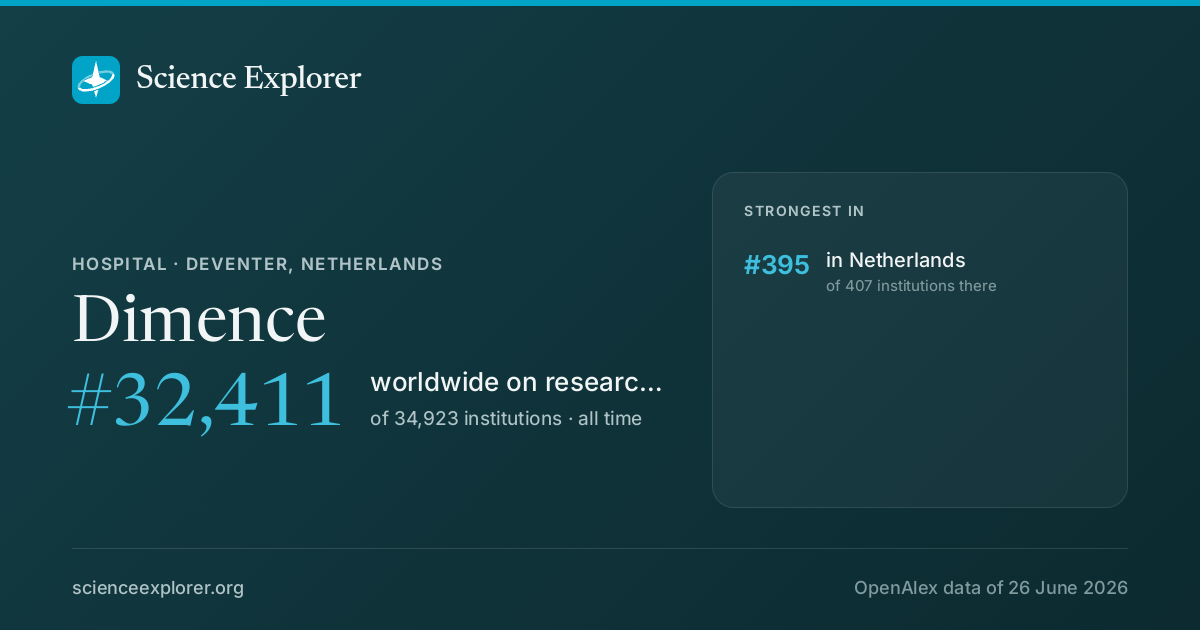
- World rank, all time
- #32,411 of 34,923
- Rank in Netherlands
- #395 of 407
- Research works
- 124 ▼ 26% vs 2018-21
- Citations
- 2.3k 18.8 per fractional work
- Top-10% rate
- 12.6% all institutions 10.0%
- vs its own fields
- 0.98× 1.00× is exactly expected
- Open access
- 47% world 40%
- International
- 26% world 18%
Which fields of science does Dimence work in?
In 2022-now, 45% of research at Dimence is in Social Sciences, 43% in Health Sciences. Its largest fields are Psychology (36%), Medicine (32%), Health Professions (10%). It does 1.6× the world's share of Health Sciences.
Each ring splits the one inside it: the four domains of science, their fields, their subfields. Size is fractional works in 2022-now. Every slice is a page; the interactive view zooms down to single topics and colours each by how much more of it this institution does than the world.
Its 4 domains and 18 fields, with their numbers
- Social Sciences1244.7%
- Health Sciences1243.0%
- Medicine932.3%
- Health Professions39.8%
- Dentistry00.5%
- Nursing00.5%
- Life Sciences26.6%
- Physical Sciences25.7%
- Computer Science13.0%
- Environmental Science01.5%
- Engineering01.2%
Field profile
Location quotient across every field it publishes in: outside the ring is more than an institution of this size would be expected to publish, inside it is less.
Rings at 0.5×, 1× and 2×. Widest outward: Psychology, 11.8×. Every wedge is a field page.
All 18 fields, with their numbers
- Psychology11.84×10 works
- Health Professions3.71×3 works
- Neuroscience2.29×1 works
- Medicine1.68×9 works
- Dentistry0.99×0 works
- Nursing0.94×0 works
- Arts and Humanities0.80×1 works
- Computer Science0.39×1 works
- Business, Management and Accounting0.39×0 works
- Agricultural and Biological Sciences0.38×0 works
- Pharmacology, Toxicology and Pharmaceutics0.38×0 works
- Social Sciences0.37×1 works
- Environmental Science0.30×0 works
- Biochemistry, Genetics and Molecular Biology0.17×0 works
- Decision Sciences0.12×0 works
- Economics, Econometrics and Finance0.11×0 works
- Engineering0.08×0 works
- Immunology and Microbiology0.04×0 works
- Psychology 11.8×
- Health Professions 3.7×
- Neuroscience 2.3×
- Medicine 1.7×
- Dentistry 1.0×
- Nursing 0.9×
- Arts and Humanities 0.8×
- Computer Science 0.4×
- Business, Management and Accounting 0.4×
- Agricultural and Biological Sciences 0.4×
- Pharmacology, Toxicology and Pharmaceutics 0.4×
- Social Sciences 0.4×
- Environmental Science 0.3×
- Biochemistry, Genetics and Molecular Biology 0.2×
- Decision Sciences 0.1×
- Economics, Econometrics and Finance 0.1×
- Engineering 0.1×
- Immunology and Microbiology 0.0×
Who are the top researchers at Dimence?
Ranked on the quality score, Bram B. Sizoo, Anja W. M. M. Stevens and Bram Bovendeerd lead among researchers whose main affiliation is Dimence.
- 1
Bram B. Sizoo
 Netherlands · #1,787,723 worldwide
1.2k citations · 68 works
- 2
Anja W. M. M. Stevens
Netherlands · #2,552,900 worldwide
562 citations · 36 works
- 3
Bram Bovendeerd
Netherlands · #2,693,613 worldwide
127 citations · 24 works
- 4
Hans van Andel
Netherlands · #2,962,379 worldwide
24 citations · 15 works
- 5
Maarten K. van Dijk
Netherlands · #3,297,207 worldwide
615 citations · 38 works
- 6
Linda M. Kronenberg
Netherlands · #3,902,435 worldwide
294 citations · 17 works
- 7
Bart Geerling
Netherlands · #4,006,524 worldwide
105 citations · 27 works
- 8
Peter J. J. Goossens
Netherlands · #5,039,310 worldwide
2.2k citations · 116 works
Which keywords describe research at Dimence?
By fractional works in 2022-now, weighted toward what it does more of than the world: Depression, Emotion Regulation, Mental Health, Anxiety, Neurobiology, Epidemiology, Genetics and Prevalence.
- Well-being
- Neuroscience
- Quality of Life
- Anxiety Disorders
- Treatment Guidelines
- Resilience
- Bipolar Spectrum Disorder
- Psychological Distress
- Neuroimaging
- Evidence-Based Practice
- Psychological Interventions
- Cognitive Therapy
- Prevalence
- Neurobiology
- Mental Health
- Epidemiology
- Depression
- Emotion Regulation
- Anxiety
- Genetics
- Adolescents
- Meta-Analysis
- Psychopathology
- Inflammation
- Interoception
- Somatic Symptoms
- Cognitive Behavioral Therapy
- Treatment
- Adherence
- Mobile Health
- Cognitive Impairment
- Psychiatric Disorders
Size is fractional works in 2022-now in the topics tagged with each word; colour is the word's share of this institution's work against its share of the world's. The 32 words are chosen for being large and distinctive. Each links to the topic it comes from most.
All 32 words, with their numbers
- Depression4▲ 17×12 topics
- Epidemiology3▲ 3.1×12 topics
- Emotion Regulation3▲ 36×6 topics
- Mental Health3▲ 7.8×12 topics
- Anxiety3▲ 21×6 topics
- Neurobiology2▲ 35×6 topics
- Genetics2▲ 10×6 topics
- Prevalence2▲ 17×3 topics
- Adolescents2▲ 17×5 topics
- Cognitive Therapy2▲ 54×3 topics
- Meta-Analysis2▲ 11×5 topics
- Psychological Interventions2▲ 44×3 topics
- Psychopathology2▲ 32×3 topics
- Evidence-Based Practice2▲ 41×4 topics
- Inflammation2▲ 2.5×3 topics
- Neuroimaging2▲ 19×2 topics
- Interoception1▲ 160×1 topic
- Psychological Distress1▲ 21×4 topics
- Somatic Symptoms1▲ 160×1 topic
- Bipolar Spectrum Disorder1▲ 210×1 topic
- Cognitive Behavioral Therapy1▲ 32×3 topics
- Resilience1▲ 9.9×5 topics
- Treatment1▲ 3.9×5 topics
- Treatment Guidelines1▲ 22×1 topic
- Adherence1▲ 35×2 topics
- Anxiety Disorders1▲ 39×2 topics
- Mobile Health1▲ 30×2 topics
- Quality of Life1▲ 3.0×10 topics
- Cognitive Impairment1▲ 15×3 topics
- Neuroscience1▲ 13×4 topics
- Psychiatric Disorders1▲ 29×3 topics
- Well-being1▲ 9.3×7 topics
Which research topics does Dimence publish most on?
By volume in 2022-now: Psychosomatic Disorders and Their Treatments, Bipolar Disorder and Treatment, Psychotherapy Techniques and Applications and Digital Mental Health Interventions.
Area is fractional works; colour is the subfield each topic belongs to.
- 1 Psychosomatic Disorders and Their Treatments Psychiatry and Mental health 1 works
- 2 Bipolar Disorder and Treatment Psychiatry and Mental health 1 works
- 3 Psychotherapy Techniques and Applications Clinical Psychology 1 works
- 4 Digital Mental Health Interventions Applied Psychology 1 works
- 5 Child and Adolescent Psychosocial and Emotional Development Clinical Psychology 1 works
- 6 Treatment of Major Depression Pharmacology 1 works
- 7 Schizophrenia research and treatment Psychiatry and Mental health 1 works
- 8 Fibromyalgia and Chronic Fatigue Syndrome Research Psychiatry and Mental health 1 works
- 9 Mental Health and Patient Involvement General Health Professions 1 works
- 10 Personality Disorders and Psychopathology Clinical Psychology 1 works
How open and international is its research?
Against the world's own shares: the tick on each track. Both are shares of its output, so they sit on one scale and can be read against each other as well as against the world.
World: 40% of research is openly available.
World: 18% is written across borders.
How has Dimence's research output changed?
Output in 2022-2025 was 26% lower than in 2018-2021.
The same series as a ribbon: one cell per year, darker for more. The line above answers how much; this answers when.
Its share of all research
Growing output can still be a shrinking share: all of science grows. This is Dimence as a percentage of every work published that year, 0.00013% in 2024.
Fractional works of Dimence over all fractional works that year. How the balance of science has shifted.
Other research institutions in Deventer
- De Gezondheidsdienst voor Dieren
- Deventer Ziekenhuis
- Goudappel Coffeng
- Tactus Verslavingszorg
- Royal GD (Netherlands)
- Altana (Netherlands)
- Tauw Group (Netherlands)
- Zorggroep Solis
Share Dimence's ranking
Badges for a website1Each links back here and updates with every snapshot

Research measures only: rankings here say nothing about teaching, admissions or student experience. Comparable institutions and collaboration partners have tabs of their own, above.
Discussion
Ask a question or share a note about Dimence. Posts are plain text and can be reported.