- World rank, 2022-now
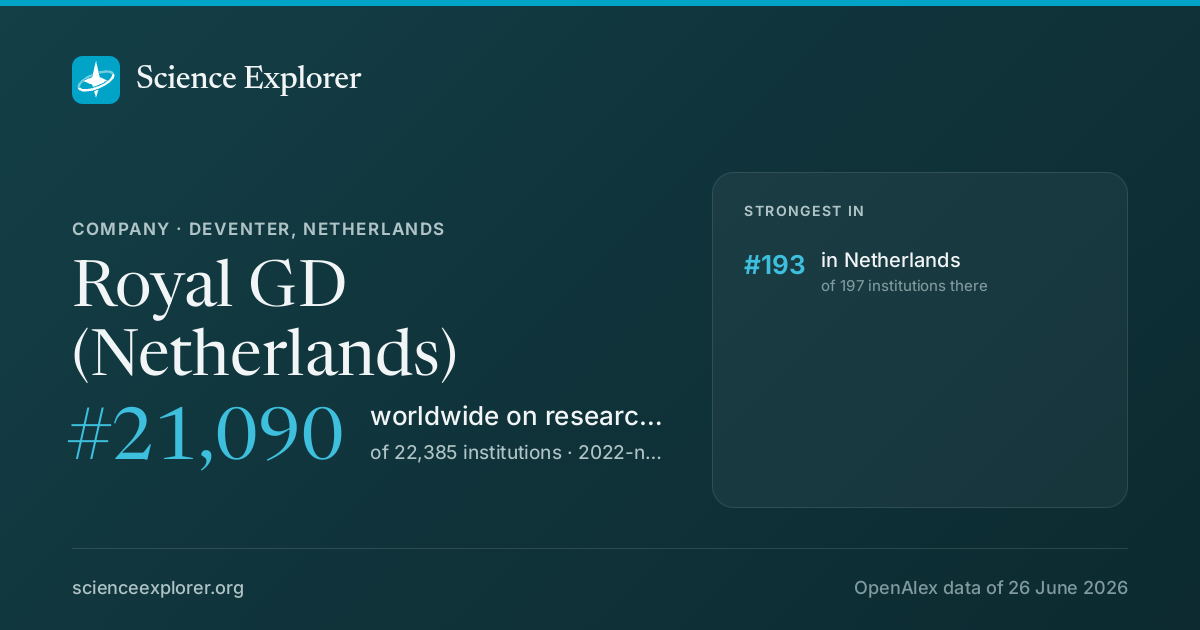
- #21,090 of 22,385
- Rank in Netherlands
- #193 of 197
- Research works
- 101 ▲ 188% vs 2018-21
- Citations
- 893 8.8 per fractional work
- Top-10% rate
- 12.0% all institutions 10.0%
- vs its own fields
- 1.01× 1.00× is exactly expected
- Open access
- 76% world 40%
- International
- 29% world 18%
Which fields of science does Royal GD (Netherlands) work in?
In 2022-now, 54% of research at Royal GD (Netherlands) is in Life Sciences, 31% in Health Sciences. Its largest fields are Agricultural and Biological Sciences (38%), Medicine (21%), Immunology and Microbiology (9%). It does 3.4× the world's share of Life Sciences.
Each ring splits the one inside it: the four domains of science, their fields, their subfields. Size is fractional works in 2022-now. Every slice is a page; the interactive view zooms down to single topics and colours each by how much more of it this institution does than the world.
Its 4 domains and 19 fields, with their numbers
- Life Sciences4253.8%
- Health Sciences2431.1%
- Medicine1620.8%
- Veterinary79.3%
- Health Professions00.6%
- Nursing00.4%
- Physical Sciences1012.9%
- Engineering56.0%
- Environmental Science34.3%
- Computer Science10.9%
- Physics and Astronomy10.9%
- Materials Science00.5%
- Mathematics00.2%
- Chemistry00.1%
- Social Sciences22.2%
Field profile
Location quotient across every field it publishes in: outside the ring is more than an institution of this size would be expected to publish, inside it is less.
Rings at 0.5×, 1× and 2×. Widest outward: Veterinary, 68.6×. Every wedge is a field page.
All 19 fields, with their numbers
- Veterinary68.64×7 works
- Immunology and Microbiology9.30×7 works
- Agricultural and Biological Sciences8.10×30 works
- Biochemistry, Genetics and Molecular Biology1.11×5 works
- Medicine1.08×16 works
- Environmental Science0.87×3 works
- Nursing0.76×0 works
- Psychology0.41×1 works
- Engineering0.40×5 works
- Physics and Astronomy0.39×1 works
- Health Professions0.23×0 works
- Decision Sciences0.22×0 works
- Mathematics0.16×0 works
- Materials Science0.14×0 works
- Computer Science0.12×1 works
- Business, Management and Accounting0.07×0 works
- Economics, Econometrics and Finance0.06×0 works
- Chemistry0.05×0 works
- Social Sciences0.03×0 works
- Veterinary 68.6×
- Immunology and Microbiology 9.3×
- Agricultural and Biological Sciences 8.1×
- Biochemistry, Genetics and Molecular Biology 1.1×
- Medicine 1.1×
- Environmental Science 0.9×
- Nursing 0.8×
- Psychology 0.4×
- Engineering 0.4×
- Physics and Astronomy 0.4×
- Health Professions 0.2×
- Decision Sciences 0.2×
- Mathematics 0.2×
- Materials Science 0.1×
- Computer Science 0.1×
- Business, Management and Accounting 0.1×
- Economics, Econometrics and Finance 0.1×
- Chemistry 0.1×
- Social Sciences 0.0×
Who are the top researchers at Royal GD (Netherlands)?
Ranked on the quality score, René van den Brom, Annet Heuvelink and Katrien M. J. A. van den Brink lead among researchers whose main affiliation is Royal GD (Netherlands).
- 1
René van den Brom
 Netherlands · #389,556 worldwide
2.1k citations · 64 works
- 2
Annet Heuvelink
Netherlands · #1,330,642 worldwide
4.2k citations · 120 works
- 3
Katrien M. J. A. van den Brink
Netherlands · #1,394,406 worldwide
143 citations · 17 works
- 4
Jobke van Hout
Netherlands · #1,841,527 worldwide
235 citations · 16 works
- 5
Manon M. C. Holstege
Netherlands · #2,568,068 worldwide
151 citations · 20 works
- 6
Jeanine Wiegel
Netherlands · #4,711,665 worldwide
157 citations · 31 works
Which keywords describe research at Royal GD (Netherlands)?
By fractional works in 2022-now, weighted toward what it does more of than the world: Epidemiology, Genetic Characterization, Pathogenesis, Viral Pathogenesis, African Swine Fever, Foot-and-Mouth Disease, Antimicrobial Resistance and Vaccines.
- Gut Microbiota
- Milk Quality
- Bovine Mastitis
- Zoonotic Infections
- Pathogenicity
- Antibiotic Resistance
- Coronavirus
- Milk Composition
- Emotional State
- Mycoplasma
- Host-Pathogen Interactions
- Infection
- Animal Welfare
- Culicoides Biting Midges
- Genomic Sequencing
- Vaccine
- Climate Change
- Foot-and-Mouth Disease
- Viral Pathogenesis
- Genetic Characterization
- Epidemiology
- Pathogenesis
- African Swine Fever
- Antimicrobial Resistance
- Vaccines
- Vaccine Development
- Bluetongue Virus
- Virulence Factors
- Public Health
- Genetic Diversity
- Immune Response
- Pasteurella
- Stress Indicators
- Dairy Cattle
- Metagenomics
- Heat Stress
- Viral Hemorrhagic Fevers
- Probiotics
- Circovirus
- Porcine Reproductive and Respiratory Syndrome Virus
Size is fractional works in 2022-now in the topics tagged with each word; colour is the word's share of this institution's work against its share of the world's. The 40 words are chosen for being large and distinctive. Each links to the topic it comes from most.
All 40 words, with their numbers
- Epidemiology24▲ 7.9×29 topics
- Genetic Characterization14▲ 411×2 topics
- Pathogenesis14▲ 36×8 topics
- Viral Pathogenesis9▲ 192×2 topics
- African Swine Fever9▲ 415×1 topic
- Foot-and-Mouth Disease9▲ 415×1 topic
- Antimicrobial Resistance8▲ 52×6 topics
- Climate Change8▲ 3.9×7 topics
- Vaccines7▲ 158×2 topics
- Vaccine6▲ 19×6 topics
- Vaccine Development6▲ 30×5 topics
- Genomic Sequencing6▲ 66×3 topics
- Bluetongue Virus6▲ 405×1 topic
- Culicoides Biting Midges6▲ 405×1 topic
- Virulence Factors5▲ 46×4 topics
- Animal Welfare4▲ 62×2 topics
- Public Health4▲ 3.8×5 topics
- Infection4▲ 22×3 topics
- Genetic Diversity4▲ 12×4 topics
- Host-Pathogen Interactions4▲ 59×2 topics
- Immune Response4▲ 8.5×4 topics
- Mycoplasma4▲ 235×1 topic
- Pasteurella4▲ 235×1 topic
- Emotional State3▲ 132×1 topic
- Stress Indicators3▲ 132×1 topic
- Milk Composition3▲ 86×2 topics
- Dairy Cattle3▲ 65×2 topics
- Coronavirus2▲ 16×2 topics
- Metagenomics2▲ 35×2 topics
- Antibiotic Resistance2▲ 7.8×4 topics
- Heat Stress2▲ 38×2 topics
- Pathogenicity2▲ 45×3 topics
- Viral Hemorrhagic Fevers2▲ 75×1 topic
- Zoonotic Infections2▲ 57×1 topic
- Probiotics2▲ 12×4 topics
- Bovine Mastitis2▲ 179×1 topic
- Circovirus2▲ 87×1 topic
- Milk Quality2▲ 179×1 topic
- Porcine Reproductive and Respiratory Syndrome Virus2▲ 87×1 topic
- Gut Microbiota2▲ 7.4×4 topics
Which research topics does Royal GD (Netherlands) publish most on?
By volume in 2022-now: Animal Disease Management and Epidemiology, Vector-Borne Animal Diseases, Microbial infections and disease research and Animal Behavior and Welfare Studies.
Area is fractional works; colour is the subfield each topic belongs to.
- 1 Animal Disease Management and Epidemiology Agronomy and Crop Science 9 works
- 2 Vector-Borne Animal Diseases Ecology, Evolution, Behavior and Systematics 6 works
- 3 Microbial infections and disease research Microbiology 4 works
- 4 Animal Behavior and Welfare Studies Small Animals 3 works
- 5 Viral Infections and Vectors Infectious Diseases 2 works
- 6 Animal Virus Infections Studies Animal Science and Zoology 2 works
- 7 Milk Quality and Mastitis in Dairy Cows Agronomy and Crop Science 2 works
- 8 Viral gastroenteritis research and epidemiology Infectious Diseases 2 works
- 9 Animal health and immunology Small Animals 2 works
- 10 Reproductive Physiology in Livestock Agronomy and Crop Science 2 works
How open and international is its research?
Against the world's own shares: the tick on each track. Both are shares of its output, so they sit on one scale and can be read against each other as well as against the world.
World: 40% of research is openly available.
World: 18% is written across borders.
How has Royal GD (Netherlands)'s research output changed?
Output in 2022-2025 was 188% higher than in 2018-2021.
The same series as a ribbon: one cell per year, darker for more. The line above answers how much; this answers when.
Other research institutions in Deventer
- De Gezondheidsdienst voor Dieren
- Deventer Ziekenhuis
- Goudappel Coffeng
- Tactus Verslavingszorg
- Dimence
- Altana (Netherlands)
- Tauw Group (Netherlands)
- Zorggroep Solis
Share Royal GD (Netherlands)'s ranking
Badges for a website1Each links back here and updates with every snapshot

Research measures only: rankings here say nothing about teaching, admissions or student experience. Comparable institutions and collaboration partners have tabs of their own, above.
Discussion
Ask a question or share a note about Royal GD (Netherlands). Posts are plain text and can be reported.