Science Explorer Back to mapMap
Discussion
Nonprofit · Deventer · Netherlands

Tactus Verslavingszorg

World rank, all time
#26,121
of 34,923
Rank in Netherlands
#332
of 407
Research works
160
▲ 39% vs 2018-21
Citations
2.1k
13.3 per fractional work
Top-10% rate
28.9%
all institutions 10.0%
vs its own fields
0.94×
1.00× is exactly expected
Open access
68%
world 40%
International
31%
world 18%

Which fields of science does Tactus Verslavingszorg work in?

In 2022-now, 57% of research at Tactus Verslavingszorg is in Social Sciences, 22% in Health Sciences. Its largest fields are Business, Management and Accounting (19%), Medicine (18%), Social Sciences (16%). It does 2.1× the world's share of Social Sciences.

Social Sciences: 34 fractional works · 56.9% of its workBusiness, Management and Accounting: 11 fractional works · 18.9% of its workManagement Information Systems: 5 fractional works · 7.9% of its workStrategy and Management: 4 fractional works · 6.6% of its workManagement of Technology and Innovation: 1 fractional works · 1.4% of its workAccounting: 1 fractional works · 1.1% of its workBusiness and International Management: 0 fractional works · 0.8% of its workOrganizational Behavior and Human Resource Management: 0 fractional works · 0.6% of its workMarketing: 0 fractional works · 0.5% of its workSocial Sciences: 9 fractional works · 15.5% of its workSociology and Political Science: 3 fractional works · 5.6% of its workEducation: 2 fractional works · 3.6% of its workGender Studies: 2 fractional works · 2.8% of its workGeography, Planning and Development: 1 fractional works · 1.1% of its workPolitical Science and International Relations: 1 fractional works · 1.1% of its workAnthropology: 1 fractional works · 1.0% of its workSmaller subfields together: 0 fractional works · 0.2% of its workPsychology: 5 fractional works · 8.5% of its workSocial Psychology: 2 fractional works · 2.9% of its workClinical Psychology: 1 fractional works · 2.4% of its workDevelopmental and Educational Psychology: 1 fractional works · 1.5% of its workExperimental and Cognitive Psychology: 1 fractional works · 0.9% of its workApplied Psychology: 0 fractional works · 0.8% of its workEconomics, Econometrics and Finance: 3 fractional works · 5.6% of its workEconomics and Econometrics: 3 fractional works · 4.8% of its workFinance: 0 fractional works · 0.8% of its workArts and Humanities: 3 fractional works · 5.4% of its workLiterature and Literary Theory: 2 fractional works · 3.1% of its workVisual Arts and Performing Arts: 1 fractional works · 1.0% of its workPhilosophy: 0 fractional works · 0.6% of its workArcheology: 0 fractional works · 0.3% of its workSmaller subfields together: 0 fractional works · 0.6% of its workDecision Sciences: 2 fractional works · 3.0% of its workManagement Science and Operations Research: 1 fractional works · 2.3% of its workInformation Systems and Management: 0 fractional works · 0.7% of its workSmaller subfields together: 0 fractional works · 0.0% of its workHealth Sciences: 13 fractional works · 21.7% of its workMedicine: 11 fractional works · 18.1% of its workPublic Health, Environmental and Occupational Health: 2 fractional works · 3.7% of its workNeurology: 2 fractional works · 3.1% of its workPsychiatry and Mental health: 1 fractional works · 1.9% of its workEpidemiology: 1 fractional works · 1.6% of its workRheumatology: 1 fractional works · 1.3% of its workHematology: 1 fractional works · 1.1% of its workPediatrics, Perinatology and Child Health: 1 fractional works · 1.0% of its workSurgery: 1 fractional works · 1.0% of its workPulmonary and Respiratory Medicine: 0 fractional works · 0.8% of its workHealth Informatics: 0 fractional works · 0.4% of its workPhysiology: 0 fractional works · 0.4% of its workEndocrinology, Diabetes and Metabolism: 0 fractional works · 0.3% of its workInfectious Diseases: 0 fractional works · 0.3% of its workComplementary and alternative medicine: 0 fractional works · 0.3% of its workGastroenterology: 0 fractional works · 0.3% of its workSmaller subfields together: 0 fractional works · 0.6% of its workHealth Professions: 2 fractional works · 3.5% of its workGeneral Health Professions: 1 fractional works · 1.6% of its workPhysical Therapy, Sports Therapy and Rehabilitation: 1 fractional works · 1.2% of its workHealth Information Management: 0 fractional works · 0.4% of its workPharmacy: 0 fractional works · 0.3% of its workVeterinary: 0 fractional works · 0.2% of its workPhysical Sciences: 9 fractional works · 15.6% of its workEngineering: 4 fractional works · 6.5% of its workIndustrial and Manufacturing Engineering: 1 fractional works · 2.2% of its workMedia Technology: 1 fractional works · 1.6% of its workAerospace Engineering: 0 fractional works · 0.8% of its workElectrical and Electronic Engineering: 0 fractional works · 0.8% of its workOcean Engineering: 0 fractional works · 0.8% of its workBiomedical Engineering: 0 fractional works · 0.3% of its workComputer Science: 3 fractional works · 4.8% of its workComputer Vision and Pattern Recognition: 1 fractional works · 1.7% of its workInformation Systems: 1 fractional works · 1.4% of its workArtificial Intelligence: 0 fractional works · 0.8% of its workComputer Networks and Communications: 0 fractional works · 0.6% of its workHuman-Computer Interaction: 0 fractional works · 0.4% of its workEnergy: 1 fractional works · 1.6% of its workGeneral Energy: 1 fractional works · 1.1% of its workEnergy Engineering and Power Technology: 0 fractional works · 0.3% of its workRenewable Energy, Sustainability and the Environment: 0 fractional works · 0.2% of its workEnvironmental Science: 1 fractional works · 1.6% of its workEcology: 1 fractional works · 1.1% of its workPollution: 0 fractional works · 0.3% of its workSmaller subfields together: 0 fractional works · 0.2% of its workChemistry: 0 fractional works · 0.6% of its workOrganic Chemistry: 0 fractional works · 0.3% of its workSpectroscopy: 0 fractional works · 0.3% of its workMathematics: 0 fractional works · 0.4% of its workStatistics and Probability: 0 fractional works · 0.4% of its workPhysics and Astronomy: 0 fractional works · 0.2% of its workLife Sciences: 3 fractional works · 5.7% of its workAgricultural and Biological Sciences: 2 fractional works · 2.5% of its workEcology, Evolution, Behavior and Systematics: 1 fractional works · 0.9% of its workGeneral Agricultural and Biological Sciences: 0 fractional works · 0.7% of its workAgronomy and Crop Science: 0 fractional works · 0.7% of its workPlant Science: 0 fractional works · 0.3% of its workNeuroscience: 1 fractional works · 2.1% of its workCognitive Neuroscience: 1 fractional works · 1.1% of its workCellular and Molecular Neuroscience: 1 fractional works · 0.9% of its workSmaller subfields together: 0 fractional works · 0.1% of its workBiochemistry, Genetics and Molecular Biology: 1 fractional works · 1.0% of its workMolecular Biology: 0 fractional works · 0.7% of its workSmaller subfields together: 0 fractional works · 0.3% of its workPharmacology, Toxicology and Pharmaceutics: 0 fractional works · 0.1% of its workALL ITS WORKTactusVerslavingszorg60fractional works, 2022-now
Life Sciences6%Physical Sciences16%Health Sciences22%Social Sciences57%

Each ring splits the one inside it: the four domains of science, their fields, their subfields. Size is fractional works in 2022-now. Every slice is a page; the interactive view zooms down to single topics and colours each by how much more of it this institution does than the world.

Its 4 domains and 20 fields, with their numbers
    1. Business, Management and Accounting1118.9%
    2. Social Sciences915.5%
    3. Psychology58.5%
    4. Economics, Econometrics and Finance35.6%
    5. Arts and Humanities35.4%
    6. Decision Sciences23.0%
    1. Medicine1118.1%
    2. Health Professions23.5%
    3. Veterinary00.2%
    1. Engineering46.5%
    2. Computer Science34.8%
    3. Energy11.6%
    4. Environmental Science11.6%
    5. Chemistry00.6%
    6. Mathematics00.4%
    7. Physics and Astronomy00.2%
    1. Agricultural and Biological Sciences22.5%
    2. Neuroscience12.1%
    3. Biochemistry, Genetics and Molecular Biology11.0%
    4. Pharmacology, Toxicology and Pharmaceutics00.1%
All of science, and how each field's share has moved since 1950: the Science domain explorer

Field profile

Location quotient across every field it publishes in: outside the ring is more than an institution of this size would be expected to publish, inside it is less.

Agricultural and Biological Sciences: 0.53× its world share, 2 worksAgricultural and Bio…Biochemistry, Genetics and Molecular Biology: 0.18× its world share, 1 worksBiochemistry, Geneti…Neuroscience: 1.30× its world share, 1 worksNeurosciencePharmacology, Toxicology and Pharmaceutics: 0.39× its world share, 0 worksPharmacology, Toxico…Chemistry: 0.35× its world share, 0 worksChemistryComputer Science: 0.62× its world share, 3 worksComputer ScienceEnergy: 1.74× its world share, 1 worksEnergyEngineering: 0.43× its world share, 4 worksEngineeringEnvironmental Science: 0.32× its world share, 1 worksEnvironmental ScienceMathematics: 0.32× its world share, 0 worksMathematicsPhysics and Astronomy: 0.08× its world share, 0 worksPhysics and AstronomyHealth Professions: 1.32× its world share, 2 worksHealth ProfessionsMedicine: 0.94× its world share, 11 worksMedicineVeterinary: 1.36× its world share, 0 worksVeterinaryArts and Humanities: 1.88× its world share, 3 worksArts and HumanitiesBusiness, Management and Accounting: 5.87× its world share, 11 worksBusiness, Management…Decision Sciences: 3.06× its world share, 2 worksDecision SciencesEconomics, Econometrics and Finance: 2.62× its world share, 3 worksEconomics, Econometr…Psychology: 2.80× its world share, 5 worksPsychologySocial Sciences: 1.22× its world share, 9 worksSocial Sciences1×world share
more than its size predictsabout as predictedless

Rings at 0.5×, 1× and 2×. Widest outward: Business, Management and Accounting, 5.9×. Every wedge is a field page.

All 20 fields, with their numbers
  1. Business, Management and Accounting5.87×11 works
  2. Decision Sciences3.06×2 works
  3. Psychology2.80×5 works
  4. Economics, Econometrics and Finance2.62×3 works
  5. Arts and Humanities1.88×3 works
  6. Energy1.74×1 works
  7. Veterinary1.36×0 works
  8. Health Professions1.32×2 works
  9. Neuroscience1.30×1 works
  10. Social Sciences1.22×9 works
  11. Medicine0.94×11 works
  12. Computer Science0.62×3 works
  13. Agricultural and Biological Sciences0.53×2 works
  14. Engineering0.43×4 works
  15. Pharmacology, Toxicology and Pharmaceutics0.39×0 works
  16. Chemistry0.35×0 works
  17. Environmental Science0.32×1 works
  18. Mathematics0.32×0 works
  19. Biochemistry, Genetics and Molecular Biology0.18×1 works
  20. Physics and Astronomy0.08×0 works

Who are the top researchers at Tactus Verslavingszorg?

Ranked on the quality score, Adedoyin Tolulope Oyewole, Onyeka Chrisanctus Ofodile and David Olanrewaju Olutimehin lead among researchers whose main affiliation is Tactus Verslavingszorg.

  1. 1 Adedoyin Tolulope Oyewole Netherlands · #32,795 worldwide 1.6k citations · 29 works
  2. 2 Onyeka Chrisanctus Ofodile Netherlands · #33,768 worldwide 2.4k citations · 86 works
  3. 3 David Olanrewaju Olutimehin Netherlands · #163,101 worldwide 401 citations · 27 works
  4. 4 Elke D. ter Huurne Netherlands · #2,475,029 worldwide 454 citations · 18 works
  5. 5 Marloes Gerda Postel Netherlands · #2,684,081 worldwide 1.7k citations · 82 works
  6. 6 Hein Arnoud de Haan Netherlands · #3,022,816 worldwide 1.3k citations · 55 works
  7. 7 Ruud J. T. Rutten Netherlands · #4,110,785 worldwide 30 citations · 19 works
  8. 8 Tim Kok Netherlands · #4,675,612 worldwide 131 citations · 21 works
All ranked researchers at Tactus Verslavingszorg

What are the most cited papers from Tactus Verslavingszorg?

The most cited paper from Tactus Verslavingszorg is "Effectiveness and treatment moderators of internet interventions for adult problem drinking: An individual patient data meta-analysis of 19 randomised controlled trials" (Heleen M. Riper et al., 2018), with 297 citations. Next come "Prevalence of cognitive impairment in patients with substance use disorder" (185) and "Personality disorders in alcoholics and drug addicts" (176).

Most cited papers
#PaperReleasedCitations
1 Effectiveness and treatment moderators of internet interventions for adult problem drinking: An individual patient data meta-analysis of 19 randomised controlled trials Heleen M. Riper et al. · PLoS Medicine ReviewOpen access 18 Dec 2018 297
2 Prevalence of cognitive impairment in patients with substance use disorder Carolien J. W. H. Bruijnen, Boukje A.G. Dijkstra, Serge J. W. Walvoort et al. · Drug and Alcohol Review Open access 27 Mar 2019 185
3 Personality disorders in alcoholics and drug addicts Cornelis H.C. Dejong, Wim van den Brink, Felicia M. Harteveld et al. · Comprehensive Psychiatry Mar 1993 176
4 Ten-Item Internet Gaming Disorder Test (IGDT-10): Measurement invariance and cross-cultural validation across seven language-based samples. Orsolya Király, Beáta Bőthe, Jano Ramos‐Diaz et al. · Psychology of Addictive Behaviors Open access 27 Dec 2018 142
5 A standardized validity assessment protocol for physiological signals from wearable technology: Methodological underpinnings and an application to the E4 biosensor Hendrika G. van Lier, Marcel E. Pieterse, Ainara Garde et al. · Behavior Research Methods Open access 9 Jul 2019 136
All 60 most cited papers, with filters and sorting

Which keywords describe research at Tactus Verslavingszorg?

By fractional works in 2022-now, weighted toward what it does more of than the world: Sustainability, Supply Chain Management, Entrepreneurship, Social Capital, Big Data, Globalization, Economic Development and Internet of Things.

▲ more of its work than of the world's◆ about the world's share▼ less than the world's

Size is fractional works in 2022-now in the topics tagged with each word; colour is the word's share of this institution's work against its share of the world's. The 40 words are chosen for being large and distinctive. Each links to the topic it comes from most.

All 40 words, with their numbers
  1. Sustainability7▲ 4.6×10 topics
  2. Supply Chain Management4▲ 8.2×5 topics
  3. Globalization4▲ 3.6×7 topics
  4. Entrepreneurship4▲ 17×6 topics
  5. Big Data4▲ 6.2×4 topics
  6. Social Capital3▲ 11×4 topics
  7. Economic Development3▲ 6.2×5 topics
  8. Internet of Things3▲ 5.7×5 topics
  9. Educational Technologies2▲ 44×2 topics
  10. Neuroimaging2▲ 15×4 topics
  11. Crowdfunding2▲ 54×1 topic
  12. Fintech2▲ 50×1 topic
  13. Oxidative Stress2▲ 2.2×5 topics
  14. Pedagogy2▲ 7.2×1 topic
  15. Teaching Methods2▲ 22×1 topic
  16. Mental Health2▲ 2.4×8 topics
  17. Innovation2▲ 3.1×9 topics
  18. Regulation2▲ 6.1×3 topics
  19. Economic Growth2▲ 3.8×4 topics
  20. Risk Management2▲ 6.2×4 topics
  21. Leadership2▲ 5.7×3 topics
  22. Neuropathology2▲ 22×2 topics
  23. Cyber-Physical Systems2▲ 10×2 topics
  24. Digital Twin2▲ 19×2 topics
  25. Thiamine Deficiency2▲ 178×1 topic
  26. Wernicke-Korsakoff Syndrome2▲ 178×1 topic
  27. Global Governance2▲ 10×3 topics
  28. Analytics1▲ 27×1 topic
  29. Business Intelligence1▲ 27×1 topic
  30. Governance1▲ 7.2×3 topics
  31. Cloud Manufacturing1▲ 24×1 topic
  32. Geopolitics1▲ 15×2 topics
  33. Philosophy1▲ 5.0×2 topics
  34. Smart Manufacturing1▲ 24×1 topic
  35. Investment1▲ 17×3 topics
  36. China1▲ 18×1 topic
  37. Detective Stories1▲ 347×1 topic
  38. Disruption Mitigation1▲ 34×1 topic
  39. Psychiatric Disorders1▲ 12×3 topics
  40. Substance Use Disorders1▲ 22×2 topics

Which research topics does Tactus Verslavingszorg publish most on?

By volume in 2022-now: FinTech, Crowdfunding, Digital Finance, Education, Innovation and Language Studies, Alcoholism and Thiamine Deficiency and Big Data and Business Intelligence.

  1. 1 FinTech, Crowdfunding, Digital Finance Management Information Systems 2 works
  2. 2 Education, Innovation and Language Studies Education 2 works
  3. 3 Alcoholism and Thiamine Deficiency Neurology 2 works
  4. 4 Big Data and Business Intelligence Management Information Systems 1 works
  5. 5 Digital Transformation in Industry Industrial and Manufacturing Engineering 1 works
  6. 6 Neonatal and Maternal Infections Public Health, Environmental and Occupational Health 1 works
  7. 7 Gender, Labor, and Family Dynamics Gender Studies 1 works
  8. 8 Crime and Detective Fiction Studies Literature and Literary Theory 1 works
  9. 9 Chinese history and philosophy Sociology and Political Science 1 works
  10. 10 Handwritten Text Recognition Techniques Computer Vision and Pattern Recognition 1 works

How open and international is its research?

Against the world's own shares: the tick on each track. Both are shares of its output, so they sit on one scale and can be read against each other as well as against the world.

openly available68.4%not open31.6%

World: 40% of research is openly available.

with international co-authors30.8%domestic only69.2%

World: 18% is written across borders.

How has Tactus Verslavingszorg's research output changed?

Output in 2022-2025 was 39% higher than in 2018-2021.

still counting1990200020102020
grewheldshrank

The same series as a ribbon: one cell per year, darker for more. The line above answers how much; this answers when.

Its share of all research

Growing output can still be a shrinking share: all of science grows. This is Tactus Verslavingszorg as a percentage of every work published that year, 0.00051% in 2024.

still counting0.00020%0.00040%0.00060%Tactus Verslavingszorg0.00016% in 202519801990200020102020

Fractional works of Tactus Verslavingszorg over all fractional works that year. How the balance of science has shifted.

Other research institutions in Deventer

All research institutions in Deventer

Share Tactus Verslavingszorg's ranking
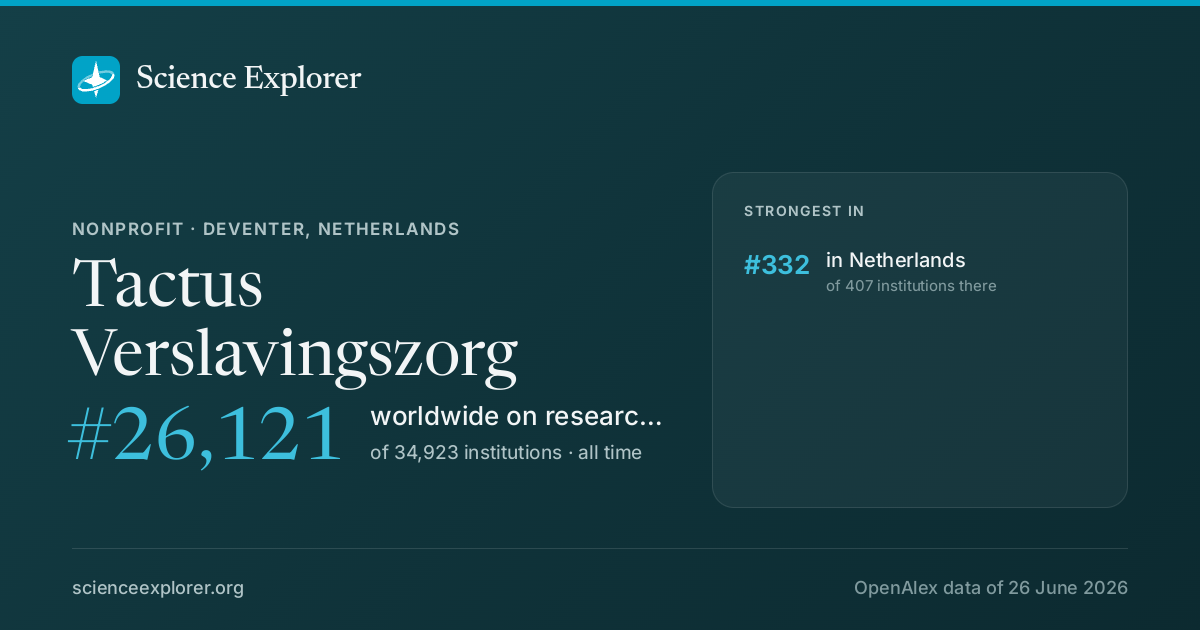
Tactus Verslavingszorg on Science Explorer

A card with Tactus Verslavingszorg's standing and the fields it leads in, for a post or a slide. A link to this page previews as the same card.

Download the card

1200 × 630 PNG, sized for social posts, drawn from the latest snapshot.

Badges for a website1Each links back here and updates with every snapshot

Research measures only: rankings here say nothing about teaching, admissions or student experience. Comparable institutions and collaboration partners have tabs of their own, above.

Discussion

Ask a question or share a note about Tactus Verslavingszorg. Posts are plain text and can be reported.
