Science Explorer Back to mapMap
Discussion
Nonprofit · Hyderabad · India

Dr. Reddy's Foundation

World rank, all time
#33,451
of 34,923
Rank in India
#1,650
of 1,754
Research works
148
▲ 146% vs 2018-21
Citations
3.5k
23.3 per fractional work
Top-10% rate
10.8%
all institutions 10.0%
vs its own fields
0.90×
1.00× is exactly expected
Open access
32%
world 40%
International
14%
world 18%

Which fields of science does Dr. Reddy's Foundation work in?

In 2022-now, 33% of research at Dr. Reddy's Foundation is in Life Sciences, 26% in Health Sciences. Its largest fields are Agricultural and Biological Sciences (24%), Medicine (21%), Computer Science (10%). It does 1.9× the world's share of Life Sciences.

Life Sciences: 11 fractional works · 32.6% of its workAgricultural and Biological Sciences: 9 fractional works · 24.5% of its workPlant Science: 3 fractional works · 9.7% of its workGeneral Agricultural and Biological Sciences: 2 fractional works · 5.1% of its workEcology, Evolution, Behavior and Systematics: 2 fractional works · 4.8% of its workSoil Science: 1 fractional works · 2.7% of its workAgronomy and Crop Science: 0 fractional works · 1.4% of its workFood Science: 0 fractional works · 0.8% of its workBiochemistry, Genetics and Molecular Biology: 2 fractional works · 5.8% of its workMolecular Biology: 1 fractional works · 2.6% of its workGenetics: 1 fractional works · 2.0% of its workCancer Research: 0 fractional works · 0.9% of its workCell Biology: 0 fractional works · 0.2% of its workImmunology and Microbiology: 0 fractional works · 1.1% of its workImmunology: 0 fractional works · 1.0% of its workSmaller subfields together: 0 fractional works · 0.2% of its workNeuroscience: 0 fractional works · 1.1% of its workNeurology: 0 fractional works · 0.9% of its workSmaller subfields together: 0 fractional works · 0.2% of its workHealth Sciences: 9 fractional works · 25.6% of its workMedicine: 7 fractional works · 21.3% of its workSurgery: 1 fractional works · 3.7% of its workEndocrinology, Diabetes and Metabolism: 1 fractional works · 3.1% of its workInfectious Diseases: 1 fractional works · 2.8% of its workPublic Health, Environmental and Occupational Health: 1 fractional works · 2.6% of its workPulmonary and Respiratory Medicine: 1 fractional works · 1.6% of its workPediatrics, Perinatology and Child Health: 0 fractional works · 1.3% of its workPathology and Forensic Medicine: 0 fractional works · 1.0% of its workRadiology, Nuclear Medicine and Imaging: 0 fractional works · 0.8% of its workOncology: 0 fractional works · 0.7% of its workEpidemiology: 0 fractional works · 0.6% of its workObstetrics and Gynecology: 0 fractional works · 0.5% of its workOtorhinolaryngology: 0 fractional works · 0.5% of its workPsychiatry and Mental health: 0 fractional works · 0.5% of its workNeurology: 0 fractional works · 0.5% of its workComplementary and alternative medicine: 0 fractional works · 0.3% of its workHematology: 0 fractional works · 0.3% of its workSmaller subfields together: 0 fractional works · 0.4% of its workHealth Professions: 1 fractional works · 2.6% of its workGeneral Health Professions: 1 fractional works · 1.8% of its workRadiological and Ultrasound Technology: 0 fractional works · 0.5% of its workHealth Information Management: 0 fractional works · 0.3% of its workDentistry: 1 fractional works · 1.7% of its workPeriodontics: 0 fractional works · 0.8% of its workGeneral Dentistry: 0 fractional works · 0.5% of its workOral Surgery: 0 fractional works · 0.5% of its workPhysical Sciences: 8 fractional works · 23.8% of its workComputer Science: 3 fractional works · 9.5% of its workInformation Systems: 1 fractional works · 4.1% of its workArtificial Intelligence: 1 fractional works · 3.2% of its workComputer Networks and Communications: 1 fractional works · 1.9% of its workComputer Vision and Pattern Recognition: 0 fractional works · 0.3% of its workEngineering: 2 fractional works · 4.6% of its workMedia Technology: 1 fractional works · 1.9% of its workBuilding and Construction: 0 fractional works · 0.9% of its workAerospace Engineering: 0 fractional works · 0.6% of its workBiomedical Engineering: 0 fractional works · 0.6% of its workElectrical and Electronic Engineering: 0 fractional works · 0.2% of its workMechanical Engineering: 0 fractional works · 0.2% of its workSmaller subfields together: 0 fractional works · 0.0% of its workEnvironmental Science: 1 fractional works · 3.7% of its workEcology: 1 fractional works · 2.1% of its workEnvironmental Engineering: 0 fractional works · 1.4% of its workSmaller subfields together: 0 fractional works · 0.2% of its workMathematics: 1 fractional works · 3.4% of its workAlgebra and Number Theory: 0 fractional works · 0.9% of its workApplied Mathematics: 0 fractional works · 0.9% of its workNumerical Analysis: 0 fractional works · 0.9% of its workGeometry and Topology: 0 fractional works · 0.6% of its workSmaller subfields together: 0 fractional works · 0.0% of its workEarth and Planetary Sciences: 0 fractional works · 1.2% of its workAtmospheric Science: 0 fractional works · 0.9% of its workGeophysics: 0 fractional works · 0.2% of its workSmaller subfields together: 0 fractional works · 0.0% of its workMaterials Science: 0 fractional works · 0.7% of its workMaterials Chemistry: 0 fractional works · 0.5% of its workSmaller subfields together: 0 fractional works · 0.2% of its workChemistry: 0 fractional works · 0.6% of its workSpectroscopy: 0 fractional works · 0.6% of its workSocial Sciences: 6 fractional works · 18.0% of its workSocial Sciences: 3 fractional works · 8.8% of its workSociology and Political Science: 1 fractional works · 3.2% of its workPolitical Science and International Relations: 1 fractional works · 1.9% of its workDemography: 0 fractional works · 1.1% of its workGender Studies: 0 fractional works · 0.9% of its workHealth: 0 fractional works · 0.9% of its workCultural Studies: 0 fractional works · 0.3% of its workEducation: 0 fractional works · 0.3% of its workLaw: 0 fractional works · 0.2% of its workBusiness, Management and Accounting: 1 fractional works · 3.2% of its workStrategy and Management: 1 fractional works · 3.2% of its workPsychology: 1 fractional works · 2.7% of its workExperimental and Cognitive Psychology: 1 fractional works · 1.7% of its workClinical Psychology: 0 fractional works · 1.0% of its workArts and Humanities: 1 fractional works · 2.4% of its workReligious studies: 0 fractional works · 1.4% of its workMuseology: 0 fractional works · 0.9% of its workDecision Sciences: 0 fractional works · 0.5% of its workManagement Science and Operations Research: 0 fractional works · 0.5% of its workEconomics, Econometrics and Finance: 0 fractional works · 0.5% of its workEconomics and Econometrics: 0 fractional works · 0.5% of its workALL ITS WORKDr. Reddy'sFoundation35fractional works, 2022-now
Life Sciences33%Physical Sciences24%Health Sciences26%Social Sciences18%

Each ring splits the one inside it: the four domains of science, their fields, their subfields. Size is fractional works in 2022-now. Every slice is a page; the interactive view zooms down to single topics and colours each by how much more of it this institution does than the world.

Its 4 domains and 20 fields, with their numbers
    1. Agricultural and Biological Sciences924.5%
    2. Biochemistry, Genetics and Molecular Biology25.8%
    3. Immunology and Microbiology01.1%
    4. Neuroscience01.1%
    1. Medicine721.3%
    2. Health Professions12.6%
    3. Dentistry11.7%
    1. Computer Science39.5%
    2. Engineering24.6%
    3. Environmental Science13.7%
    4. Mathematics13.4%
    5. Earth and Planetary Sciences01.2%
    6. Materials Science00.7%
    7. Chemistry00.6%
    1. Social Sciences38.8%
    2. Business, Management and Accounting13.2%
    3. Psychology12.7%
    4. Arts and Humanities12.4%
    5. Decision Sciences00.5%
    6. Economics, Econometrics and Finance00.5%
All of science, and how each field's share has moved since 1950: the Science domain explorer

Field profile

Location quotient across every field it publishes in: outside the ring is more than an institution of this size would be expected to publish, inside it is less.

Agricultural and Biological Sciences: 5.16× its world share, 9 worksAgricultural and Bio…Biochemistry, Genetics and Molecular Biology: 1.09× its world share, 2 worksBiochemistry, Geneti…Immunology and Microbiology: 1.14× its world share, 0 worksImmunology and Micro…Neuroscience: 0.70× its world share, 0 worksNeuroscienceChemistry: 0.41× its world share, 0 worksChemistryComputer Science: 1.22× its world share, 3 worksComputer ScienceEarth and Planetary Sciences: 0.76× its world share, 0 worksEarth and Planetary …Engineering: 0.31× its world share, 2 worksEngineeringEnvironmental Science: 0.75× its world share, 1 worksEnvironmental ScienceMaterials Science: 0.19× its world share, 0 worksMaterials ScienceMathematics: 2.92× its world share, 1 worksMathematicsDentistry: 3.61× its world share, 1 worksDentistryHealth Professions: 0.99× its world share, 1 worksHealth ProfessionsMedicine: 1.10× its world share, 7 worksMedicineArts and Humanities: 0.83× its world share, 1 worksArts and HumanitiesBusiness, Management and Accounting: 0.98× its world share, 1 worksBusiness, Management…Decision Sciences: 0.49× its world share, 0 worksDecision SciencesEconomics, Econometrics and Finance: 0.22× its world share, 0 worksEconomics, Econometr…Psychology: 0.89× its world share, 1 worksPsychologySocial Sciences: 0.70× its world share, 3 worksSocial Sciences1×world share
more than its size predictsabout as predictedless

Rings at 0.5×, 1× and 2×. Widest outward: Agricultural and Biological Sciences, 5.2×. Every wedge is a field page.

All 20 fields, with their numbers
  1. Agricultural and Biological Sciences5.16×9 works
  2. Dentistry3.61×1 works
  3. Mathematics2.92×1 works
  4. Computer Science1.22×3 works
  5. Immunology and Microbiology1.14×0 works
  6. Medicine1.10×7 works
  7. Biochemistry, Genetics and Molecular Biology1.09×2 works
  8. Health Professions0.99×1 works
  9. Business, Management and Accounting0.98×1 works
  10. Psychology0.89×1 works
  11. Arts and Humanities0.83×1 works
  12. Earth and Planetary Sciences0.76×0 works
  13. Environmental Science0.75×1 works
  14. Neuroscience0.70×0 works
  15. Social Sciences0.70×3 works
  16. Decision Sciences0.49×0 works
  17. Chemistry0.41×0 works
  18. Engineering0.31×2 works
  19. Economics, Econometrics and Finance0.22×0 works
  20. Materials Science0.19×0 works

Who are the top researchers at Dr. Reddy's Foundation?

Ranked on the quality score, Braj Bhushan Lohray, Reeba Kannimel Vikramadithyan and A. Sekar Reddy lead among researchers whose main affiliation is Dr. Reddy's Foundation.

  1. 1 Braj Bhushan Lohray India · #2,120,069 worldwide 3.1k citations · 136 works
  2. 2 Reeba Kannimel Vikramadithyan India · #3,038,188 worldwide 1.7k citations · 36 works
  3. 3 A. Sekar Reddy India · #4,529,692 worldwide 320 citations · 15 works
  4. 4 Ramanujam Rajagopalan India · #4,759,652 worldwide 823 citations · 27 works
  5. 5 Ramesh M. Gidwani India · #5,277,252 worldwide 79 citations · 20 works
  6. 6 Dan Rao India · #5,420,613 worldwide 366 citations · 23 works
  7. 7 Pavuluri Panduranga Rao India · #5,627,141 worldwide 594 citations · 57 works
All ranked researchers at Dr. Reddy's Foundation

What are the most cited papers from Dr. Reddy's Foundation?

The most cited paper from Dr. Reddy's Foundation is "Enhancing plant phosphorus use efficiency for sustainable cropping" (Vinay Shenoy, Girish Kalagudi, 2005), with 345 citations. Next come "Cu(I)-catalyzed three component coupling protocol for the synthesis of quinoline derivatives" (189) and "Novel indolo[2,1-b]quinazoline analogues as cytostatic agents: synthesis, biological evaluation and structure–activity relationship" (158).

Most cited papers
#PaperReleasedCitations
1 Enhancing plant phosphorus use efficiency for sustainable cropping Vinay Shenoy, Girish Kalagudi · Biotechnology Advances 3 Sep 2005 345
2 Cu(I)-catalyzed three component coupling protocol for the synthesis of quinoline derivatives H. Z. Syeda Huma, Rajkumar Halder, Swinderjeet Singh Kalra et al. · Tetrahedron Letters Sep 2002 189
3 Novel indolo[2,1-b]quinazoline analogues as cytostatic agents: synthesis, biological evaluation and structure–activity relationship Vedula M. Sharma, Pragya Prasanna, K.V. Adi Seshu et al. · Bioorganic & Medicinal Chemistry Letters Sep 2002 158
4 Drought yield index to select high yielding rice lines under different drought stress severities Anitha K. Raman, Satish Balkrishna Verulkar, Nimai Prasad Mandal et al. · Rice Open access 4 Oct 2012 152
5 Breeding resilient and productive genotypes adapted to drought-prone rainfed ecosystem of India Satish Balkrishna Verulkar et al. · Field Crops Research 10 Apr 2010 143
All 61 most cited papers, with filters and sorting

Which keywords describe research at Dr. Reddy's Foundation?

By fractional works in 2022-now, weighted toward what it does more of than the world: Food Security, Sustainability, Machine Learning, Social Networks, Sustainable Agriculture, Agriculture, Risk Management and Deep Learning.

▲ more of its work than of the world's◆ about the world's share▼ less than the world's

Size is fractional works in 2022-now in the topics tagged with each word; colour is the word's share of this institution's work against its share of the world's. The 29 words are chosen for being large and distinctive. Each links to the topic it comes from most.

All 29 words, with their numbers
  1. Machine Learning3▲ 2.7×9 topics
  2. Food Security3▲ 16×6 topics
  3. Sustainability3▲ 3.6×7 topics
  4. Deep Learning3▲ 2.4×9 topics
  5. Social Networks2▲ 20×2 topics
  6. Healthcare2▲ 4.3×6 topics
  7. Sustainable Agriculture2▲ 16×2 topics
  8. Agriculture2▲ 12×3 topics
  9. Climate Change2▲ 1.73×5 topics
  10. Risk Management2▲ 9.7×2 topics
  11. Cancer2▲ 3.2×7 topics
  12. Epidemiology1◆ 1.02×12 topics
  13. Water Management1▲ 32×3 topics
  14. Agricultural Innovation1▲ 79×1 topic
  15. Biodiversity1▲ 4.8×2 topics
  16. Ecosystem Services1▲ 9.9×2 topics
  17. Internet of Things1▲ 4.5×4 topics
  18. Livelihood Diversification1▲ 117×1 topic
  19. Remote Sensing1▲ 3.1×4 topics
  20. Aquaculture1▲ 14×2 topics
  21. Integrated Farming Systems1▲ 225×1 topic
  22. Pandemic1▲ 3.5×4 topics
  23. QTL Mapping1▲ 29×2 topics
  24. Rice-Fish Farming1▲ 225×1 topic
  25. Wireless Sensor Networks1▲ 7.5×3 topics
  26. Vulnerability1▲ 14×2 topics
  27. Disruption Mitigation1▲ 58×1 topic
  28. Drought Resistance1▲ 31×2 topics
  29. Supply Chain Resilience1▲ 58×1 topic

Which research topics does Dr. Reddy's Foundation publish most on?

By volume in 2022-now: Agricultural Innovations and Practices, Agricultural Systems and Practices, Supply Chain Resilience and Risk Management and Rice Cultivation and Yield Improvement.

  1. 1 Agricultural Innovations and Practices General Agricultural and Biological Sciences 1 works
  2. 2 Agricultural Systems and Practices Ecology, Evolution, Behavior and Systematics 1 works
  3. 3 Supply Chain Resilience and Risk Management Strategy and Management 1 works
  4. 4 Rice Cultivation and Yield Improvement Plant Science 1 works
  5. 5 Agricultural risk and resilience Soil Science 1 works
  6. 6 Indian and Buddhist Studies Religious studies 0 works
  7. 7 Agricultural Economics and Practices General Agricultural and Biological Sciences 0 works
  8. 8 Climate change impacts on agriculture Ecology, Evolution, Behavior and Systematics 0 works
  9. 9 Remote Sensing in Agriculture Ecology 0 works
  10. 10 Smart Agriculture and AI Plant Science 0 works

How open and international is its research?

Against the world's own shares: the tick on each track. Both are shares of its output, so they sit on one scale and can be read against each other as well as against the world.

openly available32.4%not open67.6%

World: 40% of research is openly available.

with international co-authors13.6%domestic only86.4%

World: 18% is written across borders.

How has Dr. Reddy's Foundation's research output changed?

Output in 2022-2025 was 146% higher than in 2018-2021.

still counting200020052010201520202025
grewheldshrank

The same series as a ribbon: one cell per year, darker for more. The line above answers how much; this answers when.

Its share of all research

Growing output can still be a shrinking share: all of science grows. This is Dr. Reddy's Foundation as a percentage of every work published that year, 0.00020% in 2024.

still counting0.00050%0.0010%0.0015%Dr. Reddy's Foundation0.00016% in 2025200020102020

Fractional works of Dr. Reddy's Foundation over all fractional works that year. How the balance of science has shifted.

Other research institutions in Hyderabad

All research institutions in Hyderabad

Share Dr. Reddy's Foundation's ranking
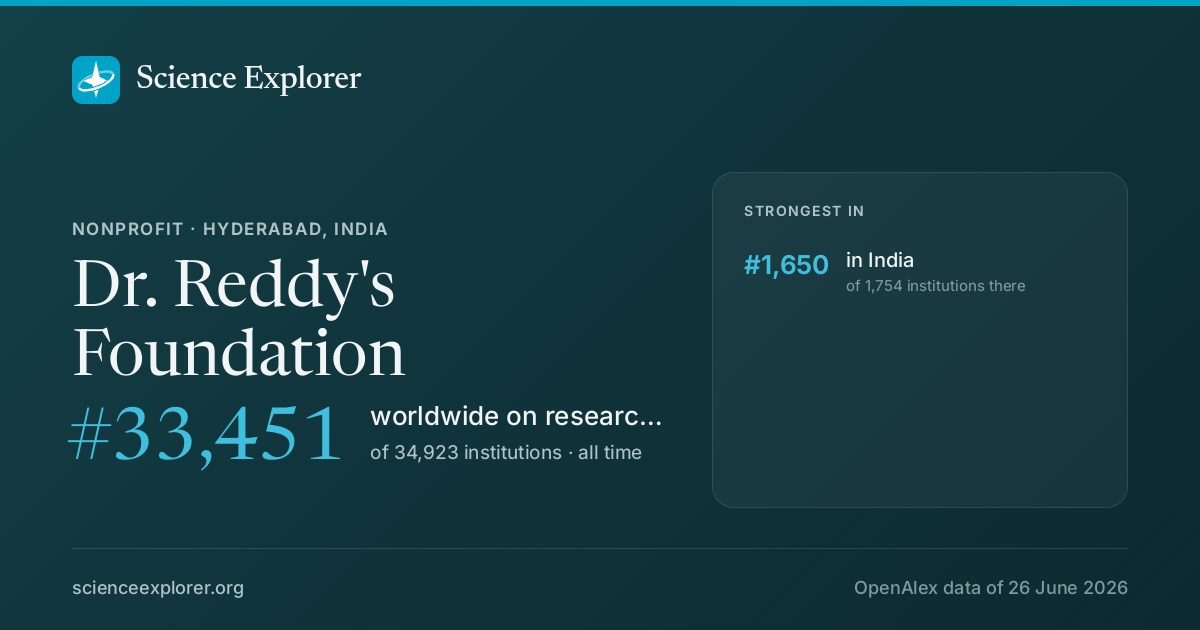
Dr. Reddy's Foundation on Science Explorer

A card with Dr. Reddy's Foundation's standing and the fields it leads in, for a post or a slide. A link to this page previews as the same card.

Download the card

1200 × 630 PNG, sized for social posts, drawn from the latest snapshot.

Badges for a website1Each links back here and updates with every snapshot

Research measures only: rankings here say nothing about teaching, admissions or student experience. Comparable institutions and collaboration partners have tabs of their own, above.

Discussion

Ask a question or share a note about Dr. Reddy's Foundation. Keep it to the research: no personal attacks, advertising or links. Any reader can report a post, which collapses it for everyone until it is opened.