Science Explorer Back to mapMap
University · Cergy-Pontoise · France

ECAM-EPMI

World rank, all time
#33,691
of 34,923
Rank in France
#922
of 943
Research works
122
▼ 26% vs 2018-21
Citations
932
7.6 per fractional work
Top-10% rate
6.0%
all institutions 10.0%
vs its own fields
0.96×
1.00× is exactly expected
Open access
38%
world 40%
International
56%
world 18%

Which fields of science does ECAM-EPMI work in?

In 2022-now, 85% of research at ECAM-EPMI is in Physical Sciences, 9% in Social Sciences. Its largest fields are Engineering (32%), Environmental Science (15%), Earth and Planetary Sciences (13%). It does 2.0× the world's share of Physical Sciences.

Physical Sciences: 36 fractional works · 85.1% of its workEngineering: 13 fractional works · 31.5% of its workControl and Systems Engineering: 3 fractional works · 8.0% of its workElectrical and Electronic Engineering: 3 fractional works · 6.3% of its workMechanical Engineering: 2 fractional works · 5.9% of its workComputational Mechanics: 1 fractional works · 2.2% of its workBuilding and Construction: 1 fractional works · 2.2% of its workIndustrial and Manufacturing Engineering: 1 fractional works · 1.8% of its workAerospace Engineering: 0 fractional works · 1.0% of its workAutomotive Engineering: 0 fractional works · 1.0% of its workCivil and Structural Engineering: 0 fractional works · 0.9% of its workBiomedical Engineering: 0 fractional works · 0.7% of its workMechanics of Materials: 0 fractional works · 0.7% of its workMedia Technology: 0 fractional works · 0.6% of its workOcean Engineering: 0 fractional works · 0.3% of its workEnvironmental Science: 6 fractional works · 15.1% of its workGlobal and Planetary Change: 2 fractional works · 5.8% of its workEnvironmental Engineering: 2 fractional works · 4.7% of its workEcology: 1 fractional works · 2.5% of its workWater Science and Technology: 0 fractional works · 0.9% of its workIndustrial and Manufacturing Engineering: 0 fractional works · 0.4% of its workEcological Modeling: 0 fractional works · 0.3% of its workEnvironmental Chemistry: 0 fractional works · 0.3% of its workManagement, Monitoring, Policy and Law: 0 fractional works · 0.3% of its workEarth and Planetary Sciences: 6 fractional works · 13.2% of its workAtmospheric Science: 5 fractional works · 12.0% of its workEarth-Surface Processes: 0 fractional works · 0.8% of its workOceanography: 0 fractional works · 0.3% of its workSmaller subfields together: 0 fractional works · 0.2% of its workComputer Science: 5 fractional works · 11.1% of its workComputer Vision and Pattern Recognition: 2 fractional works · 4.6% of its workArtificial Intelligence: 1 fractional works · 3.2% of its workComputational Theory and Mathematics: 1 fractional works · 1.4% of its workSignal Processing: 0 fractional works · 0.8% of its workComputer Science Applications: 0 fractional works · 0.4% of its workComputer Networks and Communications: 0 fractional works · 0.3% of its workHardware and Architecture: 0 fractional works · 0.3% of its workInformation Systems: 0 fractional works · 0.3% of its workPhysics and Astronomy: 2 fractional works · 5.5% of its workStatistical and Nonlinear Physics: 1 fractional works · 3.5% of its workAstronomy and Astrophysics: 0 fractional works · 0.8% of its workNuclear and High Energy Physics: 0 fractional works · 0.8% of its workCondensed Matter Physics: 0 fractional works · 0.4% of its workEnergy: 2 fractional works · 4.6% of its workRenewable Energy, Sustainability and the Environment: 1 fractional works · 3.1% of its workEnergy Engineering and Power Technology: 1 fractional works · 1.4% of its workMaterials Science: 1 fractional works · 1.6% of its workPolymers and Plastics: 0 fractional works · 1.0% of its workMaterials Chemistry: 0 fractional works · 0.6% of its workChemistry: 1 fractional works · 1.3% of its workAnalytical Chemistry: 0 fractional works · 0.8% of its workSpectroscopy: 0 fractional works · 0.5% of its workSmaller subfields together: 0 fractional works · 0.0% of its workMathematics: 0 fractional works · 0.9% of its workApplied Mathematics: 0 fractional works · 0.8% of its workSmaller subfields together: 0 fractional works · 0.1% of its workChemical Engineering: 0 fractional works · 0.3% of its workCatalysis: 0 fractional works · 0.3% of its workSocial Sciences: 4 fractional works · 8.8% of its workDecision Sciences: 1 fractional works · 2.6% of its workStatistics, Probability and Uncertainty: 1 fractional works · 2.4% of its workInformation Systems and Management: 0 fractional works · 0.3% of its workBusiness, Management and Accounting: 1 fractional works · 2.5% of its workManagement Information Systems: 0 fractional works · 1.2% of its workManagement of Technology and Innovation: 0 fractional works · 0.4% of its workStrategy and Management: 0 fractional works · 0.4% of its workOrganizational Behavior and Human Resource Management: 0 fractional works · 0.3% of its workBusiness and International Management: 0 fractional works · 0.3% of its workSocial Sciences: 1 fractional works · 2.0% of its workSociology and Political Science: 0 fractional works · 1.0% of its workCommunication: 0 fractional works · 0.3% of its workTransportation: 0 fractional works · 0.3% of its workUrban Studies: 0 fractional works · 0.3% of its workSmaller subfields together: 0 fractional works · 0.1% of its workPsychology: 0 fractional works · 0.9% of its workDevelopmental and Educational Psychology: 0 fractional works · 0.5% of its workSocial Psychology: 0 fractional works · 0.3% of its workSmaller subfields together: 0 fractional works · 0.1% of its workEconomics, Econometrics and Finance: 0 fractional works · 0.7% of its workEconomics and Econometrics: 0 fractional works · 0.7% of its workArts and Humanities: 0 fractional works · 0.1% of its workLife Sciences: 2 fractional works · 4.9% of its workAgricultural and Biological Sciences: 1 fractional works · 2.7% of its workPlant Science: 1 fractional works · 1.4% of its workSoil Science: 0 fractional works · 0.9% of its workEcology, Evolution, Behavior and Systematics: 0 fractional works · 0.4% of its workNeuroscience: 1 fractional works · 2.0% of its workCognitive Neuroscience: 1 fractional works · 2.0% of its workImmunology and Microbiology: 0 fractional works · 0.1% of its workHealth Sciences: 0 fractional works · 1.2% of its workMedicine: 0 fractional works · 0.9% of its workComplementary and alternative medicine: 0 fractional works · 0.3% of its workOrthopedics and Sports Medicine: 0 fractional works · 0.3% of its workPulmonary and Respiratory Medicine: 0 fractional works · 0.3% of its workSmaller subfields together: 0 fractional works · 0.1% of its workHealth Professions: 0 fractional works · 0.3% of its workPhysical Therapy, Sports Therapy and Rehabilitation: 0 fractional works · 0.3% of its workALL ITS WORKECAM-EPMI42fractional works, 2022-now
Life Sciences5%Physical Sciences85%Health Sciences1%Social Sciences9%

Each ring splits the one inside it: the four domains of science, their fields, their subfields. Size is fractional works in 2022-now. Every slice is a page; the interactive view zooms down to single topics and colours each by how much more of it this institution does than the world.

Its 4 domains and 21 fields, with their numbers
    1. Engineering1331.5%
    2. Environmental Science615.1%
    3. Earth and Planetary Sciences613.2%
    4. Computer Science511.1%
    5. Physics and Astronomy25.5%
    6. Energy24.6%
    7. Materials Science11.6%
    8. Chemistry11.3%
    9. Mathematics00.9%
    10. Chemical Engineering00.3%
    1. Decision Sciences12.6%
    2. Business, Management and Accounting12.5%
    3. Social Sciences12.0%
    4. Psychology00.9%
    5. Economics, Econometrics and Finance00.7%
    6. Arts and Humanities00.1%
    1. Agricultural and Biological Sciences12.7%
    2. Neuroscience12.0%
    3. Immunology and Microbiology00.1%
    1. Medicine00.9%
    2. Health Professions00.3%
All of science, and how each field's share has moved since 1950: the Science domain explorer

Field profile

Location quotient across every field it publishes in: outside the ring is more than an institution of this size would be expected to publish, inside it is less.

Agricultural and Biological Sciences: 0.58× its world share, 1 worksAgricultural and Bio…Immunology and Microbiology: 0.13× its world share, 0 worksImmunology and Micro…Neuroscience: 1.22× its world share, 1 worksNeuroscienceChemical Engineering: 0.75× its world share, 0 worksChemical EngineeringChemistry: 0.81× its world share, 0 worksChemistryComputer Science: 1.43× its world share, 5 worksComputer ScienceEarth and Planetary Sciences: 8.43× its world share, 6 worksEarth and Planetary …Energy: 4.97× its world share, 2 worksEnergyEngineering: 2.10× its world share, 13 worksEngineeringEnvironmental Science: 3.04× its world share, 6 worksEnvironmental ScienceMaterials Science: 0.46× its world share, 1 worksMaterials ScienceMathematics: 0.78× its world share, 0 worksMathematicsPhysics and Astronomy: 2.46× its world share, 2 worksPhysics and AstronomyHealth Professions: 0.10× its world share, 0 worksHealth ProfessionsMedicine: 0.05× its world share, 0 worksMedicineArts and Humanities: 0.03× its world share, 0 worksArts and HumanitiesBusiness, Management and Accounting: 0.79× its world share, 1 worksBusiness, Management…Decision Sciences: 2.73× its world share, 1 worksDecision SciencesEconomics, Econometrics and Finance: 0.31× its world share, 0 worksEconomics, Econometr…Psychology: 0.31× its world share, 0 worksPsychologySocial Sciences: 0.16× its world share, 1 worksSocial Sciences1×world share
more than its size predictsabout as predictedless

Rings at 0.5×, 1× and 2×. Widest outward: Earth and Planetary Sciences, 8.4×. Every wedge is a field page.

All 21 fields, with their numbers
  1. Earth and Planetary Sciences8.43×6 works
  2. Energy4.97×2 works
  3. Environmental Science3.04×6 works
  4. Decision Sciences2.73×1 works
  5. Physics and Astronomy2.46×2 works
  6. Engineering2.10×13 works
  7. Computer Science1.43×5 works
  8. Neuroscience1.22×1 works
  9. Chemistry0.81×0 works
  10. Business, Management and Accounting0.79×1 works
  11. Mathematics0.78×0 works
  12. Chemical Engineering0.75×0 works
  13. Agricultural and Biological Sciences0.58×1 works
  14. Materials Science0.46×1 works
  15. Economics, Econometrics and Finance0.31×0 works
  16. Psychology0.31×0 works
  17. Social Sciences0.16×1 works
  18. Immunology and Microbiology0.13×0 works
  19. Health Professions0.10×0 works
  20. Medicine0.05×0 works
  21. Arts and Humanities0.03×0 works

Who are the top researchers at ECAM-EPMI?

Ranked on the quality score, Abdelmoumen Darcherif, Ikram El Abbassi and Karim Labadi lead among researchers whose main affiliation is ECAM-EPMI.

  1. 1 Abdelmoumen Darcherif France · #2,995,618 worldwide 268 citations · 22 works
  2. 2 Ikram El Abbassi France · #3,437,050 worldwide 724 citations · 66 works
  3. 3 Karim Labadi France · #3,475,730 worldwide 1.6k citations · 105 works
  4. 4 Jean Michel Brucker France · #4,134,940 worldwide 225 citations · 15 works
  5. 5 Mouhamad Abou Chahine France · #4,684,588 worldwide 39 citations · 16 works
  6. 6 Samir Hamaci France · #4,732,092 worldwide 142 citations · 38 works
  7. 7 Moumen A. Darcherif France · #4,800,539 worldwide 67 citations · 19 works
  8. 8 Abdel Moumen Darcherif France · #4,904,462 worldwide 367 citations · 38 works
  9. 9 Moncef Benkherrat France · #5,252,335 worldwide 39 citations · 33 works
  10. 10 Rafik Absi France · #6,247,067 worldwide 1.1k citations · 156 works
All ranked researchers at ECAM-EPMI

What are the most cited papers from ECAM-EPMI?

The most cited paper from ECAM-EPMI is "A local energy management of a hybrid PV-storage based distributed generation for microgrids" (Adel Choudar, Djamel Boukhetala, Said Barkat et al., 2014), with 166 citations. Next come "Energy management in the smart grid: State-of-the-art and future trends" (165) and "A branch-and-bound algorithm for solving the static rebalancing problem in bicycle-sharing systems" (116).

Most cited papers
#PaperReleasedCitations
1 A local energy management of a hybrid PV-storage based distributed generation for microgrids Adel Choudar, Djamel Boukhetala, Said Barkat et al. · Energy Conversion and Management 20 Nov 2014 166
2 Energy management in the smart grid: State-of-the-art and future trends Meryem Meliani, Abdellah El Barkany, Ikram El Abbassi et al. · International Journal of Engineering Business Management Open access 2021 165
3 A branch-and-bound algorithm for solving the static rebalancing problem in bicycle-sharing systems Ahmed Abdelmoumene Kadri, Imed Kacem, Karim Labadi · Computers & Industrial Engineering 9 Feb 2016 116
4 Wind Speed Data Analysis Using Weibull and Rayleigh Distribution Functions, Case Study: Five Cities Northern Morocco Hicham Bidaoui, Ikram El Abbassi, Abdelmajid El Bouardi et al. · Procedia Manufacturing Open access 2019 95
5 Analysis of Digital Twin Applications in Energy Efficiency: A Systematic Review Labouda Ba, Fatma Tangour, Ikram El Abbassi et al. · Sustainability ReviewOpen access 15 Apr 2025 92
All 60 most cited papers, with filters and sorting

Which keywords describe research at ECAM-EPMI?

By fractional works in 2022-now, weighted toward what it does more of than the world: Hydrological Modeling, Validation, Data Assimilation, Renewable Energy, Remote Sensing, Precipitation, Satellite and Convective Parameterization.

▲ more of its work than of the world's◆ about the world's share▼ less than the world's

Size is fractional works in 2022-now in the topics tagged with each word; colour is the word's share of this institution's work against its share of the world's. The 34 words are chosen for being large and distinctive. Each links to the topic it comes from most.

All 34 words, with their numbers
  1. Hydrological Modeling5▲ 50×4 topics
  2. Validation3▲ 89×2 topics
  3. Renewable Energy3▲ 5.4×10 topics
  4. Climate Change3▲ 2.7×10 topics
  5. Remote Sensing3▲ 6.0×8 topics
  6. Data Assimilation3▲ 43×2 topics
  7. Precipitation3▲ 129×1 topic
  8. Satellite3▲ 306×1 topic
  9. Convective Parameterization2▲ 92×1 topic
  10. Ensemble Kalman Filter2▲ 52×1 topic
  11. Machine Learning2▲ 1.39×6 topics
  12. Artificial Intelligence2▲ 2.6×3 topics
  13. Decentralized Control2▲ 32×2 topics
  14. Sustainability2▲ 1.57×9 topics
  15. Energy Efficiency2▲ 3.9×7 topics
  16. Mechanical Properties2▲ 3.6×7 topics
  17. Environmental Impact1▲ 1.94×4 topics
  18. Sediment Transport1▲ 20×4 topics
  19. Smart Grid Applications1▲ 25×2 topics
  20. Flood Risk1▲ 38×1 topic
  21. Surface Water Mapping1▲ 40×1 topic
  22. Distributed Power Generation1▲ 28×1 topic
  23. Microgrid Control1▲ 28×1 topic
  24. Smart Grid1▲ 8.2×3 topics
  25. Chaos1▲ 35×2 topics
  26. Energy Management1▲ 17×2 topics
  27. Cloud Robotics1▲ 89×1 topic
  28. Deep Learning1▼ 0.71×6 topics
  29. Forecasting1▲ 12×2 topics
  30. Internet of Robotic Things1▲ 89×1 topic
  31. Measurement Uncertainty1▲ 242×1 topic
  32. Redefinition of SI Units1▲ 242×1 topic
  33. Support Vector Machines1▲ 7.4×2 topics
  34. Water Resources1▲ 10.0×2 topics

Which research topics does ECAM-EPMI publish most on?

By volume in 2022-now: Precipitation Measurement and Analysis, Meteorological Phenomena and Simulations, Flood Risk Assessment and Management and Microgrid Control and Optimization.

  1. 1 Precipitation Measurement and Analysis Atmospheric Science 3 works
  2. 2 Meteorological Phenomena and Simulations Atmospheric Science 2 works
  3. 3 Flood Risk Assessment and Management Global and Planetary Change 1 works
  4. 4 Microgrid Control and Optimization Control and Systems Engineering 1 works
  5. 5 Robotics and Automated Systems Control and Systems Engineering 1 works
  6. 6 Scientific Measurement and Uncertainty Evaluation Statistics, Probability and Uncertainty 1 works
  7. 7 Smart Grid Energy Management Electrical and Electronic Engineering 1 works
  8. 8 Hydrology and Sediment Transport Processes Ecology 1 works
  9. 9 Soil Moisture and Remote Sensing Environmental Engineering 1 works
  10. 10 Hydrological Forecasting Using AI Environmental Engineering 1 works

How open and international is its research?

Against the world's own shares: the tick on each track. Both are shares of its output, so they sit on one scale and can be read against each other as well as against the world.

openly available37.6%not open62.4%

World: 40% of research is openly available.

with international co-authors56.4%domestic only43.6%

World: 18% is written across borders.

How has ECAM-EPMI's research output changed?

Output in 2022-2025 was 26% lower than in 2018-2021.

still counting200020102020
grewheldshrank

The same series as a ribbon: one cell per year, darker for more. The line above answers how much; this answers when.

Its share of all research

Growing output can still be a shrinking share: all of science grows. This is ECAM-EPMI as a percentage of every work published that year, 0.00016% in 2024.

still counting0.00010%0.00020%0.00030%ECAM-EPMI0.00010% in 2025200020102020

Fractional works of ECAM-EPMI over all fractional works that year. How the balance of science has shifted.

Other research institutions in Cergy-Pontoise

All research institutions in Cergy-Pontoise

Share ECAM-EPMI's ranking
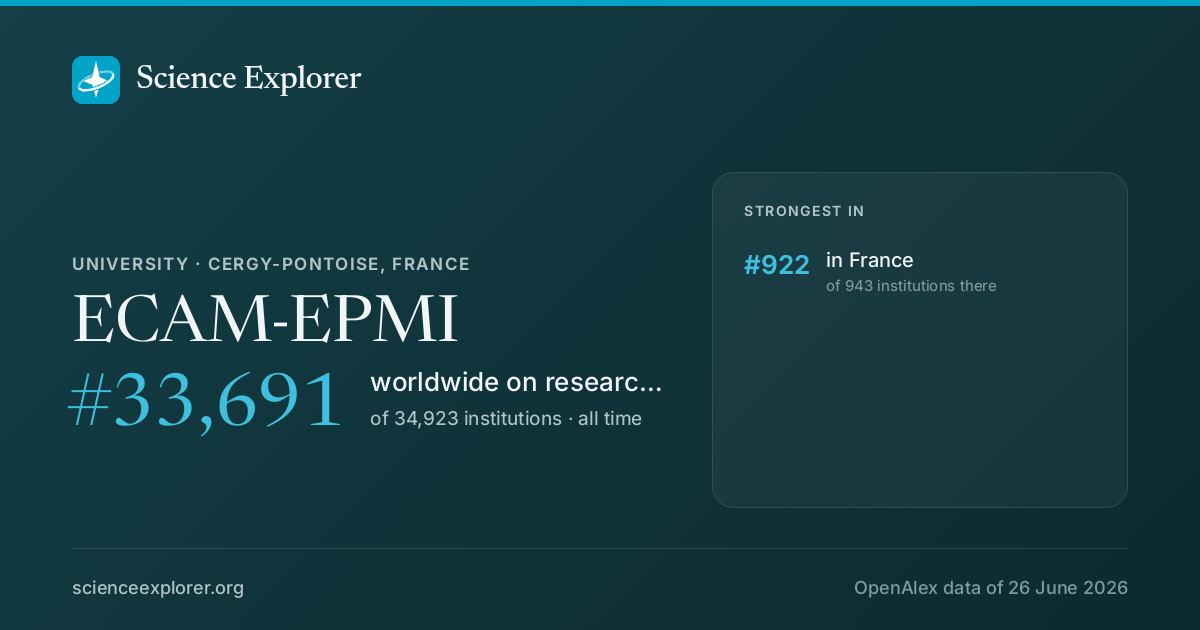
ECAM-EPMI on Science Explorer

A card with ECAM-EPMI's standing and the fields it leads in, for a post or a slide. A link to this page previews as the same card.

Download the card

1200 × 630 PNG, sized for social posts, drawn from the latest snapshot.

Badges for a website1Each links back here and updates with every snapshot

Research measures only: rankings here say nothing about teaching, admissions or student experience. Comparable institutions and collaboration partners have tabs of their own, above.

Discussion

Ask a question or share a note about ECAM-EPMI. Posts are plain text and can be reported.
