Science Explorer Back to mapMap
Discussion
Company · Steyr · Austria

Engineering Software Steyr (Austria)

World rank, all time
#24,138
of 34,923
Rank in Austria
#194
of 255
Research works
158
▲ 42% vs 2018-21
Citations
2k
12.7 per fractional work
Top-10% rate
12.0%
all institutions 10.0%
vs its own fields
1.04×
1.00× is exactly expected
Open access
31%
world 40%
International
33%
world 18%

Which fields of science does Engineering Software Steyr (Austria) work in?

In 2022-now, 54% of research at Engineering Software Steyr (Austria) is in Physical Sciences, 27% in Health Sciences. Its largest fields are Engineering (40%), Medicine (16%), Health Professions (10%). It does 1.3× the world's share of Physical Sciences.

Physical Sciences: 32 fractional works · 53.8% of its workEngineering: 24 fractional works · 40.4% of its workComputational Mechanics: 7 fractional works · 12.0% of its workCivil and Structural Engineering: 3 fractional works · 4.6% of its workElectrical and Electronic Engineering: 3 fractional works · 4.4% of its workIndustrial and Manufacturing Engineering: 2 fractional works · 4.1% of its workControl and Systems Engineering: 2 fractional works · 3.8% of its workMechanics of Materials: 2 fractional works · 3.3% of its workMechanical Engineering: 2 fractional works · 2.9% of its workAutomotive Engineering: 1 fractional works · 1.8% of its workAerospace Engineering: 1 fractional works · 1.7% of its workBuilding and Construction: 0 fractional works · 0.8% of its workSafety, Risk, Reliability and Quality: 0 fractional works · 0.6% of its workSmaller subfields together: 0 fractional works · 0.4% of its workComputer Science: 3 fractional works · 5.7% of its workArtificial Intelligence: 2 fractional works · 2.9% of its workInformation Systems: 1 fractional works · 1.5% of its workComputational Theory and Mathematics: 0 fractional works · 0.6% of its workComputer Networks and Communications: 0 fractional works · 0.3% of its workSmaller subfields together: 0 fractional works · 0.3% of its workPhysics and Astronomy: 2 fractional works · 3.5% of its workAstronomy and Astrophysics: 2 fractional works · 3.1% of its workStatistical and Nonlinear Physics: 0 fractional works · 0.3% of its workSmaller subfields together: 0 fractional works · 0.2% of its workEnvironmental Science: 1 fractional works · 2.5% of its workEnvironmental Engineering: 1 fractional works · 1.3% of its workManagement, Monitoring, Policy and Law: 0 fractional works · 0.8% of its workIndustrial and Manufacturing Engineering: 0 fractional works · 0.3% of its workMaterials Science: 1 fractional works · 1.1% of its workMaterials Chemistry: 1 fractional works · 1.0% of its workSmaller subfields together: 0 fractional works · 0.1% of its workEnergy: 0 fractional works · 0.4% of its workRenewable Energy, Sustainability and the Environment: 0 fractional works · 0.4% of its workEarth and Planetary Sciences: 0 fractional works · 0.3% of its workHealth Sciences: 16 fractional works · 26.7% of its workMedicine: 9 fractional works · 15.9% of its workPathology and Forensic Medicine: 2 fractional works · 2.9% of its workPulmonary and Respiratory Medicine: 1 fractional works · 2.2% of its workPublic Health, Environmental and Occupational Health: 1 fractional works · 1.6% of its workCardiology and Cardiovascular Medicine: 1 fractional works · 1.2% of its workSurgery: 1 fractional works · 1.2% of its workReproductive Medicine: 1 fractional works · 1.1% of its workPsychiatry and Mental health: 0 fractional works · 0.8% of its workHealth Informatics: 0 fractional works · 0.6% of its workInfectious Diseases: 0 fractional works · 0.5% of its workNephrology: 0 fractional works · 0.5% of its workRheumatology: 0 fractional works · 0.5% of its workEpidemiology: 0 fractional works · 0.4% of its workNeurology: 0 fractional works · 0.3% of its workRadiology, Nuclear Medicine and Imaging: 0 fractional works · 0.3% of its workUrology: 0 fractional works · 0.3% of its workHematology: 0 fractional works · 0.3% of its workRehabilitation: 0 fractional works · 0.2% of its workSmaller subfields together: 1 fractional works · 0.9% of its workHealth Professions: 6 fractional works · 10.5% of its workGeneral Health Professions: 6 fractional works · 10.1% of its workHealth Information Management: 0 fractional works · 0.3% of its workSmaller subfields together: 0 fractional works · 0.1% of its workNursing: 0 fractional works · 0.4% of its workNutrition and Dietetics: 0 fractional works · 0.4% of its workSocial Sciences: 10 fractional works · 16.7% of its workBusiness, Management and Accounting: 3 fractional works · 5.6% of its workMarketing: 2 fractional works · 2.7% of its workStrategy and Management: 1 fractional works · 1.2% of its workManagement Information Systems: 1 fractional works · 1.0% of its workManagement of Technology and Innovation: 0 fractional works · 0.4% of its workSmaller subfields together: 0 fractional works · 0.3% of its workEconomics, Econometrics and Finance: 2 fractional works · 4.2% of its workEconomics and Econometrics: 2 fractional works · 3.9% of its workFinance: 0 fractional works · 0.3% of its workSocial Sciences: 2 fractional works · 2.9% of its workSociology and Political Science: 1 fractional works · 1.2% of its workTransportation: 0 fractional works · 0.6% of its workCommunication: 0 fractional works · 0.3% of its workGender Studies: 0 fractional works · 0.3% of its workSafety Research: 0 fractional works · 0.3% of its workSmaller subfields together: 0 fractional works · 0.3% of its workDecision Sciences: 1 fractional works · 2.4% of its workManagement Science and Operations Research: 1 fractional works · 2.2% of its workSmaller subfields together: 0 fractional works · 0.1% of its workPsychology: 1 fractional works · 1.1% of its workSocial Psychology: 1 fractional works · 1.1% of its workArts and Humanities: 0 fractional works · 0.6% of its workPhilosophy: 0 fractional works · 0.6% of its workLife Sciences: 2 fractional works · 2.7% of its workBiochemistry, Genetics and Molecular Biology: 1 fractional works · 0.9% of its workMolecular Biology: 0 fractional works · 0.6% of its workSmaller subfields together: 0 fractional works · 0.3% of its workPharmacology, Toxicology and Pharmaceutics: 0 fractional works · 0.6% of its workPharmacology: 0 fractional works · 0.6% of its workImmunology and Microbiology: 0 fractional works · 0.5% of its workImmunology: 0 fractional works · 0.4% of its workSmaller subfields together: 0 fractional works · 0.1% of its workAgricultural and Biological Sciences: 0 fractional works · 0.5% of its workPlant Science: 0 fractional works · 0.3% of its workSmaller subfields together: 0 fractional works · 0.2% of its workNeuroscience: 0 fractional works · 0.3% of its workALL ITS WORKEngineeringSoftware Steyr…60fractional works, 2022-now
Life Sciences3%Physical Sciences54%Health Sciences27%Social Sciences17%

Each ring splits the one inside it: the four domains of science, their fields, their subfields. Size is fractional works in 2022-now. Every slice is a page; the interactive view zooms down to single topics and colours each by how much more of it this institution does than the world.

Its 4 domains and 21 fields, with their numbers
    1. Engineering2440.4%
    2. Computer Science35.7%
    3. Physics and Astronomy23.5%
    4. Environmental Science12.5%
    5. Materials Science11.1%
    6. Energy00.4%
    7. Earth and Planetary Sciences00.3%
    1. Medicine915.9%
    2. Health Professions610.5%
    3. Nursing00.4%
    1. Business, Management and Accounting35.6%
    2. Economics, Econometrics and Finance24.2%
    3. Social Sciences22.9%
    4. Decision Sciences12.4%
    5. Psychology11.1%
    6. Arts and Humanities00.6%
    1. Biochemistry, Genetics and Molecular Biology10.9%
    2. Pharmacology, Toxicology and Pharmaceutics00.6%
    3. Immunology and Microbiology00.5%
    4. Agricultural and Biological Sciences00.5%
    5. Neuroscience00.3%
All of science, and how each field's share has moved since 1950: the Science domain explorer

Field profile

Location quotient across every field it publishes in: outside the ring is more than an institution of this size would be expected to publish, inside it is less.

Agricultural and Biological Sciences: 0.10× its world share, 0 worksAgricultural and Bio…Biochemistry, Genetics and Molecular Biology: 0.17× its world share, 0 worksBiochemistry, Geneti…Immunology and Microbiology: 0.51× its world share, 0 worksImmunology and Micro…Neuroscience: 0.18× its world share, 0 worksNeurosciencePharmacology, Toxicology and Pharmaceutics: 1.59× its world share, 0 worksPharmacology, Toxico…Computer Science: 0.73× its world share, 3 worksComputer ScienceEarth and Planetary Sciences: 0.18× its world share, 0 worksEarth and Planetary …Energy: 0.41× its world share, 0 worksEnergyEngineering: 2.69× its world share, 24 worksEngineeringEnvironmental Science: 0.50× its world share, 2 worksEnvironmental ScienceMaterials Science: 0.32× its world share, 1 worksMaterials SciencePhysics and Astronomy: 1.59× its world share, 2 worksPhysics and AstronomyHealth Professions: 3.97× its world share, 6 worksHealth ProfessionsMedicine: 0.83× its world share, 10 worksMedicineNursing: 0.76× its world share, 0 worksNursingArts and Humanities: 0.19× its world share, 0 worksArts and HumanitiesBusiness, Management and Accounting: 1.73× its world share, 3 worksBusiness, Management…Decision Sciences: 2.43× its world share, 1 worksDecision SciencesEconomics, Econometrics and Finance: 1.96× its world share, 2 worksEconomics, Econometr…Psychology: 0.37× its world share, 1 worksPsychologySocial Sciences: 0.23× its world share, 2 worksSocial Sciences1×world share
more than its size predictsabout as predictedless

Rings at 0.5×, 1× and 2×. Widest outward: Health Professions, 4.0×. Every wedge is a field page.

All 21 fields, with their numbers
  1. Health Professions3.97×6 works
  2. Engineering2.69×24 works
  3. Decision Sciences2.43×1 works
  4. Economics, Econometrics and Finance1.96×2 works
  5. Business, Management and Accounting1.73×3 works
  6. Pharmacology, Toxicology and Pharmaceutics1.59×0 works
  7. Physics and Astronomy1.59×2 works
  8. Medicine0.83×10 works
  9. Nursing0.76×0 works
  10. Computer Science0.73×3 works
  11. Immunology and Microbiology0.51×0 works
  12. Environmental Science0.50×2 works
  13. Energy0.41×0 works
  14. Psychology0.37×1 works
  15. Materials Science0.32×1 works
  16. Social Sciences0.23×2 works
  17. Arts and Humanities0.19×0 works
  18. Neuroscience0.18×0 works
  19. Earth and Planetary Sciences0.18×0 works
  20. Biochemistry, Genetics and Molecular Biology0.17×0 works
  21. Agricultural and Biological Sciences0.10×0 works

Who are the top researchers at Engineering Software Steyr (Austria)?

Ranked on the quality score, Chong Peng, Robert Stolba and Markus Knasmüller lead among researchers whose main affiliation is Engineering Software Steyr (Austria).

  1. 1 Chong Peng Austria · #382,119 worldwide 3k citations · 147 works
  2. 2 Robert Stolba Austria · #3,451,469 worldwide 248 citations · 20 works
  3. 3 Markus Knasmüller Austria · #3,513,016 worldwide 34 citations · 19 works
  4. 4 Helmut Dannbauer Austria · #4,726,804 worldwide 110 citations · 24 works
  5. 5 Martin Schifko Austria · #4,762,549 worldwide 69 citations · 17 works
All ranked researchers at Engineering Software Steyr (Austria)

What are the most cited papers from Engineering Software Steyr (Austria)?

The most cited paper from Engineering Software Steyr (Austria) is "Extracorporeal shock wave therapy: an update" (Vinzenz Auersperg, Klemens Trieb, 2020), with 187 citations. Next come "Transmission of cytomegalovirus via breast milk to the prematurely born infant: a systematic review" (162) and "LOQUAT: an open-source GPU-accelerated SPH solver for geotechnical modeling" (161).

Most cited papers
#PaperReleasedCitations
1 Extracorporeal shock wave therapy: an update Vinzenz Auersperg, Klemens Trieb · EFORT Open Reviews Open access Oct 2020 187
2 Transmission of cytomegalovirus via breast milk to the prematurely born infant: a systematic review Stefan Kurath, Gabriele Halwachs‐Baumann, Wilhelm D. Müller et al. · Clinical Microbiology and Infection ReviewOpen access 8 Mar 2010 162
3 LOQUAT: an open-source GPU-accelerated SPH solver for geotechnical modeling Chong Peng, Shun Wang, Wei Wu et al. · Acta Geotechnica 21 Jun 2019 161
4 Probably Benign Breast Masses at US: Is Follow-up an Acceptable Alternative to Biopsy? Oswald Graf, Thomas H. Helbich, Gottfried Hopf et al. · Radiology Jul 2007 153
5 Amino acid kinetics in patients with sepsis Wilfred Druml, Günther Heinzel, GUNTER KLEINBERGER · American Journal of Clinical Nutrition Open access May 2001 124
All 62 most cited papers, with filters and sorting

Which keywords describe research at Engineering Software Steyr (Austria)?

By fractional works in 2022-now, weighted toward what it does more of than the world: Numerical Simulation, Fluid-Structure Interaction, Germany, Health Surveys, Public Health, Smoothed Particle Hydrodynamics, SPH Method and Multiphase Flow.

▲ more of its work than of the world's◆ about the world's share▼ less than the world's

Size is fractional works in 2022-now in the topics tagged with each word; colour is the word's share of this institution's work against its share of the world's. The 40 words are chosen for being large and distinctive. Each links to the topic it comes from most.

All 40 words, with their numbers
  1. Numerical Simulation5▲ 27×3 topics
  2. Public Health5▲ 5.3×4 topics
  3. Fluid-Structure Interaction4▲ 48×3 topics
  4. Germany4▲ 359×1 topic
  5. Health Surveys4▲ 359×1 topic
  6. SPH Method3▲ 184×1 topic
  7. Smoothed Particle Hydrodynamics3▲ 184×1 topic
  8. Machine Learning2▲ 1.20×12 topics
  9. Deep Learning2◆ 1.01×11 topics
  10. Multiphase Flow2▲ 40×4 topics
  11. Fluid Dynamics2▲ 22×3 topics
  12. Electrostatic Precipitators2▲ 153×1 topic
  13. Filtration Technologies2▲ 153×1 topic
  14. Diagnostic Criteria2▲ 13×2 topics
  15. Neural Networks2▲ 1.84×6 topics
  16. Simulation2▲ 10×3 topics
  17. Artificial Intelligence1▲ 1.60×6 topics
  18. Radial Basis Functions1▲ 34×2 topics
  19. Treatment1▲ 1.93×7 topics
  20. Distribution1▲ 88×1 topic
  21. Economic Evaluation1▲ 19×2 topics
  22. Lightning1▲ 138×1 topic
  23. Quality Improvement1▲ 12×2 topics
  24. Seismic1▲ 39×1 topic
  25. Tunnel1▲ 26×1 topic
  26. Customer Experience1▲ 12×4 topics
  27. Heat Transfer1▲ 4.2×5 topics
  28. Multiple Sclerosis1▲ 54×1 topic
  29. Neuromyelitis Optica1▲ 54×1 topic
  30. Fracture1▲ 19×1 topic
  31. Machine Vision1▲ 9.1×3 topics
  32. Manufacturing1▲ 41×2 topics
  33. Meshless Methods1▲ 59×1 topic
  34. Adaptive Control1▲ 12×2 topics
  35. Choosing Wisely1▲ 79×1 topic
  36. Consumer Behavior1▲ 2.8×3 topics
  37. Design Optimization1▲ 45×1 topic
  38. Low-Value Care1▲ 79×1 topic
  39. Market Competition1▲ 39×2 topics
  40. Structural Analysis1▲ 19×1 topic

Which research topics does Engineering Software Steyr (Austria) publish most on?

By volume in 2022-now: Health and Medical Studies, Fluid Dynamics Simulations and Interactions, Aerosol Filtration and Electrostatic Precipitation and Geotechnical Engineering and Underground Structures.

  1. 1 Health and Medical Studies General Health Professions 4 works
  2. 2 Fluid Dynamics Simulations and Interactions Computational Mechanics 3 works
  3. 3 Aerosol Filtration and Electrostatic Precipitation Electrical and Electronic Engineering 2 works
  4. 4 Geotechnical Engineering and Underground Structures Civil and Structural Engineering 1 works
  5. 5 Lightning and Electromagnetic Phenomena Astronomy and Astrophysics 1 works
  6. 6 Multiple Sclerosis Research Studies Pathology and Forensic Medicine 1 works
  7. 7 Numerical methods in engineering Mechanics of Materials 1 works
  8. 8 Healthcare cost, quality, practices General Health Professions 1 works
  9. 9 Engineering Applied Research Civil and Structural Engineering 1 works
  10. 10 Scheduling and Optimization Algorithms Industrial and Manufacturing Engineering 1 works

How open and international is its research?

Against the world's own shares: the tick on each track. Both are shares of its output, so they sit on one scale and can be read against each other as well as against the world.

openly available31.0%not open69.0%

World: 40% of research is openly available.

with international co-authors33.4%domestic only66.6%

World: 18% is written across borders.

How has Engineering Software Steyr (Austria)'s research output changed?

Output in 2022-2025 was 42% higher than in 2018-2021.

still counting1990200020102020
grewheldshrank

The same series as a ribbon: one cell per year, darker for more. The line above answers how much; this answers when.

Its share of all research

Growing output can still be a shrinking share: all of science grows. This is Engineering Software Steyr (Austria) as a percentage of every work published that year, 0.00041% in 2024.

still counting0.00020%0.00040%0.00060%Engineering Software Steyr (Austria)0.00022% in 202519801990200020102020

Fractional works of Engineering Software Steyr (Austria) over all fractional works that year. How the balance of science has shifted.

Other research institutions in Steyr

All research institutions in Steyr

Share Engineering Software Steyr (Austria)'s ranking
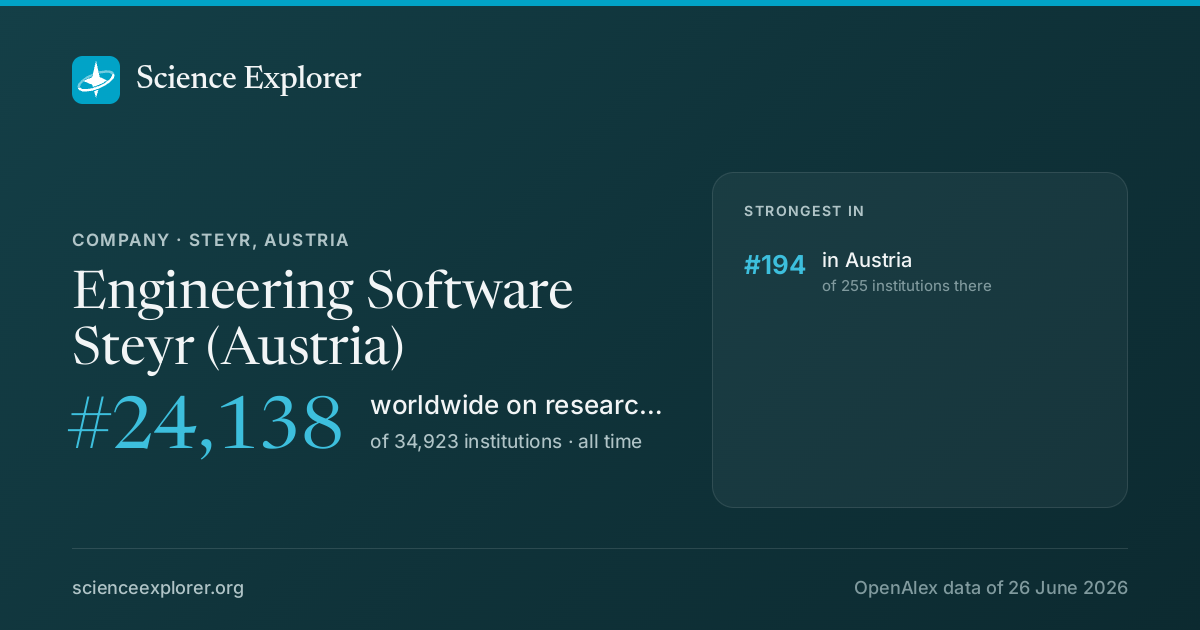
Engineering Software Steyr (Austria) on Science Explorer

A card with Engineering Software Steyr (Austria)'s standing and the fields it leads in, for a post or a slide. A link to this page previews as the same card.

Download the card

1200 × 630 PNG, sized for social posts, drawn from the latest snapshot.

Badges for a website1Each links back here and updates with every snapshot

Research measures only: rankings here say nothing about teaching, admissions or student experience. Comparable institutions and collaboration partners have tabs of their own, above.

Discussion

Ask a question or share a note about Engineering Software Steyr (Austria). Posts are plain text and can be reported.