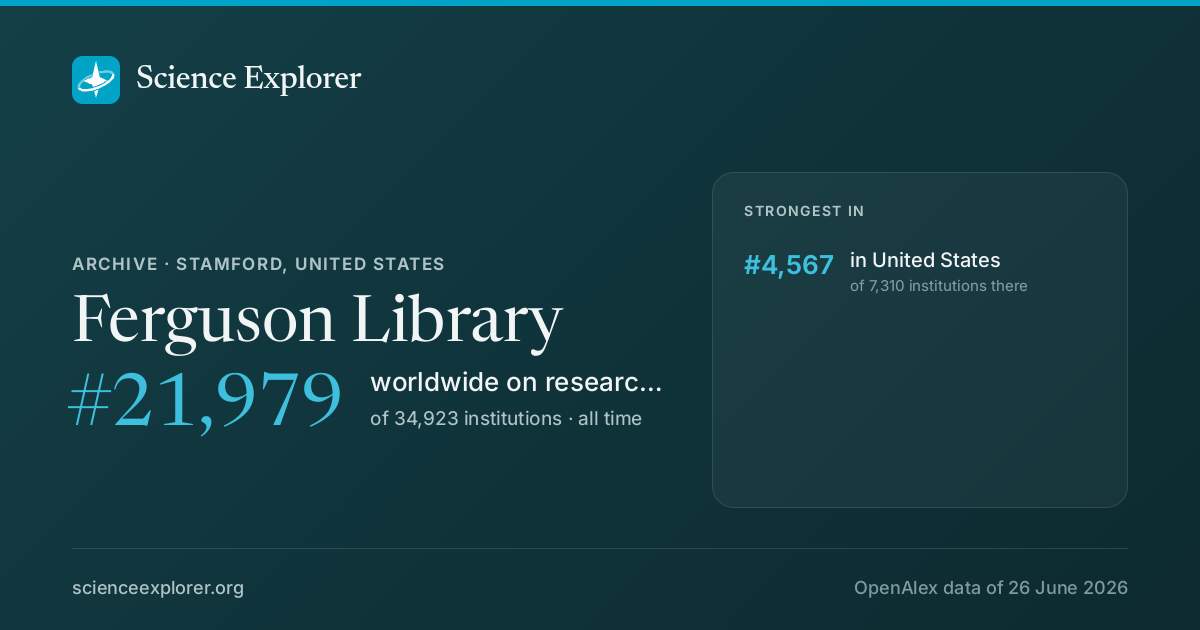
- World rank, all time
- #21,979 of 34,923
- Rank in United States
- #4,567 of 7,310
- Research works
- 197 ▼ 23% vs 2018-21
- Citations
- 6.4k 32.5 per fractional work
- Top-10% rate
- 5.3% all institutions 10.0%
- vs its own fields
- 0.93× 1.00× is exactly expected
- Open access
- 17% world 40%
- International
- 16% world 18%
Which fields of science does Ferguson Library work in?
In all years, 52% of research at Ferguson Library is in Health Sciences, 20% in Physical Sciences. Its largest fields are Medicine (47%), Engineering (13%), Social Sciences (8%). It does 2.1× the world's share of Health Sciences.
Each ring splits the one inside it: the four domains of science, their fields, their subfields. Size is fractional works in all years. Every slice is a page; the interactive view zooms down to single topics and colours each by how much more of it this institution does than the world.
Its 4 domains and 25 fields, with their numbers
- Health Sciences10251.8%
- Medicine9347.2%
- Health Professions73.4%
- Nursing21.0%
- Veterinary00.1%
- Dentistry00.0%
- Physical Sciences3919.6%
- Engineering2713.5%
- Environmental Science42.2%
- Computer Science31.3%
- Chemistry20.8%
- Earth and Planetary Sciences20.8%
- Materials Science10.5%
- Physics and Astronomy00.2%
- Energy00.2%
- Mathematics00.1%
- Social Sciences3517.6%
- Life Sciences2211.0%
Field profile
Location quotient across every field it publishes in: outside the ring is more than an institution of this size would be expected to publish, inside it is less.
Rings at 0.5×, 1× and 2×. Widest outward: Arts and Humanities, 5.0×. Every wedge is a field page.
All 19 fields, with their numbers
- Arts and Humanities4.97×2 works
- Veterinary2.54×0 works
- Social Sciences2.14×3 works
- Agricultural and Biological Sciences2.11×1 works
- Health Professions1.72×0 works
- Immunology and Microbiology1.68×0 works
- Nursing1.46×0 works
- Psychology1.41×0 works
- Decision Sciences1.34×0 works
- Medicine0.96×2 works
- Chemistry0.91×0 works
- Business, Management and Accounting0.89×0 works
- Dentistry0.54×0 works
- Computer Science0.51×0 works
- Biochemistry, Genetics and Molecular Biology0.38×0 works
- Materials Science0.34×0 works
- Economics, Econometrics and Finance0.34×0 works
- Engineering0.29×0 works
- Environmental Science0.06×0 works
- Arts and Humanities 5.0×
- Veterinary 2.5×
- Social Sciences 2.1×
- Agricultural and Biological Sciences 2.1×
- Health Professions 1.7×
- Immunology and Microbiology 1.7×
- Nursing 1.5×
- Psychology 1.4×
- Decision Sciences 1.3×
- Medicine 1.0×
- Chemistry 0.9×
- Business, Management and Accounting 0.9×
- Dentistry 0.5×
- Computer Science 0.5×
- Biochemistry, Genetics and Molecular Biology 0.4×
- Materials Science 0.3×
- Economics, Econometrics and Finance 0.3×
- Engineering 0.3×
- Environmental Science 0.1×
Who are the top researchers at Ferguson Library?
Ranked on the quality score, John M. MacKeigan, James A. Surrell and Edwin H. Horning lead among researchers whose main affiliation is Ferguson Library.
- 1
John M. MacKeigan
 United States · #670,858 worldwide
1.3k citations · 31 works
- 2
James A. Surrell
United States · #2,462,631 worldwide
512 citations · 17 works
- 3
Edwin H. Horning
United States · #7,420,041 worldwide
326 citations · 145 works
Which keywords describe research at Ferguson Library?
By fractional works in all years, weighted toward what it does more of than the world: Epidemiology, Quality of Life, Treatment, Clinical Practice Guidelines, Colonic Diverticulitis, Diverticulitis, Fistulas and Hemorrhoids.
- Pelvic Floor Dysfunction
- Terrain Interaction
- Perioperative Care
- Enteric Nervous System
- Cultural Competence
- Anal Cancer
- Elderly Patients
- Quality Improvement
- Surgical Treatment
- Surgical Management
- Rehabilitation
- Guidelines
- Rectal Cancer
- Tumor Markers
- Mental Health
- Hemorrhoids
- Diverticulitis
- Clinical Practice Guidelines
- Inflammation
- Quality of Life
- Epidemiology
- Treatment
- Risk Factors
- Colonic Diverticulitis
- Fistulas
- Adjuvant Chemotherapy
- Laparoscopic Surgery
- Preoperative Chemoradiotherapy
- Chemotherapy
- Heart Failure
- Pain Management
- Stem Cells
- Driver Behavior
- Postoperative Pain
- Molecular Characterization
- Chemoradiation
- Urinary Incontinence
- Injury Severity
- Soil Mechanics
- Colorectal Cancer
Size is fractional works in all years in the topics tagged with each word; colour is the word's share of this institution's work against its share of the world's. The 40 words are chosen for being large and distinctive. Each links to the topic it comes from most.
All 40 words, with their numbers
- Epidemiology21▲ 2.6×42 topics
- Quality of Life10▲ 3.8×16 topics
- Treatment10▲ 3.8×11 topics
- Inflammation8▲ 1.81×31 topics
- Risk Factors8▲ 3.8×12 topics
- Clinical Practice Guidelines7▲ 6.5×6 topics
- Colonic Diverticulitis6▲ 135×1 topic
- Diverticulitis6▲ 135×1 topic
- Fistulas6▲ 82×1 topic
- Hemorrhoids6▲ 163×1 topic
- Adjuvant Chemotherapy6▲ 39×2 topics
- Mental Health5▲ 2.4×16 topics
- Laparoscopic Surgery5▲ 24×3 topics
- Tumor Markers5▲ 35×2 topics
- Preoperative Chemoradiotherapy5▲ 34×1 topic
- Rectal Cancer5▲ 67×1 topic
- Chemotherapy4▲ 3.1×5 topics
- Guidelines4▲ 3.7×7 topics
- Heart Failure3▲ 3.8×7 topics
- Rehabilitation3▲ 4.6×5 topics
- Pain Management3▲ 7.2×5 topics
- Surgical Management3▲ 3.6×9 topics
- Stem Cells3▲ 5.1×5 topics
- Surgical Treatment3▲ 7.5×3 topics
- Driver Behavior3▲ 22×2 topics
- Quality Improvement3▲ 6.5×6 topics
- Postoperative Pain3▲ 13×2 topics
- Elderly Patients2▲ 10.0×4 topics
- Molecular Characterization2▲ 6.7×3 topics
- Anal Cancer2▲ 50×1 topic
- Chemoradiation2▲ 20×1 topic
- Cultural Competence2▲ 9.3×2 topics
- Urinary Incontinence2▲ 13×2 topics
- Enteric Nervous System2▲ 24×2 topics
- Injury Severity2▲ 16×2 topics
- Perioperative Care2▲ 9.4×2 topics
- Soil Mechanics2▲ 54×1 topic
- Terrain Interaction2▲ 54×1 topic
- Colorectal Cancer2▲ 11×2 topics
- Pelvic Floor Dysfunction2▲ 22×1 topic
Which research topics does Ferguson Library publish most on?
By volume in 2022-now: South Asian Cinema and Culture, Medical History and Innovations, History of Medical Practice and Organic Food and Agriculture.
Area is fractional works; colour is the subfield each topic belongs to.
- 1 South Asian Cinema and Culture Visual Arts and Performing Arts 1 works
- 2 Medical History and Innovations History 0 works
- 3 History of Medical Practice Neurology 0 works
- 4 Organic Food and Agriculture Plant Science 0 works
- 5 Urban Planning and Governance Urban Studies 0 works
- 6 ICT in Developing Communities Information Systems 0 works
- 7 Intimate Partner and Family Violence Health 0 works
- 8 Gender, Feminism, and Media Gender Studies 0 works
- 9 Sexual Assault and Victimization Studies Gender Studies 0 works
- 10 Genetically Modified Organisms Research Plant Science 0 works
How open and international is its research?
Against the world's own shares: the tick on each track. Both are shares of its output, so they sit on one scale and can be read against each other as well as against the world.
World: 40% of research is openly available.
World: 18% is written across borders.
How has Ferguson Library's research output changed?
Output in 2022-2025 was 23% lower than in 2018-2021.
The same series as a ribbon: one cell per year, darker for more. The line above answers how much; this answers when.
Its share of all research
Growing output can still be a shrinking share: all of science grows. This is Ferguson Library as a percentage of every work published that year, 0.000061% in 2024.
Fractional works of Ferguson Library over all fractional works that year. How the balance of science has shifted.
Other research institutions in Stamford
- Gaertner (United States)
- Short and Associates (United States)
- Purdue Pharma (United States)
- New England Institute for Neurology and Headache
- Sema4 (United States)
- Cara Therapeutics (United States)
- Loxo Oncology at Lilly (United States)
- Pitney Bowes (United States)
Share Ferguson Library's ranking
Badges for a website1Each links back here and updates with every snapshot

Research measures only: rankings here say nothing about teaching, admissions or student experience. Comparable institutions and collaboration partners have tabs of their own, above.
Discussion
Ask a question or share a note about Ferguson Library. Keep it to the research: no personal attacks, advertising or links. Any reader can report a post, which collapses it for everyone until it is opened.