Science Explorer Back to mapMap
Discussion
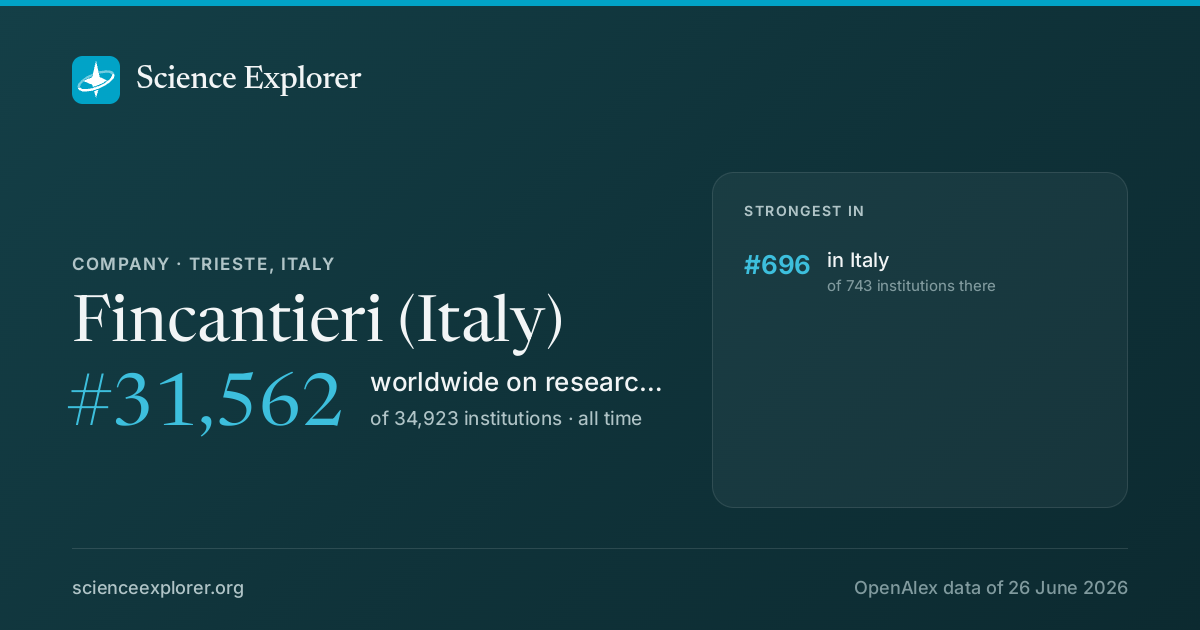
Company · Trieste · Italy

Fincantieri (Italy)

World rank, all time
#31,562
of 34,923
Rank in Italy
#696
of 743
Research works
136
▲ 216% vs 2018-21
Citations
745
5.5 per fractional work
Top-10% rate
5.8%
all institutions 10.0%
vs its own fields
0.92×
1.00× is exactly expected
Open access
55%
world 40%
International
20%
world 18%

Which fields of science does Fincantieri (Italy) work in?

In 2022-now, 72% of research at Fincantieri (Italy) is in Physical Sciences, 17% in Social Sciences. Its largest fields are Engineering (45%), Environmental Science (13%), Social Sciences (7%). It does 1.8× the world's share of Physical Sciences.

Physical Sciences: 49 fractional works · 72.2% of its workEngineering: 30 fractional works · 44.7% of its workOcean Engineering: 10 fractional works · 14.4% of its workAerospace Engineering: 5 fractional works · 7.7% of its workIndustrial and Manufacturing Engineering: 2 fractional works · 3.4% of its workControl and Systems Engineering: 2 fractional works · 3.3% of its workElectrical and Electronic Engineering: 2 fractional works · 3.3% of its workMechanical Engineering: 2 fractional works · 2.9% of its workAutomotive Engineering: 2 fractional works · 2.5% of its workMechanics of Materials: 1 fractional works · 2.1% of its workComputational Mechanics: 1 fractional works · 1.7% of its workCivil and Structural Engineering: 1 fractional works · 1.4% of its workBiomedical Engineering: 1 fractional works · 1.4% of its workBuilding and Construction: 0 fractional works · 0.4% of its workSafety, Risk, Reliability and Quality: 0 fractional works · 0.2% of its workEnvironmental Science: 9 fractional works · 12.7% of its workEnvironmental Engineering: 7 fractional works · 9.6% of its workEcology: 1 fractional works · 1.2% of its workGlobal and Planetary Change: 0 fractional works · 0.5% of its workWater Science and Technology: 0 fractional works · 0.5% of its workPollution: 0 fractional works · 0.2% of its workSmaller subfields together: 0 fractional works · 0.6% of its workPhysics and Astronomy: 2 fractional works · 2.7% of its workAstronomy and Astrophysics: 1 fractional works · 1.0% of its workInstrumentation: 1 fractional works · 1.0% of its workCondensed Matter Physics: 0 fractional works · 0.3% of its workStatistical and Nonlinear Physics: 0 fractional works · 0.3% of its workSmaller subfields together: 0 fractional works · 0.1% of its workEarth and Planetary Sciences: 2 fractional works · 2.5% of its workAtmospheric Science: 1 fractional works · 1.1% of its workOceanography: 1 fractional works · 1.0% of its workSmaller subfields together: 0 fractional works · 0.3% of its workEnergy: 2 fractional works · 2.5% of its workEnergy Engineering and Power Technology: 2 fractional works · 2.5% of its workMaterials Science: 2 fractional works · 2.4% of its workMaterials Chemistry: 1 fractional works · 1.7% of its workGeneral Materials Science: 0 fractional works · 0.2% of its workPolymers and Plastics: 0 fractional works · 0.2% of its workSmaller subfields together: 0 fractional works · 0.1% of its workComputer Science: 1 fractional works · 2.0% of its workComputer Vision and Pattern Recognition: 1 fractional works · 1.1% of its workComputational Theory and Mathematics: 0 fractional works · 0.6% of its workInformation Systems: 0 fractional works · 0.2% of its workMathematics: 1 fractional works · 1.4% of its workGeometry and Topology: 0 fractional works · 0.5% of its workTheoretical Computer Science: 0 fractional works · 0.5% of its workDiscrete Mathematics and Combinatorics: 0 fractional works · 0.4% of its workChemistry: 1 fractional works · 1.2% of its workPhysical and Theoretical Chemistry: 0 fractional works · 0.6% of its workOrganic Chemistry: 0 fractional works · 0.3% of its workSmaller subfields together: 0 fractional works · 0.3% of its workChemical Engineering: 0 fractional works · 0.2% of its workFluid Flow and Transfer Processes: 0 fractional works · 0.2% of its workSocial Sciences: 12 fractional works · 17.1% of its workSocial Sciences: 5 fractional works · 6.8% of its workSociology and Political Science: 2 fractional works · 2.6% of its workCultural Studies: 1 fractional works · 1.0% of its workTransportation: 1 fractional works · 1.0% of its workEducation: 1 fractional works · 0.8% of its workPolitical Science and International Relations: 0 fractional works · 0.6% of its workAnthropology: 0 fractional works · 0.4% of its workDemography: 0 fractional works · 0.3% of its workSmaller subfields together: 0 fractional works · 0.1% of its workArts and Humanities: 2 fractional works · 3.4% of its workHistory: 1 fractional works · 2.0% of its workHistory and Philosophy of Science: 1 fractional works · 1.0% of its workMuseology: 0 fractional works · 0.5% of its workBusiness, Management and Accounting: 2 fractional works · 2.9% of its workManagement Information Systems: 1 fractional works · 1.4% of its workStrategy and Management: 0 fractional works · 0.6% of its workManagement of Technology and Innovation: 0 fractional works · 0.5% of its workOrganizational Behavior and Human Resource Management: 0 fractional works · 0.5% of its workPsychology: 2 fractional works · 2.5% of its workClinical Psychology: 1 fractional works · 2.1% of its workDevelopmental and Educational Psychology: 0 fractional works · 0.5% of its workEconomics, Econometrics and Finance: 1 fractional works · 0.9% of its workEconomics and Econometrics: 1 fractional works · 0.9% of its workDecision Sciences: 0 fractional works · 0.6% of its workStatistics, Probability and Uncertainty: 0 fractional works · 0.6% of its workHealth Sciences: 4 fractional works · 6.4% of its workMedicine: 4 fractional works · 5.3% of its workRadiology, Nuclear Medicine and Imaging: 1 fractional works · 1.0% of its workPulmonary and Respiratory Medicine: 1 fractional works · 0.8% of its workPediatrics, Perinatology and Child Health: 0 fractional works · 0.6% of its workObstetrics and Gynecology: 0 fractional works · 0.5% of its workPublic Health, Environmental and Occupational Health: 0 fractional works · 0.5% of its workCardiology and Cardiovascular Medicine: 0 fractional works · 0.3% of its workPharmacology: 0 fractional works · 0.3% of its workEmergency Medicine: 0 fractional works · 0.2% of its workEpidemiology: 0 fractional works · 0.2% of its workGeriatrics and Gerontology: 0 fractional works · 0.2% of its workNeurology: 0 fractional works · 0.2% of its workRehabilitation: 0 fractional works · 0.2% of its workSmaller subfields together: 0 fractional works · 0.1% of its workHealth Professions: 1 fractional works · 0.9% of its workSpeech and Hearing: 0 fractional works · 0.4% of its workOccupational Therapy: 0 fractional works · 0.3% of its workSmaller subfields together: 0 fractional works · 0.2% of its workNursing: 0 fractional works · 0.2% of its workVeterinary: 0 fractional works · 0.1% of its workLife Sciences: 3 fractional works · 4.2% of its workAgricultural and Biological Sciences: 1 fractional works · 2.1% of its workEcology, Evolution, Behavior and Systematics: 1 fractional works · 1.0% of its workSoil Science: 0 fractional works · 0.5% of its workPlant Science: 0 fractional works · 0.5% of its workSmaller subfields together: 0 fractional works · 0.2% of its workBiochemistry, Genetics and Molecular Biology: 1 fractional works · 1.6% of its workGenetics: 0 fractional works · 0.6% of its workMolecular Biology: 0 fractional works · 0.5% of its workBiochemistry: 0 fractional works · 0.2% of its workBiotechnology: 0 fractional works · 0.2% of its workNeuroscience: 0 fractional works · 0.5% of its workCognitive Neuroscience: 0 fractional works · 0.2% of its workNeurology: 0 fractional works · 0.2% of its workALL ITS WORKFincantieri(Italy)68fractional works, 2022-now
Life Sciences4%Physical Sciences72%Health Sciences6%Social Sciences17%

Each ring splits the one inside it: the four domains of science, their fields, their subfields. Size is fractional works in 2022-now. Every slice is a page; the interactive view zooms down to single topics and colours each by how much more of it this institution does than the world.

Its 4 domains and 23 fields, with their numbers
    1. Engineering3044.7%
    2. Environmental Science912.7%
    3. Physics and Astronomy22.7%
    4. Earth and Planetary Sciences22.5%
    5. Energy22.5%
    6. Materials Science22.4%
    7. Computer Science12.0%
    8. Mathematics11.4%
    9. Chemistry11.2%
    10. Chemical Engineering00.2%
    1. Social Sciences56.8%
    2. Arts and Humanities23.4%
    3. Business, Management and Accounting22.9%
    4. Psychology22.5%
    5. Economics, Econometrics and Finance10.9%
    6. Decision Sciences00.6%
    1. Medicine45.3%
    2. Health Professions10.9%
    3. Nursing00.2%
    4. Veterinary00.1%
    1. Agricultural and Biological Sciences12.1%
    2. Biochemistry, Genetics and Molecular Biology11.6%
    3. Neuroscience00.5%
All of science, and how each field's share has moved since 1950: the Science domain explorer

Field profile

Location quotient across every field it publishes in: outside the ring is more than an institution of this size would be expected to publish, inside it is less.

Agricultural and Biological Sciences: 0.45× its world share, 2 worksAgricultural and Bio…Biochemistry, Genetics and Molecular Biology: 0.30× its world share, 1 worksBiochemistry, Geneti…Neuroscience: 0.30× its world share, 0 worksNeuroscienceChemical Engineering: 0.70× its world share, 0 worksChemical EngineeringChemistry: 0.79× its world share, 1 worksChemistryComputer Science: 0.26× its world share, 1 worksComputer ScienceEarth and Planetary Sciences: 1.56× its world share, 2 worksEarth and Planetary …Energy: 2.66× its world share, 2 worksEnergyEngineering: 2.98× its world share, 30 worksEngineeringEnvironmental Science: 2.55× its world share, 9 worksEnvironmental ScienceMaterials Science: 0.69× its world share, 2 worksMaterials ScienceMathematics: 1.14× its world share, 1 worksMathematicsPhysics and Astronomy: 1.23× its world share, 2 worksPhysics and AstronomyHealth Professions: 0.32× its world share, 1 worksHealth ProfessionsMedicine: 0.28× its world share, 4 worksMedicineNursing: 0.33× its world share, 0 worksNursingVeterinary: 0.72× its world share, 0 worksVeterinaryArts and Humanities: 1.19× its world share, 2 worksArts and HumanitiesBusiness, Management and Accounting: 0.91× its world share, 2 worksBusiness, Management…Decision Sciences: 0.63× its world share, 0 worksDecision SciencesEconomics, Econometrics and Finance: 0.40× its world share, 1 worksEconomics, Econometr…Psychology: 0.84× its world share, 2 worksPsychologySocial Sciences: 0.53× its world share, 5 worksSocial Sciences1×world share
more than its size predictsabout as predictedless

Rings at 0.5×, 1× and 2×. Widest outward: Engineering, 3.0×. Every wedge is a field page.

All 23 fields, with their numbers
  1. Engineering2.98×30 works
  2. Energy2.66×2 works
  3. Environmental Science2.55×9 works
  4. Earth and Planetary Sciences1.56×2 works
  5. Physics and Astronomy1.23×2 works
  6. Arts and Humanities1.19×2 works
  7. Mathematics1.14×1 works
  8. Business, Management and Accounting0.91×2 works
  9. Psychology0.84×2 works
  10. Chemistry0.79×1 works
  11. Veterinary0.72×0 works
  12. Chemical Engineering0.70×0 works
  13. Materials Science0.69×2 works
  14. Decision Sciences0.63×0 works
  15. Social Sciences0.53×5 works
  16. Agricultural and Biological Sciences0.45×2 works
  17. Economics, Econometrics and Finance0.40×1 works
  18. Nursing0.33×0 works
  19. Health Professions0.32×1 works
  20. Biochemistry, Genetics and Molecular Biology0.30×1 works
  21. Neuroscience0.30×0 works
  22. Medicine0.28×4 works
  23. Computer Science0.26×1 works

What are the most cited papers from Fincantieri (Italy)?

The most cited paper from Fincantieri (Italy) is "Friction stir welding of an AA6061/Al2O3/20p reinforced alloy" (Luisa Marzoli, A. V. Strombeck, Jorge Fernandez dos Santos et al., 2005), with 163 citations. Next come "A study on the numerical prediction of propellers cavitating tip vortex" (114) and "Shore-to-Ship Power" (95).

Most cited papers
#PaperReleasedCitations
1 Friction stir welding of an AA6061/Al2O3/20p reinforced alloy Luisa Marzoli, A. V. Strombeck, Jorge Fernandez dos Santos et al. · Composites Science and Technology 30 Jun 2005 163
2 A study on the numerical prediction of propellers cavitating tip vortex Stefano Gaggero, Giorgio Tani, Michele Viviani et al. · Ocean Engineering 22 Oct 2014 114
3 Shore-to-Ship Power Giorgio Sulligoi, Daniele Bosich, Roberto Pelaschiar et al. · Proceedings of the IEEE Open access 4 Nov 2015 95
4 Advanced Joining Techniques in European Shipbuilding Frank Roland, Luciano Manzon, Pentti Kujala et al. · Journal of Ship Production Aug 2004 70
5 Measurements and analysis of PLC channels in a cruise ship Massimo Antoniali, Andrea M. Tonello, Matteo Lenardon et al. Conference paper Apr 2011 68
All 60 most cited papers, with filters and sorting

Which keywords describe research at Fincantieri (Italy)?

By fractional works in 2022-now, weighted toward what it does more of than the world: Maritime Transportation, Environmental Impact, Climate Change, Emissions, Air Quality, Fuel Consumption, Ship Propulsion and Shipping.

▲ more of its work than of the world's◆ about the world's share▼ less than the world's

Size is fractional works in 2022-now in the topics tagged with each word; colour is the word's share of this institution's work against its share of the world's. The 40 words are chosen for being large and distinctive. Each links to the topic it comes from most.

All 40 words, with their numbers
  1. Maritime Transportation11▲ 293×2 topics
  2. Climate Change9▲ 4.7×12 topics
  3. Environmental Impact9▲ 7.4×9 topics
  4. Emissions7▲ 51×3 topics
  5. Air Quality7▲ 51×3 topics
  6. Fuel Consumption6▲ 131×2 topics
  7. Ship Propulsion6▲ 383×1 topic
  8. Shipping6▲ 182×1 topic
  9. Collision Avoidance5▲ 43×2 topics
  10. Path Planning5▲ 63×2 topics
  11. Risk Assessment5▲ 12×4 topics
  12. Human Factors5▲ 88×1 topic
  13. Unmanned Surface Vehicles5▲ 225×1 topic
  14. Sustainability4▲ 2.2×9 topics
  15. Renewable Energy3▲ 2.9×7 topics
  16. CFD Simulations2▲ 254×1 topic
  17. Ship Maneuvering2▲ 254×1 topic
  18. Energy Storage2▲ 3.8×2 topics
  19. History2▲ 3.5×4 topics
  20. Numerical Simulation2▲ 8.6×6 topics
  21. Renewable Resources2▲ 14×2 topics
  22. Supply Chain Management2▲ 2.8×4 topics
  23. Electrolysis2▲ 34×1 topic
  24. Hydrogen2▲ 26×1 topic
  25. Fault Detection1▲ 15×2 topics
  26. Finite Element Analysis1▲ 8.7×4 topics
  27. Particle Swarm Optimization1▲ 18×2 topics
  28. Wireless Sensor Networks1▲ 4.5×2 topics
  29. Turbulent Flow1▲ 16×4 topics
  30. Acoustic Communications1▲ 42×1 topic
  31. Cryogenic Storage1▲ 66×1 topic
  32. Cyber-Physical Systems1▲ 6.5×2 topics
  33. Data-Driven Techniques1▲ 21×1 topic
  34. Fluid-Structure Interaction1▲ 12×3 topics
  35. Genetic Algorithms1▲ 13×2 topics
  36. Liquefied Natural Gas (LNG)1▲ 66×1 topic
  37. Process Monitoring1▲ 18×1 topic
  38. Underwater Acoustic Sensor Networks1▲ 42×1 topic
  39. Control Strategies1▲ 11×3 topics
  40. Population Dynamics1▲ 6.3×4 topics

Which research topics does Fincantieri (Italy) publish most on?

By volume in 2022-now: Maritime Transport Emissions and Efficiency, Maritime Navigation and Safety, Ship Hydrodynamics and Maneuverability and Hybrid Renewable Energy Systems.

  1. 1 Maritime Transport Emissions and Efficiency Environmental Engineering 6 works
  2. 2 Maritime Navigation and Safety Ocean Engineering 5 works
  3. 3 Ship Hydrodynamics and Maneuverability Ocean Engineering 2 works
  4. 4 Hybrid Renewable Energy Systems Energy Engineering and Power Technology 2 works
  5. 5 Spacecraft and Cryogenic Technologies Aerospace Engineering 1 works
  6. 6 Underwater Vehicles and Communication Systems Ocean Engineering 1 works
  7. 7 Fault Detection and Control Systems Control and Systems Engineering 1 works
  8. 8 Digital Transformation in Industry Industrial and Manufacturing Engineering 1 works
  9. 9 Antenna Design and Optimization Aerospace Engineering 1 works
  10. 10 Structural Integrity and Reliability Analysis Mechanical Engineering 1 works

How open and international is its research?

Against the world's own shares: the tick on each track. Both are shares of its output, so they sit on one scale and can be read against each other as well as against the world.

openly available55.4%not open44.6%

World: 40% of research is openly available.

with international co-authors20.2%domestic only79.8%

World: 18% is written across borders.

How has Fincantieri (Italy)'s research output changed?

Output in 2022-2025 was 216% higher than in 2018-2021.

still counting1990200020102020
grewheldshrank

The same series as a ribbon: one cell per year, darker for more. The line above answers how much; this answers when.

Its share of all research

Growing output can still be a shrinking share: all of science grows. This is Fincantieri (Italy) as a percentage of every work published that year, 0.00020% in 2024.

still counting0.00020%0.00040%0.00060%Fincantieri (Italy)0.00048% in 202519801990200020102020

Fractional works of Fincantieri (Italy) over all fractional works that year. How the balance of science has shifted.

Other research institutions in Trieste

All research institutions in Trieste

Share Fincantieri (Italy)'s ranking

Fincantieri (Italy) on Science Explorer

A card with Fincantieri (Italy)'s standing and the fields it leads in, for a post or a slide. A link to this page previews as the same card.

Download the card

1200 × 630 PNG, sized for social posts, drawn from the latest snapshot.

Badges for a website1Each links back here and updates with every snapshot

Research measures only: rankings here say nothing about teaching, admissions or student experience. Comparable institutions and collaboration partners have tabs of their own, above.

Discussion

Ask a question or share a note about Fincantieri (Italy). Posts are plain text and can be reported.