Fisk University
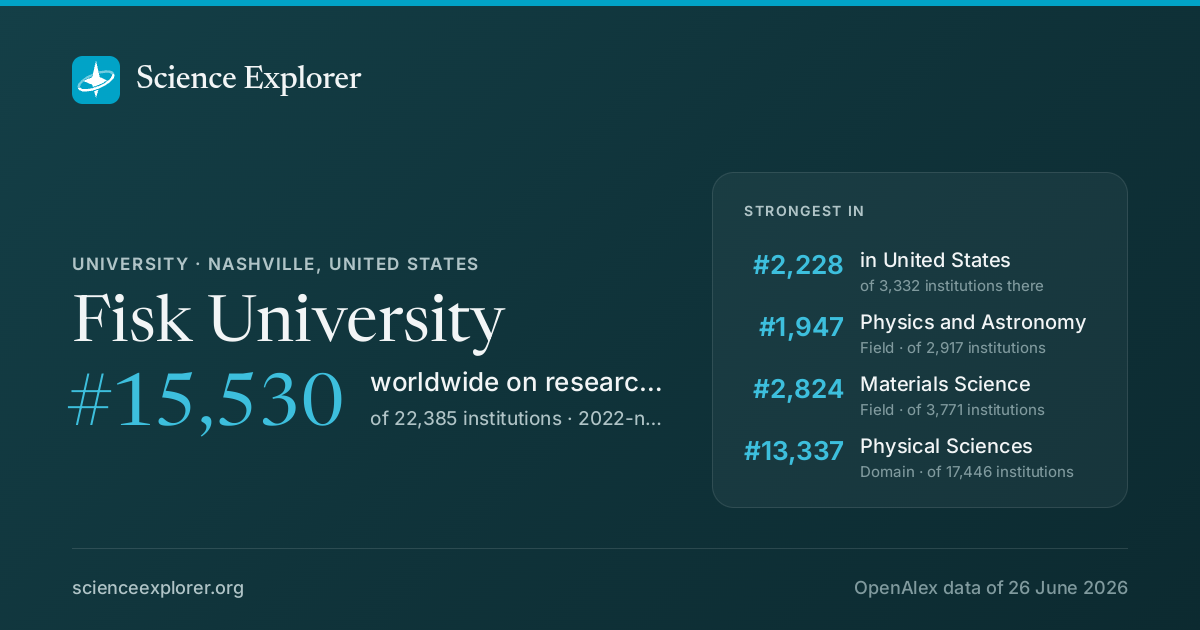
In research, Fisk University stands highest in Physics and Astronomy (#1,947 of 2,917 worldwide), Materials Science (#2,824 of 3,771 worldwide) and Physical Sciences (#13,337 of 17,446 worldwide), over all time. Relative to its size it is most specialised in Economics, Econometrics and Finance (Economics, Econometrics and Finance is 8.2× its share of world research).
- World rank, 2022-now
- #15,530 of 22,385 · #16,856 all time
- Rank in United States
- #2,228 of 3,332
- Research works
- 1k ▼ 16% vs 2018-21
- Citations
- 14k 14.0 per fractional work
- Top-10% rate
- 11.1% all institutions 10.0%
- vs its own fields
- 0.96× 1.00× is exactly expected
- Open access
- 31% world 40%
- International
- 14% world 18%
What is Fisk University known for in research?
The fields where it stands highest, over all time, ranked among every institution above the floor in each field.
| Field | World rank | Where that sits | Top-10% rate | Works |
|---|---|---|---|---|
| Physics and AstronomyField | #1,947 of 2,917 | 8.5% | 160 | |
| Materials ScienceField | #2,824 of 3,771 | 8.0% | 136 | |
| Physical SciencesDomain | #13,337 of 17,446 | 7.2% | 621 | |
| Social SciencesDomain | #12,693 of 14,833 | 7.1% | 272 | |
| EngineeringField | #8,165 of 9,532 | 7.8% | 181 |
Each strip is that field's whole ranked pool, with the notch where Fisk University sits in it, in the colour of the band that rank falls in. The track under the rate is the rate itself: it carries no average mark, because the average differs by field (from about 6% in Dentistry to 21% in Economics).
Which fields of science does Fisk University work in?
In 2022-now, 49% of research at Fisk University is in Social Sciences, 32% in Physical Sciences. Its largest fields are Economics, Econometrics and Finance (18%), Social Sciences (17%), Physics and Astronomy (10%). It does 1.9× the world's share of Social Sciences.
Each ring splits the one inside it: the four domains of science, their fields, their subfields. Size is fractional works in 2022-now. Every slice is a page; the interactive view zooms down to single topics and colours each by how much more of it this institution does than the world.
Its 4 domains and 23 fields, with their numbers
- Social Sciences5749.2%
- Economics, Econometrics and Finance2017.6%
- Social Sciences1916.6%
- Business, Management and Accounting64.8%
- Arts and Humanities54.2%
- Decision Sciences43.2%
- Psychology32.8%
- Physical Sciences3631.5%
- Physics and Astronomy119.8%
- Engineering87.3%
- Computer Science65.2%
- Materials Science54.6%
- Environmental Science21.4%
- Chemistry11.3%
- Mathematics11.0%
- Energy00.4%
- Earth and Planetary Sciences00.4%
- Chemical Engineering00.1%
- Life Sciences1311.7%
- Health Sciences97.6%
- Medicine65.1%
- Health Professions32.3%
- Nursing00.2%
What does Fisk University specialise in?
Where its research is concentrated relative to its size: Economics, Econometrics and Finance takes 8.2× the share of its output that it takes of world research.
- Economics, Econometrics and FinanceField · 20.4 works8.2×
Location quotient, a volume reading rather than an impact one. It surfaces small, lopsided specialities.
Field profile
Location quotient across every field it publishes in: outside the ring is more than an institution of this size would be expected to publish, inside it is less.
Rings at 0.5×, 1× and 2×. Widest outward: Economics, Econometrics and Finance, 8.2×. Every wedge is a field page.
All 23 fields, with their numbers
- Economics, Econometrics and Finance8.25×20 works
- Physics and Astronomy4.41×11 works
- Decision Sciences3.33×4 works
- Biochemistry, Genetics and Molecular Biology1.68×10 works
- Business, Management and Accounting1.48×6 works
- Arts and Humanities1.45×5 works
- Materials Science1.31×5 works
- Social Sciences1.31×19 works
- Immunology and Microbiology1.20×1 works
- Psychology0.93×3 works
- Health Professions0.86×3 works
- Mathematics0.85×1 works
- Chemistry0.81×2 works
- Computer Science0.67×6 works
- Engineering0.49×8 works
- Energy0.47×0 works
- Chemical Engineering0.41×0 works
- Nursing0.35×0 works
- Neuroscience0.28×0 works
- Environmental Science0.28×2 works
- Medicine0.27×6 works
- Earth and Planetary Sciences0.26×0 works
- Agricultural and Biological Sciences0.21×1 works
- Economics, Econometrics and Finance 8.2×
- Physics and Astronomy 4.4×
- Decision Sciences 3.3×
- Biochemistry, Genetics and Molecular Biology 1.7×
- Business, Management and Accounting 1.5×
- Arts and Humanities 1.4×
- Materials Science 1.3×
- Social Sciences 1.3×
- Immunology and Microbiology 1.2×
- Psychology 0.9×
- Health Professions 0.9×
- Mathematics 0.8×
- Chemistry 0.8×
- Computer Science 0.7×
- Engineering 0.5×
- Energy 0.5×
- Chemical Engineering 0.4×
- Nursing 0.3×
- Neuroscience 0.3×
- Environmental Science 0.3×
- Medicine 0.3×
- Earth and Planetary Sciences 0.3×
- Agricultural and Biological Sciences 0.2×
Who are the top researchers at Fisk University?
Ranked on the quality score, Steven M. Damo, Oghenovo A. Obrimah and Nelson Fuson lead among researchers whose main affiliation is Fisk University.
- 1
Steven M. Damo
 United States · #792,699 worldwide
2.3k citations · 105 works
- 2
Oghenovo A. Obrimah
United States · #1,711,944 worldwide
432 citations · 147 works
- 3
Nelson Fuson
United States · #2,043,651 worldwide
1.4k citations · 44 works
- 4
Lorenzo Dow Turner
United States · #2,195,343 worldwide
738 citations · 32 works
- 5
Richard R. Mu
United States · #2,254,024 worldwide
3.2k citations · 214 works
- 6
Carroll J. Bourg
United States · #2,294,087 worldwide
1k citations · 29 works
- 7
Emmanuel Rowe
United States · #2,305,793 worldwide
914 citations · 54 works
- 8
Ivan A. Curtis
United States · #2,439,148 worldwide
1.2k citations · 34 works
- 9
Jitsuichi Masuoka
United States · #2,685,693 worldwide
148 citations · 31 works
- 10
William H. Connor
United States · #2,797,261 worldwide
424 citations · 16 works
Which keywords describe research at Fisk University?
By fractional works in 2022-now, weighted toward what it does more of than the world: Asset Pricing, Economic Growth, Liquidity, Competitive Economy, Market Efficiency, Monetary Equilibrium, Stock Returns and Crystal Growth.
- Lab-on-a-Chip
- Option Pricing
- Monte Carlo Simulation
- Radiation Detection
- Light-Emitting Diodes
- Upconversion Nanoparticles
- Gravitational Waves
- Genomics
- Solid-State Lighting
- Luminescent Materials
- Feminism
- Technology Integration
- Econophysics
- Agent-Based Modeling
- Narrative
- Globalization
- Stock Returns
- Market Efficiency
- Liquidity
- Economic Growth
- Asset Pricing
- Education
- Competitive Economy
- Monetary Equilibrium
- Crystal Growth
- Literature
- Risk Management
- Neoliberalism
- Multifractal Analysis
- Cultural Studies
- Innate Immunity
- Medical Imaging
- Black Holes
- Solar Cell Efficiency
- Nanocrystal Synthesis
- Social Movements
- Race
- Stability
- Game Theory
- Stochastic Calculus
Size is fractional works in 2022-now in the topics tagged with each word; colour is the word's share of this institution's work against its share of the world's. The 40 words are chosen for being large and distinctive. Each links to the topic it comes from most.
All 40 words, with their numbers
- Asset Pricing8▲ 83×2 topics
- Economic Growth6▲ 6.8×7 topics
- Education6▲ 2.8×15 topics
- Liquidity5▲ 56×2 topics
- Competitive Economy4▲ 170×1 topic
- Market Efficiency4▲ 51×1 topic
- Monetary Equilibrium4▲ 170×1 topic
- Stock Returns4▲ 81×1 topic
- Crystal Growth4▲ 11×6 topics
- Globalization4▲ 1.57×9 topics
- Literature3▲ 5.3×5 topics
- Narrative3▲ 17×3 topics
- Risk Management3▲ 5.2×4 topics
- Agent-Based Modeling3▲ 17×2 topics
- Neoliberalism2▲ 6.0×4 topics
- Econophysics2▲ 69×1 topic
- Multifractal Analysis2▲ 69×1 topic
- Technology Integration2▲ 6.6×3 topics
- Cultural Studies2▲ 5.5×2 topics
- Feminism2▲ 6.9×5 topics
- Innate Immunity2▲ 5.8×3 topics
- Luminescent Materials2▲ 26×2 topics
- Medical Imaging2▲ 3.5×4 topics
- Solid-State Lighting2▲ 24×2 topics
- Black Holes2▲ 18×3 topics
- Genomics2▲ 6.0×4 topics
- Solar Cell Efficiency2▲ 18×2 topics
- Gravitational Waves2▲ 28×2 topics
- Nanocrystal Synthesis2▲ 36×1 topic
- Upconversion Nanoparticles2▲ 36×1 topic
- Social Movements2▲ 5.4×3 topics
- Light-Emitting Diodes2▲ 9.9×3 topics
- Race2▲ 12×4 topics
- Radiation Detection2▲ 34×2 topics
- Stability2▲ 6.7×3 topics
- Monte Carlo Simulation2▲ 6.8×2 topics
- Game Theory2▲ 7.6×4 topics
- Option Pricing2▲ 55×1 topic
- Stochastic Calculus2▲ 55×1 topic
- Lab-on-a-Chip1▲ 10×3 topics
Which research topics does Fisk University publish most on?
By volume in 2022-now: Economic theories and models, Financial Markets and Investment Strategies, Complex Systems and Time Series Analysis and Luminescence Properties of Advanced Materials.
Area is fractional works; colour is the subfield each topic belongs to.
- 1 Economic theories and models Economics and Econometrics 4 works
- 2 Financial Markets and Investment Strategies Finance 4 works
- 3 Complex Systems and Time Series Analysis Economics and Econometrics 2 works
- 4 Luminescence Properties of Advanced Materials Materials Chemistry 2 works
- 5 Stochastic processes and financial applications Finance 2 works
- 6 Pulsars and Gravitational Waves Research Astronomy and Astrophysics 1 works
- 7 Decision-Making and Behavioral Economics General Decision Sciences 1 works
- 8 Digital Storytelling and Education Speech and Hearing 1 works
- 9 Risk and Portfolio Optimization Management Science and Operations Research 1 works
- 10 S100 Proteins and Annexins Molecular Biology 1 works
How open and international is its research?
Against the world's own shares: the tick on each track. Both are shares of its output, so they sit on one scale and can be read against each other as well as against the world.
World: 40% of research is openly available.
World: 18% is written across borders.
How has Fisk University's research output changed?
Output in 2022-2025 was 16% lower than in 2018-2021.
The same series as a ribbon: one cell per year, darker for more. The line above answers how much; this answers when.
Its share of all research
Growing output can still be a shrinking share: all of science grows. This is Fisk University as a percentage of every work published that year, 0.00040% in 2024.
Fractional works of Fisk University over all fractional works that year. How the balance of science has shifted.
How much of it reaches the world top 10%
Year by year, against all institutions in the same year.
Of each year's output, the share that reached the world's 10% most cited for its field and year. Peak 17.1% in 2010.
Other research institutions in Nashville
- Vanderbilt University
- Tennessee State University
- Meharry Medical College
- Vanderbilt Health
- Nashville Oncology Associates
- Hypertension Institute
- Belmont University
- Sarah Cannon
Share Fisk University's ranking
Badges for a website1Each links back here and updates with every snapshot

Research measures only: rankings here say nothing about teaching, admissions or student experience. Comparable institutions and collaboration partners have tabs of their own, above.
Discussion
Ask a question or share a note about Fisk University. Posts are plain text and can be reported.