- World rank, all time
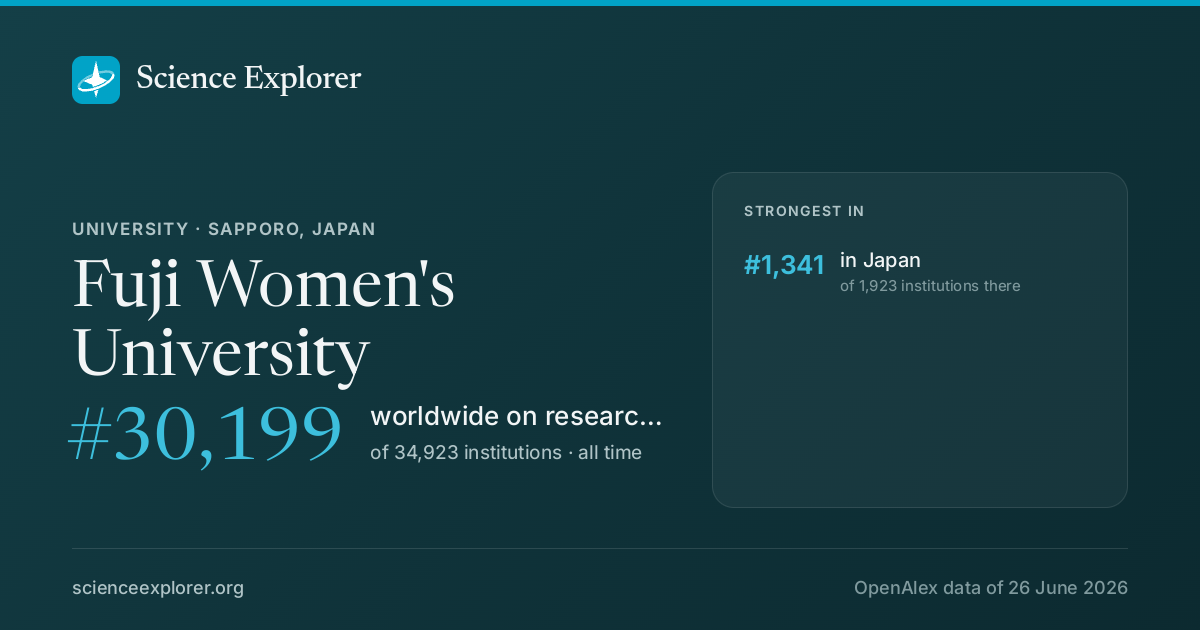
- #30,199 of 34,923
- Rank in Japan
- #1,341 of 1,923
- Research works
- 146 ▼ 22% vs 2018-21
- Citations
- 1.6k 11.1 per fractional work
- Top-10% rate
- 6.4% all institutions 10.0%
- vs its own fields
- 0.91× 1.00× is exactly expected
- Open access
- 54% world 40%
- International
- 11% world 18%
Which fields of science does Fuji Women's University work in?
In 2022-now, 63% of research at Fuji Women's University is in Social Sciences, 15% in Physical Sciences. Its largest fields are Arts and Humanities (29%), Social Sciences (20%), Psychology (13%). It does 2.0× the world's share of Social Sciences.
Each ring splits the one inside it: the four domains of science, their fields, their subfields. Size is fractional works in 2022-now. Every slice is a page; the interactive view zooms down to single topics and colours each by how much more of it this institution does than the world.
Its 4 domains and 14 fields, with their numbers
- Social Sciences1562.9%
- Arts and Humanities729.3%
- Social Sciences520.1%
- Psychology313.3%
- Decision Sciences00.3%
- Physical Sciences415.5%
- Computer Science16.4%
- Engineering15.8%
- Environmental Science13.4%
- Life Sciences311.5%
- Health Sciences210.0%
- Medicine28.3%
- Health Professions01.2%
- Nursing00.6%
Field profile
Location quotient across every field it publishes in: outside the ring is more than an institution of this size would be expected to publish, inside it is less.
Rings at 0.5×, 1× and 2×. Widest outward: Arts and Humanities, 10.1×. Every wedge is a field page.
All 14 fields, with their numbers
- Arts and Humanities10.14×7 works
- Psychology4.38×3 works
- Social Sciences1.59×5 works
- Neuroscience1.33×0 works
- Nursing1.18×0 works
- Agricultural and Biological Sciences0.94×1 works
- Biochemistry, Genetics and Molecular Biology0.84×1 works
- Computer Science0.82×2 works
- Environmental Science0.68×1 works
- Health Professions0.46×0 works
- Medicine0.43×2 works
- Immunology and Microbiology0.41×0 works
- Engineering0.38×1 works
- Decision Sciences0.25×0 works
- Arts and Humanities 10.1×
- Psychology 4.4×
- Social Sciences 1.6×
- Neuroscience 1.3×
- Nursing 1.2×
- Agricultural and Biological Sciences 0.9×
- Biochemistry, Genetics and Molecular Biology 0.8×
- Computer Science 0.8×
- Environmental Science 0.7×
- Health Professions 0.5×
- Medicine 0.4×
- Immunology and Microbiology 0.4×
- Engineering 0.4×
- Decision Sciences 0.2×
Who are the top researchers at Fuji Women's University?
Ranked on the quality score, Charles M. Mueller, Yukako Okazaki and Hideyuki Chiji lead among researchers whose main affiliation is Fuji Women's University.
- 1
Charles M. Mueller
 Japan · #2,846,113 worldwide
353 citations · 45 works
- 2
Yukako Okazaki
Japan · #4,555,037 worldwide
1.1k citations · 49 works
- 3
Hideyuki Chiji
Japan · #4,615,709 worldwide
1.6k citations · 60 works
- 4
富士子 吾田
Japan · #4,711,019 worldwide
0 citations · 21 works
- 5
Naoko Aoki
Japan · #4,733,374 worldwide
121 citations · 49 works
- 6
Rieko Mitamura
Japan · #5,035,428 worldwide
307 citations · 29 works
- 7
Atsushi Takase
Japan · #5,105,951 worldwide
17 citations · 25 works
- 8
仁子 甲斐
Japan · #5,992,139 worldwide
1 citations · 44 works
- 9
義博 藤井
Japan · #6,269,495 worldwide
0 citations · 54 works
- 10
Masaharu Kawakatsu
Japan · #7,467,507 worldwide
1.2k citations · 161 works
Which keywords describe research at Fuji Women's University?
By fractional works in 2022-now, weighted toward what it does more of than the world: Pragmatics, Social Interaction, Narrative Analysis, Conversation Analysis, Interactional Linguistics, Corpus Linguistics, Semantics and Syntax.
- Trademark Law
- Metaphor
- Language
- Child Development
- Syntax
- Interactional Linguistics
- Conversation Analysis
- Social Interaction
- Pragmatics
- Narrative Analysis
- Corpus Linguistics
- Semantics
- Globalization
- Embodiment
- Copyright Law
- Time
Size is fractional works in 2022-now in the topics tagged with each word; colour is the word's share of this institution's work against its share of the world's. The 16 words are chosen for being large and distinctive. Each links to the topic it comes from most.
All 16 words, with their numbers
- Pragmatics3▲ 94×4 topics
- Social Interaction2▲ 23×3 topics
- Narrative Analysis2▲ 140×2 topics
- Conversation Analysis2▲ 230×1 topic
- Corpus Linguistics2▲ 31×3 topics
- Interactional Linguistics2▲ 230×1 topic
- Semantics2▲ 239×1 topic
- Syntax2▲ 88×1 topic
- Globalization1▲ 3.1×3 topics
- Child Development1▲ 13×4 topics
- Embodiment1▲ 28×2 topics
- Language1▲ 21×2 topics
- Copyright Law1▲ 225×1 topic
- Metaphor1▲ 107×1 topic
- Time1▲ 97×1 topic
- Trademark Law1▲ 471×1 topic
Which research topics does Fuji Women's University publish most on?
By volume in 2022-now: Syntax, Semantics, Linguistic Variation, Language, Discourse, Communication Strategies, Intellectual Property Law and Language, Metaphor, and Cognition.
Area is fractional works; colour is the subfield each topic belongs to.
- 1 Syntax, Semantics, Linguistic Variation Language and Linguistics 2 works
- 2 Language, Discourse, Communication Strategies Language and Linguistics 2 works
- 3 Intellectual Property Law Law 1 works
- 4 Language, Metaphor, and Cognition Experimental and Cognitive Psychology 1 works
- 5 Natural Language Processing Techniques Artificial Intelligence 1 works
- 6 Recycled Aggregate Concrete Performance Building and Construction 1 works
- 7 Innovative concrete reinforcement materials Civil and Structural Engineering 1 works
- 8 Medieval Philosophy and Theology Philosophy 1 works
- 9 Municipal Solid Waste Management Industrial and Manufacturing Engineering 1 works
- 10 Second Language Learning and Teaching Literature and Literary Theory 0 works
How open and international is its research?
Against the world's own shares: the tick on each track. Both are shares of its output, so they sit on one scale and can be read against each other as well as against the world.
World: 40% of research is openly available.
World: 18% is written across borders.
How has Fuji Women's University's research output changed?
Output in 2022-2025 was 22% lower than in 2018-2021.
The same series as a ribbon: one cell per year, darker for more. The line above answers how much; this answers when.
Its share of all research
Growing output can still be a shrinking share: all of science grows. This is Fuji Women's University as a percentage of every work published that year, 0.00011% in 2024.
Fractional works of Fuji Women's University over all fractional works that year. How the balance of science has shifted.
Other research institutions in Sapporo
- Hokkaido University
- Sapporo Medical University
- Hokkaido University of Science
- Hokkaido University of Education
- Hokkaido Pharmaceutical University
- Sapporo University
- Hokkai Gakuen University
- Megmilk Snow Brand (Japan)
Share Fuji Women's University's ranking
Badges for a website1Each links back here and updates with every snapshot

Research measures only: rankings here say nothing about teaching, admissions or student experience. Comparable institutions and collaboration partners have tabs of their own, above.
Discussion
Ask a question or share a note about Fuji Women's University. Keep it to the research: no personal attacks, advertising or links. Any reader can report a post, which collapses it for everyone until it is opened.