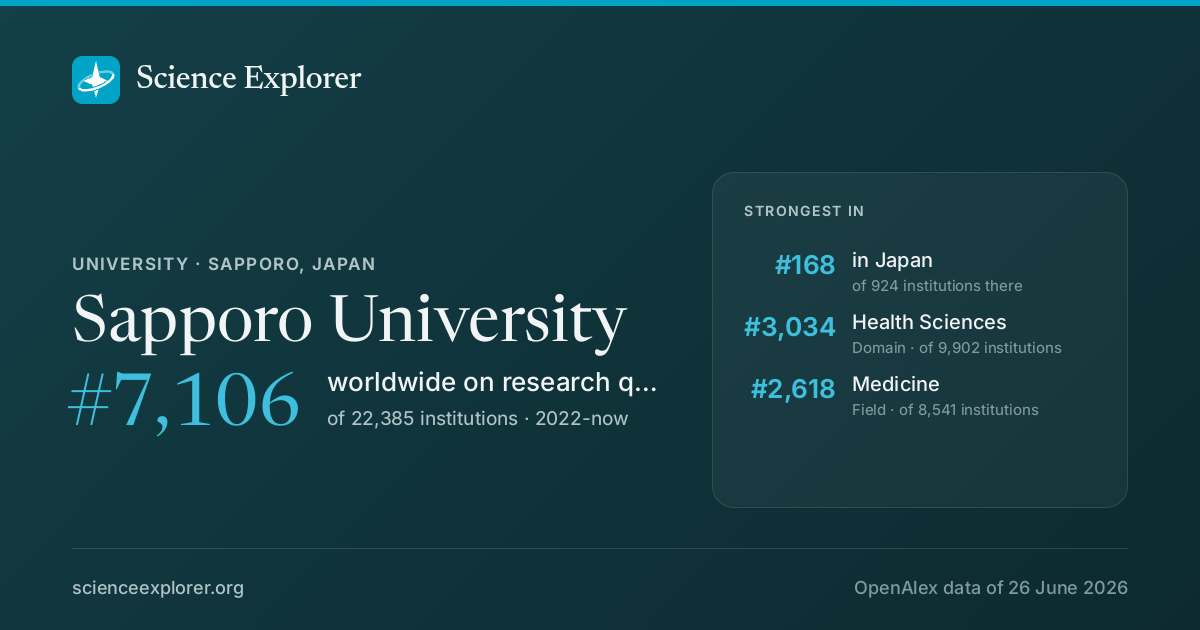
World rank, 2022-now #7,106
of 22,385 · #8,168 all time
Rank in Japan #168
of 924 Research works 1.6k
▲ 40% vs 2018-21
Citations 27k 16.4 per fractional work
Top-10% rate 8.2%
all institutions 10.0%
vs its own fields 0.92×
1.00× is exactly expected
Open access 43%
world 40%
International 15%
world 18%
What is Sapporo University known for in research?
The fields where it stands highest, 2022-now, ranked among every institution above the floor in each field.
Field World rank Where that sits Top-10% rate Works All time Domain #3,034 of 9,902 8.9% 134
#5142 Field #2,618 of 8,541 8.8% 118
#4245
Which fields of science does Sapporo University work in?
In 2022-now, 49% of research at Sapporo University is in Health Sciences , 19% in Life Sciences . Its largest fields are Medicine (44%), Biochemistry, Genetics and Molecular Biology (10%), Engineering (7%). It does 2.1× the world's share of Health Sciences.
Health Sciences: 152 fractional works · 49.1% of its work Medicine: 135 fractional works · 43.6% of its work Surgery: 18 fractional works · 5.8% of its work Pulmonary and Respiratory Medicine: 10 fractional works · 3.2% of its work Epidemiology: 9 fractional works · 3.0% of its work Physiology: 9 fractional works · 2.8% of its work Orthopedics and Sports Medicine: 7 fractional works · 2.3% of its work Cardiology and Cardiovascular Medicine: 7 fractional works · 2.1% of its work Oncology: 6 fractional works · 1.9% of its work Radiology, Nuclear Medicine and Imaging: 6 fractional works · 1.9% of its work Infectious Diseases: 6 fractional works · 1.9% of its work Pathology and Forensic Medicine: 6 fractional works · 1.8% of its work Public Health, Environmental and Occupational Health: 6 fractional works · 1.8% of its work Rheumatology: 5 fractional works · 1.7% of its work Hematology: 5 fractional works · 1.6% of its work Endocrinology, Diabetes and Metabolism: 3 fractional works · 1.1% of its work Genetics: 3 fractional works · 1.0% of its work Neurology: 3 fractional works · 1.0% of its work Pharmacology: 3 fractional works · 0.8% of its work Psychiatry and Mental health: 3 fractional works · 0.8% of its work Hepatology: 2 fractional works · 0.7% of its work Obstetrics and Gynecology: 2 fractional works · 0.7% of its work Pediatrics, Perinatology and Child Health: 2 fractional works · 0.7% of its work Rehabilitation: 2 fractional works · 0.6% of its work Nephrology: 2 fractional works · 0.6% of its work Geriatrics and Gerontology: 1 fractional works · 0.5% of its work Dermatology: 1 fractional works · 0.4% of its work Ophthalmology: 1 fractional works · 0.4% of its work Gastroenterology: 1 fractional works · 0.3% of its work Immunology and Allergy: 1 fractional works · 0.3% of its work Reproductive Medicine: 1 fractional works · 0.3% of its work Emergency Medicine: 1 fractional works · 0.3% of its work Critical Care and Intensive Care Medicine: 1 fractional works · 0.2% of its work Complementary and alternative medicine: 1 fractional works · 0.2% of its work Smaller subfields together: 3 fractional works · 1.0% of its work Health Professions: 10 fractional works · 3.3% of its work General Health Professions: 6 fractional works · 1.8% of its work Emergency Medical Services: 1 fractional works · 0.3% of its work Physical Therapy, Sports Therapy and Rehabilitation: 1 fractional works · 0.3% of its work Occupational Therapy: 1 fractional works · 0.2% of its work Radiological and Ultrasound Technology: 1 fractional works · 0.2% of its work Smaller subfields together: 1 fractional works · 0.4% of its work Nursing: 5 fractional works · 1.7% of its work Nutrition and Dietetics: 5 fractional works · 1.6% of its work Smaller subfields together: 0 fractional works · 0.1% of its work Dentistry: 1 fractional works · 0.4% of its work Veterinary: 0 fractional works · 0.1% of its work Life Sciences: 60 fractional works · 19.5% of its work Biochemistry, Genetics and Molecular Biology: 31 fractional works · 9.8% of its work Molecular Biology: 18 fractional works · 5.7% of its work Genetics: 3 fractional works · 0.9% of its work Cell Biology: 3 fractional works · 0.8% of its work Biochemistry: 2 fractional works · 0.7% of its work Cancer Research: 1 fractional works · 0.4% of its work Biophysics: 1 fractional works · 0.4% of its work Biotechnology: 1 fractional works · 0.3% of its work Clinical Biochemistry: 1 fractional works · 0.3% of its work Smaller subfields together: 1 fractional works · 0.4% of its work Neuroscience: 12 fractional works · 3.8% of its work Cognitive Neuroscience: 5 fractional works · 1.8% of its work Neurology: 3 fractional works · 0.8% of its work Cellular and Molecular Neuroscience: 2 fractional works · 0.7% of its work Sensory Systems: 1 fractional works · 0.3% of its work Smaller subfields together: 1 fractional works · 0.3% of its work Agricultural and Biological Sciences: 9 fractional works · 2.9% of its work Plant Science: 2 fractional works · 0.6% of its work Ecology, Evolution, Behavior and Systematics: 1 fractional works · 0.5% of its work Animal Science and Zoology: 1 fractional works · 0.4% of its work Food Science: 1 fractional works · 0.4% of its work Aquatic Science: 1 fractional works · 0.4% of its work Insect Science: 1 fractional works · 0.3% of its work Agronomy and Crop Science: 1 fractional works · 0.2% of its work Smaller subfields together: 1 fractional works · 0.2% of its work Immunology and Microbiology: 7 fractional works · 2.4% of its work Immunology: 5 fractional works · 1.5% of its work Parasitology: 2 fractional works · 0.5% of its work Microbiology: 1 fractional works · 0.3% of its work Smaller subfields together: 0 fractional works · 0.2% of its work Pharmacology, Toxicology and Pharmaceutics: 1 fractional works · 0.5% of its work Pharmacology: 1 fractional works · 0.4% of its work Smaller subfields together: 0 fractional works · 0.1% of its work Physical Sciences: 57 fractional works · 18.3% of its work Engineering: 21 fractional works · 6.8% of its work Biomedical Engineering: 8 fractional works · 2.5% of its work Mechanical Engineering: 2 fractional works · 0.7% of its work Aerospace Engineering: 2 fractional works · 0.7% of its work Civil and Structural Engineering: 2 fractional works · 0.5% of its work Electrical and Electronic Engineering: 2 fractional works · 0.5% of its work Mechanics of Materials: 2 fractional works · 0.5% of its work Computational Mechanics: 1 fractional works · 0.4% of its work Control and Systems Engineering: 1 fractional works · 0.4% of its work Building and Construction: 1 fractional works · 0.2% of its work Smaller subfields together: 1 fractional works · 0.3% of its work Environmental Science: 9 fractional works · 3.0% of its work Health, Toxicology and Mutagenesis: 3 fractional works · 0.9% of its work Ecology: 2 fractional works · 0.7% of its work Global and Planetary Change: 2 fractional works · 0.5% of its work Smaller subfields together: 3 fractional works · 0.9% of its work Computer Science: 8 fractional works · 2.7% of its work Artificial Intelligence: 4 fractional works · 1.3% of its work Computer Vision and Pattern Recognition: 2 fractional works · 0.6% of its work Smaller subfields together: 2 fractional works · 0.7% of its work Materials Science: 5 fractional works · 1.5% of its work Materials Chemistry: 2 fractional works · 0.8% of its work Biomaterials: 1 fractional works · 0.3% of its work Electronic, Optical and Magnetic Materials: 1 fractional works · 0.2% of its work Smaller subfields together: 1 fractional works · 0.2% of its work Physics and Astronomy: 4 fractional works · 1.3% of its work Atomic and Molecular Physics, and Optics: 1 fractional works · 0.5% of its work Radiation: 1 fractional works · 0.3% of its work Smaller subfields together: 2 fractional works · 0.6% of its work Earth and Planetary Sciences: 3 fractional works · 1.1% of its work Atmospheric Science: 1 fractional works · 0.4% of its work Geology: 1 fractional works · 0.3% of its work Oceanography: 1 fractional works · 0.2% of its work Smaller subfields together: 1 fractional works · 0.2% of its work Chemistry: 3 fractional works · 0.8% of its work Organic Chemistry: 1 fractional works · 0.3% of its work Spectroscopy: 1 fractional works · 0.3% of its work Smaller subfields together: 1 fractional works · 0.2% of its work Mathematics: 2 fractional works · 0.7% of its work Geometry and Topology: 1 fractional works · 0.2% of its work Smaller subfields together: 2 fractional works · 0.5% of its work Chemical Engineering: 1 fractional works · 0.2% of its work Energy: 0 fractional works · 0.1% of its work Social Sciences: 41 fractional works · 13.2% of its work Social Sciences: 20 fractional works · 6.4% of its work Sociology and Political Science: 6 fractional works · 2.0% of its work Cultural Studies: 2 fractional works · 0.8% of its work Political Science and International Relations: 2 fractional works · 0.8% of its work Demography: 2 fractional works · 0.5% of its work Anthropology: 1 fractional works · 0.5% of its work Health: 1 fractional works · 0.5% of its work Education: 1 fractional works · 0.4% of its work Transportation: 1 fractional works · 0.3% of its work Urban Studies: 1 fractional works · 0.2% of its work Smaller subfields together: 2 fractional works · 0.5% of its work Psychology: 9 fractional works · 2.8% of its work Clinical Psychology: 3 fractional works · 0.9% of its work Experimental and Cognitive Psychology: 3 fractional works · 0.8% of its work Social Psychology: 2 fractional works · 0.8% of its work Smaller subfields together: 1 fractional works · 0.4% of its work Arts and Humanities: 7 fractional works · 2.1% of its work Language and Linguistics: 4 fractional works · 1.2% of its work Literature and Literary Theory: 1 fractional works · 0.3% of its work Smaller subfields together: 2 fractional works · 0.7% of its work Business, Management and Accounting: 3 fractional works · 1.0% of its work Accounting: 1 fractional works · 0.3% of its work Marketing: 1 fractional works · 0.3% of its work Smaller subfields together: 1 fractional works · 0.4% of its work Decision Sciences: 2 fractional works · 0.5% of its work Management Science and Operations Research: 1 fractional works · 0.3% of its work Smaller subfields together: 1 fractional works · 0.2% of its work Economics, Econometrics and Finance: 1 fractional works · 0.3% of its work Economics and Econometrics: 1 fractional works · 0.2% of its work Smaller subfields together: 0 fractional works · 0.1% of its work Health Sciences Medicine Health Pr… Nursing Life Sciences Biochemistry Neuroscie… Agricultu… Immunolog… Physical Sciences Engineeri… Environme… Computer… Materials… Social Sciences Social Sciences Psychology Arts and… ALL ITS WORK Sapporo University 310 fractional works, 2022-now 19% 18% 49% 13%
Each ring splits the one inside it: the four domains of science, their fields, their subfields. Size is fractional works in 2022-now. Every slice is a page; the interactive view zooms down to single topics and colours each by how much more of it this institution does than the world.
Its 4 domains and 26 fields, with their numbers 135 43.6% 10 3.3% 5 1.7% 1 0.4% 0 0.1% 31 9.8% 12 3.8% 9 2.9% 7 2.4% 1 0.5% 21 6.8% 9 3.0% 8 2.7% 5 1.5% 4 1.3% 3 1.1% 3 0.8% 2 0.7% 1 0.2% 0 0.1% 20 6.4% 9 2.8% 7 2.1% 3 1.0% 2 0.5% 1 0.3% All of science, and how each field's share has moved since 1950: the Science domain explorer
Field profile
Location quotient across every field it publishes in: outside the ring is more than an institution of this size would be expected to publish, inside it is less.
Agricultural and Biological Sciences: 0.61× its world share, 9 works Agricultural and Bio… Biochemistry, Genetics and Molecular Biology: 1.85× its world share, 31 works Biochemistry, Geneti… Immunology and Microbiology: 2.40× its world share, 8 works Immunology and Micro… Neuroscience: 2.37× its world share, 12 works Neuroscience Pharmacology, Toxicology and Pharmaceutics: 1.31× its world share, 1 works Pharmacology, Toxico… Chemical Engineering: 0.71× its world share, 1 works Chemical Engineering Chemistry: 0.53× its world share, 3 works Chemistry Computer Science: 0.34× its world share, 8 works Computer Science Earth and Planetary Sciences: 0.68× its world share, 3 works Earth and Planetary … Energy: 0.15× its world share, 0 works Energy Engineering: 0.45× its world share, 21 works Engineering Environmental Science: 0.61× its world share, 9 works Environmental Science Materials Science: 0.43× its world share, 5 works Materials Science Mathematics: 0.61× its world share, 2 works Mathematics Physics and Astronomy: 0.61× its world share, 4 works Physics and Astronomy Dentistry: 0.73× its world share, 1 works Dentistry Health Professions: 1.24× its world share, 10 works Health Professions Medicine: 2.27× its world share, 135 works Medicine Nursing: 3.52× its world share, 5 works Nursing Veterinary: 0.71× its world share, 0 works Veterinary Arts and Humanities: 0.74× its world share, 7 works Arts and Humanities Business, Management and Accounting: 0.30× its world share, 3 works Business, Management… Decision Sciences: 0.53× its world share, 2 works Decision Sciences Economics, Econometrics and Finance: 0.16× its world share, 1 works Economics, Econometr… Psychology: 0.93× its world share, 9 works Psychology Social Sciences: 0.50× its world share, 20 works Social Sciences 1× world share
Rings at 0.5×, 1× and 2×. Widest outward: Nursing , 3.5×. Every wedge is a field page.
All 26 fields, with their numbers Nursing 3.52× 5 works Immunology and Microbiology 2.40× 8 works Neuroscience 2.37× 12 works Medicine 2.27× 135 works Biochemistry, Genetics and Molecular Biology 1.85× 31 works Pharmacology, Toxicology and Pharmaceutics 1.31× 1 works Health Professions 1.24× 10 works Psychology 0.93× 9 works Arts and Humanities 0.74× 7 works Dentistry 0.73× 1 works Chemical Engineering 0.71× 1 works Veterinary 0.71× 0 works Earth and Planetary Sciences 0.68× 3 works Agricultural and Biological Sciences 0.61× 9 works Environmental Science 0.61× 9 works Mathematics 0.61× 2 works Physics and Astronomy 0.61× 4 works Chemistry 0.53× 3 works Decision Sciences 0.53× 2 works Social Sciences 0.50× 20 works Engineering 0.45× 21 works Materials Science 0.43× 5 works Computer Science 0.34× 8 works Business, Management and Accounting 0.30× 3 works Economics, Econometrics and Finance 0.16× 1 works Energy 0.15× 0 works
Who are the top researchers at Sapporo University?
Ranked on the quality score, Shigeo Uehara , Yue Wu and Hikari Sato lead among researchers whose main affiliation is Sapporo University.
1
Shigeo Uehara
Japan · #2,019,991 worldwide1.9k citations · 48 works
2
Yue Wu
Japan · #2,483,192 worldwide1.2k citations · 62 works
3
Hikari Sato
Japan · #4,421,155 worldwide0 citations · 25 works
4
Masakazu Sengoku
Japan · #4,864,099 worldwide0 citations · 20 works
5
Masaki Takahashi
Japan · #5,007,361 worldwide0 citations · 15 works
6
Matsumoto Gentaro
Japan · #5,098,982 worldwide48 citations · 16 works
7
Hideo Mikami
Japan · #5,289,511 worldwide77 citations · 19 works
8
Tokuzo Mishima
Japan · #5,295,546 worldwide16 citations · 20 works
9
Hiroshi Unoura
Japan · #5,541,250 worldwide13 citations · 25 works
10
Tsutomu Anazawa
Japan · #5,547,704 worldwide13 citations · 25 works
All ranked researchers at Sapporo University
What are the most cited papers from Sapporo University?
The most cited paper from Sapporo University is "Guidelines for the use and interpretation of assays for monitoring autophagy (3rd edition)" (Daniel J. Klionsky et al., 2016), with 6,023 citations. Next come "Cancer Incidence, Mortality, Years of Life Lost, Years Lived With Disability, and Disability-Adjusted Life Years for 29 Cancer Groups From 2010 to 2019" (2,100) and "A systematic review on silver nanoparticles-induced cytotoxicity: Physicochemical properties and perspectives" (1,227).
Most cited papers
# Paper Released Citations 1
Guidelines for the use and interpretation of assays for monitoring autophagy (3rd edition)
Daniel J. Klionsky et al. · Autophagy
Open access 2,467 authors 2 Jan 2016
6,023 2
Cancer Incidence, Mortality, Years of Life Lost, Years Lived With Disability, and Disability-Adjusted Life Years for 29 Cancer Groups From 2010 to 2019
Jonathan Kocarnik et al. · JAMA Oncology
Open access 601 authors 30 Dec 2021
2,100 3
A systematic review on silver nanoparticles-induced cytotoxicity: Physicochemical properties and perspectives
Mahmuda Akter, Md. Tajuddin Sikder, Md. Mostafizur Rahman et al. · Journal of Advanced Research
Review Open access 2 Nov 2017
1,227 4
Attenuated fusogenicity and pathogenicity of SARS-CoV-2 Omicron variant
Rigel Suzuki et al. · Nature
Open access Feb 2022
756 5
Global Strategy for the Diagnosis, Management and Prevention of Chronic Obstructive Lung Disease 2017 Report
Claus Franz Vogelmeier et al. · Respirology
2 Feb 2017
697
All 60 most cited papers, with filters and sorting
Which keywords describe research at Sapporo University?
By fractional works in 2022-now, weighted toward what it does more of than the world: Epidemiology , Inflammation, Oxidative Stress, Metabolic Syndrome, Cardiovascular Disease, Diagnosis, Treatment and Mitochondrial Dysfunction.
Size is fractional works in 2022-now in the topics tagged with each word; colour is the word's share of this institution's work against its share of the world's. The 40 words are chosen for being large and distinctive. Each links to the topic it comes from most.
All 40 words, with their numbers Epidemiology 33 ▲ 2.7× 96 topics Inflammation 21 ▲ 3.2× 60 topics Oxidative Stress 13 ▲ 2.5× 38 topics Cardiovascular Disease 10 ▲ 2.7× 25 topics Metabolic Syndrome 9 ▲ 3.6× 15 topics Treatment 9 ▲ 2.5× 31 topics Diagnosis 8 ▲ 2.9× 28 topics Quality of Life 8 ▲ 1.75× 35 topics Obesity 7 ▲ 2.8× 20 topics Aging 6 ▲ 3.7× 9 topics Risk Factors 6 ▲ 1.86× 21 topics Pathogenesis 6 ▲ 3.7× 18 topics Management 6 ▲ 2.3× 21 topics Insulin Resistance 6 ▲ 4.0× 7 topics Biomarkers 6 ▲ 2.5× 14 topics Mitochondrial Dysfunction 6 ▲ 6.1× 10 topics Prevention 5 ▲ 4.0× 10 topics Metabolism 5 ▲ 3.1× 17 topics Rehabilitation 5 ▲ 4.1× 10 topics Biomechanics 5 ▲ 5.3× 7 topics Global Burden 4 ▲ 2.6× 11 topics Heart Failure 4 ▲ 3.2× 12 topics Thrombosis 4 ▲ 5.2× 7 topics Metabolic Regulation 4 ▲ 7.8× 4 topics Autoantibodies 4 ▲ 5.1× 8 topics Hepatic Steatosis 4 ▲ 8.3× 2 topics Corpus Linguistics 4 ▲ 5.3× 3 topics Gait Analysis 4 ▲ 12× 2 topics Hepatocellular Carcinoma 3 ▲ 5.3× 3 topics Injury Prevention 3 ▲ 7.7× 2 topics Machine Translation 3 ▲ 5.6× 2 topics Mitochondria 3 ▲ 6.9× 5 topics Neurodegenerative Diseases 3 ▲ 5.7× 6 topics Arthroplasty 3 ▲ 9.2× 2 topics Muscle Injuries 3 ▲ 14× 1 topic Sports Injury 3 ▲ 14× 1 topic Foot Strike Patterns 3 ▲ 23× 1 topic Omega-3 Fatty Acids 3 ▲ 12× 2 topics Running Injuries 3 ▲ 23× 1 topic Dietary Intake 2 ▲ 18× 3 topics
How open and international is its research?
Against the world's own shares: the tick on each track. Both are shares of its output, so they
sit on one scale and can be read against each other as well as against the world.
43% 57%
43.2% 56.8%
World: 40% of research is openly available.
15% 85%
14.9% 85.1%
World: 18% is written across borders.
How has Sapporo University's research output changed?
Output in 2022-2025 was 40% higher than in 2018-2021.
still counting 1990 2000 2010 2020
The same series as a ribbon: one cell per year, darker for more. The line above answers how much ; this answers when .
Its share of all research
still counting 0.0020% 0.0040% 0.0060% Sapporo University 0.0013% in 2025 1980 1990 2000 2010 2020 Fractional works of Sapporo University over all fractional works that year. How the balance of science has shifted .
How much of it reaches the world top 10%
still counting 10% 20% all institutions 10.0% in 2025 Sapporo University 7.2% in 2025 2000 2010 2020 Of each year's output, the share that reached the world's 10% most cited for its field and year. Peak 15.8% in 2014.
Share Sapporo University's ranking
A card with Sapporo University's standing and the fields it leads in, for a post or a slide. A link to this page previews as the same card.
Badges for a website 1 Each links back here and updates with every snapshot
 Japan · #2,019,991 worldwide
1.9k citations · 48 works