Fundação Dom Cabral
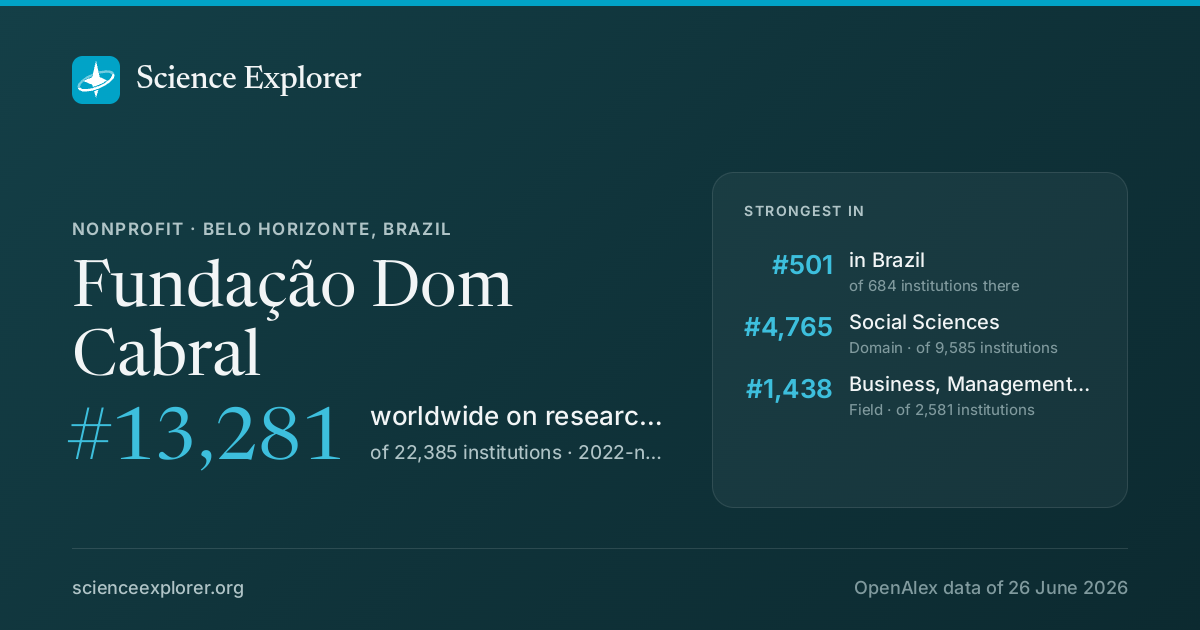
In research, Fundação Dom Cabral stands highest in Social Sciences (#4,765 of 9,585 worldwide) and Business, Management and Accounting (#1,438 of 2,581 worldwide), 2022-now. Relative to its size it is most specialised in Information Systems and Management, Strategy and Management and Decision Sciences (Information Systems and Management is 37.6× its share of world research).
- World rank, 2022-now
- #13,281 of 22,385 · #17,904 all time
- Rank in Brazil
- #501 of 684
- Research works
- 451 ▲ 101% vs 2018-21
- Citations
- 3.2k 7.2 per fractional work
- Top-10% rate
- 11.8% all institutions 10.0%
- vs its own fields
- 0.98× 1.00× is exactly expected
- Open access
- 63% world 40%
- International
- 27% world 18%
What is Fundação Dom Cabral known for in research?
The fields where it stands highest, 2022-now, ranked among every institution above the floor in each field.
| Field | World rank | Where that sits | Top-10% rate | Works | All time |
|---|---|---|---|---|---|
| Social SciencesDomain | #4,765 of 9,585 | 12.5% | 133 | #6481 | |
| Business, Management and AccountingField | #1,438 of 2,581 | 9.1% | 64 | #2436 |
Each strip is that field's whole ranked pool, with the notch where Fundação Dom Cabral sits in it, in the colour of the band that rank falls in. The track under the rate is the rate itself: it carries no average mark, because the average differs by field (from about 6% in Dentistry to 21% in Economics).
Which fields of science does Fundação Dom Cabral work in?
In 2022-now, 81% of research at Fundação Dom Cabral is in Social Sciences, 9% in Physical Sciences. Its largest fields are Business, Management and Accounting (37%), Social Sciences (21%), Decision Sciences (13%). It does 3.1× the world's share of Social Sciences.
Each ring splits the one inside it: the four domains of science, their fields, their subfields. Size is fractional works in 2022-now. Every slice is a page; the interactive view zooms down to single topics and colours each by how much more of it this institution does than the world.
Its 4 domains and 23 fields, with their numbers
- Social Sciences15380.9%
- Business, Management and Accounting7036.8%
- Social Sciences4021.0%
- Decision Sciences2513.1%
- Economics, Econometrics and Finance115.9%
- Psychology63.1%
- Arts and Humanities21.0%
- Physical Sciences168.7%
- Computer Science52.7%
- Engineering52.6%
- Environmental Science52.4%
- Energy10.4%
- Mathematics00.2%
- Physics and Astronomy00.2%
- Chemistry00.1%
- Materials Science00.0%
- Health Sciences158.1%
- Health Professions84.0%
- Medicine73.8%
- Dentistry00.1%
- Nursing00.1%
- Veterinary00.0%
- Life Sciences42.3%
What does Fundação Dom Cabral specialise in?
Where its research is concentrated relative to its size: Information Systems and Management takes 37.6× the share of its output that it takes of world research.
- Information Systems and ManagementSubfield · 20.4 works38×
- Strategy and ManagementSubfield · 29.9 works18×
- Decision SciencesField · 24.9 works14×
- Business, Management and AccountingField · 69.6 works11×
Location quotient, a volume reading rather than an impact one. It surfaces small, lopsided specialities.
Field profile
Location quotient across every field it publishes in: outside the ring is more than an institution of this size would be expected to publish, inside it is less.
Rings at 0.5×, 1× and 2×. Widest outward: Decision Sciences, 13.6×. Every wedge is a field page.
All 23 fields, with their numbers
- Decision Sciences13.59×25 works
- Business, Management and Accounting11.41×70 works
- Economics, Econometrics and Finance2.75×11 works
- Social Sciences1.66×40 works
- Health Professions1.53×8 works
- Psychology1.00×6 works
- Environmental Science0.49×5 works
- Energy0.44×1 works
- Arts and Humanities0.36×2 works
- Computer Science0.34×5 works
- Veterinary0.32×0 works
- Agricultural and Biological Sciences0.29×3 works
- Dentistry0.29×0 works
- Nursing0.25×0 works
- Neuroscience0.22×1 works
- Mathematics0.20×0 works
- Medicine0.20×7 works
- Engineering0.17×5 works
- Immunology and Microbiology0.15×0 works
- Physics and Astronomy0.10×0 works
- Biochemistry, Genetics and Molecular Biology0.08×1 works
- Chemistry0.07×0 works
- Materials Science0.01×0 works
- Decision Sciences 13.6×
- Business, Management and Accounting 11.4×
- Economics, Econometrics and Finance 2.8×
- Social Sciences 1.7×
- Health Professions 1.5×
- Psychology 1.0×
- Environmental Science 0.5×
- Energy 0.4×
- Arts and Humanities 0.4×
- Computer Science 0.3×
- Veterinary 0.3×
- Agricultural and Biological Sciences 0.3×
- Dentistry 0.3×
- Nursing 0.2×
- Neuroscience 0.2×
- Mathematics 0.2×
- Medicine 0.2×
- Engineering 0.2×
- Immunology and Microbiology 0.1×
- Physics and Astronomy 0.1×
- Biochemistry, Genetics and Molecular Biology 0.1×
- Chemistry 0.1×
- Materials Science 0.0×
Who are the top researchers at Fundação Dom Cabral?
Ranked on the quality score, Paulo Renato de Sousa, Heiko Hosomi Spitzeck and Ana Luiza Lara de Araújo Burcharth lead among researchers whose main affiliation is Fundação Dom Cabral.
- 1
Paulo Renato de Sousa
 Brazil · #632,431 worldwide
1.1k citations · 65 works
- 2
Heiko Hosomi Spitzeck
Brazil · #1,072,321 worldwide
1.1k citations · 118 works
- 3
Ana Luiza Lara de Araújo Burcharth
Brazil · #1,651,791 worldwide
762 citations · 44 works
- 4
Lívia Lopes Barakat
Brazil · #1,880,610 worldwide
295 citations · 31 works
- 5
Alice Erthal
Brazil · #2,229,161 worldwide
204 citations · 28 works
- 6
Olivier Cattaneo
Brazil · #2,550,278 worldwide
658 citations · 47 works
- 7
Jianlin Jiang
Brazil · #2,589,649 worldwide
49 citations · 17 works
- 8
Heiko Hosomi Spitzeck
Brazil · #2,784,000 worldwide
0 citations · 20 works
- 9
Rosileia Das Mercês Milagres
Brazil · #2,918,319 worldwide
177 citations · 34 works
- 10
Rogério Gava
Brazil · #2,979,558 worldwide
17 citations · 18 works
Which keywords describe research at Fundação Dom Cabral?
By fractional works in 2022-now, weighted toward what it does more of than the world: Qualitative Research, Innovation Management, Case Study, Organizational Management, Research Methods, Innovation, Social Capital and Strategic Alliances.
- Value Creation
- Technological Innovation
- Institutional Entrepreneurship
- Organizational Identity
- Collaborative Relationships
- Organizational Change
- Risk Management
- Market Dynamics
- Public Policy
- Entrepreneurship
- Leadership
- Dynamic Capabilities
- Sustainable Development
- Corporate Governance
- Organizational Learning
- Supply Chain Management
- Social Capital
- Innovation
- Organizational Management
- Case Study
- Qualitative Research
- Innovation Management
- Research Methods
- Sustainability
- Strategic Alliances
- Knowledge Transfer
- Performance Measurement
- Market Orientation
- Business Models
- Innovation Networks
- Environmental Management
- Financial Performance
- Institutional Theory
- Knowledge Sharing
- Social Movements
- Information Sharing
- Lean Manufacturing
- Professionalism
- Sensemaking
- Financial Constraints
Size is fractional works in 2022-now in the topics tagged with each word; colour is the word's share of this institution's work against its share of the world's. The 40 words are chosen for being large and distinctive. Each links to the topic it comes from most.
All 40 words, with their numbers
- Qualitative Research22▲ 14×9 topics
- Case Study19▲ 159×2 topics
- Innovation Management19▲ 64×3 topics
- Organizational Management19▲ 164×1 topic
- Research Methods19▲ 64×1 topic
- Innovation17▲ 8.5×27 topics
- Sustainability14▲ 3.0×29 topics
- Social Capital13▲ 13×7 topics
- Strategic Alliances11▲ 90×3 topics
- Supply Chain Management11▲ 6.4×13 topics
- Knowledge Transfer8▲ 90×2 topics
- Organizational Learning8▲ 66×5 topics
- Performance Measurement8▲ 15×5 topics
- Corporate Governance7▲ 5.3×10 topics
- Market Orientation7▲ 82×2 topics
- Sustainable Development7▲ 2.5×18 topics
- Business Models7▲ 52×2 topics
- Dynamic Capabilities7▲ 105×1 topic
- Innovation Networks7▲ 85×1 topic
- Leadership7▲ 7.2×10 topics
- Environmental Management7▲ 8.6×7 topics
- Entrepreneurship6▲ 8.4×9 topics
- Financial Performance6▲ 5.9×7 topics
- Public Policy6▲ 7.0×9 topics
- Institutional Theory6▲ 32×3 topics
- Market Dynamics6▲ 41×2 topics
- Knowledge Sharing6▲ 19×6 topics
- Risk Management6▲ 6.1×6 topics
- Social Movements5▲ 9.4×3 topics
- Organizational Change5▲ 33×4 topics
- Information Sharing5▲ 36×2 topics
- Collaborative Relationships4▲ 52×1 topic
- Lean Manufacturing4▲ 13×1 topic
- Organizational Identity4▲ 64×2 topics
- Professionalism4▲ 14×2 topics
- Institutional Entrepreneurship4▲ 81×1 topic
- Sensemaking4▲ 81×1 topic
- Technological Innovation4▲ 30×2 topics
- Financial Constraints4▲ 20×2 topics
- Value Creation4▲ 57×2 topics
Which research topics does Fundação Dom Cabral publish most on?
By volume in 2022-now: Business and Management Studies, Innovation and Knowledge Management, Quality and Supply Management and Management and Organizational Studies.
Area is fractional works; colour is the subfield each topic belongs to.
- 1 Business and Management Studies Information Systems and Management 19 works
- 2 Innovation and Knowledge Management Strategy and Management 7 works
- 3 Quality and Supply Management Management Information Systems 4 works
- 4 Management and Organizational Studies Organizational Behavior and Human Resource Management 4 works
- 5 Entrepreneurship Studies and Influences Management of Technology and Innovation 4 works
- 6 Supply Chain Resilience and Risk Management Strategy and Management 3 works
- 7 Business Strategy and Innovation Strategy and Management 3 works
- 8 Sustainable Supply Chain Management Strategy and Management 3 works
- 9 University-Industry-Government Innovation Models Management of Technology and Innovation 3 works
- 10 Social and Economic Solidarity Sociology and Political Science 2 works
How open and international is its research?
Against the world's own shares: the tick on each track. Both are shares of its output, so they sit on one scale and can be read against each other as well as against the world.
World: 40% of research is openly available.
World: 18% is written across borders.
How has Fundação Dom Cabral's research output changed?
Output in 2022-2025 was 101% higher than in 2018-2021.
The same series as a ribbon: one cell per year, darker for more. The line above answers how much; this answers when.
Its share of all research
Growing output can still be a shrinking share: all of science grows. This is Fundação Dom Cabral as a percentage of every work published that year, 0.00075% in 2024.
Fractional works of Fundação Dom Cabral over all fractional works that year. How the balance of science has shifted.
How much of it reaches the world top 10%
Year by year, against all institutions in the same year.
Of each year's output, the share that reached the world's 10% most cited for its field and year. Peak 13.4% in 2025.
Other research institutions in Belo Horizonte
- Universidade Federal de Minas Gerais
- Pontifícia Universidade Católica de Minas Gerais
- Universidade do Estado de Minas Gerais
- Federal Center for Technological Education of Minas Gerais
- Secretaria Municipal de Saúde
- Faculdade de Ciências Médicas de Minas Gerais
- Instituto Federal de Educação, Ciência e Tecnologia de Minas Gerais
- Centro Universitário de Belo Horizonte

Share Fundação Dom Cabral's ranking
Badges for a website1Each links back here and updates with every snapshot

Research measures only: rankings here say nothing about teaching, admissions or student experience. Comparable institutions and collaboration partners have tabs of their own, above.
Discussion
Ask a question or share a note about Fundação Dom Cabral. Posts are plain text and can be reported.