Science Explorer Back to mapMap
Discussion
Institution · Barcelona · Spain

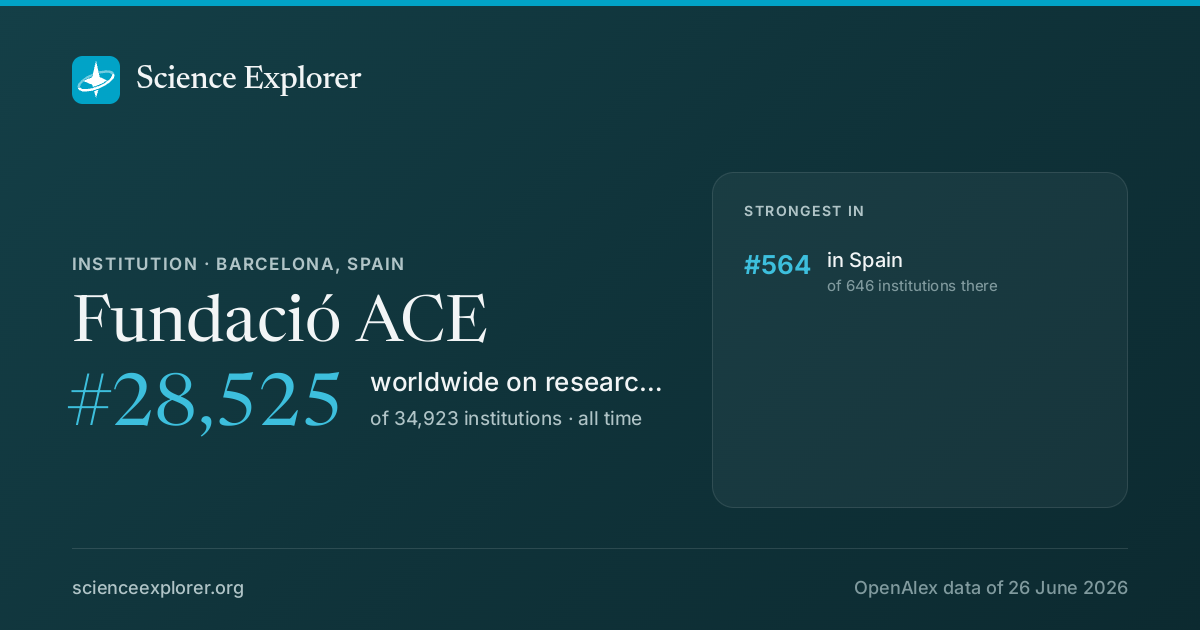
Fundació ACE

World rank, all time
#28,525
of 34,923
Rank in Spain
#564
of 646
Research works
138
◆ 1% vs 2018-21
Citations
3.7k
27.2 per fractional work
Top-10% rate
14.7%
all institutions 10.0%
vs its own fields
1.04×
1.00× is exactly expected
Open access
52%
world 40%
International
36%
world 18%

Which fields of science does Fundació ACE work in?

In 2022-now, 55% of research at Fundació ACE is in Health Sciences, 27% in Life Sciences. Its largest fields are Medicine (52%), Biochemistry, Genetics and Molecular Biology (16%), Neuroscience (7%). It does 2.0× the world's share of Health Sciences.

Health Sciences: 16 fractional works · 55.4% of its workMedicine: 15 fractional works · 51.6% of its workPhysiology: 4 fractional works · 15.3% of its workPsychiatry and Mental health: 3 fractional works · 11.9% of its workNeurology: 1 fractional works · 3.4% of its workInfectious Diseases: 1 fractional works · 3.1% of its workOrthopedics and Sports Medicine: 1 fractional works · 2.0% of its workPublic Health, Environmental and Occupational Health: 1 fractional works · 1.9% of its workRheumatology: 1 fractional works · 1.9% of its workEpidemiology: 0 fractional works · 1.6% of its workSurgery: 0 fractional works · 1.3% of its workPulmonary and Respiratory Medicine: 0 fractional works · 1.3% of its workPharmacology: 0 fractional works · 1.2% of its workAnatomy: 0 fractional works · 1.1% of its workOphthalmology: 0 fractional works · 0.9% of its workCardiology and Cardiovascular Medicine: 0 fractional works · 0.8% of its workRadiology, Nuclear Medicine and Imaging: 0 fractional works · 0.8% of its workOncology: 0 fractional works · 0.6% of its workPediatrics, Perinatology and Child Health: 0 fractional works · 0.5% of its workEmergency Medicine: 0 fractional works · 0.4% of its workComplementary and alternative medicine: 0 fractional works · 0.2% of its workDermatology: 0 fractional works · 0.2% of its workEndocrinology, Diabetes and Metabolism: 0 fractional works · 0.2% of its workGastroenterology: 0 fractional works · 0.2% of its workSmaller subfields together: 0 fractional works · 0.5% of its workHealth Professions: 1 fractional works · 3.4% of its workGeneral Health Professions: 1 fractional works · 1.9% of its workSpeech and Hearing: 0 fractional works · 0.5% of its workPharmacy: 0 fractional works · 0.4% of its workMedical Terminology: 0 fractional works · 0.4% of its workSmaller subfields together: 0 fractional works · 0.2% of its workNursing: 0 fractional works · 0.3% of its workLife Sciences: 8 fractional works · 26.8% of its workBiochemistry, Genetics and Molecular Biology: 5 fractional works · 15.9% of its workMolecular Biology: 3 fractional works · 10.2% of its workGenetics: 1 fractional works · 4.5% of its workCancer Research: 0 fractional works · 0.5% of its workCell Biology: 0 fractional works · 0.2% of its workSmaller subfields together: 0 fractional works · 0.3% of its workNeuroscience: 2 fractional works · 7.4% of its workNeurology: 1 fractional works · 4.5% of its workCognitive Neuroscience: 0 fractional works · 1.1% of its workCellular and Molecular Neuroscience: 0 fractional works · 0.9% of its workBiological Psychiatry: 0 fractional works · 0.8% of its workSmaller subfields together: 0 fractional works · 0.2% of its workImmunology and Microbiology: 1 fractional works · 3.5% of its workImmunology: 1 fractional works · 1.9% of its workVirology: 0 fractional works · 0.9% of its workParasitology: 0 fractional works · 0.7% of its workSocial Sciences: 3 fractional works · 10.9% of its workPsychology: 1 fractional works · 3.9% of its workClinical Psychology: 0 fractional works · 1.6% of its workExperimental and Cognitive Psychology: 0 fractional works · 1.1% of its workSocial Psychology: 0 fractional works · 0.7% of its workApplied Psychology: 0 fractional works · 0.4% of its workSmaller subfields together: 0 fractional works · 0.1% of its workSocial Sciences: 1 fractional works · 3.7% of its workSociology and Political Science: 0 fractional works · 1.4% of its workSafety Research: 0 fractional works · 1.1% of its workDemography: 0 fractional works · 0.8% of its workUrban Studies: 0 fractional works · 0.2% of its workSmaller subfields together: 0 fractional works · 0.2% of its workEconomics, Econometrics and Finance: 1 fractional works · 1.9% of its workEconomics and Econometrics: 0 fractional works · 1.7% of its workFinance: 0 fractional works · 0.2% of its workBusiness, Management and Accounting: 0 fractional works · 0.8% of its workManagement of Technology and Innovation: 0 fractional works · 0.4% of its workOrganizational Behavior and Human Resource Management: 0 fractional works · 0.4% of its workArts and Humanities: 0 fractional works · 0.6% of its workConservation: 0 fractional works · 0.4% of its workSmaller subfields together: 0 fractional works · 0.2% of its workDecision Sciences: 0 fractional works · 0.0% of its workPhysical Sciences: 2 fractional works · 6.9% of its workComputer Science: 1 fractional works · 2.3% of its workComputer Networks and Communications: 0 fractional works · 0.9% of its workComputational Theory and Mathematics: 0 fractional works · 0.7% of its workArtificial Intelligence: 0 fractional works · 0.4% of its workComputer Vision and Pattern Recognition: 0 fractional works · 0.4% of its workSmaller subfields together: 0 fractional works · 0.0% of its workEngineering: 0 fractional works · 1.6% of its workElectrical and Electronic Engineering: 0 fractional works · 0.9% of its workIndustrial and Manufacturing Engineering: 0 fractional works · 0.8% of its workChemistry: 0 fractional works · 1.4% of its workSpectroscopy: 0 fractional works · 1.4% of its workMathematics: 0 fractional works · 0.7% of its workStatistics and Probability: 0 fractional works · 0.6% of its workSmaller subfields together: 0 fractional works · 0.1% of its workEnvironmental Science: 0 fractional works · 0.7% of its workHealth, Toxicology and Mutagenesis: 0 fractional works · 0.4% of its workSmaller subfields together: 0 fractional works · 0.2% of its workMaterials Science: 0 fractional works · 0.2% of its workALL ITS WORKFundació ACE29fractional works, 2022-now
Life Sciences27%Physical Sciences7%Health Sciences55%Social Sciences11%

Each ring splits the one inside it: the four domains of science, their fields, their subfields. Size is fractional works in 2022-now. Every slice is a page; the interactive view zooms down to single topics and colours each by how much more of it this institution does than the world.

Its 4 domains and 18 fields, with their numbers
    1. Medicine1551.6%
    2. Health Professions13.4%
    3. Nursing00.3%
    1. Biochemistry, Genetics and Molecular Biology515.9%
    2. Neuroscience27.4%
    3. Immunology and Microbiology13.5%
    1. Psychology13.9%
    2. Social Sciences13.7%
    3. Economics, Econometrics and Finance11.9%
    4. Business, Management and Accounting00.8%
    5. Arts and Humanities00.6%
    6. Decision Sciences00.0%
    1. Computer Science12.3%
    2. Engineering01.6%
    3. Chemistry01.4%
    4. Mathematics00.7%
    5. Environmental Science00.7%
    6. Materials Science00.2%
All of science, and how each field's share has moved since 1950: the Science domain explorer

Field profile

Location quotient across every field it publishes in: outside the ring is more than an institution of this size would be expected to publish, inside it is less.

Biochemistry, Genetics and Molecular Biology: 2.98× its world share, 5 worksBiochemistry, Geneti…Immunology and Microbiology: 3.51× its world share, 1 worksImmunology and Micro…Neuroscience: 4.56× its world share, 2 worksNeuroscienceChemistry: 0.89× its world share, 0 worksChemistryComputer Science: 0.30× its world share, 1 worksComputer ScienceEngineering: 0.11× its world share, 0 worksEngineeringEnvironmental Science: 0.13× its world share, 0 worksEnvironmental ScienceMaterials Science: 0.05× its world share, 0 worksMaterials ScienceMathematics: 0.61× its world share, 0 worksMathematicsHealth Professions: 1.30× its world share, 1 worksHealth ProfessionsMedicine: 2.69× its world share, 15 worksMedicineNursing: 0.72× its world share, 0 worksNursingArts and Humanities: 0.20× its world share, 0 worksArts and HumanitiesBusiness, Management and Accounting: 0.24× its world share, 0 worksBusiness, Management…Decision Sciences: 0.03× its world share, 0 worksDecision SciencesEconomics, Econometrics and Finance: 0.90× its world share, 1 worksEconomics, Econometr…Psychology: 1.28× its world share, 1 worksPsychologySocial Sciences: 0.29× its world share, 1 worksSocial Sciences1×world share
more than its size predictsabout as predictedless

Rings at 0.5×, 1× and 2×. Widest outward: Neuroscience, 4.6×. Every wedge is a field page.

All 18 fields, with their numbers
  1. Neuroscience4.56×2 works
  2. Immunology and Microbiology3.51×1 works
  3. Biochemistry, Genetics and Molecular Biology2.98×5 works
  4. Medicine2.69×15 works
  5. Health Professions1.30×1 works
  6. Psychology1.28×1 works
  7. Economics, Econometrics and Finance0.90×1 works
  8. Chemistry0.89×0 works
  9. Nursing0.72×0 works
  10. Mathematics0.61×0 works
  11. Computer Science0.30×1 works
  12. Social Sciences0.29×1 works
  13. Business, Management and Accounting0.24×0 works
  14. Arts and Humanities0.20×0 works
  15. Environmental Science0.13×0 works
  16. Engineering0.11×0 works
  17. Materials Science0.05×0 works
  18. Decision Sciences0.03×0 works

Who are the top researchers at Fundació ACE?

Ranked on the quality score, Merçé Boada, Isabel Hernández and Carla Abdelnour lead among researchers whose main affiliation is Fundació ACE.

  1. 1 Merçé Boada Spain · #67,623 worldwide 41k citations · 665 works
  2. 2 Isabel Hernández Spain · #78,346 worldwide 9.7k citations · 96 works
  3. 3 Carla Abdelnour Spain · #99,320 worldwide 6.4k citations · 129 works
  4. 4 Agustı́n Ruiz Spain · #120,434 worldwide 32k citations · 527 works
  5. 5 Sonia Moreno–Grau Spain · #131,927 worldwide 11k citations · 99 works
  6. 6 Montserrat Alegret Spain · #168,677 worldwide 11k citations · 205 works
  7. 7 Ana Espinosa Spain · #237,615 worldwide 7.3k citations · 124 works
  8. 8 Liliana Castilleja Vargas Spain · #274,141 worldwide 4.9k citations · 86 works
  9. 9 Maitée Rosende‐Roca Spain · #286,499 worldwide 3.9k citations · 133 works
  10. 10 Ángela Sanabria Spain · #299,960 worldwide 5.2k citations · 84 works
All ranked researchers at Fundació ACE

What are the most cited papers from Fundació ACE?

The most cited paper from Fundació ACE is "Meta-analysis of 74,046 individuals identifies 11 new susceptibility loci for Alzheimer's disease" (European Alzheimer's Disease Initiative (EADI) et al., 2013), with 4,711 citations. Next come "Genetic meta-analysis of diagnosed Alzheimer’s disease identifies new risk loci and implicates Aβ, tau, immunity and lipid processing" (3,277) and "New insights into the genetic etiology of Alzheimer’s disease and related dementias" (2,608).

Most cited papers
#PaperReleasedCitations
1 Meta-analysis of 74,046 individuals identifies 11 new susceptibility loci for Alzheimer's disease European Alzheimer's Disease Initiative (EADI) et al. · Nature Genetics ReviewOpen access184 authors 27 Oct 2013 4,711
2 Genetic meta-analysis of diagnosed Alzheimer’s disease identifies new risk loci and implicates Aβ, tau, immunity and lipid processing Brian W. Kunkle et al. · Nature Genetics ReviewOpen access469 authors 28 Feb 2019 3,277
3 New insights into the genetic etiology of Alzheimer’s disease and related dementias Céline Bellenguez et al. · Nature Genetics Open access1,266 authors Apr 2022 2,608
4 Analysis of shared heritability in common disorders of the brain Verneri Anttila et al. · Science Open access577 authors 21 Jun 2018 2,056
5 The characterisation of subjective cognitive decline Frank Jessen, Rebecca England Amariglio, Rachel F. Buckley et al. · The Lancet Neurology Open access 17 Jan 2020 1,435
All 60 most cited papers, with filters and sorting

Which keywords describe research at Fundació ACE?

By fractional works in 2022-now, weighted toward what it does more of than the world: Neurodegeneration, Oxidative Stress, Neuroinflammation, Amyloid Hypothesis, Tau Pathology, Biomarkers, Neuroimaging and Alzheimer's Disease.

▲ more of its work than of the world's◆ about the world's share▼ less than the world's

Size is fractional works in 2022-now in the topics tagged with each word; colour is the word's share of this institution's work against its share of the world's. The 19 words are chosen for being large and distinctive. Each links to the topic it comes from most.

All 19 words, with their numbers
  1. Neurodegeneration6▲ 65×9 topics
  2. Oxidative Stress5▲ 11×9 topics
  3. Neuroinflammation5▲ 61×4 topics
  4. Amyloid Hypothesis4▲ 243×1 topic
  5. Tau Pathology4▲ 243×1 topic
  6. Biomarkers4▲ 17×6 topics
  7. Alzheimer's Disease3▲ 35×5 topics
  8. Neuroimaging3▲ 35×6 topics
  9. Aging3▲ 16×6 topics
  10. Caregiver Burden3▲ 80×3 topics
  11. Dementia2▲ 89×2 topics
  12. Cognitive Decline2▲ 68×1 topic
  13. Cognitive Training2▲ 89×2 topics
  14. Mild Cognitive Impairment2▲ 97×1 topic
  15. Inflammation2▲ 2.6×20 topics
  16. Epidemiology2▲ 1.30×26 topics
  17. Quality of Life2▲ 3.7×13 topics
  18. Neurological Disorders1▲ 7.3×9 topics
  19. Innate Immunity1▲ 11×4 topics

Which research topics does Fundació ACE publish most on?

By volume in 2022-now: Alzheimer's disease research and treatments, Dementia and Cognitive Impairment Research, Genetic Associations and Epidemiology and Neuroinflammation and Neurodegeneration Mechanisms.

  1. 1 Alzheimer's disease research and treatments Physiology 4 works
  2. 2 Dementia and Cognitive Impairment Research Psychiatry and Mental health 2 works
  3. 3 Genetic Associations and Epidemiology Genetics 1 works
  4. 4 Neuroinflammation and Neurodegeneration Mechanisms Neurology 0 works
  5. 5 Health Systems, Economic Evaluations, Quality of Life Economics and Econometrics 0 works
  6. 6 Bioinformatics and Genomic Networks Molecular Biology 0 works
  7. 7 Metabolomics and Mass Spectrometry Studies Molecular Biology 0 works
  8. 8 Advanced Proteomics Techniques and Applications Spectroscopy 0 works
  9. 9 S100 Proteins and Annexins Molecular Biology 0 works
  10. 10 Neurology and Historical Studies Neurology 0 works

How open and international is its research?

Against the world's own shares: the tick on each track. Both are shares of its output, so they sit on one scale and can be read against each other as well as against the world.

openly available52.0%not open48.0%

World: 40% of research is openly available.

with international co-authors36.2%domestic only63.8%

World: 18% is written across borders.

How has Fundació ACE's research output changed?

Output in 2022-2025 was 1% lower than in 2018-2021.

still counting200020102020
grewheldshrank

The same series as a ribbon: one cell per year, darker for more. The line above answers how much; this answers when.

Its share of all research

Growing output can still be a shrinking share: all of science grows. This is Fundació ACE as a percentage of every work published that year, 0.00014% in 2024.

still counting0.00020%0.00040%Fundació ACE0.00012% in 2025200020102020

Fractional works of Fundació ACE over all fractional works that year. How the balance of science has shifted.

Other research institutions in Barcelona

All research institutions in Barcelona

Share Fundació ACE's ranking

Fundació ACE on Science Explorer

A card with Fundació ACE's standing and the fields it leads in, for a post or a slide. A link to this page previews as the same card.

Download the card

1200 × 630 PNG, sized for social posts, drawn from the latest snapshot.

Badges for a website1Each links back here and updates with every snapshot

Research measures only: rankings here say nothing about teaching, admissions or student experience. Comparable institutions and collaboration partners have tabs of their own, above.

Discussion

Ask a question or share a note about Fundació ACE. Posts are plain text and can be reported.