Science Explorer Back to mapMap
Discussion
Company · Mississauga · Canada

General Electric (Canada)

In research, General Electric (Canada) stands highest in Physical Sciences (#8,057 of 17,446 worldwide) and Engineering (#6,161 of 9,532 worldwide), over all time.

World rank, all time
#12,590
of 34,923
Rank in Canada
#248
of 718
Research works
467
▲ 40% vs 2018-21
Citations
7.6k
16.3 per fractional work
Top-10% rate
7.8%
all institutions 10.0%
vs its own fields
1.02×
1.00× is exactly expected
Open access
17%
world 40%
International
24%
world 18%

What is General Electric (Canada) known for in research?

The fields where it stands highest, over all time, ranked among every institution above the floor in each field.

FieldWorld rankWhere that sitsTop-10% rateWorks
Physical SciencesDomain #8,057 of 17,446 7.3%366
EngineeringField #6,161 of 9,532 7.1%248

Each strip is that field's whole ranked pool, with the notch where General Electric (Canada) sits in it, in the colour of the band that rank falls in. The track under the rate is the rate itself: it carries no average mark, because the average differs by field (from about 6% in Dentistry to 21% in Economics).

Which fields of science does General Electric (Canada) work in?

In 2022-now, 54% of research at General Electric (Canada) is in Physical Sciences, 20% in Social Sciences. Its largest fields are Engineering (24%), Environmental Science (20%), Social Sciences (7%). It does 1.3× the world's share of Physical Sciences.

Physical Sciences: 33 fractional works · 54.1% of its workEngineering: 15 fractional works · 24.1% of its workElectrical and Electronic Engineering: 4 fractional works · 7.2% of its workControl and Systems Engineering: 2 fractional works · 3.6% of its workCivil and Structural Engineering: 1 fractional works · 2.2% of its workAutomotive Engineering: 1 fractional works · 2.2% of its workMechanical Engineering: 1 fractional works · 1.8% of its workMechanics of Materials: 1 fractional works · 1.5% of its workSafety, Risk, Reliability and Quality: 1 fractional works · 1.2% of its workAerospace Engineering: 1 fractional works · 1.1% of its workBuilding and Construction: 1 fractional works · 1.1% of its workBiomedical Engineering: 0 fractional works · 0.7% of its workIndustrial and Manufacturing Engineering: 0 fractional works · 0.5% of its workOcean Engineering: 0 fractional works · 0.5% of its workMedia Technology: 0 fractional works · 0.3% of its workSmaller subfields together: 0 fractional works · 0.2% of its workEnvironmental Science: 12 fractional works · 20.3% of its workHealth, Toxicology and Mutagenesis: 4 fractional works · 6.6% of its workEnvironmental Engineering: 3 fractional works · 5.7% of its workEcology: 2 fractional works · 2.9% of its workNature and Landscape Conservation: 1 fractional works · 1.8% of its workGlobal and Planetary Change: 1 fractional works · 1.5% of its workPollution: 0 fractional works · 0.5% of its workManagement, Monitoring, Policy and Law: 0 fractional works · 0.4% of its workWater Science and Technology: 0 fractional works · 0.3% of its workEcological Modeling: 0 fractional works · 0.3% of its workSmaller subfields together: 0 fractional works · 0.4% of its workEarth and Planetary Sciences: 3 fractional works · 5.1% of its workAtmospheric Science: 2 fractional works · 2.9% of its workPaleontology: 1 fractional works · 1.0% of its workEarth-Surface Processes: 0 fractional works · 0.4% of its workGeophysics: 0 fractional works · 0.3% of its workGeology: 0 fractional works · 0.3% of its workSmaller subfields together: 0 fractional works · 0.3% of its workMaterials Science: 1 fractional works · 1.5% of its workMaterials Chemistry: 1 fractional works · 1.4% of its workSmaller subfields together: 0 fractional works · 0.1% of its workComputer Science: 1 fractional works · 1.1% of its workComputer Networks and Communications: 0 fractional works · 0.3% of its workInformation Systems: 0 fractional works · 0.3% of its workSmaller subfields together: 0 fractional works · 0.6% of its workEnergy: 1 fractional works · 0.9% of its workRenewable Energy, Sustainability and the Environment: 0 fractional works · 0.7% of its workSmaller subfields together: 0 fractional works · 0.2% of its workChemical Engineering: 0 fractional works · 0.4% of its workPhysics and Astronomy: 0 fractional works · 0.3% of its workAtomic and Molecular Physics, and Optics: 0 fractional works · 0.3% of its workMathematics: 0 fractional works · 0.3% of its workModeling and Simulation: 0 fractional works · 0.3% of its workChemistry: 0 fractional works · 0.1% of its workSocial Sciences: 12 fractional works · 19.9% of its workSocial Sciences: 4 fractional works · 7.2% of its workSociology and Political Science: 2 fractional works · 2.7% of its workTransportation: 1 fractional works · 1.4% of its workHealth: 0 fractional works · 0.8% of its workUrban Studies: 0 fractional works · 0.8% of its workGender Studies: 0 fractional works · 0.5% of its workGeography, Planning and Development: 0 fractional works · 0.3% of its workEducation: 0 fractional works · 0.2% of its workSmaller subfields together: 0 fractional works · 0.5% of its workPsychology: 4 fractional works · 5.9% of its workSocial Psychology: 1 fractional works · 1.9% of its workClinical Psychology: 1 fractional works · 1.9% of its workExperimental and Cognitive Psychology: 1 fractional works · 1.8% of its workSmaller subfields together: 0 fractional works · 0.3% of its workEconomics, Econometrics and Finance: 1 fractional works · 2.3% of its workEconomics and Econometrics: 1 fractional works · 2.2% of its workSmaller subfields together: 0 fractional works · 0.2% of its workArts and Humanities: 1 fractional works · 2.2% of its workArcheology: 1 fractional works · 2.1% of its workSmaller subfields together: 0 fractional works · 0.2% of its workBusiness, Management and Accounting: 1 fractional works · 1.9% of its workStrategy and Management: 0 fractional works · 0.7% of its workManagement of Technology and Innovation: 0 fractional works · 0.5% of its workMarketing: 0 fractional works · 0.5% of its workSmaller subfields together: 0 fractional works · 0.2% of its workDecision Sciences: 0 fractional works · 0.3% of its workStatistics, Probability and Uncertainty: 0 fractional works · 0.3% of its workLife Sciences: 10 fractional works · 16.2% of its workBiochemistry, Genetics and Molecular Biology: 4 fractional works · 6.2% of its workMolecular Biology: 1 fractional works · 2.1% of its workGenetics: 1 fractional works · 2.0% of its workCell Biology: 1 fractional works · 1.5% of its workDevelopmental Biology: 0 fractional works · 0.5% of its workSmaller subfields together: 0 fractional works · 0.0% of its workAgricultural and Biological Sciences: 3 fractional works · 5.7% of its workEcology, Evolution, Behavior and Systematics: 1 fractional works · 1.9% of its workPlant Science: 1 fractional works · 1.5% of its workInsect Science: 1 fractional works · 1.2% of its workFood Science: 0 fractional works · 0.5% of its workAnimal Science and Zoology: 0 fractional works · 0.3% of its workForestry: 0 fractional works · 0.3% of its workNeuroscience: 3 fractional works · 4.3% of its workCognitive Neuroscience: 1 fractional works · 1.5% of its workCellular and Molecular Neuroscience: 1 fractional works · 1.4% of its workBehavioral Neuroscience: 0 fractional works · 0.8% of its workSensory Systems: 0 fractional works · 0.3% of its workSmaller subfields together: 0 fractional works · 0.2% of its workHealth Sciences: 6 fractional works · 9.7% of its workMedicine: 4 fractional works · 6.2% of its workPublic Health, Environmental and Occupational Health: 1 fractional works · 1.5% of its workEpidemiology: 1 fractional works · 1.1% of its workEndocrinology, Diabetes and Metabolism: 1 fractional works · 0.9% of its workPediatrics, Perinatology and Child Health: 0 fractional works · 0.5% of its workInfectious Diseases: 0 fractional works · 0.4% of its workOncology: 0 fractional works · 0.3% of its workCardiology and Cardiovascular Medicine: 0 fractional works · 0.3% of its workPharmacology: 0 fractional works · 0.2% of its workRadiology, Nuclear Medicine and Imaging: 0 fractional works · 0.2% of its workPsychiatry and Mental health: 0 fractional works · 0.2% of its workSmaller subfields together: 0 fractional works · 0.6% of its workHealth Professions: 2 fractional works · 3.4% of its workGeneral Health Professions: 1 fractional works · 1.8% of its workEmergency Medical Services: 0 fractional works · 0.5% of its workPhysical Therapy, Sports Therapy and Rehabilitation: 0 fractional works · 0.5% of its workSmaller subfields together: 0 fractional works · 0.5% of its workNursing: 0 fractional works · 0.2% of its workALL ITS WORKGeneral Electric(Canada)61fractional works, 2022-now
Life Sciences16%Physical Sciences54%Health Sciences10%Social Sciences20%

Each ring splits the one inside it: the four domains of science, their fields, their subfields. Size is fractional works in 2022-now. Every slice is a page; the interactive view zooms down to single topics and colours each by how much more of it this institution does than the world.

Its 4 domains and 22 fields, with their numbers
    1. Engineering1524.1%
    2. Environmental Science1220.3%
    3. Earth and Planetary Sciences35.1%
    4. Materials Science11.5%
    5. Computer Science11.1%
    6. Energy10.9%
    7. Chemical Engineering00.4%
    8. Physics and Astronomy00.3%
    9. Mathematics00.3%
    10. Chemistry00.1%
    1. Social Sciences47.2%
    2. Psychology45.9%
    3. Economics, Econometrics and Finance12.3%
    4. Arts and Humanities12.2%
    5. Business, Management and Accounting11.9%
    6. Decision Sciences00.3%
    1. Biochemistry, Genetics and Molecular Biology46.2%
    2. Agricultural and Biological Sciences35.7%
    3. Neuroscience34.3%
    1. Medicine46.2%
    2. Health Professions23.4%
    3. Nursing00.2%
All of science, and how each field's share has moved since 1950: the Science domain explorer

Field profile

Location quotient across every field it publishes in: outside the ring is more than an institution of this size would be expected to publish, inside it is less.

Agricultural and Biological Sciences: 1.20× its world share, 4 worksAgricultural and Bio…Biochemistry, Genetics and Molecular Biology: 1.16× its world share, 4 worksBiochemistry, Geneti…Neuroscience: 2.67× its world share, 3 worksNeuroscienceChemical Engineering: 1.05× its world share, 0 worksChemical EngineeringChemistry: 0.07× its world share, 0 worksChemistryComputer Science: 0.15× its world share, 1 worksComputer ScienceEarth and Planetary Sciences: 3.28× its world share, 3 worksEarth and Planetary …Energy: 0.97× its world share, 0 worksEnergyEngineering: 1.61× its world share, 15 worksEngineeringEnvironmental Science: 4.08× its world share, 12 worksEnvironmental ScienceMaterials Science: 0.42× its world share, 1 worksMaterials ScienceMathematics: 0.23× its world share, 0 worksMathematicsPhysics and Astronomy: 0.14× its world share, 0 worksPhysics and AstronomyHealth Professions: 1.28× its world share, 2 worksHealth ProfessionsMedicine: 0.32× its world share, 4 worksMedicineNursing: 0.37× its world share, 0 worksNursingArts and Humanities: 0.78× its world share, 1 worksArts and HumanitiesBusiness, Management and Accounting: 0.59× its world share, 1 worksBusiness, Management…Decision Sciences: 0.28× its world share, 0 worksDecision SciencesEconomics, Econometrics and Finance: 1.09× its world share, 1 worksEconomics, Econometr…Psychology: 1.95× its world share, 4 worksPsychologySocial Sciences: 0.57× its world share, 4 worksSocial Sciences1×world share
more than its size predictsabout as predictedless

Rings at 0.5×, 1× and 2×. Widest outward: Environmental Science, 4.1×. Every wedge is a field page.

All 22 fields, with their numbers
  1. Environmental Science4.08×12 works
  2. Earth and Planetary Sciences3.28×3 works
  3. Neuroscience2.67×3 works
  4. Psychology1.95×4 works
  5. Engineering1.61×15 works
  6. Health Professions1.28×2 works
  7. Agricultural and Biological Sciences1.20×4 works
  8. Biochemistry, Genetics and Molecular Biology1.16×4 works
  9. Economics, Econometrics and Finance1.09×1 works
  10. Chemical Engineering1.05×0 works
  11. Energy0.97×0 works
  12. Arts and Humanities0.78×1 works
  13. Business, Management and Accounting0.59×1 works
  14. Social Sciences0.57×4 works
  15. Materials Science0.42×1 works
  16. Nursing0.37×0 works
  17. Medicine0.32×4 works
  18. Decision Sciences0.28×0 works
  19. Mathematics0.23×0 works
  20. Computer Science0.15×1 works
  21. Physics and Astronomy0.14×0 works
  22. Chemistry0.07×0 works

Who are the top researchers at General Electric (Canada)?

Ranked on the quality score, James W. Hogg, Saeed Ul Haq and Jakov Vico lead among researchers whose main affiliation is General Electric (Canada).

  1. 1 James W. Hogg Canada · #3,527,014 worldwide 396 citations · 25 works
  2. 2 Saeed Ul Haq Canada · #3,902,190 worldwide 2.3k citations · 107 works
  3. 3 Jakov Vico Canada · #3,980,439 worldwide 195 citations · 23 works
  4. 4 Rich Hunt Canada · #4,052,356 worldwide 163 citations · 19 works
  5. 5 Bill Moore Canada · #4,216,703 worldwide 353 citations · 29 works
  6. 6 Nick Stranges Canada · #4,539,965 worldwide 393 citations · 30 works
  7. 7 R.H. Rehder Canada · #4,620,048 worldwide 167 citations · 15 works
  8. 8 Farid Ayad Canada · #4,783,501 worldwide 282 citations · 17 works
  9. 9 Dennis L. Bogh Canada · #4,798,897 worldwide 184 citations · 18 works
  10. 10 Ilia Voloh Canada · #5,054,718 worldwide 701 citations · 71 works
All ranked researchers at General Electric (Canada)

What are the most cited papers from General Electric (Canada)?

The most cited paper from General Electric (Canada) is "Hyperpolarized 13 C Metabolic MRI of the Human Heart" (Charles Henry Cunningham, Justin Y. C. Lau, Albert P. Chen et al., 2016), with 369 citations. Next come "Active school transportation in the Greater Toronto Area, Canada: An exploration of trends in space and time (1986–2006)" (314) and "Synchronized Phasor and Frequency Measurement Under Transient Conditions" (280).

Most cited papers
#PaperReleasedCitations
1 Hyperpolarized 13 C Metabolic MRI of the Human Heart Charles Henry Cunningham, Justin Y. C. Lau, Albert P. Chen et al. · Circulation Research Open access 15 Sep 2016 369
2 Active school transportation in the Greater Toronto Area, Canada: An exploration of trends in space and time (1986–2006) Ron N. Buliung, Raktim Mitra, Guy Faulkner · Preventive Medicine 10 Mar 2009 314
3 Synchronized Phasor and Frequency Measurement Under Transient Conditions Arun G. PHADKE, Bogdan Kasztenny · IEEE Transactions on Power Delivery 18 Dec 2008 280
4 The design of controllers for the multivariable robust servomechanism problem using parameter optimization methods E. Davison, Ian J. Ferguson · IEEE Transactions on Automatic Control Feb 1981 253
5 Coherent Demodulation of Frequency-Shift Keying with Low Deviation Ratio R. de Buda · IRE Transactions on Communications Systems Jun 1972 245
All 60 most cited papers, with filters and sorting

Which keywords describe research at General Electric (Canada)?

By fractional works in 2022-now, weighted toward what it does more of than the world: Climate Change, Particulate Matter, Physical Activity, Ecosystem Services, Machine Learning, Remote Sensing, Health Effects and Biodiversity Conservation.

▲ more of its work than of the world's◆ about the world's share▼ less than the world's

Size is fractional works in 2022-now in the topics tagged with each word; colour is the word's share of this institution's work against its share of the world's. The 40 words are chosen for being large and distinctive. Each links to the topic it comes from most.

All 40 words, with their numbers
  1. Climate Change6▲ 3.9×24 topics
  2. Machine Learning4▲ 2.2×13 topics
  3. Remote Sensing3▲ 4.2×12 topics
  4. Particulate Matter3▲ 33×2 topics
  5. Sustainability3▲ 1.89×12 topics
  6. Public Health3▲ 2.9×5 topics
  7. Ecosystem Services2▲ 11×5 topics
  8. Physical Activity2▲ 8.6×3 topics
  9. Cardiovascular Disease2▲ 3.5×6 topics
  10. Health Effects2▲ 6.7×4 topics
  11. Neural Networks2▲ 2.4×3 topics
  12. Biodiversity Conservation2▲ 9.9×5 topics
  13. Mortality2▲ 6.2×3 topics
  14. Conservation2▲ 7.7×7 topics
  15. Global Burden of Disease2▲ 14×3 topics
  16. Air Pollution2▲ 25×2 topics
  17. Exposure Assessment2▲ 32×1 topic
  18. Fine Particulate Air Pollution2▲ 32×1 topic
  19. Neuroscience2▲ 8.8×2 topics
  20. Energy Consumption2▲ 11×2 topics
  21. Environmental Justice2▲ 18×1 topic
  22. Environmental Monitoring2▲ 6.7×2 topics
  23. Urban Green Space2▲ 44×1 topic
  24. Invasive Species1▲ 5.5×6 topics
  25. Urban Heat Island1▲ 24×2 topics
  26. Wavelet Transform1▲ 9.8×3 topics
  27. Green Roofs1▲ 41×1 topic
  28. Land Surface Temperature1▲ 41×1 topic
  29. Neurobiology1▲ 8.5×5 topics
  30. Vegetation1▲ 21×2 topics
  31. Adaptation1▲ 6.8×4 topics
  32. Air Quality Monitoring1▲ 36×1 topic
  33. Cyber-Physical Systems1▲ 7.4×3 topics
  34. Distributed Generation1▲ 25×3 topics
  35. Low-Cost Sensors1▲ 36×1 topic
  36. Fault Detection1▲ 13×2 topics
  37. Toxicology1▲ 11×2 topics
  38. Zebrafish1▲ 72×2 topics
  39. Eco-Driving1▲ 34×1 topic
  40. Metabolic Regulation1▲ 10×3 topics

Which research topics does General Electric (Canada) publish most on?

By volume in 2022-now: Air Quality and Health Impacts, Urban Green Space and Health, Urban Heat Island Mitigation and Air Quality Monitoring and Forecasting.

  1. 1 Air Quality and Health Impacts Health, Toxicology and Mutagenesis 2 works
  2. 2 Urban Green Space and Health Health, Toxicology and Mutagenesis 2 works
  3. 3 Urban Heat Island Mitigation Environmental Engineering 1 works
  4. 4 Air Quality Monitoring and Forecasting Environmental Engineering 1 works
  5. 5 Vehicle emissions and performance Automotive Engineering 1 works
  6. 6 Zebrafish Biomedical Research Applications Cell Biology 1 works
  7. 7 Migration, Health and Trauma Clinical Psychology 1 works
  8. 8 Neurobiology and Insect Physiology Research Cellular and Molecular Neuroscience 1 works
  9. 9 High voltage insulation and dielectric phenomena Materials Chemistry 1 works
  10. 10 Machine Fault Diagnosis Techniques Control and Systems Engineering 1 works

How open and international is its research?

Against the world's own shares: the tick on each track. Both are shares of its output, so they sit on one scale and can be read against each other as well as against the world.

openly available17.4%not open82.6%

World: 40% of research is openly available.

with international co-authors23.8%domestic only76.2%

World: 18% is written across borders.

How has General Electric (Canada)'s research output changed?

Output in 2022-2025 was 40% higher than in 2018-2021.

still counting1990200020102020
grewheldshrank

The same series as a ribbon: one cell per year, darker for more. The line above answers how much; this answers when.

Its share of all research

Growing output can still be a shrinking share: all of science grows. This is General Electric (Canada) as a percentage of every work published that year, 0.00026% in 2024.

still counting0.0010%0.0020%0.0030%General Electric (Canada)0.00032% in 202519801990200020102020

Fractional works of General Electric (Canada) over all fractional works that year. How the balance of science has shifted.

Other research institutions in Mississauga

All research institutions in Mississauga

Share General Electric (Canada)'s ranking
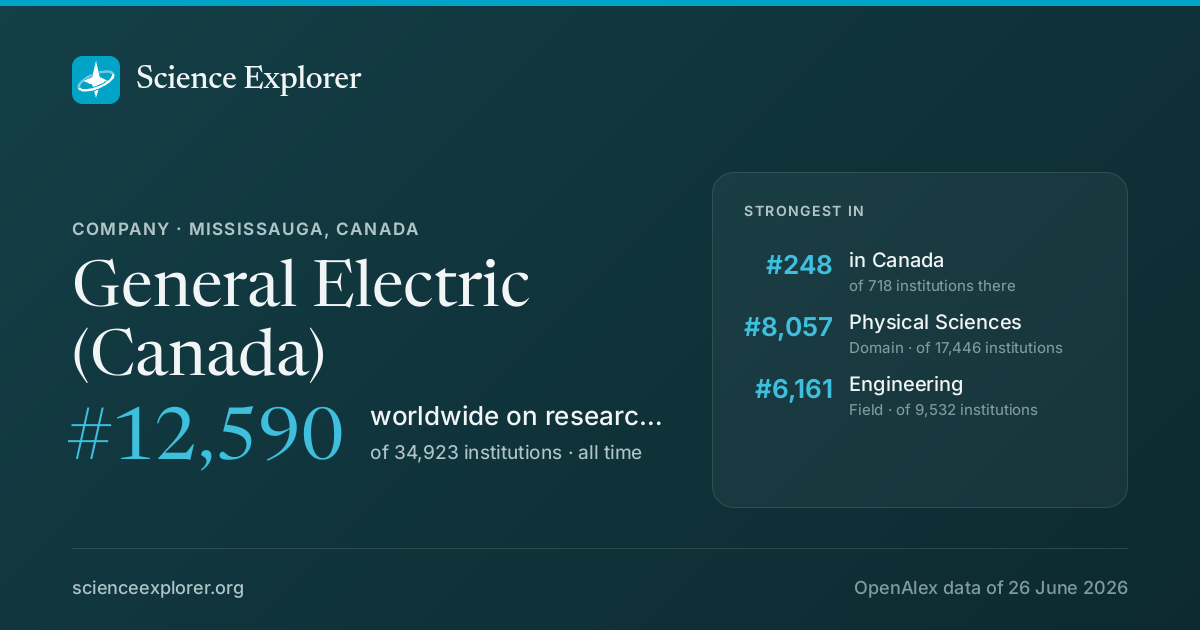
General Electric (Canada) on Science Explorer

A card with General Electric (Canada)'s standing and the fields it leads in, for a post or a slide. A link to this page previews as the same card.

Download the card

1200 × 630 PNG, sized for social posts, drawn from the latest snapshot.

Badges for a website1Each links back here and updates with every snapshot

Research measures only: rankings here say nothing about teaching, admissions or student experience. Comparable institutions and collaboration partners have tabs of their own, above.

Discussion

Ask a question or share a note about General Electric (Canada). Posts are plain text and can be reported.