Science Explorer Back to mapMap
Discussion
Company · Kolding · Denmark

General Electric (Denmark)

World rank, all time
#19,891
of 34,923
Rank in Denmark
#122
of 179
Research works
222
▲ 22% vs 2018-21
Citations
2.5k
11.3 per fractional work
Top-10% rate
6.9%
all institutions 10.0%
vs its own fields
0.93×
1.00× is exactly expected
Open access
37%
world 40%
International
32%
world 18%

Which fields of science does General Electric (Denmark) work in?

In 2022-now, 49% of research at General Electric (Denmark) is in Physical Sciences, 22% in Social Sciences. Its largest fields are Engineering (28%), Medicine (18%), Economics, Econometrics and Finance (10%).

Physical Sciences: 21 fractional works · 49.5% of its workEngineering: 12 fractional works · 27.8% of its workElectrical and Electronic Engineering: 4 fractional works · 10.0% of its workMechanics of Materials: 2 fractional works · 3.8% of its workMechanical Engineering: 1 fractional works · 3.5% of its workControl and Systems Engineering: 1 fractional works · 2.8% of its workAerospace Engineering: 1 fractional works · 2.2% of its workBiomedical Engineering: 1 fractional works · 1.9% of its workCivil and Structural Engineering: 1 fractional works · 1.5% of its workIndustrial and Manufacturing Engineering: 0 fractional works · 0.8% of its workAutomotive Engineering: 0 fractional works · 0.5% of its workComputational Mechanics: 0 fractional works · 0.3% of its workSmaller subfields together: 0 fractional works · 0.4% of its workEnvironmental Science: 2 fractional works · 5.4% of its workEcology: 1 fractional works · 1.7% of its workEnvironmental Engineering: 1 fractional works · 1.4% of its workPollution: 0 fractional works · 0.9% of its workGlobal and Planetary Change: 0 fractional works · 0.6% of its workManagement, Monitoring, Policy and Law: 0 fractional works · 0.4% of its workEcological Modeling: 0 fractional works · 0.3% of its workSmaller subfields together: 0 fractional works · 0.2% of its workComputer Science: 2 fractional works · 4.8% of its workComputer Networks and Communications: 1 fractional works · 2.8% of its workInformation Systems: 0 fractional works · 1.2% of its workComputer Vision and Pattern Recognition: 0 fractional works · 0.6% of its workArtificial Intelligence: 0 fractional works · 0.3% of its workEnergy: 2 fractional works · 4.5% of its workRenewable Energy, Sustainability and the Environment: 2 fractional works · 4.3% of its workEnergy Engineering and Power Technology: 0 fractional works · 0.3% of its workMaterials Science: 1 fractional works · 3.0% of its workMaterials Chemistry: 1 fractional works · 1.9% of its workBiomaterials: 0 fractional works · 0.6% of its workPolymers and Plastics: 0 fractional works · 0.4% of its workMathematics: 1 fractional works · 2.4% of its workMathematical Physics: 1 fractional works · 1.6% of its workApplied Mathematics: 0 fractional works · 0.8% of its workChemical Engineering: 0 fractional works · 0.8% of its workCatalysis: 0 fractional works · 0.8% of its workPhysics and Astronomy: 0 fractional works · 0.7% of its workAstronomy and Astrophysics: 0 fractional works · 0.4% of its workRadiation: 0 fractional works · 0.3% of its workChemistry: 0 fractional works · 0.2% of its workSocial Sciences: 9 fractional works · 22.1% of its workEconomics, Econometrics and Finance: 4 fractional works · 10.3% of its workEconomics and Econometrics: 4 fractional works · 10.3% of its workSocial Sciences: 4 fractional works · 10.1% of its workPolitical Science and International Relations: 4 fractional works · 8.8% of its workGeneral Social Sciences: 0 fractional works · 0.8% of its workTransportation: 0 fractional works · 0.3% of its workAnthropology: 0 fractional works · 0.2% of its workBusiness, Management and Accounting: 0 fractional works · 0.7% of its workStrategy and Management: 0 fractional works · 0.4% of its workMarketing: 0 fractional works · 0.3% of its workArts and Humanities: 0 fractional works · 0.5% of its workPhilosophy: 0 fractional works · 0.3% of its workHistory: 0 fractional works · 0.2% of its workDecision Sciences: 0 fractional works · 0.3% of its workStatistics, Probability and Uncertainty: 0 fractional works · 0.3% of its workPsychology: 0 fractional works · 0.3% of its workSocial Psychology: 0 fractional works · 0.3% of its workHealth Sciences: 8 fractional works · 19.0% of its workMedicine: 7 fractional works · 17.5% of its workReproductive Medicine: 4 fractional works · 9.5% of its workPublic Health, Environmental and Occupational Health: 1 fractional works · 1.6% of its workSurgery: 1 fractional works · 1.3% of its workPhysiology: 0 fractional works · 0.6% of its workRadiology, Nuclear Medicine and Imaging: 0 fractional works · 0.6% of its workPsychiatry and Mental health: 0 fractional works · 0.4% of its workOrthopedics and Sports Medicine: 0 fractional works · 0.4% of its workRehabilitation: 0 fractional works · 0.4% of its workEpidemiology: 0 fractional works · 0.3% of its workCardiology and Cardiovascular Medicine: 0 fractional works · 0.3% of its workOncology: 0 fractional works · 0.3% of its workPulmonary and Respiratory Medicine: 0 fractional works · 0.3% of its workEmergency Medicine: 0 fractional works · 0.2% of its workSmaller subfields together: 1 fractional works · 1.2% of its workHealth Professions: 0 fractional works · 1.2% of its workMedical Laboratory Technology: 0 fractional works · 0.4% of its workOccupational Therapy: 0 fractional works · 0.4% of its workGeneral Health Professions: 0 fractional works · 0.4% of its workNursing: 0 fractional works · 0.4% of its workNutrition and Dietetics: 0 fractional works · 0.4% of its workLife Sciences: 4 fractional works · 9.4% of its workImmunology and Microbiology: 2 fractional works · 4.4% of its workImmunology: 2 fractional works · 4.0% of its workMicrobiology: 0 fractional works · 0.4% of its workAgricultural and Biological Sciences: 1 fractional works · 2.4% of its workPlant Science: 0 fractional works · 1.2% of its workFood Science: 0 fractional works · 0.9% of its workEcology, Evolution, Behavior and Systematics: 0 fractional works · 0.3% of its workBiochemistry, Genetics and Molecular Biology: 1 fractional works · 1.4% of its workMolecular Biology: 0 fractional works · 1.2% of its workSmaller subfields together: 0 fractional works · 0.2% of its workPharmacology, Toxicology and Pharmaceutics: 0 fractional works · 1.0% of its workPharmacology: 0 fractional works · 0.8% of its workSmaller subfields together: 0 fractional works · 0.2% of its workNeuroscience: 0 fractional works · 0.3% of its workCognitive Neuroscience: 0 fractional works · 0.3% of its workALL ITS WORKGeneral Electric(Denmark)42fractional works, 2022-now
Life Sciences9%Physical Sciences49%Health Sciences19%Social Sciences22%

Each ring splits the one inside it: the four domains of science, their fields, their subfields. Size is fractional works in 2022-now. Every slice is a page; the interactive view zooms down to single topics and colours each by how much more of it this institution does than the world.

Its 4 domains and 23 fields, with their numbers
    1. Engineering1227.8%
    2. Environmental Science25.4%
    3. Computer Science24.8%
    4. Energy24.5%
    5. Materials Science13.0%
    6. Mathematics12.4%
    7. Chemical Engineering00.8%
    8. Physics and Astronomy00.7%
    9. Chemistry00.2%
    1. Economics, Econometrics and Finance410.3%
    2. Social Sciences410.1%
    3. Business, Management and Accounting00.7%
    4. Arts and Humanities00.5%
    5. Decision Sciences00.3%
    6. Psychology00.3%
    1. Medicine717.5%
    2. Health Professions01.2%
    3. Nursing00.4%
    1. Immunology and Microbiology24.4%
    2. Agricultural and Biological Sciences12.4%
    3. Biochemistry, Genetics and Molecular Biology11.4%
    4. Pharmacology, Toxicology and Pharmaceutics01.0%
    5. Neuroscience00.3%
All of science, and how each field's share has moved since 1950: the Science domain explorer

Field profile

Location quotient across every field it publishes in: outside the ring is more than an institution of this size would be expected to publish, inside it is less.

Agricultural and Biological Sciences: 0.49× its world share, 1 worksAgricultural and Bio…Biochemistry, Genetics and Molecular Biology: 0.26× its world share, 1 worksBiochemistry, Geneti…Immunology and Microbiology: 4.33× its world share, 2 worksImmunology and Micro…Neuroscience: 0.20× its world share, 0 worksNeurosciencePharmacology, Toxicology and Pharmaceutics: 2.81× its world share, 0 worksPharmacology, Toxico…Chemical Engineering: 2.27× its world share, 0 worksChemical EngineeringChemistry: 0.13× its world share, 0 worksChemistryComputer Science: 0.62× its world share, 2 worksComputer ScienceEnergy: 4.92× its world share, 2 worksEnergyEngineering: 1.85× its world share, 12 worksEngineeringEnvironmental Science: 1.08× its world share, 2 worksEnvironmental ScienceMaterials Science: 0.85× its world share, 1 worksMaterials ScienceMathematics: 2.02× its world share, 1 worksMathematicsPhysics and Astronomy: 0.30× its world share, 0 worksPhysics and AstronomyHealth Professions: 0.44× its world share, 0 worksHealth ProfessionsMedicine: 0.91× its world share, 7 worksMedicineNursing: 0.73× its world share, 0 worksNursingArts and Humanities: 0.17× its world share, 0 worksArts and HumanitiesBusiness, Management and Accounting: 0.22× its world share, 0 worksBusiness, Management…Decision Sciences: 0.27× its world share, 0 worksDecision SciencesEconomics, Econometrics and Finance: 4.82× its world share, 4 worksEconomics, Econometr…Psychology: 0.09× its world share, 0 worksPsychologySocial Sciences: 0.80× its world share, 4 worksSocial Sciences1×world share
more than its size predictsabout as predictedless

Rings at 0.5×, 1× and 2×. Widest outward: Energy, 4.9×. Every wedge is a field page.

All 23 fields, with their numbers
  1. Energy4.92×2 works
  2. Economics, Econometrics and Finance4.82×4 works
  3. Immunology and Microbiology4.33×2 works
  4. Pharmacology, Toxicology and Pharmaceutics2.81×0 works
  5. Chemical Engineering2.27×0 works
  6. Mathematics2.02×1 works
  7. Engineering1.85×12 works
  8. Environmental Science1.08×2 works
  9. Medicine0.91×7 works
  10. Materials Science0.85×1 works
  11. Social Sciences0.80×4 works
  12. Nursing0.73×0 works
  13. Computer Science0.62×2 works
  14. Agricultural and Biological Sciences0.49×1 works
  15. Health Professions0.44×0 works
  16. Physics and Astronomy0.30×0 works
  17. Decision Sciences0.27×0 works
  18. Biochemistry, Genetics and Molecular Biology0.26×1 works
  19. Business, Management and Accounting0.22×0 works
  20. Neuroscience0.20×0 works
  21. Arts and Humanities0.17×0 works
  22. Chemistry0.13×0 works
  23. Psychology0.09×0 works

Who are the top researchers at General Electric (Denmark)?

Ranked on the quality score, Jesper Madsen, Lee Ash and Madeleine Modin lead among researchers whose main affiliation is General Electric (Denmark).

  1. 1 Jesper Madsen Denmark · #2,769,023 worldwide 509 citations · 34 works
  2. 2 Lee Ash Denmark · #3,265,902 worldwide 177 citations · 63 works
  3. 3 Madeleine Modin Denmark · #4,046,513 worldwide 0 citations · 15 works
All ranked researchers at General Electric (Denmark)

What are the most cited papers from General Electric (Denmark)?

The most cited paper from General Electric (Denmark) is "Formation of siderite and vivianite and the pore-water composition of a Recent bog sediment in Denmark" (Dieke Postma, 1980), with 175 citations. Next come "Electric Vehicle Charging Management Based on Deep Reinforcement Learning" (142) and "Hyperpolarized 13C metabolic imaging using dissolution dynamic nuclear polarization" (105).

Most cited papers
#PaperReleasedCitations
1 Formation of siderite and vivianite and the pore-water composition of a Recent bog sediment in Denmark Dieke Postma · Chemical Geology 1980 175
2 Electric Vehicle Charging Management Based on Deep Reinforcement Learning Sichen Li, Weihao Hu, Di Cao et al. · Journal of Modern Power Systems and Clean Energy Open access 2022 142
3 Hyperpolarized 13C metabolic imaging using dissolution dynamic nuclear polarization Ralph E. Hurd, Yi‐Fen Yen, Albert S. Chen et al. · Journal of Magnetic Resonance Imaging 16 Nov 2012 105
4 Diagnostic et quantification de la fibrose hépatique par IRM de diffusion : résultats préliminaires Christophe Aubé, P.X. Racineux, Jerome Lebigot et al. · Journal de Radiologie Mar 2004 104
5 Rotation and deformation of randomly oriented planar and linear structures in progressive simple shear Lilian Skjernaa · Journal of Structural Geology 1980 100
All 61 most cited papers, with filters and sorting

Which keywords describe research at General Electric (Denmark)?

By fractional works in 2022-now, weighted toward what it does more of than the world: Corporate Governance, International Law, Health Claims, Human Rights, Law and Economics, Public Policy, Regulatory Policymaking and scientific opinion.

▲ more of its work than of the world's◆ about the world's share▼ less than the world's

Size is fractional works in 2022-now in the topics tagged with each word; colour is the word's share of this institution's work against its share of the world's. The 19 words are chosen for being large and distinctive. Each links to the topic it comes from most.

All 19 words, with their numbers
  1. Corporate Governance7▲ 24×2 topics
  2. International Law7▲ 55×2 topics
  3. Health Claims4▲ 284×1 topic
  4. Human Rights4▲ 8.5×1 topic
  5. Law and Economics4▲ 1723×1 topic
  6. Public Policy4▲ 18×1 topic
  7. Regulatory Policymaking4▲ 1109×1 topic
  8. scientific opinion4▲ 1524×1 topic
  9. Renewable Energy3▲ 4.6×11 topics
  10. Deep Learning1◆ 0.96×7 topics
  11. Machine Learning1◆ 1.03×7 topics
  12. Internet of Things1▲ 3.4×5 topics
  13. Parameter Estimation1▲ 22×4 topics
  14. Climate Change1◆ 0.97×7 topics
  15. Smart Grid Applications1▲ 20×2 topics
  16. Environmental Monitoring1▲ 6.2×4 topics
  17. Finite Element Analysis1▲ 11×2 topics
  18. Power Electronics1▲ 7.4×2 topics
  19. Solar Energy1▲ 7.8×3 topics

Which research topics does General Electric (Denmark) publish most on?

By volume in 2022-now: Legal Cases and Commentary, Legal case studies and regulations, Legal and Constitutional Studies and Mechanical Behavior of Composites.

  1. 1 Legal Cases and Commentary Reproductive Medicine 4 works
  2. 2 Legal case studies and regulations Political Science and International Relations 4 works
  3. 3 Legal and Constitutional Studies Economics and Econometrics 4 works
  4. 4 Mechanical Behavior of Composites Mechanics of Materials 1 works
  5. 5 Photovoltaic System Optimization Techniques Renewable Energy, Sustainability and the Environment 1 works
  6. 6 Solar Thermal and Photovoltaic Systems Renewable Energy, Sustainability and the Environment 1 works
  7. 7 Microgrid Control and Optimization Control and Systems Engineering 1 works
  8. 8 Rangeland and Wildlife Management Ecology 0 works
  9. 9 Botany, Ecology, and Taxonomy Studies Plant Science 0 works
  10. 10 Electrical Fault Detection and Protection Electrical and Electronic Engineering 0 works

How open and international is its research?

Against the world's own shares: the tick on each track. Both are shares of its output, so they sit on one scale and can be read against each other as well as against the world.

openly available37.3%not open62.7%

World: 40% of research is openly available.

with international co-authors32.4%domestic only67.6%

World: 18% is written across borders.

How has General Electric (Denmark)'s research output changed?

Output in 2022-2025 was 22% higher than in 2018-2021.

still counting1990200020102020
grewheldshrank

The same series as a ribbon: one cell per year, darker for more. The line above answers how much; this answers when.

Its share of all research

Growing output can still be a shrinking share: all of science grows. This is General Electric (Denmark) as a percentage of every work published that year, 0.00010% in 2024.

still counting0.0010%0.0020%General Electric (Denmark)0.00026% in 202519801990200020102020

Fractional works of General Electric (Denmark) over all fractional works that year. How the balance of science has shifted.

Other research institutions in Kolding

All research institutions in Kolding

Share General Electric (Denmark)'s ranking
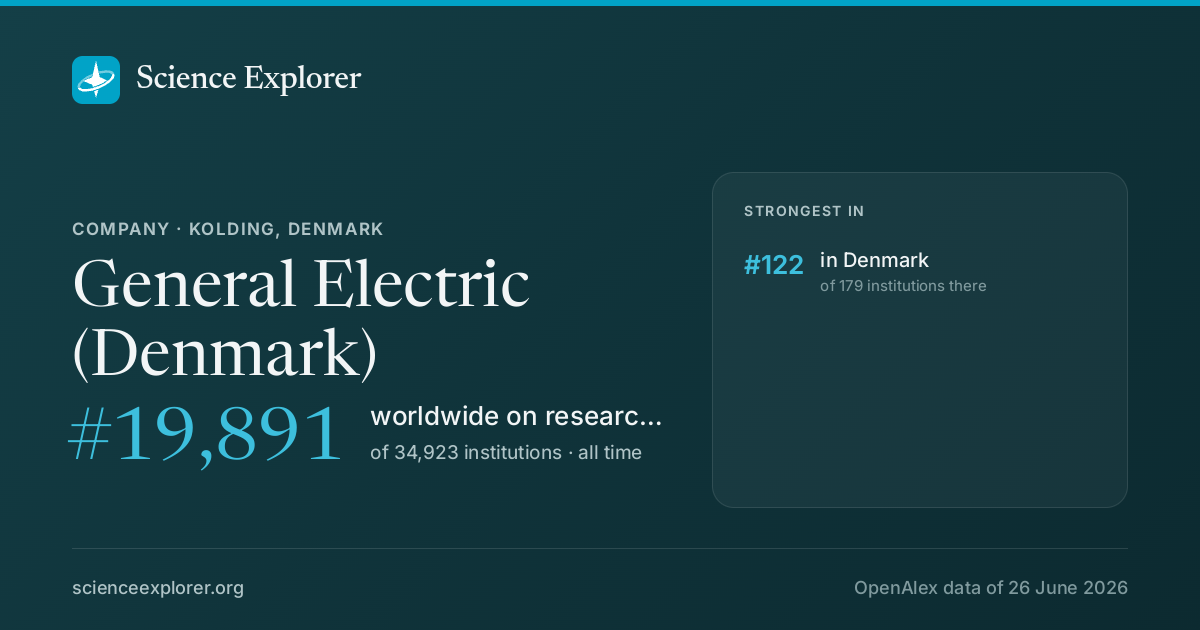
General Electric (Denmark) on Science Explorer

A card with General Electric (Denmark)'s standing and the fields it leads in, for a post or a slide. A link to this page previews as the same card.

Download the card

1200 × 630 PNG, sized for social posts, drawn from the latest snapshot.

Badges for a website1Each links back here and updates with every snapshot

Research measures only: rankings here say nothing about teaching, admissions or student experience. Comparable institutions and collaboration partners have tabs of their own, above.

Discussion

Ask a question or share a note about General Electric (Denmark). Posts are plain text and can be reported.