Glasgow Life
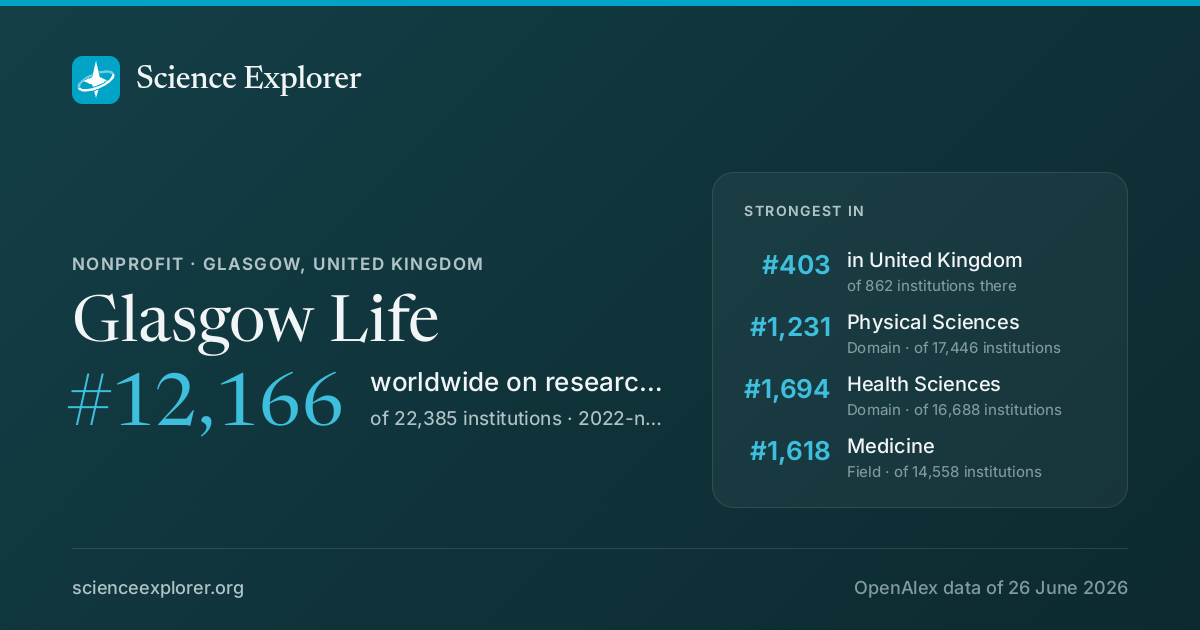
In research, Glasgow Life stands highest in Physical Sciences (#1,231 of 17,446 worldwide), Health Sciences (#1,694 of 16,688 worldwide) and Medicine (#1,618 of 14,558 worldwide), over all time.
- World rank, 2022-now
- #12,166 of 22,385 · #1,381 all time
- Rank in United Kingdom
- #403 of 862
- Research works
- 2.5k ▼ 48% vs 2018-21
- Citations
- 25k 9.8 per fractional work
- Top-10% rate
- 8.1% all institutions 10.0%
- vs its own fields
- 0.97× 1.00× is exactly expected
- Open access
- 21% world 40%
- International
- 8% world 18%
What is Glasgow Life known for in research?
The fields where it stands highest, over all time, ranked among every institution above the floor in each field.
| Field | World rank | Where that sits | Top-10% rate | Works |
|---|---|---|---|---|
| Physical SciencesDomain | #1,231 of 17,446 | 8.8% | 355 | |
| Health SciencesDomain | #1,694 of 16,688 | 5.9% | 766 | |
| MedicineField | #1,618 of 14,558 | 6.7% | 558 | |
| Social SciencesDomain | #2,183 of 14,833 | 5.7% | 1,207 | |
| Social SciencesField | #1,448 of 9,330 | 6.5% | 414 | |
| Life SciencesDomain | #1,851 of 11,023 | 7.1% | 168 | |
| Arts and HumanitiesField | #941 of 3,511 | 5.1% | 643 | |
| Sociology and Political ScienceSubfield | #1,210 of 4,066 | 8.3% | 135 | |
| Literature and Literary TheorySubfield | #356 of 956 | 2.9% | 172 | |
| General Health ProfessionsSubfield | #718 of 1,886 | 3.8% | 135 |
Each strip is that field's whole ranked pool, with the notch where Glasgow Life sits in it, in the colour of the band that rank falls in. The track under the rate is the rate itself: it carries no average mark, because the average differs by field (from about 6% in Dentistry to 21% in Economics).
Which fields of science does Glasgow Life work in?
In 2022-now, 50% of research at Glasgow Life is in Social Sciences, 28% in Health Sciences. Its largest fields are Social Sciences (23%), Medicine (20%), Arts and Humanities (18%). It does 2.0× the world's share of Social Sciences.
Each ring splits the one inside it: the four domains of science, their fields, their subfields. Size is fractional works in 2022-now. Every slice is a page; the interactive view zooms down to single topics and colours each by how much more of it this institution does than the world.
Its 4 domains and 23 fields, with their numbers
- Social Sciences7450.4%
- Social Sciences3322.8%
- Arts and Humanities2718.5%
- Economics, Econometrics and Finance64.0%
- Psychology53.5%
- Decision Sciences10.9%
- Business, Management and Accounting10.8%
- Health Sciences4027.6%
- Medicine2920.0%
- Health Professions95.9%
- Dentistry11.0%
- Veterinary10.5%
- Nursing00.1%
- Physical Sciences1711.7%
- Engineering96.0%
- Computer Science32.2%
- Environmental Science21.3%
- Physics and Astronomy10.8%
- Earth and Planetary Sciences10.7%
- Energy10.4%
- Materials Science00.3%
- Life Sciences1510.3%
Field profile
Location quotient across every field it publishes in: outside the ring is more than an institution of this size would be expected to publish, inside it is less.
Rings at 0.5×, 1× and 2×. Widest outward: Arts and Humanities, 6.4×. Every wedge is a field page.
All 23 fields, with their numbers
- Arts and Humanities6.39×27 works
- Veterinary3.92×1 works
- Health Professions2.25×9 works
- Dentistry2.00×1 works
- Economics, Econometrics and Finance1.85×6 works
- Social Sciences1.80×33 works
- Biochemistry, Genetics and Molecular Biology1.28×10 works
- Psychology1.15×5 works
- Neuroscience1.14×3 works
- Medicine1.04×29 works
- Pharmacology, Toxicology and Pharmaceutics0.94×0 works
- Decision Sciences0.94×1 works
- Immunology and Microbiology0.80×1 works
- Earth and Planetary Sciences0.46×1 works
- Energy0.46×1 works
- Engineering0.40×9 works
- Physics and Astronomy0.36×1 works
- Computer Science0.28×3 works
- Environmental Science0.25×2 works
- Business, Management and Accounting0.25×1 works
- Nursing0.23×0 works
- Agricultural and Biological Sciences0.12×1 works
- Materials Science0.09×0 works
- Arts and Humanities 6.4×
- Veterinary 3.9×
- Health Professions 2.2×
- Dentistry 2.0×
- Economics, Econometrics and Finance 1.9×
- Social Sciences 1.8×
- Biochemistry, Genetics and Molecular Biology 1.3×
- Psychology 1.1×
- Neuroscience 1.1×
- Medicine 1.0×
- Pharmacology, Toxicology and Pharmaceutics 0.9×
- Decision Sciences 0.9×
- Immunology and Microbiology 0.8×
- Earth and Planetary Sciences 0.5×
- Energy 0.5×
- Engineering 0.4×
- Physics and Astronomy 0.4×
- Computer Science 0.3×
- Environmental Science 0.2×
- Business, Management and Accounting 0.2×
- Nursing 0.2×
- Agricultural and Biological Sciences 0.1×
- Materials Science 0.1×
Who are the top researchers at Glasgow Life?
Ranked on the quality score, William George Black, William John Macquorn Rankine and Robert F. Gardiner lead among researchers whose main affiliation is Glasgow Life.
- 1
William George Black
 United Kingdom · #1,710,078 worldwide
229 citations · 321 works
- 2
William John Macquorn Rankine
United Kingdom · #1,839,744 worldwide
1.9k citations · 155 works
- 3
Robert F. Gardiner
United Kingdom · #1,910,630 worldwide
6 citations · 130 works
- 4
Rewey Belle Inglis
United Kingdom · #1,923,232 worldwide
20 citations · 153 works
- 5
Geo. Neilson
United Kingdom · #1,939,635 worldwide
31 citations · 121 works
- 6
Andrew S. Cairncross
United Kingdom · #2,086,857 worldwide
96 citations · 30 works
- 7
C. E. STROMEYER
United Kingdom · #2,144,381 worldwide
200 citations · 61 works
- 8
Fraser Inglis
United Kingdom · #2,169,656 worldwide
618 citations · 28 works
- 9
G. H. Stevenson
United Kingdom · #2,193,490 worldwide
108 citations · 19 works
- 10
W. A. Clouston
United Kingdom · #2,311,349 worldwide
27 citations · 42 works
Which keywords describe research at Glasgow Life?
By fractional works in 2022-now, weighted toward what it does more of than the world: Literature, Globalization, National Identity, Neoliberalism, Nationalism, Colonialism, History and Devolution.
- Postmodernism
- Economic Institutions
- Postcolonialism
- Marxism
- Income Inequality
- Narrative
- Welsh literature
- Maternal Plasma DNA Sequencing
- Aneuploidy Screening
- Cell-Free DNA
- Ethics
- Primary Care
- Capitalism
- Union of 1707
- Cultural Politics
- Empire
- Cultural Identity
- Nationalism
- Neoliberalism
- Literature
- Globalization
- National Identity
- History
- Colonialism
- Devolution
- Public Health
- Scotland
- Identity
- Diaspora
- Property Rights
- Political Dynamics
- Prenatal Diagnosis
- Imperialism
- Wales
- Ethnicity
- Quality Improvement
- Intergovernmental Relations
- Multinational Federations
- Uneven and Combined Development
- Institutional Economics
Size is fractional works in 2022-now in the topics tagged with each word; colour is the word's share of this institution's work against its share of the world's. The 40 words are chosen for being large and distinctive. Each links to the topic it comes from most.
All 40 words, with their numbers
- Globalization10▲ 3.5×22 topics
- Literature8▲ 10×8 topics
- National Identity7▲ 40×3 topics
- Neoliberalism6▲ 12×8 topics
- History6▲ 5.8×6 topics
- Nationalism6▲ 8.6×7 topics
- Colonialism5▲ 7.7×9 topics
- Cultural Identity5▲ 7.1×7 topics
- Devolution5▲ 230×2 topics
- Empire5▲ 38×2 topics
- Public Health5▲ 2.2×16 topics
- Cultural Politics5▲ 48×2 topics
- Scotland4▲ 384×1 topic
- Union of 17074▲ 384×1 topic
- Identity4▲ 3.9×12 topics
- Capitalism3▲ 36×2 topics
- Diaspora3▲ 38×3 topics
- Primary Care3▲ 5.8×5 topics
- Property Rights3▲ 32×3 topics
- Ethics3▲ 3.9×9 topics
- Political Dynamics3▲ 74×2 topics
- Cell-Free DNA3▲ 20×2 topics
- Prenatal Diagnosis3▲ 13×2 topics
- Aneuploidy Screening3▲ 71×1 topic
- Imperialism3▲ 24×2 topics
- Maternal Plasma DNA Sequencing3▲ 71×1 topic
- Wales3▲ 292×1 topic
- Welsh literature3▲ 292×1 topic
- Ethnicity2▲ 4.6×6 topics
- Narrative2▲ 11×4 topics
- Quality Improvement2▲ 8.9×4 topics
- Income Inequality2▲ 11×3 topics
- Intergovernmental Relations2▲ 129×1 topic
- Marxism2▲ 36×1 topic
- Multinational Federations2▲ 184×1 topic
- Postcolonialism2▲ 11×4 topics
- Uneven and Combined Development2▲ 77×1 topic
- Economic Institutions2▲ 85×1 topic
- Institutional Economics2▲ 74×1 topic
- Postmodernism2▲ 37×4 topics
Which research topics does Glasgow Life publish most on?
By volume in 2022-now: Scottish History and National Identity, Historical Studies of British Isles, Prenatal Screening and Diagnostics and Political Systems and Governance.
Area is fractional works; colour is the subfield each topic belongs to.
- 1 Scottish History and National Identity History 4 works
- 2 Historical Studies of British Isles History 3 works
- 3 Prenatal Screening and Diagnostics Pediatrics, Perinatology and Child Health 3 works
- 4 Political Systems and Governance Political Science and International Relations 2 works
- 5 Political Economy and Marxism Sociology and Political Science 2 works
- 6 Economic Theory and Institutions Economics and Econometrics 2 works
- 7 Neurology and Historical Studies Neurology 2 works
- 8 Maritime and Coastal Archaeology Archeology 2 works
- 9 Healthcare Systems and Challenges General Health Professions 1 works
- 10 Genetics, Bioinformatics, and Biomedical Research Molecular Biology 1 works
How open and international is its research?
Against the world's own shares: the tick on each track. Both are shares of its output, so they sit on one scale and can be read against each other as well as against the world.
World: 40% of research is openly available.
World: 18% is written across borders.
How has Glasgow Life's research output changed?
Output in 2022-2025 was 48% lower than in 2018-2021.
The same series as a ribbon: one cell per year, darker for more. The line above answers how much; this answers when.
Its share of all research
Growing output can still be a shrinking share: all of science grows. This is Glasgow Life as a percentage of every work published that year, 0.00064% in 2024.
Fractional works of Glasgow Life over all fractional works that year. How the balance of science has shifted.
How much of it reaches the world top 10%
Year by year, against all institutions in the same year.
Of each year's output, the share that reached the world's 10% most cited for its field and year. Peak 17.7% in 2014.
Other research institutions in Glasgow
- University of Glasgow
- University of Strathclyde
- Glasgow Caledonian University
- NHS Greater Glasgow and Clyde
- Institute of Nanotechnology
- Turing Institute
- Beatson West of Scotland Cancer Centre
- Glasgow School of Art


Share Glasgow Life's ranking



Research measures only: rankings here say nothing about teaching, admissions or student experience. Comparable institutions and collaboration partners have tabs of their own, above.
Discussion
Ask a question or share a note about Glasgow Life. Posts are plain text and can be reported.