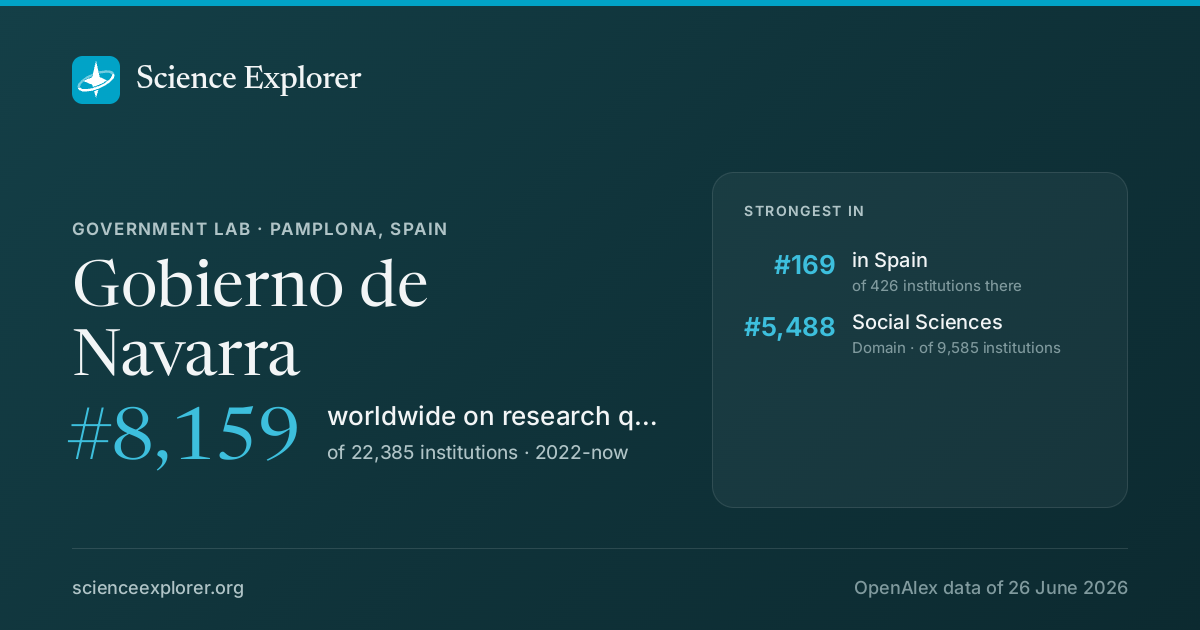
World rank, 2022-now #8,159
of 22,385 · #6,927 all time
Rank in Spain #169
of 426 Research works 1k
▼ 3% vs 2018-21
Citations 10k 10.1 per fractional work
Top-10% rate 8.4%
all institutions 10.0%
vs its own fields 0.96×
1.00× is exactly expected
Open access 72%
world 40%
International 34%
world 18%
What is Gobierno de Navarra known for in research?
The fields where it stands highest, 2022-now, ranked among every institution above the floor in each field.
Field World rank Where that sits Top-10% rate Works All time Domain #5,488 of 9,585 9.1% 94
#5225
Which fields of science does Gobierno de Navarra work in?
In 2022-now, 46% of research at Gobierno de Navarra is in Social Sciences , 24% in Health Sciences . Its largest fields are Social Sciences (21%), Medicine (18%), Arts and Humanities (13%). It does 1.8× the world's share of Social Sciences.
Social Sciences: 104 fractional works · 45.6% of its work Social Sciences: 48 fractional works · 20.9% of its work Education: 10 fractional works · 4.2% of its work Sociology and Political Science: 9 fractional works · 3.9% of its work Cultural Studies: 6 fractional works · 2.6% of its work Political Science and International Relations: 5 fractional works · 2.3% of its work Communication: 2 fractional works · 1.0% of its work Law: 2 fractional works · 1.0% of its work Geography, Planning and Development: 2 fractional works · 1.0% of its work General Social Sciences: 2 fractional works · 1.0% of its work Demography: 2 fractional works · 0.9% of its work Urban Studies: 2 fractional works · 0.7% of its work Development: 2 fractional works · 0.7% of its work Safety Research: 1 fractional works · 0.4% of its work Health: 1 fractional works · 0.4% of its work Life-span and Life-course Studies: 1 fractional works · 0.3% of its work Smaller subfields together: 1 fractional works · 0.5% of its work Arts and Humanities: 30 fractional works · 13.1% of its work History: 8 fractional works · 3.4% of its work Archeology: 5 fractional works · 2.1% of its work Literature and Literary Theory: 5 fractional works · 2.1% of its work Language and Linguistics: 3 fractional works · 1.3% of its work Visual Arts and Performing Arts: 3 fractional works · 1.1% of its work Philosophy: 2 fractional works · 1.0% of its work Conservation: 2 fractional works · 0.8% of its work Museology: 2 fractional works · 0.8% of its work History and Philosophy of Science: 1 fractional works · 0.3% of its work General Arts and Humanities: 0 fractional works · 0.2% of its work Psychology: 10 fractional works · 4.2% of its work Social Psychology: 4 fractional works · 1.7% of its work Clinical Psychology: 3 fractional works · 1.1% of its work Neuropsychology and Physiological Psychology: 1 fractional works · 0.5% of its work Developmental and Educational Psychology: 1 fractional works · 0.4% of its work Experimental and Cognitive Psychology: 1 fractional works · 0.4% of its work Smaller subfields together: 0 fractional works · 0.0% of its work Business, Management and Accounting: 10 fractional works · 4.2% of its work Organizational Behavior and Human Resource Management: 4 fractional works · 1.6% of its work Strategy and Management: 3 fractional works · 1.1% of its work Accounting: 1 fractional works · 0.4% of its work Management of Technology and Innovation: 1 fractional works · 0.4% of its work Marketing: 1 fractional works · 0.4% of its work Smaller subfields together: 0 fractional works · 0.2% of its work Economics, Econometrics and Finance: 5 fractional works · 2.3% of its work Economics and Econometrics: 5 fractional works · 2.3% of its work Smaller subfields together: 0 fractional works · 0.1% of its work Decision Sciences: 2 fractional works · 0.8% of its work Information Systems and Management: 1 fractional works · 0.6% of its work Smaller subfields together: 0 fractional works · 0.2% of its work Health Sciences: 56 fractional works · 24.5% of its work Medicine: 41 fractional works · 18.0% of its work Public Health, Environmental and Occupational Health: 7 fractional works · 3.0% of its work Surgery: 5 fractional works · 2.3% of its work Epidemiology: 4 fractional works · 1.5% of its work Infectious Diseases: 3 fractional works · 1.5% of its work Oncology: 3 fractional works · 1.4% of its work Physiology: 2 fractional works · 0.9% of its work Psychiatry and Mental health: 2 fractional works · 0.7% of its work Pulmonary and Respiratory Medicine: 2 fractional works · 0.7% of its work Endocrinology, Diabetes and Metabolism: 1 fractional works · 0.7% of its work Rheumatology: 1 fractional works · 0.5% of its work Pediatrics, Perinatology and Child Health: 1 fractional works · 0.4% of its work Pharmacology: 1 fractional works · 0.4% of its work Dermatology: 1 fractional works · 0.4% of its work Hematology: 1 fractional works · 0.4% of its work Neurology: 1 fractional works · 0.4% of its work Cardiology and Cardiovascular Medicine: 1 fractional works · 0.4% of its work Emergency Medicine: 1 fractional works · 0.3% of its work Biochemistry: 1 fractional works · 0.3% of its work Pathology and Forensic Medicine: 1 fractional works · 0.2% of its work Radiology, Nuclear Medicine and Imaging: 1 fractional works · 0.2% of its work Orthopedics and Sports Medicine: 1 fractional works · 0.2% of its work Smaller subfields together: 3 fractional works · 1.1% of its work Health Professions: 13 fractional works · 5.7% of its work General Health Professions: 7 fractional works · 3.0% of its work Health Information Management: 1 fractional works · 0.5% of its work Pharmacy: 1 fractional works · 0.5% of its work Complementary and Manual Therapy: 1 fractional works · 0.5% of its work Emergency Medical Services: 1 fractional works · 0.4% of its work Occupational Therapy: 1 fractional works · 0.3% of its work Speech and Hearing: 1 fractional works · 0.2% of its work Smaller subfields together: 1 fractional works · 0.3% of its work Nursing: 1 fractional works · 0.5% of its work Nutrition and Dietetics: 1 fractional works · 0.3% of its work Smaller subfields together: 0 fractional works · 0.2% of its work Veterinary: 1 fractional works · 0.2% of its work Small Animals: 1 fractional works · 0.2% of its work Dentistry: 0 fractional works · 0.1% of its work Physical Sciences: 40 fractional works · 17.7% of its work Environmental Science: 19 fractional works · 8.3% of its work Ecology: 8 fractional works · 3.6% of its work Management, Monitoring, Policy and Law: 2 fractional works · 1.1% of its work Water Science and Technology: 1 fractional works · 0.6% of its work Health, Toxicology and Mutagenesis: 1 fractional works · 0.6% of its work Nature and Landscape Conservation: 1 fractional works · 0.6% of its work Ecological Modeling: 1 fractional works · 0.6% of its work Global and Planetary Change: 1 fractional works · 0.5% of its work Industrial and Manufacturing Engineering: 1 fractional works · 0.3% of its work Environmental Engineering: 1 fractional works · 0.3% of its work Smaller subfields together: 0 fractional works · 0.1% of its work Engineering: 10 fractional works · 4.3% of its work Industrial and Manufacturing Engineering: 4 fractional works · 1.5% of its work Aerospace Engineering: 1 fractional works · 0.5% of its work Mechanical Engineering: 1 fractional works · 0.4% of its work Ocean Engineering: 1 fractional works · 0.4% of its work Civil and Structural Engineering: 1 fractional works · 0.3% of its work Electrical and Electronic Engineering: 1 fractional works · 0.3% of its work Biomedical Engineering: 1 fractional works · 0.2% of its work Smaller subfields together: 1 fractional works · 0.6% of its work Computer Science: 6 fractional works · 2.8% of its work Computer Networks and Communications: 2 fractional works · 1.0% of its work Information Systems: 2 fractional works · 0.8% of its work Computer Science Applications: 1 fractional works · 0.4% of its work Computer Vision and Pattern Recognition: 1 fractional works · 0.3% of its work Smaller subfields together: 1 fractional works · 0.3% of its work Earth and Planetary Sciences: 2 fractional works · 1.0% of its work Geophysics: 1 fractional works · 0.3% of its work Oceanography: 1 fractional works · 0.3% of its work Paleontology: 0 fractional works · 0.2% of its work Smaller subfields together: 0 fractional works · 0.2% of its work Energy: 1 fractional works · 0.5% of its work Renewable Energy, Sustainability and the Environment: 1 fractional works · 0.4% of its work Smaller subfields together: 0 fractional works · 0.0% of its work Materials Science: 0 fractional works · 0.2% of its work Chemistry: 0 fractional works · 0.2% of its work Mathematics: 0 fractional works · 0.2% of its work Chemical Engineering: 0 fractional works · 0.1% of its work Physics and Astronomy: 0 fractional works · 0.1% of its work Life Sciences: 28 fractional works · 12.3% of its work Agricultural and Biological Sciences: 17 fractional works · 7.3% of its work Plant Science: 6 fractional works · 2.7% of its work Ecology, Evolution, Behavior and Systematics: 3 fractional works · 1.3% of its work Food Science: 3 fractional works · 1.2% of its work General Agricultural and Biological Sciences: 2 fractional works · 0.8% of its work Insect Science: 1 fractional works · 0.5% of its work Agronomy and Crop Science: 1 fractional works · 0.3% of its work Aquatic Science: 1 fractional works · 0.3% of its work Animal Science and Zoology: 1 fractional works · 0.2% of its work Smaller subfields together: 0 fractional works · 0.1% of its work Biochemistry, Genetics and Molecular Biology: 9 fractional works · 3.8% of its work Molecular Biology: 4 fractional works · 2.0% of its work Genetics: 2 fractional works · 0.9% of its work Cell Biology: 0 fractional works · 0.2% of its work Smaller subfields together: 2 fractional works · 0.8% of its work Immunology and Microbiology: 2 fractional works · 1.1% of its work Immunology: 1 fractional works · 0.4% of its work Microbiology: 1 fractional works · 0.3% of its work Virology: 0 fractional works · 0.2% of its work Smaller subfields together: 0 fractional works · 0.2% of its work Neuroscience: 0 fractional works · 0.1% of its work Social Sciences Social Sciences Arts and Humanities Psychology Business Economics Health Sciences Medicine Health Pr… Physical Sciences Environmental Science Engineeri… Computer… Life Sciences Agricultur… Biochemis… ALL ITS WORK Gobierno de Navarra 229 fractional works, 2022-now 12% 18% 24% 46%
Each ring splits the one inside it: the four domains of science, their fields, their subfields. Size is fractional works in 2022-now. Every slice is a page; the interactive view zooms down to single topics and colours each by how much more of it this institution does than the world.
Its 4 domains and 25 fields, with their numbers 48 20.9% 30 13.1% 10 4.2% 10 4.2% 5 2.3% 2 0.8% 41 18.0% 13 5.7% 1 0.5% 1 0.2% 0 0.1% 19 8.3% 10 4.3% 6 2.8% 2 1.0% 1 0.5% 0 0.2% 0 0.2% 0 0.2% 0 0.1% 0 0.1% 17 7.3% 9 3.8% 2 1.1% 0 0.1% All of science, and how each field's share has moved since 1950: the Science domain explorer
Field profile
Location quotient across every field it publishes in: outside the ring is more than an institution of this size would be expected to publish, inside it is less.
Agricultural and Biological Sciences: 1.54× its world share, 17 works Agricultural and Bio… Biochemistry, Genetics and Molecular Biology: 0.72× its world share, 9 works Biochemistry, Geneti… Immunology and Microbiology: 1.05× its world share, 2 works Immunology and Micro… Neuroscience: 0.07× its world share, 0 works Neuroscience Chemical Engineering: 0.38× its world share, 0 works Chemical Engineering Chemistry: 0.11× its world share, 0 works Chemistry Computer Science: 0.36× its world share, 6 works Computer Science Earth and Planetary Sciences: 0.64× its world share, 2 works Earth and Planetary … Energy: 0.53× its world share, 1 works Energy Engineering: 0.29× its world share, 10 works Engineering Environmental Science: 1.67× its world share, 19 works Environmental Science Materials Science: 0.05× its world share, 0 works Materials Science Mathematics: 0.14× its world share, 0 works Mathematics Physics and Astronomy: 0.06× its world share, 0 works Physics and Astronomy Dentistry: 0.15× its world share, 0 works Dentistry Health Professions: 2.15× its world share, 13 works Health Professions Medicine: 0.94× its world share, 41 works Medicine Nursing: 0.94× its world share, 1 works Nursing Veterinary: 1.82× its world share, 1 works Veterinary Arts and Humanities: 4.55× its world share, 30 works Arts and Humanities Business, Management and Accounting: 1.29× its world share, 10 works Business, Management… Decision Sciences: 0.85× its world share, 2 works Decision Sciences Economics, Econometrics and Finance: 1.09× its world share, 5 works Economics, Econometr… Psychology: 1.37× its world share, 10 works Psychology Social Sciences: 1.65× its world share, 48 works Social Sciences 1× world share
Rings at 0.5×, 1× and 2×. Widest outward: Arts and Humanities , 4.5×. Every wedge is a field page.
All 25 fields, with their numbers Arts and Humanities 4.55× 30 works Health Professions 2.15× 13 works Veterinary 1.82× 1 works Environmental Science 1.67× 19 works Social Sciences 1.65× 48 works Agricultural and Biological Sciences 1.54× 17 works Psychology 1.37× 10 works Business, Management and Accounting 1.29× 10 works Economics, Econometrics and Finance 1.09× 5 works Immunology and Microbiology 1.05× 2 works Medicine 0.94× 41 works Nursing 0.94× 1 works Decision Sciences 0.85× 2 works Biochemistry, Genetics and Molecular Biology 0.72× 9 works Earth and Planetary Sciences 0.64× 2 works Energy 0.53× 1 works Chemical Engineering 0.38× 0 works Computer Science 0.36× 6 works Engineering 0.29× 10 works Dentistry 0.15× 0 works Mathematics 0.14× 0 works Chemistry 0.11× 0 works Neuroscience 0.07× 0 works Physics and Astronomy 0.06× 0 works Materials Science 0.05× 0 works
Who are the top researchers at Gobierno de Navarra?
Ranked on the quality score, María Jesús Guembe , Gustavo Eydallin and Saioa Burgui lead among researchers whose main affiliation is Gobierno de Navarra.
1
María Jesús Guembe
Spain · #837,846 worldwide2k citations · 30 works
2
Gustavo Eydallin
Spain · #2,339,759 worldwide1.2k citations · 19 works
3
Saioa Burgui
Spain · #2,660,360 worldwide389 citations · 16 works
4
Ángela María Sánchez‐López
Spain · #3,278,892 worldwide1.1k citations · 66 works
5
Adriana Ricarte-Bermejo
Spain · #3,657,323 worldwide362 citations · 27 works
6
José Javier Viñes Rueda
Spain · #3,903,686 worldwide369 citations · 27 works
7
Samuel Gámez‐Arcas
Spain · #4,125,606 worldwide168 citations · 16 works
8
Constantino Ánchel
Spain · #4,543,211 worldwide3 citations · 28 works
9
Celia Martín Larumbe
Spain · #4,687,570 worldwide2 citations · 17 works
10
Javier Ibáñez Santos
Spain · #4,715,713 worldwide75 citations · 18 works
All ranked researchers at Gobierno de Navarra
What are the most cited papers from Gobierno de Navarra?
The most cited paper from Gobierno de Navarra is "Bacillus thuringiensis Toxins: An Overview of Their Biocidal Activity" (Leopoldo Palma, Delia Muñoz, Colin Berry et al., 2014), with 829 citations. Next come "Biofilm dispersion and quorum sensing" (639) and "Neuromuscular adaptations during concurrent strength and endurance training versus strength training" (526).
Most cited papers
# Paper Released Citations 1
Bacillus thuringiensis Toxins: An Overview of Their Biocidal Activity
Leopoldo Palma, Delia Muñoz, Colin Berry et al. · Toxins
Open access 11 Dec 2014
829 2
Biofilm dispersion and quorum sensing
Cristina Solano, Maite Echeverz, Íñigo Lasa · Current Opinion in Microbiology
Review Open access 21 Mar 2014
639 3
Neuromuscular adaptations during concurrent strength and endurance training versus strength training
K. Häkkinen, Markku Alén, William J. Kraemer et al. · European Journal of Applied Physiology
Mar 2003
526 4
Regulation of glycogen metabolism in yeast and bacteria
Wayne A. Wilson, Peter J. Roach, Manuel Montero et al. · FEMS Microbiology Reviews
Open access 20 Mar 2010
431 5
Differences in Physical Fitness and Throwing Velocity Among Elite and Amateur Male Handball Players
Esteban M. Gorostiaga, Cristina Granados, Javier Courel‐Ibáñez et al. · International Journal of Sports Medicine
18 Mar 2005
418
All 60 most cited papers, with filters and sorting
Which keywords describe research at Gobierno de Navarra?
By fractional works in 2022-now, weighted toward what it does more of than the world: History , Climate Change, Spain , Epidemiology , Public Health , Education , Gender and Television.
Size is fractional works in 2022-now in the topics tagged with each word; colour is the word's share of this institution's work against its share of the world's. The 40 words are chosen for being large and distinctive. Each links to the topic it comes from most.
All 40 words, with their numbers Epidemiology 17 ▲ 1.86× 67 topics Climate Change 16 ▲ 2.5× 42 topics History 14 ▲ 8.7× 13 topics Education 11 ▲ 2.9× 30 topics Public Health 11 ▲ 3.3× 29 topics Globalization 10 ▲ 2.2× 29 topics Sustainability 8 ▲ 1.52× 35 topics Spain 8 ▲ 101× 5 topics Sustainable Development 8 ▲ 2.1× 21 topics Gender 8 ▲ 6.1× 10 topics COVID-19 7 ▲ 2.4× 14 topics Quality of Life 7 ▲ 2.1× 25 topics Literature 6 ▲ 5.2× 7 topics Cultural Heritage 6 ▲ 5.2× 13 topics Identity 6 ▲ 3.9× 11 topics Culture 6 ▲ 5.3× 9 topics Television 6 ▲ 150× 2 topics Communication 6 ▲ 7.8× 14 topics Latin America 6 ▲ 13× 10 topics Health Promotion 6 ▲ 7.6× 10 topics Urban Development 6 ▲ 6.8× 7 topics Pedagogy 5 ▲ 4.6× 8 topics Health Policy 5 ▲ 14× 5 topics Community Participation 4 ▲ 5.6× 8 topics Economic Impact 4 ▲ 3.7× 5 topics Rural Development 4 ▲ 5.3× 9 topics Cultural Studies 4 ▲ 4.8× 11 topics Population Dynamics 4 ▲ 6.7× 8 topics Propaganda 4 ▲ 33× 2 topics Iberian Peninsula 4 ▲ 56× 3 topics Francoism 4 ▲ 110× 2 topics Portugal 4 ▲ 138× 1 topic Press 4 ▲ 227× 1 topic Society 4 ▲ 8.0× 6 topics Aging Population 3 ▲ 17× 4 topics Habitat Selection 3 ▲ 20× 2 topics Media Studies 3 ▲ 24× 3 topics Small and Medium Enterprises 3 ▲ 8.3× 2 topics Tourism 3 ▲ 16× 5 topics Welfare State 3 ▲ 18× 3 topics
Which research topics does Gobierno de Navarra publish most on?
By volume in 2022-now: Media, Journalism, and Communication History , Business, Innovation, and Economy , Basque language and culture studies and Media and Digital Communication .
1
History 4 works
2
Economics and Econometrics 3 works
3
Cultural Studies 3 works
4
Computer Networks and Communications 2 works
5
General Social Sciences 2 works
6
History 2 works
7
Public Health, Environmental and Occupational Health 2 works
8
General Health Professions 2 works
9
Cultural Studies 2 works
10
Education 2 works
How open and international is its research?
Against the world's own shares: the tick on each track. Both are shares of its output, so they
sit on one scale and can be read against each other as well as against the world.
72% 28%
72.2% 27.8%
World: 40% of research is openly available.
34% 66%
33.5% 66.5%
World: 18% is written across borders.
How has Gobierno de Navarra's research output changed?
Output in 2022-2025 was 3% lower than in 2018-2021.
still counting 1990 2000 2010 2020
The same series as a ribbon: one cell per year, darker for more. The line above answers how much ; this answers when .
Its share of all research
still counting 0.0010% 0.0020% 0.0030% Gobierno de Navarra 0.00098% in 2025 1980 1990 2000 2010 2020 Fractional works of Gobierno de Navarra over all fractional works that year. How the balance of science has shifted .
How much of it reaches the world top 10%
still counting 5% 10% 15% all institutions 10.0% in 2025 Gobierno de Navarra 7.1% in 2025 2010 2020 Of each year's output, the share that reached the world's 10% most cited for its field and year. Peak 13.3% in 2020.
Share Gobierno de Navarra's ranking
A card with Gobierno de Navarra's standing and the fields it leads in, for a post or a slide. A link to this page previews as the same card.
Badges for a website 1 Each links back here and updates with every snapshot
 Spain · #837,846 worldwide
2k citations · 30 works