Science Explorer Back to mapMap
Institution · Écully · France

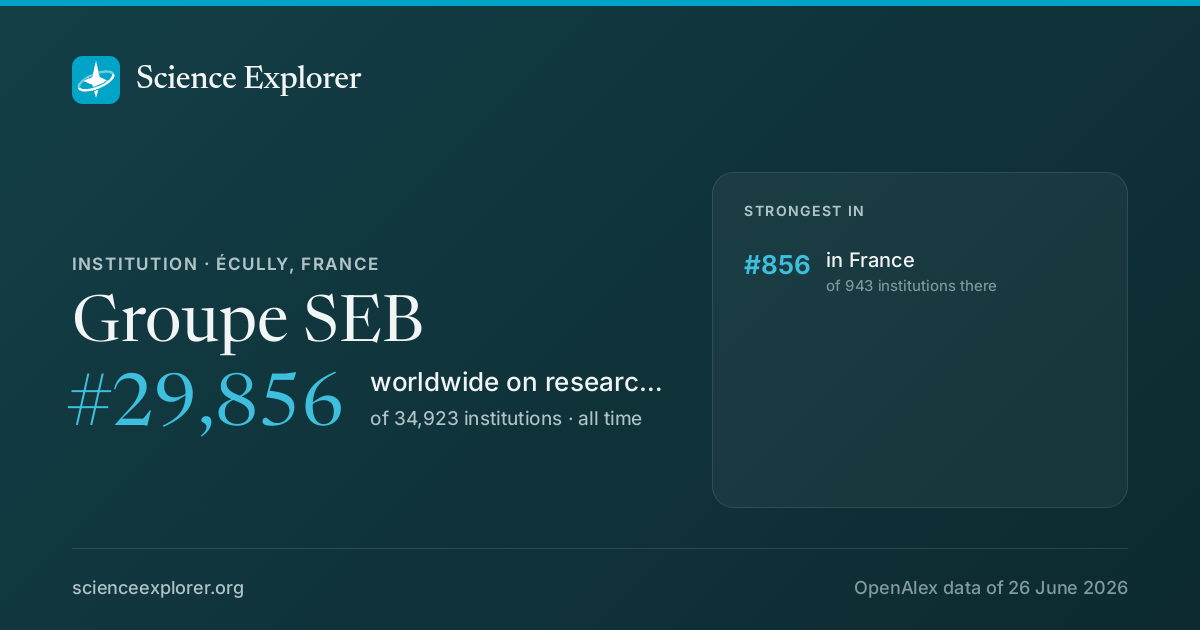
Groupe SEB

World rank, all time
#29,856
of 34,923
Rank in France
#856
of 943
Research works
137
▲ 8% vs 2018-21
Citations
1.2k
8.5 per fractional work
Top-10% rate
7.9%
all institutions 10.0%
vs its own fields
0.90×
1.00× is exactly expected
Open access
34%
world 40%
International
20%
world 18%

Which fields of science does Groupe SEB work in?

In 2022-now, 41% of research at Groupe SEB is in Physical Sciences, 38% in Social Sciences. Its largest fields are Social Sciences (24%), Engineering (17%), Materials Science (11%). It does 1.3× the world's share of Social Sciences.

Physical Sciences: 9 fractional works · 41.2% of its workEngineering: 4 fractional works · 16.8% of its workCivil and Structural Engineering: 1 fractional works · 3.1% of its workAerospace Engineering: 1 fractional works · 2.4% of its workMechanical Engineering: 0 fractional works · 2.3% of its workMechanics of Materials: 0 fractional works · 2.1% of its workElectrical and Electronic Engineering: 0 fractional works · 2.0% of its workBiomedical Engineering: 0 fractional works · 1.5% of its workOcean Engineering: 0 fractional works · 1.1% of its workAutomotive Engineering: 0 fractional works · 1.0% of its workBuilding and Construction: 0 fractional works · 0.5% of its workIndustrial and Manufacturing Engineering: 0 fractional works · 0.5% of its workComputational Mechanics: 0 fractional works · 0.3% of its workMaterials Science: 2 fractional works · 10.8% of its workPolymers and Plastics: 2 fractional works · 8.6% of its workElectronic, Optical and Magnetic Materials: 0 fractional works · 1.3% of its workBiomaterials: 0 fractional works · 0.9% of its workChemistry: 1 fractional works · 6.8% of its workOrganic Chemistry: 1 fractional works · 5.7% of its workInorganic Chemistry: 0 fractional works · 0.9% of its workSpectroscopy: 0 fractional works · 0.2% of its workSmaller subfields together: 0 fractional works · 0.0% of its workComputer Science: 1 fractional works · 4.1% of its workArtificial Intelligence: 1 fractional works · 2.6% of its workInformation Systems: 0 fractional works · 0.6% of its workComputer Vision and Pattern Recognition: 0 fractional works · 0.5% of its workComputer Science Applications: 0 fractional works · 0.3% of its workEarth and Planetary Sciences: 1 fractional works · 2.4% of its workGeophysics: 1 fractional works · 2.4% of its workPhysics and Astronomy: 0 fractional works · 0.3% of its workAtomic and Molecular Physics, and Optics: 0 fractional works · 0.3% of its workSocial Sciences: 8 fractional works · 37.9% of its workSocial Sciences: 5 fractional works · 24.5% of its workSociology and Political Science: 3 fractional works · 14.4% of its workPolitical Science and International Relations: 2 fractional works · 7.7% of its workUrban Studies: 0 fractional works · 1.2% of its workDemography: 0 fractional works · 0.5% of its workEducation: 0 fractional works · 0.5% of its workSmaller subfields together: 0 fractional works · 0.2% of its workEconomics, Econometrics and Finance: 1 fractional works · 3.2% of its workGeneral Economics, Econometrics and Finance: 1 fractional works · 3.1% of its workSmaller subfields together: 0 fractional works · 0.1% of its workArts and Humanities: 1 fractional works · 3.1% of its workArcheology: 0 fractional works · 1.5% of its workHistory: 0 fractional works · 0.8% of its workPhilosophy: 0 fractional works · 0.8% of its workBusiness, Management and Accounting: 1 fractional works · 2.9% of its workMarketing: 0 fractional works · 1.3% of its workManagement Information Systems: 0 fractional works · 0.8% of its workStrategy and Management: 0 fractional works · 0.8% of its workPsychology: 1 fractional works · 2.5% of its workClinical Psychology: 0 fractional works · 1.7% of its workDevelopmental and Educational Psychology: 0 fractional works · 0.8% of its workDecision Sciences: 0 fractional works · 1.8% of its workStatistics, Probability and Uncertainty: 0 fractional works · 1.0% of its workManagement Science and Operations Research: 0 fractional works · 0.8% of its workHealth Sciences: 2 fractional works · 11.5% of its workHealth Professions: 2 fractional works · 7.0% of its workOccupational Therapy: 1 fractional works · 4.6% of its workGeneral Health Professions: 0 fractional works · 2.2% of its workSmaller subfields together: 0 fractional works · 0.1% of its workMedicine: 1 fractional works · 3.4% of its workPediatrics, Perinatology and Child Health: 0 fractional works · 0.8% of its workSurgery: 0 fractional works · 0.8% of its workPublic Health, Environmental and Occupational Health: 0 fractional works · 0.5% of its workDermatology: 0 fractional works · 0.4% of its workOrthopedics and Sports Medicine: 0 fractional works · 0.4% of its workInfectious Diseases: 0 fractional works · 0.3% of its workBiochemistry: 0 fractional works · 0.3% of its workNursing: 0 fractional works · 1.2% of its workNutrition and Dietetics: 0 fractional works · 1.2% of its workLife Sciences: 2 fractional works · 9.3% of its workAgricultural and Biological Sciences: 1 fractional works · 3.5% of its workAquatic Science: 0 fractional works · 1.5% of its workFood Science: 0 fractional works · 0.7% of its workPlant Science: 0 fractional works · 0.7% of its workEcology, Evolution, Behavior and Systematics: 0 fractional works · 0.3% of its workForestry: 0 fractional works · 0.3% of its workPharmacology, Toxicology and Pharmaceutics: 0 fractional works · 2.3% of its workPharmaceutical Science: 0 fractional works · 1.9% of its workPharmacology: 0 fractional works · 0.4% of its workBiochemistry, Genetics and Molecular Biology: 0 fractional works · 2.0% of its workMolecular Biology: 0 fractional works · 1.6% of its workBiotechnology: 0 fractional works · 0.4% of its workImmunology and Microbiology: 0 fractional works · 1.5% of its workImmunology: 0 fractional works · 1.5% of its workALL ITS WORKGroupe SEB22fractional works, 2022-now
Life Sciences9%Physical Sciences41%Health Sciences12%Social Sciences38%

Each ring splits the one inside it: the four domains of science, their fields, their subfields. Size is fractional works in 2022-now. Every slice is a page; the interactive view zooms down to single topics and colours each by how much more of it this institution does than the world.

Its 4 domains and 19 fields, with their numbers
    1. Engineering416.8%
    2. Materials Science210.8%
    3. Chemistry16.8%
    4. Computer Science14.1%
    5. Earth and Planetary Sciences12.4%
    6. Physics and Astronomy00.3%
    1. Social Sciences524.5%
    2. Economics, Econometrics and Finance13.2%
    3. Arts and Humanities13.1%
    4. Business, Management and Accounting12.9%
    5. Psychology12.5%
    6. Decision Sciences01.8%
    1. Health Professions27.0%
    2. Medicine13.4%
    3. Nursing01.2%
    1. Agricultural and Biological Sciences13.5%
    2. Pharmacology, Toxicology and Pharmaceutics02.3%
    3. Biochemistry, Genetics and Molecular Biology02.0%
    4. Immunology and Microbiology01.5%
All of science, and how each field's share has moved since 1950: the Science domain explorer

Field profile

Location quotient across every field it publishes in: outside the ring is more than an institution of this size would be expected to publish, inside it is less.

Agricultural and Biological Sciences: 0.74× its world share, 1 worksAgricultural and Bio…Biochemistry, Genetics and Molecular Biology: 0.38× its world share, 0 worksBiochemistry, Geneti…Immunology and Microbiology: 1.53× its world share, 0 worksImmunology and Micro…Pharmacology, Toxicology and Pharmaceutics: 6.55× its world share, 0 worksPharmacology, Toxico…Chemistry: 4.34× its world share, 2 worksChemistryComputer Science: 0.52× its world share, 1 worksComputer ScienceEarth and Planetary Sciences: 1.51× its world share, 0 worksEarth and Planetary …Engineering: 1.12× its world share, 4 worksEngineeringMaterials Science: 3.10× its world share, 2 worksMaterials SciencePhysics and Astronomy: 0.12× its world share, 0 worksPhysics and AstronomyHealth Professions: 2.65× its world share, 2 worksHealth ProfessionsMedicine: 0.18× its world share, 1 worksMedicineNursing: 2.35× its world share, 0 worksNursingArts and Humanities: 1.07× its world share, 1 worksArts and HumanitiesBusiness, Management and Accounting: 0.89× its world share, 1 worksBusiness, Management…Decision Sciences: 1.86× its world share, 0 worksDecision SciencesEconomics, Econometrics and Finance: 1.52× its world share, 1 worksEconomics, Econometr…Psychology: 0.81× its world share, 0 worksPsychologySocial Sciences: 1.93× its world share, 5 worksSocial Sciences1×world share
more than its size predictsabout as predictedless

Rings at 0.5×, 1× and 2×. Widest outward: Pharmacology, Toxicology and Pharmaceutics, 6.5×. Every wedge is a field page.

All 19 fields, with their numbers
  1. Pharmacology, Toxicology and Pharmaceutics6.55×0 works
  2. Chemistry4.34×2 works
  3. Materials Science3.10×2 works
  4. Health Professions2.65×2 works
  5. Nursing2.35×0 works
  6. Social Sciences1.93×5 works
  7. Decision Sciences1.86×0 works
  8. Immunology and Microbiology1.53×0 works
  9. Economics, Econometrics and Finance1.52×1 works
  10. Earth and Planetary Sciences1.51×0 works
  11. Engineering1.12×4 works
  12. Arts and Humanities1.07×1 works
  13. Business, Management and Accounting0.89×1 works
  14. Psychology0.81×0 works
  15. Agricultural and Biological Sciences0.74×1 works
  16. Computer Science0.52×1 works
  17. Biochemistry, Genetics and Molecular Biology0.38×0 works
  18. Medicine0.18×1 works
  19. Physics and Astronomy0.12×0 works

Who are the top researchers at Groupe SEB?

Ranked on the quality score, Davy Duriatti, Bernard Drevon and Mariette Sicard lead among researchers whose main affiliation is Groupe SEB.

  1. 1 Davy Duriatti France · #3,708,544 worldwide 303 citations · 28 works
  2. 2 Bernard Drevon France · #4,718,991 worldwide 15 citations · 20 works
  3. 3 Mariette Sicard France · #4,850,655 worldwide 49 citations · 26 works
  4. 4 Antoine Barbulée France · #4,988,836 worldwide 81 citations · 19 works
All ranked researchers at Groupe SEB

What are the most cited papers from Groupe SEB?

The most cited paper from Groupe SEB is "The values of soil animals for conservation biology" (Thibaud Decaëns, Juan José Jiménez, Carmela La Gioia et al., 2006), with 425 citations. Next come "State of art of natural inhibitors of calcium carbonate scaling. A review article" (351) and "Managing the new service development process: towards a systemic model" (179).

Most cited papers
#PaperReleasedCitations
1 The values of soil animals for conservation biology Thibaud Decaëns, Juan José Jiménez, Carmela La Gioia et al. · European Journal of Soil Biology 22 Jul 2006 425
2 State of art of natural inhibitors of calcium carbonate scaling. A review article Marie Chaussemier, Ermane Pourmohtasham, Dominique Gelus et al. · Desalination 24 Oct 2014 351
3 Managing the new service development process: towards a systemic model Éric Stevens, Sergios Dimitriadis · European Journal of Marketing 2005 179
4 Experimental investigation on removal of heavy metals (Cu2+, Pb2+, and Zn2+) from aqueous solution by flax fibres Bouamama Abbar, Abdellah Alem, Stéphane Marcotte et al. · Process Safety and Environmental Protection 2 Jun 2017 118
5 New service development through the lens of organisational learning: evidence from longitudinal case studies Éric Stevens, Sergios Dimitriadis · Journal of Business Research 25 Mar 2003 118
All 60 most cited papers, with filters and sorting

Which keywords describe research at Groupe SEB?

By fractional works in 2022-now, weighted toward what it does more of than the world: Public Policy, Sustainable Development, Community Engagement, Territorial Governance, Social Justice, Social Determinants of Health, Citizen Participation and Environmental Participation.

▲ more of its work than of the world's◆ about the world's share▼ less than the world's

Size is fractional works in 2022-now in the topics tagged with each word; colour is the word's share of this institution's work against its share of the world's. The 23 words are chosen for being large and distinctive. Each links to the topic it comes from most.

All 23 words, with their numbers
  1. Public Policy3▲ 28×2 topics
  2. Sustainable Development2▲ 6.6×3 topics
  3. Community Engagement2▲ 26×2 topics
  4. Social Justice2▲ 14×2 topics
  5. Territorial Governance2▲ 74×2 topics
  6. Social Determinants of Health2▲ 37×3 topics
  7. Citizen Participation2▲ 64×1 topic
  8. Environmental Participation2▲ 103×1 topic
  9. Mechanical Properties2▲ 7.2×6 topics
  10. Environmental Impact1▲ 3.9×4 topics
  11. Healthcare Access1▲ 24×2 topics
  12. Family Law1▲ 142×1 topic
  13. Reform1▲ 97×1 topic
  14. Composites1▲ 75×1 topic
  15. Family Support Policies1▲ 386×1 topic
  16. Inequality1▲ 25×1 topic
  17. Mental Health1▲ 3.9×3 topics
  18. Natural Fibers1▲ 84×1 topic
  19. Healthcare Workers1▲ 21×3 topics
  20. Quality of Life1▲ 3.7×2 topics
  21. Education Professionals1▲ 293×1 topic
  22. Occupational Stress1▲ 293×1 topic
  23. Psychological Distress1▲ 20×2 topics

Which research topics does Groupe SEB publish most on?

By volume in 2022-now: French Urban and Social Studies, Multiculturalism, Politics, Migration, Gender, Social Policies and Family and Natural Fiber Reinforced Composites.

  1. 1 French Urban and Social Studies Sociology and Political Science 2 works
  2. 2 Multiculturalism, Politics, Migration, Gender Political Science and International Relations 1 works
  3. 3 Social Policies and Family Sociology and Political Science 1 works
  4. 4 Natural Fiber Reinforced Composites Polymers and Plastics 1 works
  5. 5 Occupational Health and Burnout Occupational Therapy 1 works
  6. 6 Mechanical Behavior of Composites Mechanics of Materials 0 works
  7. 7 Geotechnical Engineering and Soil Stabilization Civil and Structural Engineering 0 works
  8. 8 Engineering and Agricultural Innovations Aquatic Science 0 works
  9. 9 Tailings Management and Properties Civil and Structural Engineering 0 works
  10. 10 Economic Issues in Ukraine General Economics, Econometrics and Finance 0 works

How open and international is its research?

Against the world's own shares: the tick on each track. Both are shares of its output, so they sit on one scale and can be read against each other as well as against the world.

openly available34.4%not open65.6%

World: 40% of research is openly available.

with international co-authors19.5%domestic only80.5%

World: 18% is written across borders.

How has Groupe SEB's research output changed?

Output in 2022-2025 was 8% higher than in 2018-2021.

still counting1990200020102020
grewheldshrank

The same series as a ribbon: one cell per year, darker for more. The line above answers how much; this answers when.

Its share of all research

Growing output can still be a shrinking share: all of science grows. This is Groupe SEB as a percentage of every work published that year, 0.000058% in 2024.

still counting0.00050%0.0010%Groupe SEB0.000062% in 202519801990200020102020

Fractional works of Groupe SEB over all fractional works that year. How the balance of science has shifted.

Other research institutions in Écully

All research institutions in Écully

Share Groupe SEB's ranking

Groupe SEB on Science Explorer

A card with Groupe SEB's standing and the fields it leads in, for a post or a slide. A link to this page previews as the same card.

Download the card

1200 × 630 PNG, sized for social posts, drawn from the latest snapshot.

Badges for a website1Each links back here and updates with every snapshot

Research measures only: rankings here say nothing about teaching, admissions or student experience. Comparable institutions and collaboration partners have tabs of their own, above.

Discussion

Ask a question or share a note about Groupe SEB. Posts are plain text and can be reported.