Science Explorer Back to mapMap
Discussion
Company · Ladenburg · Germany

Heidelberg Pharma (Germany)

World rank, all time
#21,568
of 34,923
Rank in Germany
#1,058
of 1,603
Research works
124
▲ 12% vs 2018-21
Citations
2.3k
18.3 per fractional work
Top-10% rate
6.1%
all institutions 10.0%
vs its own fields
1.04×
1.00× is exactly expected
Open access
16%
world 40%
International
17%
world 18%

Which fields of science does Heidelberg Pharma (Germany) work in?

In 2022-now, 40% of research at Heidelberg Pharma (Germany) is in Health Sciences, 27% in Physical Sciences. Its largest fields are Medicine (38%), Biochemistry, Genetics and Molecular Biology (12%), Environmental Science (12%). It does 1.6× the world's share of Life Sciences.

Health Sciences: 13 fractional works · 39.9% of its workMedicine: 12 fractional works · 37.7% of its workRadiology, Nuclear Medicine and Imaging: 4 fractional works · 11.0% of its workPulmonary and Respiratory Medicine: 2 fractional works · 5.6% of its workOncology: 1 fractional works · 4.5% of its workHematology: 1 fractional works · 2.7% of its workSurgery: 1 fractional works · 2.3% of its workPharmacology: 1 fractional works · 2.1% of its workComplementary and alternative medicine: 1 fractional works · 1.9% of its workPhysiology: 0 fractional works · 1.6% of its workPublic Health, Environmental and Occupational Health: 0 fractional works · 1.3% of its workPathology and Forensic Medicine: 0 fractional works · 1.0% of its workReproductive Medicine: 0 fractional works · 1.0% of its workInfectious Diseases: 0 fractional works · 0.7% of its workNeurology: 0 fractional works · 0.6% of its workPediatrics, Perinatology and Child Health: 0 fractional works · 0.5% of its workCritical Care and Intensive Care Medicine: 0 fractional works · 0.3% of its workEndocrinology, Diabetes and Metabolism: 0 fractional works · 0.3% of its workOphthalmology: 0 fractional works · 0.2% of its workHealth Professions: 1 fractional works · 1.8% of its workGeneral Health Professions: 0 fractional works · 1.6% of its workHealth Information Management: 0 fractional works · 0.3% of its workVeterinary: 0 fractional works · 0.3% of its workSmall Animals: 0 fractional works · 0.3% of its workPhysical Sciences: 8 fractional works · 26.5% of its workEnvironmental Science: 4 fractional works · 11.7% of its workNature and Landscape Conservation: 2 fractional works · 7.6% of its workEcology: 1 fractional works · 2.6% of its workEcological Modeling: 0 fractional works · 0.5% of its workManagement, Monitoring, Policy and Law: 0 fractional works · 0.5% of its workHealth, Toxicology and Mutagenesis: 0 fractional works · 0.4% of its workEngineering: 2 fractional works · 5.4% of its workCivil and Structural Engineering: 0 fractional works · 1.0% of its workElectrical and Electronic Engineering: 0 fractional works · 1.0% of its workIndustrial and Manufacturing Engineering: 0 fractional works · 1.0% of its workMechanics of Materials: 0 fractional works · 1.0% of its workAutomotive Engineering: 0 fractional works · 0.6% of its workBuilding and Construction: 0 fractional works · 0.6% of its workSmaller subfields together: 0 fractional works · 0.0% of its workMaterials Science: 1 fractional works · 3.8% of its workBiomaterials: 1 fractional works · 3.8% of its workComputer Science: 1 fractional works · 3.3% of its workArtificial Intelligence: 1 fractional works · 3.1% of its workSmaller subfields together: 0 fractional works · 0.1% of its workChemistry: 1 fractional works · 1.9% of its workSpectroscopy: 0 fractional works · 1.4% of its workOrganic Chemistry: 0 fractional works · 0.3% of its workSmaller subfields together: 0 fractional works · 0.2% of its workEarth and Planetary Sciences: 0 fractional works · 0.5% of its workPaleontology: 0 fractional works · 0.5% of its workLife Sciences: 8 fractional works · 26.1% of its workBiochemistry, Genetics and Molecular Biology: 4 fractional works · 11.8% of its workMolecular Biology: 2 fractional works · 5.8% of its workBiochemistry: 1 fractional works · 1.8% of its workCell Biology: 1 fractional works · 1.8% of its workBiotechnology: 0 fractional works · 1.0% of its workGenetics: 0 fractional works · 0.6% of its workDevelopmental Biology: 0 fractional works · 0.5% of its workPhysiology: 0 fractional works · 0.2% of its workNeuroscience: 2 fractional works · 5.5% of its workCellular and Molecular Neuroscience: 1 fractional works · 4.5% of its workCognitive Neuroscience: 0 fractional works · 0.3% of its workBehavioral Neuroscience: 0 fractional works · 0.3% of its workDevelopmental Neuroscience: 0 fractional works · 0.2% of its workSmaller subfields together: 0 fractional works · 0.2% of its workImmunology and Microbiology: 1 fractional works · 4.0% of its workImmunology: 1 fractional works · 3.0% of its workParasitology: 0 fractional works · 1.0% of its workPharmacology, Toxicology and Pharmaceutics: 1 fractional works · 2.8% of its workPharmacology: 0 fractional works · 1.5% of its workPharmaceutical Science: 0 fractional works · 1.0% of its workToxicology: 0 fractional works · 0.3% of its workAgricultural and Biological Sciences: 1 fractional works · 1.9% of its workPlant Science: 0 fractional works · 1.4% of its workInsect Science: 0 fractional works · 0.5% of its workSocial Sciences: 2 fractional works · 7.5% of its workArts and Humanities: 1 fractional works · 3.7% of its workLanguage and Linguistics: 0 fractional works · 1.6% of its workLiterature and Literary Theory: 0 fractional works · 0.7% of its workMuseology: 0 fractional works · 0.5% of its workPhilosophy: 0 fractional works · 0.5% of its workHistory: 0 fractional works · 0.2% of its workReligious studies: 0 fractional works · 0.2% of its workSocial Sciences: 1 fractional works · 3.1% of its workSociology and Political Science: 0 fractional works · 1.6% of its workPolitical Science and International Relations: 0 fractional works · 1.0% of its workLaw: 0 fractional works · 0.5% of its workDecision Sciences: 0 fractional works · 0.5% of its workManagement Science and Operations Research: 0 fractional works · 0.5% of its workPsychology: 0 fractional works · 0.1% of its workALL ITS WORKHeidelberg Pharma(Germany)32fractional works, 2022-now
Life Sciences26%Physical Sciences27%Health Sciences40%Social Sciences7%

Each ring splits the one inside it: the four domains of science, their fields, their subfields. Size is fractional works in 2022-now. Every slice is a page; the interactive view zooms down to single topics and colours each by how much more of it this institution does than the world.

Its 4 domains and 18 fields, with their numbers
    1. Medicine1237.7%
    2. Health Professions11.8%
    3. Veterinary00.3%
    1. Environmental Science411.7%
    2. Engineering25.4%
    3. Materials Science13.8%
    4. Computer Science13.3%
    5. Chemistry11.9%
    6. Earth and Planetary Sciences00.5%
    1. Biochemistry, Genetics and Molecular Biology411.8%
    2. Neuroscience25.5%
    3. Immunology and Microbiology14.0%
    4. Pharmacology, Toxicology and Pharmaceutics12.8%
    5. Agricultural and Biological Sciences11.9%
    1. Arts and Humanities13.7%
    2. Social Sciences13.1%
    3. Decision Sciences00.5%
    4. Psychology00.1%
All of science, and how each field's share has moved since 1950: the Science domain explorer

Field profile

Location quotient across every field it publishes in: outside the ring is more than an institution of this size would be expected to publish, inside it is less.

Agricultural and Biological Sciences: 0.41× its world share, 1 worksAgricultural and Bio…Biochemistry, Genetics and Molecular Biology: 2.22× its world share, 4 worksBiochemistry, Geneti…Immunology and Microbiology: 4.01× its world share, 1 worksImmunology and Micro…Neuroscience: 3.40× its world share, 2 worksNeurosciencePharmacology, Toxicology and Pharmaceutics: 7.86× its world share, 1 worksPharmacology, Toxico…Chemistry: 1.19× its world share, 1 worksChemistryComputer Science: 0.42× its world share, 1 worksComputer ScienceEarth and Planetary Sciences: 0.33× its world share, 0 worksEarth and Planetary …Engineering: 0.36× its world share, 2 worksEngineeringEnvironmental Science: 2.35× its world share, 4 worksEnvironmental ScienceMaterials Science: 1.09× its world share, 1 worksMaterials ScienceHealth Professions: 0.69× its world share, 1 worksHealth ProfessionsMedicine: 1.96× its world share, 12 worksMedicineVeterinary: 2.56× its world share, 0 worksVeterinaryArts and Humanities: 1.28× its world share, 1 worksArts and HumanitiesDecision Sciences: 0.54× its world share, 0 worksDecision SciencesPsychology: 0.04× its world share, 0 worksPsychologySocial Sciences: 0.25× its world share, 1 worksSocial Sciences1×world share
more than its size predictsabout as predictedless

Rings at 0.5×, 1× and 2×. Widest outward: Pharmacology, Toxicology and Pharmaceutics, 7.9×. Every wedge is a field page.

All 18 fields, with their numbers
  1. Pharmacology, Toxicology and Pharmaceutics7.86×1 works
  2. Immunology and Microbiology4.01×1 works
  3. Neuroscience3.40×2 works
  4. Veterinary2.56×0 works
  5. Environmental Science2.35×4 works
  6. Biochemistry, Genetics and Molecular Biology2.22×4 works
  7. Medicine1.96×12 works
  8. Arts and Humanities1.28×1 works
  9. Chemistry1.19×1 works
  10. Materials Science1.09×1 works
  11. Health Professions0.69×1 works
  12. Decision Sciences0.54×0 works
  13. Computer Science0.42×1 works
  14. Agricultural and Biological Sciences0.41×1 works
  15. Engineering0.36×2 works
  16. Earth and Planetary Sciences0.33×0 works
  17. Social Sciences0.25×1 works
  18. Psychology0.04×0 works

Who are the top researchers at Heidelberg Pharma (Germany)?

Ranked on the quality score, Michael Kulke, Christian Lutz and Kristin Decker lead among researchers whose main affiliation is Heidelberg Pharma (Germany).

  1. 1 Michael Kulke Germany · #543,935 worldwide 2.2k citations · 70 works
  2. 2 Christian Lutz Germany · #594,020 worldwide 4.2k citations · 54 works
  3. 3 Kristin Decker Germany · #1,415,686 worldwide 694 citations · 23 works
  4. 4 Torsten Hechler Germany · #1,619,093 worldwide 834 citations · 140 works
  5. 5 Stefan-Helmut Leitner Germany · #2,054,305 worldwide 909 citations · 18 works
  6. 6 Christoph R. Müller Germany · #2,103,057 worldwide 671 citations · 38 works
  7. 7 Anikó Pálfí Germany · #2,229,165 worldwide 202 citations · 82 works
  8. 8 Werner Simon Germany · #2,933,990 worldwide 230 citations · 23 works
  9. 9 Wolfgang Mahnke Germany · #3,027,736 worldwide 1.3k citations · 57 works
  10. 10 Martin Mutz Germany · #3,215,150 worldwide 93 citations · 23 works
All ranked researchers at Heidelberg Pharma (Germany)

What are the most cited papers from Heidelberg Pharma (Germany)?

The most cited paper from Heidelberg Pharma (Germany) is "An endogenous tumour-promoting ligand of the human aryl hydrocarbon receptor" (Christiane A. Opitz, Ulrike M. Litzenburger, Felix Sahm et al., 2011), with 1,912 citations. Next come "Health effects of dietary phospholipids" (563) and "Constitutive IDO expression in human cancer is sustained by an autocrine signaling loop involving IL-6, STAT3 and the AHR" (328).

Most cited papers
#PaperReleasedCitations
1 An endogenous tumour-promoting ligand of the human aryl hydrocarbon receptor Christiane A. Opitz, Ulrike M. Litzenburger, Felix Sahm et al. · Nature Open access Oct 2011 1,912
2 Health effects of dietary phospholipids Daniela Küllenberg, Lenka A. Taylor, Michael Schneider et al. · Lipids in Health and Disease Open access 5 Jan 2012 563
3 Constitutive IDO expression in human cancer is sustained by an autocrine signaling loop involving IL-6, STAT3 and the AHR Ulrike M. Litzenburger, Christiane A. Opitz, Felix Sahm et al. · Oncotarget Open access 20 Jan 2014 328
4 Toll-Like Receptor Engagement Enhances the Immunosuppressive Properties of Human Bone Marrow-Derived Mesenchymal Stem Cells by Inducing Indoleamine-2,3-dioxygenase-1 via Interferon-β and Protein Kinase R Christiane A. Opitz, Ulrike M. Litzenburger, Christian Lutz et al. · Stem Cells 15 Jan 2009 303
5 Synaptic plasticity in pathological pain Ceng Luo, Thomas Kuner, Rohini Kuner · Trends in Neurosciences Review 12 May 2014 257
All 59 most cited papers, with filters and sorting

Which keywords describe research at Heidelberg Pharma (Germany)?

By fractional works in 2022-now, weighted toward what it does more of than the world: Glycosylation, Antioxidant, Sustainable Development, Cancer Treatment, Biosphere Reserves, Landscape Management, Cancer Therapy and Targeted Therapy.

▲ more of its work than of the world's◆ about the world's share▼ less than the world's

Size is fractional works in 2022-now in the topics tagged with each word; colour is the word's share of this institution's work against its share of the world's. The 32 words are chosen for being large and distinctive. Each links to the topic it comes from most.

All 32 words, with their numbers
  1. Sustainable Development3▲ 6.0×2 topics
  2. Antioxidant3▲ 12×6 topics
  3. Glycosylation3▲ 78×2 topics
  4. Cancer Treatment2▲ 33×3 topics
  5. Biosphere Reserves2▲ 618×1 topic
  6. Landscape Management2▲ 429×1 topic
  7. Cancer Therapy2▲ 13×3 topics
  8. Targeted Therapy2▲ 32×2 topics
  9. Monoclonal Antibodies2▲ 73×2 topics
  10. Therapeutic Antibodies2▲ 94×2 topics
  11. Antibody Engineering2▲ 116×1 topic
  12. Fc Receptors2▲ 116×1 topic
  13. Inflammation2▲ 2.8×8 topics
  14. Cancer2▲ 4.0×8 topics
  15. Oxidative Stress2▲ 3.1×7 topics
  16. PET Imaging2▲ 31×2 topics
  17. Pharmacokinetics2▲ 17×3 topics
  18. Hepatoprotective1▲ 53×2 topics
  19. Tumor Targeting1▲ 24×2 topics
  20. Radioimmunotherapy1▲ 147×1 topic
  21. Radiopharmaceuticals1▲ 147×1 topic
  22. Drug Delivery1▲ 7.0×2 topics
  23. Immunotherapy1▲ 5.1×3 topics
  24. Nanoparticles1▲ 3.0×2 topics
  25. Neurodegeneration1▲ 12×3 topics
  26. Liver Diseases1▲ 407×1 topic
  27. Silymarin1▲ 407×1 topic
  28. Nanocarriers1▲ 58×1 topic
  29. Ontology1▲ 41×1 topic
  30. Semantic Web1▲ 33×1 topic
  31. Stress1▲ 8.8×5 topics
  32. Surface Engineering1▲ 36×1 topic

Which research topics does Heidelberg Pharma (Germany) publish most on?

By volume in 2022-now: Ecology, Conservation, and Geographical Studies, Monoclonal and Polyclonal Antibodies Research, Radiopharmaceutical Chemistry and Applications and Silymarin and Mushroom Poisoning.

  1. 1 Ecology, Conservation, and Geographical Studies Nature and Landscape Conservation 2 works
  2. 2 Monoclonal and Polyclonal Antibodies Research Radiology, Nuclear Medicine and Imaging 2 works
  3. 3 Radiopharmaceutical Chemistry and Applications Radiology, Nuclear Medicine and Imaging 1 works
  4. 4 Silymarin and Mushroom Poisoning Pulmonary and Respiratory Medicine 1 works
  5. 5 Semantic Web and Ontologies Artificial Intelligence 1 works
  6. 6 Nanoparticle-Based Drug Delivery Biomaterials 1 works
  7. 7 Toxin Mechanisms and Immunotoxins Immunology 1 works
  8. 8 Antioxidants, Aging, Portulaca oleracea Cellular and Molecular Neuroscience 1 works
  9. 9 Multiple Myeloma Research and Treatments Hematology 1 works
  10. 10 HER2/EGFR in Cancer Research Oncology 1 works

How open and international is its research?

Against the world's own shares: the tick on each track. Both are shares of its output, so they sit on one scale and can be read against each other as well as against the world.

openly available15.8%not open84.2%

World: 40% of research is openly available.

with international co-authors16.8%domestic only83.2%

World: 18% is written across borders.

How has Heidelberg Pharma (Germany)'s research output changed?

Output in 2022-2025 was 12% higher than in 2018-2021.

still counting1990200020102020
grewheldshrank

The same series as a ribbon: one cell per year, darker for more. The line above answers how much; this answers when.

Its share of all research

Growing output can still be a shrinking share: all of science grows. This is Heidelberg Pharma (Germany) as a percentage of every work published that year, 0.00014% in 2024.

still counting0.00025%0.00050%0.00075%Heidelberg Pharma (Germany)0.00018% in 202519801990200020102020

Fractional works of Heidelberg Pharma (Germany) over all fractional works that year. How the balance of science has shifted.

Other research institutions in Ladenburg

All research institutions in Ladenburg

Share Heidelberg Pharma (Germany)'s ranking
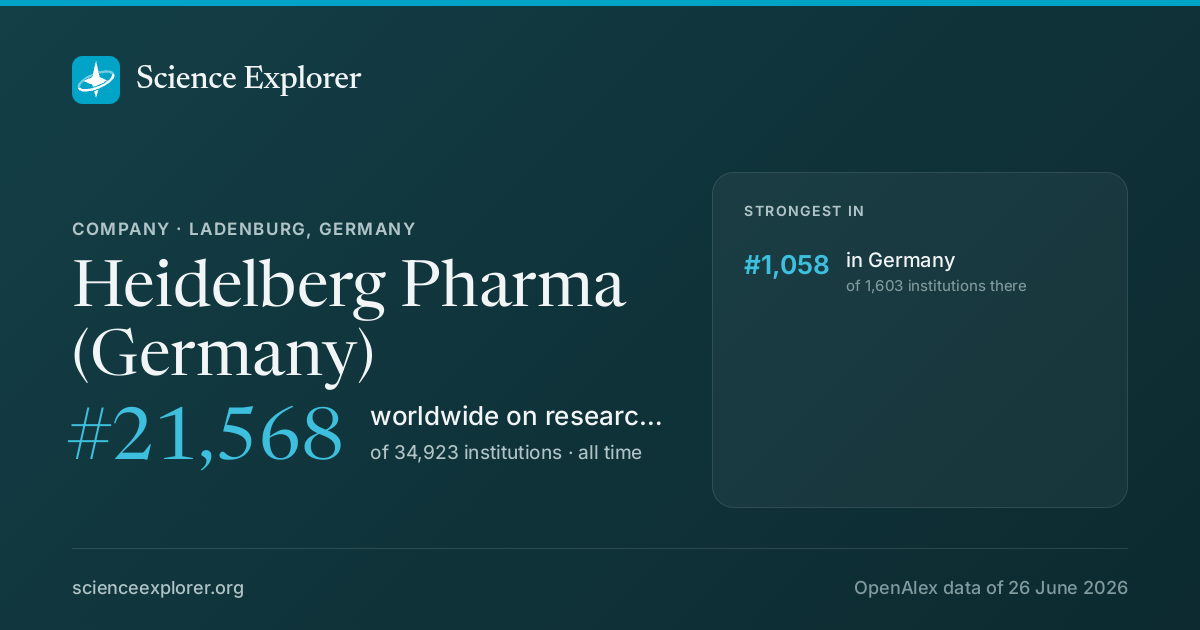
Heidelberg Pharma (Germany) on Science Explorer

A card with Heidelberg Pharma (Germany)'s standing and the fields it leads in, for a post or a slide. A link to this page previews as the same card.

Download the card

1200 × 630 PNG, sized for social posts, drawn from the latest snapshot.

Badges for a website1Each links back here and updates with every snapshot

Research measures only: rankings here say nothing about teaching, admissions or student experience. Comparable institutions and collaboration partners have tabs of their own, above.

Discussion

Ask a question or share a note about Heidelberg Pharma (Germany). Keep it to the research: no personal attacks, advertising or links. Any reader can report a post, which collapses it for everyone until it is opened.
