Science Explorer Back to mapMap
Discussion
Nonprofit · Little Rock · United States

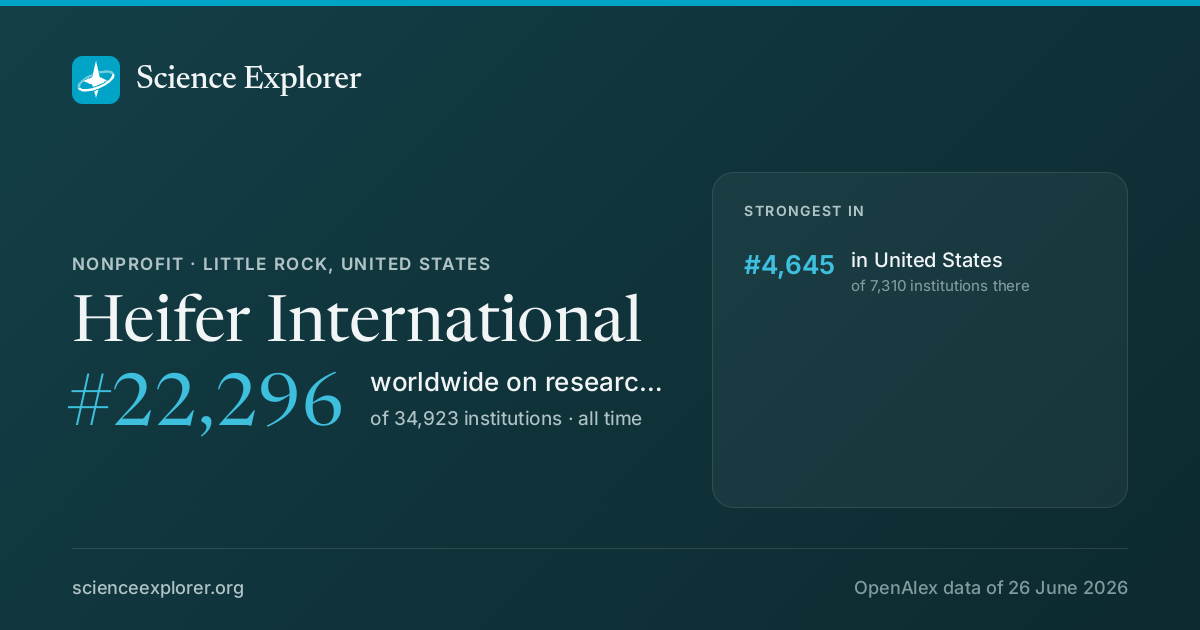
Heifer International

World rank, all time
#22,296
of 34,923
Rank in United States
#4,645
of 7,310
Research works
167
▲ 24% vs 2018-21
Citations
1.8k
11.0 per fractional work
Top-10% rate
7.0%
all institutions 10.0%
vs its own fields
0.96×
1.00× is exactly expected
Open access
28%
world 40%
International
22%
world 18%

Which fields of science does Heifer International work in?

In 2022-now, 42% of research at Heifer International is in Physical Sciences, 26% in Social Sciences. Its largest fields are Engineering (17%), Agricultural and Biological Sciences (14%), Materials Science (8%).

Physical Sciences: 12 fractional works · 42.2% of its workEngineering: 5 fractional works · 16.6% of its workElectrical and Electronic Engineering: 2 fractional works · 8.8% of its workAerospace Engineering: 0 fractional works · 1.6% of its workMechanical Engineering: 0 fractional works · 1.6% of its workComputational Mechanics: 0 fractional works · 1.2% of its workMechanics of Materials: 0 fractional works · 1.2% of its workMedia Technology: 0 fractional works · 0.8% of its workAutomotive Engineering: 0 fractional works · 0.6% of its workBiomedical Engineering: 0 fractional works · 0.4% of its workBuilding and Construction: 0 fractional works · 0.4% of its workMaterials Science: 2 fractional works · 7.8% of its workMaterials Chemistry: 1 fractional works · 2.4% of its workElectronic, Optical and Magnetic Materials: 0 fractional works · 1.8% of its workPolymers and Plastics: 0 fractional works · 1.8% of its workSurfaces, Coatings and Films: 0 fractional works · 1.8% of its workComputer Science: 2 fractional works · 6.6% of its workInformation Systems: 1 fractional works · 3.0% of its workComputer Vision and Pattern Recognition: 0 fractional works · 1.8% of its workComputer Science Applications: 0 fractional works · 1.2% of its workArtificial Intelligence: 0 fractional works · 0.6% of its workEnvironmental Science: 1 fractional works · 3.7% of its workEcology: 0 fractional works · 1.1% of its workHealth, Toxicology and Mutagenesis: 0 fractional works · 1.0% of its workGlobal and Planetary Change: 0 fractional works · 0.6% of its workManagement, Monitoring, Policy and Law: 0 fractional works · 0.3% of its workPollution: 0 fractional works · 0.3% of its workIndustrial and Manufacturing Engineering: 0 fractional works · 0.2% of its workSmaller subfields together: 0 fractional works · 0.2% of its workMathematics: 1 fractional works · 3.6% of its workAlgebra and Number Theory: 0 fractional works · 1.2% of its workApplied Mathematics: 0 fractional works · 1.2% of its workMathematical Physics: 0 fractional works · 1.2% of its workSmaller subfields together: 0 fractional works · 0.0% of its workEarth and Planetary Sciences: 1 fractional works · 2.0% of its workOceanography: 0 fractional works · 1.2% of its workAtmospheric Science: 0 fractional works · 0.8% of its workSmaller subfields together: 0 fractional works · 0.0% of its workPhysics and Astronomy: 0 fractional works · 1.8% of its workAtomic and Molecular Physics, and Optics: 0 fractional works · 1.2% of its workCondensed Matter Physics: 0 fractional works · 0.6% of its workSocial Sciences: 7 fractional works · 26.5% of its workSocial Sciences: 2 fractional works · 7.7% of its workEducation: 1 fractional works · 3.6% of its workSociology and Political Science: 0 fractional works · 1.4% of its workPolitical Science and International Relations: 0 fractional works · 1.2% of its workDemography: 0 fractional works · 1.0% of its workPublic Administration: 0 fractional works · 0.4% of its workSmaller subfields together: 0 fractional works · 0.1% of its workPsychology: 2 fractional works · 7.3% of its workSocial Psychology: 1 fractional works · 4.0% of its workClinical Psychology: 1 fractional works · 3.3% of its workArts and Humanities: 1 fractional works · 5.2% of its workHistory: 1 fractional works · 2.4% of its workHistory and Philosophy of Science: 0 fractional works · 1.2% of its workLiterature and Literary Theory: 0 fractional works · 1.2% of its workArcheology: 0 fractional works · 0.4% of its workDecision Sciences: 1 fractional works · 2.4% of its workInformation Systems and Management: 0 fractional works · 1.2% of its workManagement Science and Operations Research: 0 fractional works · 1.2% of its workSmaller subfields together: 0 fractional works · 0.0% of its workEconomics, Econometrics and Finance: 1 fractional works · 2.0% of its workEconomics and Econometrics: 1 fractional works · 2.0% of its workBusiness, Management and Accounting: 0 fractional works · 1.8% of its workManagement Information Systems: 0 fractional works · 0.6% of its workManagement of Technology and Innovation: 0 fractional works · 0.6% of its workStrategy and Management: 0 fractional works · 0.6% of its workLife Sciences: 5 fractional works · 18.5% of its workAgricultural and Biological Sciences: 4 fractional works · 14.0% of its workAgronomy and Crop Science: 2 fractional works · 6.1% of its workEcology, Evolution, Behavior and Systematics: 1 fractional works · 1.9% of its workPlant Science: 0 fractional works · 1.6% of its workSoil Science: 0 fractional works · 1.6% of its workFood Science: 0 fractional works · 1.2% of its workGeneral Agricultural and Biological Sciences: 0 fractional works · 1.1% of its workAnimal Science and Zoology: 0 fractional works · 0.5% of its workBiochemistry, Genetics and Molecular Biology: 1 fractional works · 2.8% of its workGenetics: 0 fractional works · 1.0% of its workMolecular Biology: 0 fractional works · 0.9% of its workBiophysics: 0 fractional works · 0.6% of its workMolecular Medicine: 0 fractional works · 0.3% of its workImmunology and Microbiology: 0 fractional works · 1.5% of its workMicrobiology: 0 fractional works · 1.2% of its workApplied Microbiology and Biotechnology: 0 fractional works · 0.3% of its workSmaller subfields together: 0 fractional works · 0.0% of its workNeuroscience: 0 fractional works · 0.2% of its workNeurology: 0 fractional works · 0.2% of its workHealth Sciences: 4 fractional works · 12.8% of its workMedicine: 2 fractional works · 6.2% of its workPublic Health, Environmental and Occupational Health: 1 fractional works · 1.9% of its workPediatrics, Perinatology and Child Health: 0 fractional works · 1.1% of its workReproductive Medicine: 0 fractional works · 1.0% of its workSurgery: 0 fractional works · 0.9% of its workEpidemiology: 0 fractional works · 0.5% of its workOncology: 0 fractional works · 0.3% of its workSmaller subfields together: 0 fractional works · 0.4% of its workNursing: 1 fractional works · 3.3% of its workNutrition and Dietetics: 1 fractional works · 3.0% of its workResearch and Theory: 0 fractional works · 0.3% of its workHealth Professions: 1 fractional works · 2.9% of its workGeneral Health Professions: 1 fractional works · 2.9% of its workDentistry: 0 fractional works · 0.3% of its workVeterinary: 0 fractional works · 0.1% of its workALL ITS WORKHeiferInternational28fractional works, 2022-now
Life Sciences19%Physical Sciences42%Health Sciences13%Social Sciences26%

Each ring splits the one inside it: the four domains of science, their fields, their subfields. Size is fractional works in 2022-now. Every slice is a page; the interactive view zooms down to single topics and colours each by how much more of it this institution does than the world.

Its 4 domains and 22 fields, with their numbers
    1. Engineering516.6%
    2. Materials Science27.8%
    3. Computer Science26.6%
    4. Environmental Science13.7%
    5. Mathematics13.6%
    6. Earth and Planetary Sciences12.0%
    7. Physics and Astronomy01.8%
    1. Social Sciences27.7%
    2. Psychology27.3%
    3. Arts and Humanities15.2%
    4. Decision Sciences12.4%
    5. Economics, Econometrics and Finance12.0%
    6. Business, Management and Accounting01.8%
    1. Agricultural and Biological Sciences414.0%
    2. Biochemistry, Genetics and Molecular Biology12.8%
    3. Immunology and Microbiology01.5%
    4. Neuroscience00.2%
    1. Medicine26.2%
    2. Nursing13.3%
    3. Health Professions12.9%
    4. Dentistry00.3%
    5. Veterinary00.1%
All of science, and how each field's share has moved since 1950: the Science domain explorer

Field profile

Location quotient across every field it publishes in: outside the ring is more than an institution of this size would be expected to publish, inside it is less.

Agricultural and Biological Sciences: 2.95× its world share, 4 worksAgricultural and Bio…Biochemistry, Genetics and Molecular Biology: 0.53× its world share, 1 worksBiochemistry, Geneti…Immunology and Microbiology: 1.49× its world share, 0 worksImmunology and Micro…Neuroscience: 0.12× its world share, 0 worksNeuroscienceComputer Science: 0.85× its world share, 2 worksComputer ScienceEarth and Planetary Sciences: 1.28× its world share, 1 worksEarth and Planetary …Engineering: 1.11× its world share, 5 worksEngineeringEnvironmental Science: 0.75× its world share, 1 worksEnvironmental ScienceMaterials Science: 2.24× its world share, 2 worksMaterials ScienceMathematics: 3.07× its world share, 1 worksMathematicsPhysics and Astronomy: 0.81× its world share, 0 worksPhysics and AstronomyDentistry: 0.62× its world share, 0 worksDentistryHealth Professions: 1.08× its world share, 1 worksHealth ProfessionsMedicine: 0.32× its world share, 2 worksMedicineNursing: 6.71× its world share, 1 worksNursingVeterinary: 1.11× its world share, 0 worksVeterinaryArts and Humanities: 1.80× its world share, 1 worksArts and HumanitiesBusiness, Management and Accounting: 0.56× its world share, 0 worksBusiness, Management…Decision Sciences: 2.49× its world share, 1 worksDecision SciencesEconomics, Econometrics and Finance: 0.94× its world share, 1 worksEconomics, Econometr…Psychology: 2.39× its world share, 2 worksPsychologySocial Sciences: 0.61× its world share, 2 worksSocial Sciences1×world share
more than its size predictsabout as predictedless

Rings at 0.5×, 1× and 2×. Widest outward: Nursing, 6.7×. Every wedge is a field page.

All 22 fields, with their numbers
  1. Nursing6.71×1 works
  2. Mathematics3.07×1 works
  3. Agricultural and Biological Sciences2.95×4 works
  4. Decision Sciences2.49×1 works
  5. Psychology2.39×2 works
  6. Materials Science2.24×2 works
  7. Arts and Humanities1.80×1 works
  8. Immunology and Microbiology1.49×0 works
  9. Earth and Planetary Sciences1.28×1 works
  10. Engineering1.11×5 works
  11. Veterinary1.11×0 works
  12. Health Professions1.08×1 works
  13. Economics, Econometrics and Finance0.94×1 works
  14. Computer Science0.85×2 works
  15. Physics and Astronomy0.81×0 works
  16. Environmental Science0.75×1 works
  17. Dentistry0.62×0 works
  18. Social Sciences0.61×2 works
  19. Business, Management and Accounting0.56×0 works
  20. Biochemistry, Genetics and Molecular Biology0.53×1 works
  21. Medicine0.32×2 works
  22. Neuroscience0.12×0 works

Who are the top researchers at Heifer International?

Ranked on the quality score, Mahendra Lohani, Keshav Sah and Shubh Mahato lead among researchers whose main affiliation is Heifer International.

  1. 1 Mahendra Lohani United States · #2,771,691 worldwide 405 citations · 20 works
  2. 2 Keshav Sah United States · #2,841,319 worldwide 166 citations · 15 works
  3. 3 Shubh Mahato United States · #2,894,699 worldwide 268 citations · 20 works
  4. 4 Bhola Shankar Shrestha United States · #3,748,559 worldwide 114 citations · 17 works
  5. 5 James M. Stubenrauch United States · #5,462,036 worldwide 55 citations · 33 works
  6. 6 Gail Molnar Pfeifer United States · #6,569,609 worldwide 149 citations · 81 works
All ranked researchers at Heifer International

What are the most cited papers from Heifer International?

The most cited paper from Heifer International is "Consensus recommendations on calf- and herd-level passive immunity in dairy calves in the United States" (Jason E. Lombard, Natalie J. Urie, Franklyn B. Garry et al., 2020), with 338 citations. Next come "Nonsustained Ventricular Tachycardia in Severe Heart Failure" (276) and "Biochemical mechanisms in the methane fermentation of glutamic and oleic acids" (136).

Most cited papers
#PaperReleasedCitations
1 Consensus recommendations on calf- and herd-level passive immunity in dairy calves in the United States Jason E. Lombard, Natalie J. Urie, Franklyn B. Garry et al. · Journal of Dairy Science Open access 21 May 2020 338
2 Nonsustained Ventricular Tachycardia in Severe Heart Failure Hernán C. Doval, Daniel R. Nul, Hugo Grancelli et al. · Circulation 15 Dec 1996 276
3 Biochemical mechanisms in the methane fermentation of glutamic and oleic acids Cheng-nan Weng, John S. Jeris · Water Research 1976 136
4 The effect of respiratory disease and a preventative antibiotic treatment on growth, survival, age at first calving, and milk production of dairy heifers Amy Stanton, D.F. Kelton, S.J. LeBlanc et al. · Journal of Dairy Science Open access 21 Aug 2012 126
5 Studies of platelet factor 4 and beta thromboglobulin release during exercise: lack of relationship to myocardial ischemia. Jon Stratton, Thomas William Malpass, James L. Ritchie et al. · Circulation Open access Jul 1982 101
All 63 most cited papers, with filters and sorting

Which keywords describe research at Heifer International?

By fractional works in 2022-now, weighted toward what it does more of than the world: Nanocrystals, Health Outcomes, Solar Cells, Genetic Characterization, Humor Styles Questionnaire, Photovoltaics, Psychological Well-being and Semiconductor.

▲ more of its work than of the world's◆ about the world's share▼ less than the world's

Size is fractional works in 2022-now in the topics tagged with each word; colour is the word's share of this institution's work against its share of the world's. The 10 words are chosen for being large and distinctive. Each links to the topic it comes from most.

All 10 words, with their numbers
  1. Climate Change2▲ 2.3×18 topics
  2. Nanocrystals2▲ 21×3 topics
  3. Epidemiology1▲ 1.25×8 topics
  4. Health Outcomes1▲ 17×2 topics
  5. Solar Cells1▲ 21×3 topics
  6. Genetic Characterization1▲ 85×2 topics
  7. Humor Styles Questionnaire1▲ 304×1 topic
  8. Photovoltaics1▲ 23×2 topics
  9. Psychological Well-being1▲ 25×1 topic
  10. Semiconductor1▲ 11×2 topics

Which research topics does Heifer International publish most on?

By volume in 2022-now: Humor Studies and Applications, Advanced Semiconductor Detectors and Materials, Animal Disease Management and Epidemiology and Chalcogenide Semiconductor Thin Films.

  1. 1 Humor Studies and Applications Social Psychology 1 works
  2. 2 Advanced Semiconductor Detectors and Materials Electrical and Electronic Engineering 1 works
  3. 3 Animal Disease Management and Epidemiology Agronomy and Crop Science 1 works
  4. 4 Chalcogenide Semiconductor Thin Films Electrical and Electronic Engineering 1 works
  5. 5 Suicide and Self-Harm Studies Clinical Psychology 1 works
  6. 6 Nutrition, Health and Food Behavior Nutrition and Dietetics 0 works
  7. 7 Transition Metal Oxide Nanomaterials Polymers and Plastics 0 works
  8. 8 Optical Coatings and Gratings Surfaces, Coatings and Films 0 works
  9. 9 Workplace Health and Well-being General Health Professions 0 works
  10. 10 Reproductive Physiology in Livestock Agronomy and Crop Science 0 works

How open and international is its research?

Against the world's own shares: the tick on each track. Both are shares of its output, so they sit on one scale and can be read against each other as well as against the world.

openly available27.9%not open72.1%

World: 40% of research is openly available.

with international co-authors22.4%domestic only77.6%

World: 18% is written across borders.

How has Heifer International's research output changed?

Output in 2022-2025 was 24% higher than in 2018-2021.

still counting1990200020102020
grewheldshrank

The same series as a ribbon: one cell per year, darker for more. The line above answers how much; this answers when.

Its share of all research

Growing output can still be a shrinking share: all of science grows. This is Heifer International as a percentage of every work published that year, 0.000080% in 2024.

still counting0.00050%0.0010%Heifer International0.00011% in 202519801990200020102020

Fractional works of Heifer International over all fractional works that year. How the balance of science has shifted.

Other research institutions in Little Rock

All research institutions in Little Rock

Share Heifer International's ranking

Heifer International on Science Explorer

A card with Heifer International's standing and the fields it leads in, for a post or a slide. A link to this page previews as the same card.

Download the card

1200 × 630 PNG, sized for social posts, drawn from the latest snapshot.

Badges for a website1Each links back here and updates with every snapshot

Research measures only: rankings here say nothing about teaching, admissions or student experience. Comparable institutions and collaboration partners have tabs of their own, above.

Discussion

Ask a question or share a note about Heifer International. Keep it to the research: no personal attacks, advertising or links. Any reader can report a post, which collapses it for everyone until it is opened.