Henan Polytechnic University
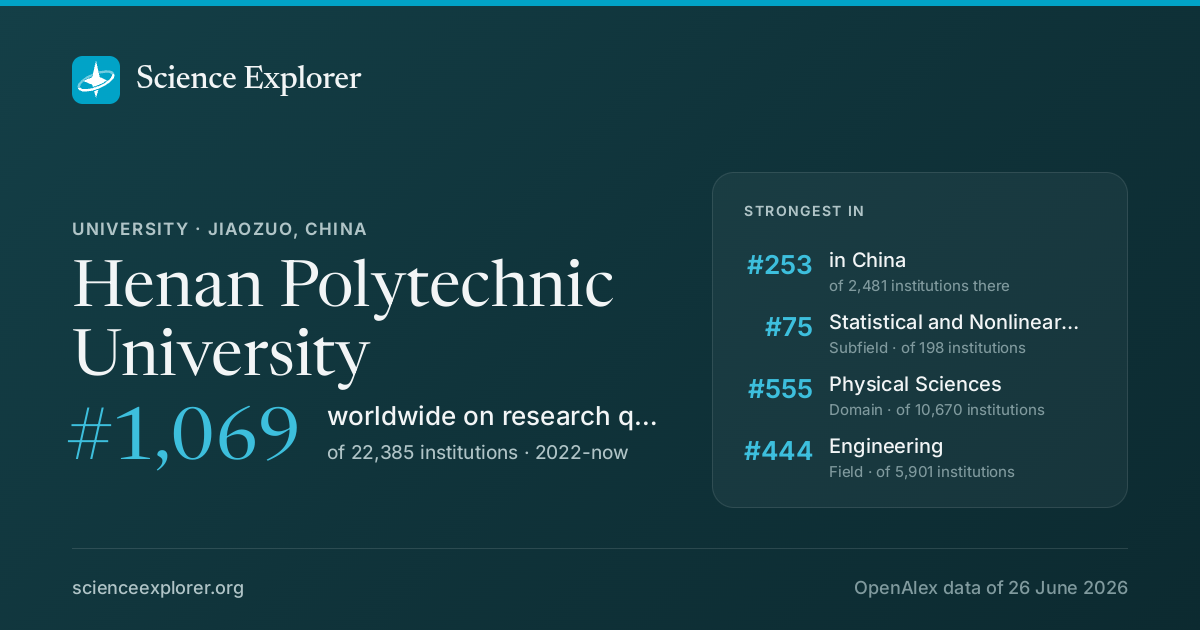
In research, Henan Polytechnic University stands highest in Physical Sciences (#555 of 10,670 worldwide), Engineering (#444 of 5,901 worldwide) and Environmental Science (#551 of 3,334 worldwide), 2022-now. Relative to its size it is most specialised in Mechanics of Materials, Safety, Risk, Reliability and Quality and Ocean Engineering (Mechanics of Materials is 9.9× its share of world research).
- World rank, 2022-now
- #1,069 of 22,385 · #1,411 all time
- Rank in China
- #253 of 2,481
- Research works
- 20k ▲ 100% vs 2018-21
- Citations
- 180k 8.9 per fractional work
- Top-10% rate
- 11.6% all institutions 10.0%
- vs its own fields
- 1.09× 1.00× is exactly expected
- Open access
- 35% world 40%
- International
- 6% world 18%
What is Henan Polytechnic University known for in research?
The fields where it stands highest, 2022-now, ranked among every institution above the floor in each field.
| Field | World rank | Where that sits | Top-10% rate | Works | All time |
|---|---|---|---|---|---|
| Physical SciencesDomain | #555 of 10,670 | 11.8% | 5,198 | #800 | |
| EngineeringField | #444 of 5,901 | 10.7% | 2,763 | #638 | |
| Environmental ScienceField | #551 of 3,334 | 11.3% | 497 | #885 | |
| Electrical and Electronic EngineeringSubfield | #469 of 2,176 | 11.7% | 466 | #817 | |
| Materials ScienceField | #501 of 2,276 | 10.1% | 516 | #865 | |
| MathematicsField | #250 of 1,051 | 25.1% | 189 | #357 | |
| Civil and Structural EngineeringSubfield | #250 of 908 | 11.2% | 318 | #440 | |
| Mechanical EngineeringSubfield | #367 of 1,319 | 12.8% | 313 | #681 | |
| Materials ChemistrySubfield | #466 of 1,473 | 10.6% | 379 | #743 | |
| Mechanics of MaterialsSubfield | #155 of 482 | 10.7% | 411 | #280 |
Each strip is that field's whole ranked pool, with the notch where Henan Polytechnic University sits in it, in the colour of the band that rank falls in. The track under the rate is the rate itself: it carries no average mark, because the average differs by field (from about 6% in Dentistry to 21% in Economics).
Which of those standings moved
The same fields on both windows: where it stood over the whole record, and where it stands in 2022-now. The distance is the story, and it is the one thing the two rank columns above cannot show.
- Physical Sciences#800 #555
- Engineering#638 #444
- Environmental Science#885 #551
- Electrical and Electronic Engineering#817 #469
- Materials Science#865 #501
- Mathematics#357 #250
- Civil and Structural Engineering#440 #250
- Mechanical Engineering#681 #367
- Materials Chemistry#743 #466
- Mechanics of Materials#280 #155
A dot further right is a better standing. Fields it was not ranked in over the whole record are left out.
Which fields of science does Henan Polytechnic University work in?
In 2022-now, 88% of research at Henan Polytechnic University is in Physical Sciences, 6% in Social Sciences. Its largest fields are Engineering (47%), Computer Science (10%), Materials Science (9%). It does 2.3× the world's share of Physical Sciences.
Each ring splits the one inside it: the four domains of science, their fields, their subfields. Size is fractional works in 2022-now. Every slice is a page; the interactive view zooms down to single topics and colours each by how much more of it this institution does than the world.
Its 4 domains and 26 fields, with their numbers
- Physical Sciences5,97487.9%
- Engineering3,17646.7%
- Computer Science68110.0%
- Materials Science5798.5%
- Environmental Science5778.5%
- Earth and Planetary Sciences2583.8%
- Mathematics2063.0%
- Physics and Astronomy1852.7%
- Energy1201.8%
- Chemical Engineering961.4%
- Chemistry951.4%
- Social Sciences4406.5%
- Social Sciences1472.2%
- Business, Management and Accounting1231.8%
- Economics, Econometrics and Finance560.8%
- Decision Sciences520.8%
- Psychology400.6%
- Arts and Humanities220.3%
- Life Sciences2193.2%
- Health Sciences1672.5%
- Medicine1342.0%
- Health Professions270.4%
- Nursing30.0%
- Dentistry20.0%
- Veterinary00.0%
What does Henan Polytechnic University specialise in?
Where its research is concentrated relative to its size: Mechanics of Materials takes 9.9× the share of its output that it takes of world research.
- Mechanics of MaterialsSubfield · 480.2 works9.9×
- Safety, Risk, Reliability and QualitySubfield · 159.1 works9.8×
- Ocean EngineeringSubfield · 253.3 works7.2×
- Modeling and SimulationSubfield · 58.3 works6.1×
- BioengineeringSubfield · 27.6 works6.1×
- Geochemistry and PetrologySubfield · 41.0 works5.9×
Location quotient, a volume reading rather than an impact one. It surfaces small, lopsided specialities.
Field profile
Location quotient across every field it publishes in: outside the ring is more than an institution of this size would be expected to publish, inside it is less.
Rings at 0.5×, 1× and 2×. Widest outward: Chemical Engineering, 4.0×. Every wedge is a field page.
All 26 fields, with their numbers
- Chemical Engineering4.03×96 works
- Engineering3.11×3,176 works
- Mathematics2.58×206 works
- Materials Science2.44×579 works
- Earth and Planetary Sciences2.42×258 works
- Energy1.92×120 works
- Environmental Science1.71×577 works
- Computer Science1.29×681 works
- Physics and Astronomy1.22×185 works
- Chemistry0.89×95 works
- Decision Sciences0.80×52 works
- Business, Management and Accounting0.56×123 works
- Economics, Econometrics and Finance0.39×56 works
- Neuroscience0.30×33 works
- Biochemistry, Genetics and Molecular Biology0.28×101 works
- Agricultural and Biological Sciences0.25×80 works
- Psychology0.19×40 works
- Social Sciences0.17×147 works
- Health Professions0.15×28 works
- Arts and Humanities0.11×22 works
- Medicine0.10×134 works
- Nursing0.08×3 works
- Dentistry0.07×2 works
- Pharmacology, Toxicology and Pharmaceutics0.05×1 works
- Immunology and Microbiology0.04×3 works
- Veterinary0.01×0 works
- Chemical Engineering 4.0×
- Engineering 3.1×
- Mathematics 2.6×
- Materials Science 2.4×
- Earth and Planetary Sciences 2.4×
- Energy 1.9×
- Environmental Science 1.7×
- Computer Science 1.3×
- Physics and Astronomy 1.2×
- Chemistry 0.9×
- Decision Sciences 0.8×
- Business, Management and Accounting 0.6×
- Economics, Econometrics and Finance 0.4×
- Neuroscience 0.3×
- Biochemistry, Genetics and Molecular Biology 0.3×
- Agricultural and Biological Sciences 0.2×
- Psychology 0.2×
- Social Sciences 0.2×
- Health Professions 0.1×
- Arts and Humanities 0.1×
- Medicine 0.1×
- Nursing 0.1×
- Dentistry 0.1×
- Pharmacology, Toxicology and Pharmaceutics 0.1×
- Immunology and Microbiology 0.0×
- Veterinary 0.0×
Who are the top researchers at Henan Polytechnic University?
Ranked on the quality score, Jienan Pan, Zhanying Zhang and Jianping Zhu lead among researchers whose main affiliation is Henan Polytechnic University.
- 1
Jienan Pan
 China · #76,338 worldwide
5k citations · 136 works
- 2
Zhanying Zhang
China · #110,993 worldwide
3.3k citations · 116 works
- 3
Jianping Zhu
China · #135,814 worldwide
6.1k citations · 153 works
- 4
Qiang Chen
China · #161,611 worldwide
18k citations · 461 works
- 5
Rongkun Pan
China · #202,833 worldwide
2.5k citations · 130 works
- 6
Zhenzhi Wang
China · #207,206 worldwide
2.4k citations · 93 works
- 7
Lin Zhu
China · #222,833 worldwide
14k citations · 332 works
- 8
Feng Shi
China · #235,625 worldwide
1.4k citations · 55 works
- 9
Daimin Hu
China · #268,454 worldwide
586 citations · 38 works
- 10
Liangxin Fan
China · #272,551 worldwide
1.9k citations · 56 works
Which keywords describe research at Henan Polytechnic University?
By fractional works in 2022-now, weighted toward what it does more of than the world: Rock Mechanics, CO2 Sequestration, Pore Structure, Deep Learning, Fracture, Dynamic Behavior, Remote Sensing and Acoustic Emission.
- Carbon Emissions
- Support Technology
- Surface Roughness
- Mining Technology
- Composite Materials
- Geopolymer
- Mechanical Behavior
- Semiconductors
- Geological Conditions
- Nanostructures
- Numerical Simulation
- Coal Permeability
- Mechanical Properties
- Brittle Failure
- Neural Networks
- Fracture
- Environmental Impact
- Pore Structure
- Remote Sensing
- Machine Learning
- Deep Learning
- Rock Mechanics
- CO2 Sequestration
- Nanomaterials
- Risk Assessment
- Dynamic Behavior
- Acoustic Emission
- Numerical Modelling
- Coal Seam
- Coalbed Methane
- Energy Storage
- Land Use Change
- Nonlinear Equations
- Tool Wear
- Chemical Sensors
- Fly Ash
- Shale Gas
- Water Inrush
- Mining Engineering
- Room Temperature
Size is fractional works in 2022-now in the topics tagged with each word; colour is the word's share of this institution's work against its share of the world's. The 40 words are chosen for being large and distinctive. Each links to the topic it comes from most.
All 40 words, with their numbers
- Deep Learning512▲ 2.2×82 topics
- Machine Learning374▲ 1.65×84 topics
- Rock Mechanics309▲ 46×4 topics
- Remote Sensing293▲ 3.5×36 topics
- CO2 Sequestration285▲ 21×4 topics
- Pore Structure278▲ 33×3 topics
- Nanomaterials249▲ 3.5×19 topics
- Environmental Impact234▲ 2.0×51 topics
- Risk Assessment224▲ 5.0×23 topics
- Fracture206▲ 31×3 topics
- Dynamic Behavior206▲ 26×3 topics
- Neural Networks195▲ 1.86×37 topics
- Acoustic Emission190▲ 45×2 topics
- Brittle Failure190▲ 48×1 topic
- Numerical Modelling190▲ 48×1 topic
- Mechanical Properties169▲ 2.5×38 topics
- Coal Seam167▲ 121×2 topics
- Coal Permeability166▲ 114×1 topic
- Coalbed Methane166▲ 114×1 topic
- Numerical Simulation153▲ 7.7×13 topics
- Energy Storage145▲ 3.3×12 topics
- Nanostructures128▲ 4.6×15 topics
- Land Use Change120▲ 5.9×7 topics
- Geological Conditions116▲ 45×3 topics
- Nonlinear Equations113▲ 13×6 topics
- Semiconductors112▲ 5.7×5 topics
- Tool Wear112▲ 13×3 topics
- Mechanical Behavior109▲ 13×5 topics
- Chemical Sensors103▲ 6.6×3 topics
- Geopolymer100▲ 10×2 topics
- Fly Ash95▲ 13×3 topics
- Composite Materials92▲ 6.5×11 topics
- Shale Gas88▲ 11×2 topics
- Mining Technology86▲ 118×1 topic
- Water Inrush86▲ 118×1 topic
- Surface Roughness82▲ 8.9×4 topics
- Mining Engineering81▲ 124×1 topic
- Support Technology81▲ 124×1 topic
- Room Temperature80▲ 7.8×3 topics
- Carbon Emissions80▲ 10×3 topics
Which research topics does Henan Polytechnic University publish most on?
By volume in 2022-now: Rock Mechanics and Modeling, Coal Properties and Utilization, Geoscience and Mining Technology and Geomechanics and Mining Engineering.
Area is fractional works; colour is the subfield each topic belongs to.
- 1 Rock Mechanics and Modeling Mechanics of Materials 190 works
- 2 Coal Properties and Utilization Ocean Engineering 166 works
- 3 Geoscience and Mining Technology Safety, Risk, Reliability and Quality 86 works
- 4 Geomechanics and Mining Engineering Mechanics of Materials 81 works
- 5 Concrete and Cement Materials Research Civil and Structural Engineering 79 works
- 6 Hydrocarbon exploration and reservoir analysis Mechanics of Materials 76 works
- 7 Gas Sensing Nanomaterials and Sensors Electrical and Electronic Engineering 74 works
- 8 Advanced machining processes and optimization Mechanical Engineering 60 works
- 9 Nonlinear Waves and Solitons Statistical and Nonlinear Physics 55 works
- 10 Fractional Differential Equations Solutions Modeling and Simulation 51 works
How open and international is its research?
Against the world's own shares: the tick on each track. Both are shares of its output, so they sit on one scale and can be read against each other as well as against the world.
World: 40% of research is openly available.
World: 18% is written across borders.
How has Henan Polytechnic University's research output changed?
Output in 2022-2025 was 100% higher than in 2018-2021.
The same series as a ribbon: one cell per year, darker for more. The line above answers how much; this answers when.
Its share of all research
Growing output can still be a shrinking share: all of science grows. This is Henan Polytechnic University as a percentage of every work published that year, 0.029% in 2024.
Fractional works of Henan Polytechnic University over all fractional works that year. How the balance of science has shifted.
How much of it reaches the world top 10%
Year by year, against all institutions in the same year.
Of each year's output, the share that reached the world's 10% most cited for its field and year. Peak 20.8% in 2004.
Other research institutions in Jiaozuo
Share Henan Polytechnic University's ranking



Research measures only: rankings here say nothing about teaching, admissions or student experience. Comparable institutions and collaboration partners have tabs of their own, above.
Discussion
Ask a question or share a note about Henan Polytechnic University. Posts are plain text and can be reported.