Husky Energy (Canada)
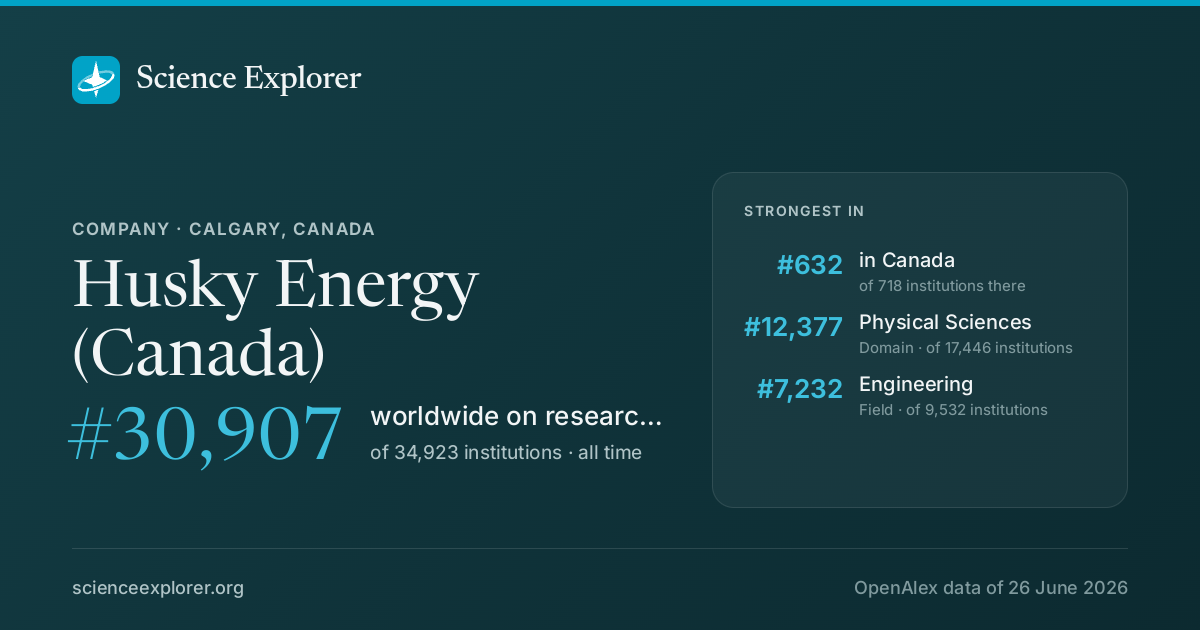
In research, Husky Energy (Canada) stands highest in Physical Sciences (#12,377 of 17,446 worldwide) and Engineering (#7,232 of 9,532 worldwide), over all time.
- World rank, all time
- #30,907 of 34,923
- Rank in Canada
- #632 of 718
- Research works
- 289 ▼ 41% vs 2018-21
- Citations
- 2.9k 10.0 per fractional work
- Top-10% rate
- 5.8% all institutions 10.0%
- vs its own fields
- 0.76× 1.00× is exactly expected
- Open access
- 8% world 40%
- International
- 18% world 18%
What is Husky Energy (Canada) known for in research?
The fields where it stands highest, over all time, ranked among every institution above the floor in each field.
| Field | World rank | Where that sits | Top-10% rate | Works |
|---|---|---|---|---|
| Physical SciencesDomain | #12,377 of 17,446 | 5.5% | 270 | |
| EngineeringField | #7,232 of 9,532 | 6.3% | 195 |
Each strip is that field's whole ranked pool, with the notch where Husky Energy (Canada) sits in it, in the colour of the band that rank falls in. The track under the rate is the rate itself: it carries no average mark, because the average differs by field (from about 6% in Dentistry to 21% in Economics).
Which fields of science does Husky Energy (Canada) work in?
In all years, 93% of research at Husky Energy (Canada) is in Physical Sciences, 5% in Social Sciences. Its largest fields are Engineering (68%), Earth and Planetary Sciences (13%), Chemistry (3%). It does 2.3× the world's share of Physical Sciences.
Each ring splits the one inside it: the four domains of science, their fields, their subfields. Size is fractional works in all years. Every slice is a page; the interactive view zooms down to single topics and colours each by how much more of it this institution does than the world.
Its 4 domains and 22 fields, with their numbers
- Physical Sciences27093.5%
- Engineering19567.5%
- Earth and Planetary Sciences3612.6%
- Chemistry93.2%
- Environmental Science93.1%
- Energy72.6%
- Computer Science62.1%
- Materials Science41.3%
- Mathematics10.5%
- Chemical Engineering10.3%
- Physics and Astronomy10.3%
- Social Sciences145.0%
- Health Sciences31.1%
- Medicine20.7%
- Health Professions10.5%
- Life Sciences10.4%
Field profile
Location quotient across every field it publishes in: outside the ring is more than an institution of this size would be expected to publish, inside it is less.
Rings at 0.5×, 1× and 2×. Widest outward: Earth and Planetary Sciences, 10.6×. Every wedge is a field page.
All 8 fields, with their numbers
- Earth and Planetary Sciences10.55×1 works
- Energy6.75×0 works
- Engineering3.01×4 works
- Materials Science2.96×1 works
- Environmental Science1.92×1 works
- Social Sciences0.70×1 works
- Health Professions0.22×0 works
- Medicine0.14×0 works
Who are the top researchers at Husky Energy (Canada)?
Ranked on the quality score, Robert F. Meldau, D.B. Anderson and Larry Mewhort lead among researchers whose main affiliation is Husky Energy (Canada).
- 1
Robert F. Meldau
 Canada · #3,588,399 worldwide
367 citations · 32 works
- 2
D.B. Anderson
Canada · #4,178,580 worldwide
154 citations · 17 works
- 3
Larry Mewhort
Canada · #4,433,741 worldwide
96 citations · 16 works
- 4
David K. Fong
Canada · #4,500,155 worldwide
59 citations · 17 works
- 5
Jamal Siavoshi
Canada · #4,501,152 worldwide
69 citations · 15 works
- 6
F. G. Fox
Canada · #4,563,872 worldwide
70 citations · 18 works
- 7
Gökhan Coşkuner
Canada · #5,059,994 worldwide
254 citations · 24 works
- 8
Karl A. Miller
Canada · #5,477,935 worldwide
240 citations · 36 works
Which keywords describe research at Husky Energy (Canada)?
By fractional works in all years, weighted toward what it does more of than the world: Hydraulic Fracturing, Fracture Propagation, Shale Gas Reservoirs, Optimization, Data Assimilation, Ensemble Kalman Filter, Well Placement and CO2 Sequestration.
- Sedimentation
- Arctic
- Full-Waveform Tomography
- Biodegradation
- Geophysical Imaging
- Continental Margin
- Tectonics
- X-ray Computed Tomography
- Nanofluids
- Porous Media
- Mudstones
- Predictive Maintenance
- Artificial Lift Systems
- Shale Gas
- Drilling Fluids
- Vibration Analysis
- CO2 Sequestration
- Ensemble Kalman Filter
- Shale Gas Reservoirs
- Fracture Propagation
- Hydraulic Fracturing
- Optimization
- Data Assimilation
- Well Placement
- Nanoparticles
- Machine Learning
- Well Integrity
- Fault Diagnosis
- Electric Submersible Pumps
- Gas Permeability
- Pore Structure
- Surfactants
- Pore-scale Modeling
- Petroleum
- Renewable Energy
- Crustal Structure
- Asphaltenes
- Naphthenic Acids
- Seismic Waveform Inversion
- Fluvial Systems
Size is fractional works in all years in the topics tagged with each word; colour is the word's share of this institution's work against its share of the world's. The 40 words are chosen for being large and distinctive. Each links to the topic it comes from most.
All 40 words, with their numbers
- Hydraulic Fracturing43▲ 126×2 topics
- Fracture Propagation42▲ 238×1 topic
- Optimization42▲ 26×5 topics
- Shale Gas Reservoirs42▲ 238×1 topic
- Data Assimilation41▲ 77×2 topics
- Ensemble Kalman Filter41▲ 121×1 topic
- Well Placement41▲ 256×1 topic
- CO2 Sequestration26▲ 63×3 topics
- Nanoparticles25▲ 6.6×4 topics
- Vibration Analysis25▲ 28×2 topics
- Machine Learning24▲ 3.9×13 topics
- Drilling Fluids24▲ 161×1 topic
- Well Integrity24▲ 161×1 topic
- Shale Gas19▲ 50×2 topics
- Fault Diagnosis19▲ 29×3 topics
- Artificial Lift Systems18▲ 207×1 topic
- Electric Submersible Pumps18▲ 207×1 topic
- Predictive Maintenance18▲ 84×2 topics
- Gas Permeability18▲ 64×2 topics
- Mudstones18▲ 81×1 topic
- Pore Structure18▲ 56×1 topic
- Porous Media17▲ 38×4 topics
- Surfactants17▲ 48×2 topics
- Nanofluids17▲ 86×2 topics
- Pore-scale Modeling17▲ 172×1 topic
- X-ray Computed Tomography17▲ 172×1 topic
- Petroleum13▲ 88×2 topics
- Tectonics11▲ 23×3 topics
- Renewable Energy10▲ 3.6×6 topics
- Continental Margin10▲ 50×2 topics
- Crustal Structure10▲ 50×2 topics
- Geophysical Imaging9▲ 41×2 topics
- Asphaltenes8▲ 112×1 topic
- Biodegradation8▲ 26×2 topics
- Naphthenic Acids8▲ 112×1 topic
- Full-Waveform Tomography8▲ 60×1 topic
- Seismic Waveform Inversion8▲ 60×1 topic
- Arctic6▲ 21×4 topics
- Fluvial Systems6▲ 47×1 topic
- Sedimentation6▲ 27×1 topic
Which research topics does Husky Energy (Canada) publish most on?
By volume in 2022-now: Geological and Geophysical Studies, Non-Destructive Testing Techniques, Hydraulic Fracturing and Reservoir Analysis and Hydrogen embrittlement and corrosion behaviors in metals.
Area is fractional works; colour is the subfield each topic belongs to.
- 1 Geological and Geophysical Studies Geology 1 works
- 2 Non-Destructive Testing Techniques Mechanical Engineering 0 works
- 3 Hydraulic Fracturing and Reservoir Analysis Mechanical Engineering 0 works
- 4 Hydrogen embrittlement and corrosion behaviors in metals Metals and Alloys 0 works
- 5 Gas Sensing Nanomaterials and Sensors Electrical and Electronic Engineering 0 works
- 6 Ga2O3 and related materials Electronic, Optical and Magnetic Materials 0 works
- 7 Welding Techniques and Residual Stresses Mechanical Engineering 0 works
- 8 Advanced Photocatalysis Techniques Renewable Energy, Sustainability and the Environment 0 works
- 9 Geotechnical Engineering and Underground Structures Civil and Structural Engineering 0 works
- 10 Drilling and Well Engineering Ocean Engineering 0 works
How open and international is its research?
Against the world's own shares: the tick on each track. Both are shares of its output, so they sit on one scale and can be read against each other as well as against the world.
World: 40% of research is openly available.
World: 18% is written across borders.
How has Husky Energy (Canada)'s research output changed?
Output in 2022-2025 was 41% lower than in 2018-2021.
The same series as a ribbon: one cell per year, darker for more. The line above answers how much; this answers when.
Its share of all research
Growing output can still be a shrinking share: all of science grows. This is Husky Energy (Canada) as a percentage of every work published that year, 0.000035% in 2024.
Fractional works of Husky Energy (Canada) over all fractional works that year. How the balance of science has shifted.
Other research institutions in Calgary
- University of Calgary
- Encana (Canada)
- Mount Royal University
- Schlumberger (Canada)
- Libin Cardiovascular Institute of Alberta
- Petro-Canada
- Institute of Cancer Research
- Nexen (Canada)


Share Husky Energy (Canada)'s ranking
Badges for a website1Each links back here and updates with every snapshot

Research measures only: rankings here say nothing about teaching, admissions or student experience. Comparable institutions and collaboration partners have tabs of their own, above.
Discussion
Ask a question or share a note about Husky Energy (Canada). Keep it to the research: no personal attacks, advertising or links. Any reader can report a post, which collapses it for everyone until it is opened.