Schlumberger (Canada)
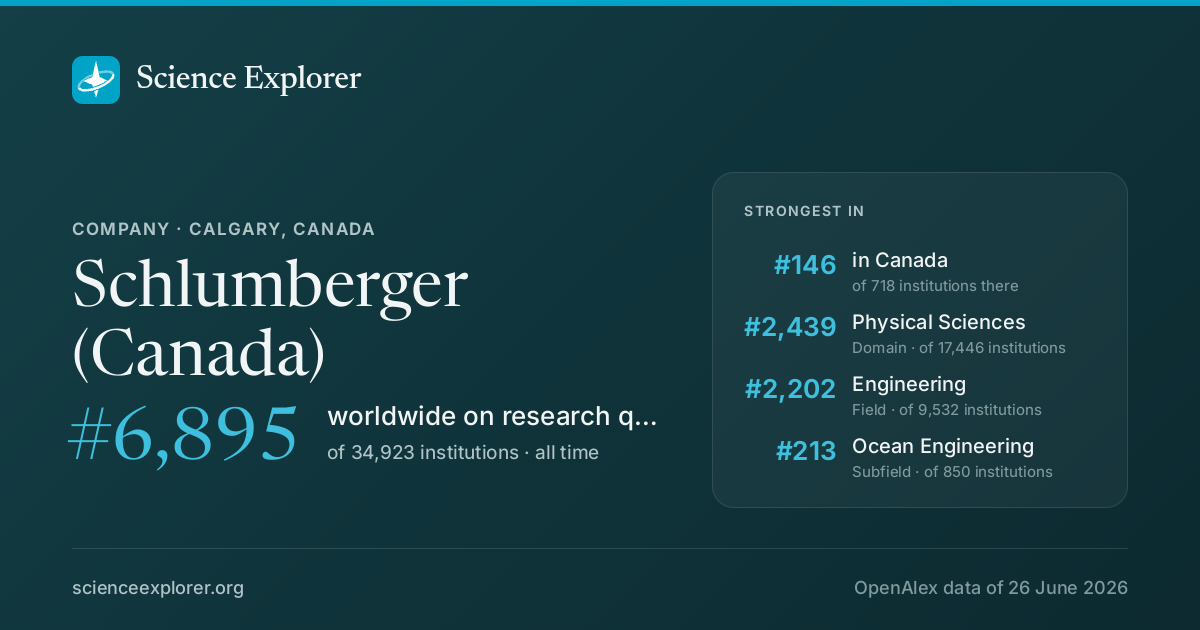
In research, Schlumberger (Canada) stands highest in Physical Sciences (#2,439 of 17,446 worldwide), Engineering (#2,202 of 9,532 worldwide) and Ocean Engineering (#213 of 850 worldwide), over all time.
- World rank, all time
- #6,895 of 34,923
- Rank in Canada
- #146 of 718
- Research works
- 976 ▼ 45% vs 2018-21
- Citations
- 16k 16.5 per fractional work
- Top-10% rate
- 5.8% all institutions 10.0%
- vs its own fields
- 1.32× 1.00× is exactly expected
- Open access
- 3% world 40%
- International
- 28% world 18%
What is Schlumberger (Canada) known for in research?
The fields where it stands highest, over all time, ranked among every institution above the floor in each field.
| Field | World rank | Where that sits | Top-10% rate | Works |
|---|---|---|---|---|
| Physical SciencesDomain | #2,439 of 17,446 | 9.0% | 946 | |
| EngineeringField | #2,202 of 9,532 | 9.1% | 786 | |
| Ocean EngineeringSubfield | #213 of 850 | 10.0% | 432 | |
| Mechanical EngineeringSubfield | #960 of 2,525 | 6.4% | 201 |
Each strip is that field's whole ranked pool, with the notch where Schlumberger (Canada) sits in it, in the colour of the band that rank falls in. The track under the rate is the rate itself: it carries no average mark, because the average differs by field (from about 6% in Dentistry to 21% in Economics).
Which fields of science does Schlumberger (Canada) work in?
In all years, 97% of research at Schlumberger (Canada) is in Physical Sciences, 2% in Social Sciences. Its largest fields are Engineering (81%), Earth and Planetary Sciences (4%), Environmental Science (4%). It does 2.4× the world's share of Physical Sciences.
Each ring splits the one inside it: the four domains of science, their fields, their subfields. Size is fractional works in all years. Every slice is a page; the interactive view zooms down to single topics and colours each by how much more of it this institution does than the world.
Its 4 domains and 21 fields, with their numbers
- Physical Sciences94697.0%
- Engineering78680.5%
- Earth and Planetary Sciences394.0%
- Environmental Science343.5%
- Chemistry293.0%
- Materials Science181.8%
- Computer Science171.7%
- Physics and Astronomy121.2%
- Chemical Engineering90.9%
- Energy30.3%
- Mathematics10.1%
- Social Sciences151.5%
- Life Sciences90.9%
- Health Sciences60.6%
- Medicine30.3%
- Health Professions20.2%
- Nursing00.0%
Field profile
Location quotient across every field it publishes in: outside the ring is more than an institution of this size would be expected to publish, inside it is less.
Rings at 0.5×, 1× and 2×. Widest outward: Chemical Engineering, 6.2×. Every wedge is a field page.
All 14 fields, with their numbers
- Chemical Engineering6.23×0 works
- Earth and Planetary Sciences5.89×1 works
- Engineering2.52×5 works
- Computer Science2.18×2 works
- Chemistry1.67×0 works
- Economics, Econometrics and Finance1.63×0 works
- Agricultural and Biological Sciences1.10×1 works
- Materials Science1.00×0 works
- Energy0.95×0 works
- Environmental Science0.85×0 works
- Business, Management and Accounting0.81×0 works
- Neuroscience0.71×0 works
- Social Sciences0.55×1 works
- Medicine0.17×0 works
- Chemical Engineering 6.2×
- Earth and Planetary Sciences 5.9×
- Engineering 2.5×
- Computer Science 2.2×
- Chemistry 1.7×
- Economics, Econometrics and Finance 1.6×
- Agricultural and Biological Sciences 1.1×
- Materials Science 1.0×
- Energy 0.9×
- Environmental Science 0.8×
- Business, Management and Accounting 0.8×
- Neuroscience 0.7×
- Social Sciences 0.6×
- Medicine 0.2×
Who are the top researchers at Schlumberger (Canada)?
Ranked on the quality score, Kenneth G. Nolte, J. L. Elbel and Roger John Card lead among researchers whose main affiliation is Schlumberger (Canada).
- 1
Kenneth G. Nolte
 Canada · #794,903 worldwide
2.8k citations · 53 works
- 2
J. L. Elbel
Canada · #1,368,941 worldwide
951 citations · 37 works
- 3
Roger John Card
Canada · #1,380,298 worldwide
1.3k citations · 48 works
- 4
Hemanta Mukherjee
Canada · #1,403,382 worldwide
691 citations · 22 works
- 5
John Ratulowski
Canada · #1,433,916 worldwide
1.9k citations · 48 works
- 6
Erik B. Nelson
Canada · #2,056,866 worldwide
671 citations · 28 works
- 7
Reinaldo C. Navarrete
Canada · #2,080,793 worldwide
803 citations · 36 works
- 8
J. Ernest Brown
Canada · #2,317,199 worldwide
516 citations · 24 works
- 9
J. F. Baret
Canada · #2,839,909 worldwide
1.1k citations · 58 works
- 10
L. Vandamme
Canada · #2,861,149 worldwide
328 citations · 17 works
Which keywords describe research at Schlumberger (Canada)?
By fractional works in all years, weighted toward what it does more of than the world: CO2 Sequestration, Nanoparticles, Hydraulic Fracturing, Rheological Properties, Vibration Analysis, Drilling Fluids, Well Integrity and Fracture Propagation.
- rock fragmentation
- Rock Mechanics
- Seismic Waveform Inversion
- Inverse Problems
- Naphthenic Acids
- Mass Spectrometry
- Biodegradation
- Thermal Maturity
- Gas Permeability
- Shale Gas
- Pore-scale Modeling
- Porous Media
- Artificial Lift Systems
- Well Placement
- Data Assimilation
- Machine Learning
- Shale Gas Reservoirs
- Drilling Fluids
- Rheological Properties
- Nanoparticles
- CO2 Sequestration
- Hydraulic Fracturing
- Vibration Analysis
- Fracture Propagation
- Well Integrity
- Optimization
- Ensemble Kalman Filter
- Fault Diagnosis
- Electric Submersible Pumps
- Surfactants
- X-ray Computed Tomography
- Pore Structure
- Mudstones
- Geophysical Imaging
- Petroleum
- Asphaltenes
- Elastic Properties
- Full-Waveform Tomography
- Performance Prediction
- TBM
Size is fractional works in all years in the topics tagged with each word; colour is the word's share of this institution's work against its share of the world's. The 40 words are chosen for being large and distinctive. Each links to the topic it comes from most.
All 40 words, with their numbers
- CO2 Sequestration187▲ 137×4 topics
- Nanoparticles182▲ 14×7 topics
- Hydraulic Fracturing178▲ 155×2 topics
- Rheological Properties176▲ 114×3 topics
- Vibration Analysis176▲ 59×4 topics
- Drilling Fluids175▲ 346×1 topic
- Fracture Propagation175▲ 297×1 topic
- Shale Gas Reservoirs175▲ 297×1 topic
- Well Integrity175▲ 346×1 topic
- Machine Learning132▲ 6.3×17 topics
- Optimization110▲ 21×7 topics
- Data Assimilation107▲ 59×2 topics
- Ensemble Kalman Filter107▲ 94×1 topic
- Well Placement107▲ 199×1 topic
- Fault Diagnosis101▲ 46×3 topics
- Artificial Lift Systems100▲ 342×1 topic
- Electric Submersible Pumps100▲ 342×1 topic
- Porous Media45▲ 29×5 topics
- Surfactants40▲ 34×4 topics
- Pore-scale Modeling36▲ 111×1 topic
- X-ray Computed Tomography36▲ 111×1 topic
- Shale Gas30▲ 23×2 topics
- Pore Structure28▲ 26×3 topics
- Gas Permeability27▲ 29×2 topics
- Mudstones27▲ 37×1 topic
- Thermal Maturity27▲ 37×1 topic
- Geophysical Imaging26▲ 37×2 topics
- Biodegradation25▲ 23×4 topics
- Petroleum24▲ 46×2 topics
- Mass Spectrometry23▲ 11×2 topics
- Asphaltenes22▲ 90×1 topic
- Naphthenic Acids22▲ 90×1 topic
- Elastic Properties20▲ 22×2 topics
- Inverse Problems20▲ 19×2 topics
- Full-Waveform Tomography20▲ 42×1 topic
- Seismic Waveform Inversion20▲ 42×1 topic
- Performance Prediction16▲ 29×2 topics
- Rock Mechanics15▲ 14×3 topics
- TBM15▲ 70×1 topic
- rock fragmentation15▲ 70×1 topic
Which research topics does Schlumberger (Canada) publish most on?
By volume in 2022-now: Hydraulic Fracturing and Reservoir Analysis, Hydrocarbon exploration and reservoir analysis, Oil and Gas Production Techniques and Reservoir Engineering and Simulation Methods.
Area is fractional works; colour is the subfield each topic belongs to.
- 1 Hydraulic Fracturing and Reservoir Analysis Mechanical Engineering 1 works
- 2 Hydrocarbon exploration and reservoir analysis Mechanics of Materials 1 works
- 3 Oil and Gas Production Techniques Ocean Engineering 1 works
- 4 Reservoir Engineering and Simulation Methods Ocean Engineering 0 works
- 5 Marine and Offshore Engineering Studies Ocean Engineering 0 works
- 6 Advanced Data Storage Technologies Computer Networks and Communications 0 works
- 7 Economic and Technological Innovation Economics and Econometrics 0 works
- 8 Ruminant Nutrition and Digestive Physiology Agronomy and Crop Science 0 works
- 9 International Business and FDI Strategy and Management 0 works
- 10 Internet of Things and AI Information Systems 0 works
How open and international is its research?
Against the world's own shares: the tick on each track. Both are shares of its output, so they sit on one scale and can be read against each other as well as against the world.
World: 40% of research is openly available.
World: 18% is written across borders.
How has Schlumberger (Canada)'s research output changed?
Output in 2022-2025 was 45% lower than in 2018-2021.
The same series as a ribbon: one cell per year, darker for more. The line above answers how much; this answers when.
Its share of all research
Growing output can still be a shrinking share: all of science grows. This is Schlumberger (Canada) as a percentage of every work published that year, 0.000052% in 2024.
Fractional works of Schlumberger (Canada) over all fractional works that year. How the balance of science has shifted.
How much of it reaches the world top 10%
Year by year, against all institutions in the same year.
Of each year's output, the share that reached the world's 10% most cited for its field and year. Peak 11.0% in 2011.
Other research institutions in Calgary
- University of Calgary
- Encana (Canada)
- Mount Royal University
- Libin Cardiovascular Institute of Alberta
- Petro-Canada
- Institute of Cancer Research
- Nexen (Canada)
- Imperial Oil (Canada)

Share Schlumberger (Canada)'s ranking
Badges for a website1Each links back here and updates with every snapshot

Research measures only: rankings here say nothing about teaching, admissions or student experience. Comparable institutions and collaboration partners have tabs of their own, above.
Discussion
Ask a question or share a note about Schlumberger (Canada). Posts are plain text and can be reported.