
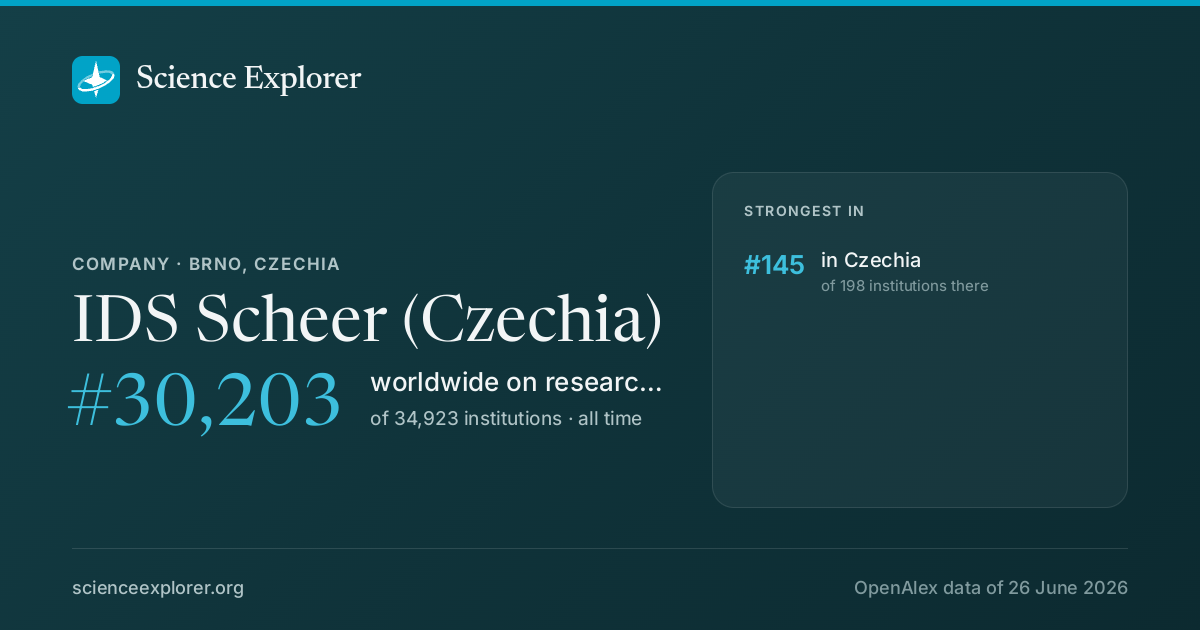
- World rank, all time
- #30,203 of 34,923
- Rank in Czechia
- #145 of 198
- Research works
- 158 ▼ 12% vs 2018-21
- Citations
- 683 4.3 per fractional work
- Top-10% rate
- 7.4% all institutions 10.0%
- vs its own fields
- 0.97× 1.00× is exactly expected
- Open access
- 21% world 40%
- International
- 26% world 18%
Which fields of science does IDS Scheer (Czechia) work in?
In all years, 70% of research at IDS Scheer (Czechia) is in Social Sciences, 20% in Physical Sciences. Its largest fields are Business, Management and Accounting (47%), Social Sciences (14%), Engineering (11%). It does 3.2× the world's share of Social Sciences.
Each ring splits the one inside it: the four domains of science, their fields, their subfields. Size is fractional works in all years. Every slice is a page; the interactive view zooms down to single topics and colours each by how much more of it this institution does than the world.
Its 4 domains and 23 fields, with their numbers
- Social Sciences11170.3%
- Business, Management and Accounting7446.9%
- Social Sciences2314.3%
- Arts and Humanities74.5%
- Economics, Econometrics and Finance42.7%
- Decision Sciences21.1%
- Psychology10.8%
- Physical Sciences3220.1%
- Engineering1711.0%
- Computer Science74.7%
- Environmental Science31.7%
- Chemistry10.9%
- Energy10.5%
- Earth and Planetary Sciences10.4%
- Mathematics10.4%
- Physics and Astronomy00.3%
- Materials Science00.2%
- Health Sciences117.0%
- Health Professions85.0%
- Medicine21.5%
- Dentistry00.2%
- Nursing00.2%
- Life Sciences42.6%
Field profile
Location quotient across every field it publishes in: outside the ring is more than an institution of this size would be expected to publish, inside it is less.
Rings at 0.5×, 1× and 2×. Widest outward: Pharmacology, Toxicology and Pharmaceutics, 4.5×. Every wedge is a field page.
All 16 fields, with their numbers
- Pharmacology, Toxicology and Pharmaceutics4.50×0 works
- Economics, Econometrics and Finance4.44×1 works
- Mathematics4.04×0 works
- Chemistry3.03×0 works
- Computer Science2.38×2 works
- Health Professions2.00×1 works
- Business, Management and Accounting1.72×1 works
- Psychology1.30×0 works
- Social Sciences1.11×2 works
- Arts and Humanities1.10×0 works
- Agricultural and Biological Sciences0.76×0 works
- Biochemistry, Genetics and Molecular Biology0.59×0 works
- Engineering0.55×1 works
- Medicine0.55×1 works
- Environmental Science0.50×0 works
- Materials Science0.27×0 works
- Pharmacology, Toxicology and Pharmaceutics 4.5×
- Economics, Econometrics and Finance 4.4×
- Mathematics 4.0×
- Chemistry 3.0×
- Computer Science 2.4×
- Health Professions 2.0×
- Business, Management and Accounting 1.7×
- Psychology 1.3×
- Social Sciences 1.1×
- Arts and Humanities 1.1×
- Agricultural and Biological Sciences 0.8×
- Biochemistry, Genetics and Molecular Biology 0.6×
- Engineering 0.6×
- Medicine 0.6×
- Environmental Science 0.5×
- Materials Science 0.3×
Who are the top researchers at IDS Scheer (Czechia)?
Ranked on the quality score, Helmut Kruppke, Peter Mattheis and Karl Wilhelm Ramler lead among researchers whose main affiliation is IDS Scheer (Czechia).
- 1
Helmut Kruppke
 Czechia · #2,614,931 worldwide
105 citations · 17 works
- 2
Peter Mattheis
Czechia · #2,639,105 worldwide
45 citations · 15 works
- 3
Karl Wilhelm Ramler
Czechia · #2,749,277 worldwide
4 citations · 28 works
- 4
Helge Heß
Czechia · #3,058,578 worldwide
142 citations · 23 works
- 5
Wolfram Jost
Czechia · #3,086,160 worldwide
412 citations · 45 works
- 6
Thomas Hemmann
Czechia · #3,266,188 worldwide
6 citations · 16 works
- 7
Claus Hüsselmann
Czechia · #3,461,866 worldwide
40 citations · 41 works
Which keywords describe research at IDS Scheer (Czechia)?
By fractional works in all years, weighted toward what it does more of than the world: Information Technology, Customer Relationship Management, Digital Capital, Value Chains, Big Data, Business Process Management, Workflow Mining and Sustainable Development.
- Governance
- Elderly
- Information Technology Governance
- Competitive Advantage
- Citizen Participation
- Social Justice
- Territorial Governance
- Business Strategy
- Healthcare
- IT Governance
- Analytics
- Knowledge Sharing
- Customer Experience
- Artificial Intelligence
- Reconfigurable Manufacturing Systems
- Supply Chain Management
- Sustainable Development
- Business Process Management
- Value Chains
- Customer Relationship Management
- Information Technology
- Digital Capital
- Big Data
- Workflow Mining
- Digital Transformation
- Flexible Automation
- Sustainability
- Business Models
- Technology Innovation
- Decision Support Systems
- Business Intelligence
- Public Policy
- Retirement
- Community Engagement
- Innovation
- Organizational Performance
- Environmental Participation
- IT Alignment
- Leadership
- Risk Management
Size is fractional works in all years in the topics tagged with each word; colour is the word's share of this institution's work against its share of the world's. The 40 words are chosen for being large and distinctive. Each links to the topic it comes from most.
All 40 words, with their numbers
- Information Technology29▲ 59×3 topics
- Customer Relationship Management28▲ 185×2 topics
- Digital Capital28▲ 576×1 topic
- Value Chains28▲ 576×1 topic
- Big Data18▲ 21×8 topics
- Business Process Management17▲ 272×1 topic
- Workflow Mining17▲ 272×1 topic
- Sustainable Development15▲ 8.5×8 topics
- Digital Transformation11▲ 26×7 topics
- Supply Chain Management11▲ 14×7 topics
- Flexible Automation11▲ 232×1 topic
- Reconfigurable Manufacturing Systems11▲ 232×1 topic
- Sustainability11▲ 3.9×16 topics
- Artificial Intelligence11▲ 8.2×7 topics
- Business Models9▲ 71×2 topics
- Customer Experience9▲ 62×1 topic
- Technology Innovation9▲ 169×1 topic
- Knowledge Sharing7▲ 26×4 topics
- Decision Support Systems6▲ 66×2 topics
- Analytics6▲ 68×1 topic
- Business Intelligence6▲ 68×1 topic
- IT Governance5▲ 119×2 topics
- Public Policy5▲ 7.3×3 topics
- Healthcare5▲ 4.4×5 topics
- Retirement5▲ 39×2 topics
- Business Strategy4▲ 47×3 topics
- Community Engagement4▲ 9.5×2 topics
- Territorial Governance4▲ 20×2 topics
- Innovation4▲ 3.1×8 topics
- Social Justice4▲ 5.4×3 topics
- Organizational Performance4▲ 18×4 topics
- Citizen Participation4▲ 21×1 topic
- Environmental Participation4▲ 27×1 topic
- Competitive Advantage4▲ 57×2 topics
- IT Alignment4▲ 144×1 topic
- Information Technology Governance4▲ 144×1 topic
- Leadership4▲ 6.4×5 topics
- Elderly3▲ 8.8×1 topic
- Risk Management3▲ 5.8×4 topics
- Governance3▲ 6.6×3 topics
Which research topics does IDS Scheer (Czechia) publish most on?
By volume in 2022-now: Aging, Elder Care, and Social Issues, Spectroscopy and Chemometric Analyses, American Constitutional Law and Politics and French Urban and Social Studies.
Area is fractional works; colour is the subfield each topic belongs to.
- 1 Aging, Elder Care, and Social Issues General Health Professions 0 works
- 2 Spectroscopy and Chemometric Analyses Analytical Chemistry 0 works
- 3 American Constitutional Law and Politics Political Science and International Relations 0 works
- 4 French Urban and Social Studies Sociology and Political Science 0 works
- 5 Clostridium difficile and Clostridium perfringens research Infectious Diseases 0 works
- 6 Explainable Artificial Intelligence (XAI) Artificial Intelligence 0 works
- 7 Biometric Identification and Security Signal Processing 0 works
- 8 Gut microbiota and health Molecular Biology 0 works
- 9 Probiotics and Fermented Foods Food Science 0 works
- 10 Indian Economic and Social Development Economics and Econometrics 0 works
How open and international is its research?
Against the world's own shares: the tick on each track. Both are shares of its output, so they sit on one scale and can be read against each other as well as against the world.
World: 40% of research is openly available.
World: 18% is written across borders.
How has IDS Scheer (Czechia)'s research output changed?
Output in 2022-2025 was 12% lower than in 2018-2021.
The same series as a ribbon: one cell per year, darker for more. The line above answers how much; this answers when.
Its share of all research
Growing output can still be a shrinking share: all of science grows. This is IDS Scheer (Czechia) as a percentage of every work published that year, 0.000029% in 2024.
Fractional works of IDS Scheer (Czechia) over all fractional works that year. How the balance of science has shifted.
Other research institutions in Brno
- Masaryk University
- Brno University of Technology
- Mendel University in Brno
- University of Defence
- University of Veterinary Sciences Brno
- St. Anne's University Hospital Brno
- Veterinary Research Institute
- Research Institute for Pharmacy and Biochemistry (Czechia)



Share IDS Scheer (Czechia)'s ranking
Badges for a website1Each links back here and updates with every snapshot

Research measures only: rankings here say nothing about teaching, admissions or student experience. Comparable institutions and collaboration partners have tabs of their own, above.
Discussion
Ask a question or share a note about IDS Scheer (Czechia). Posts are plain text and can be reported.