INESC TEC
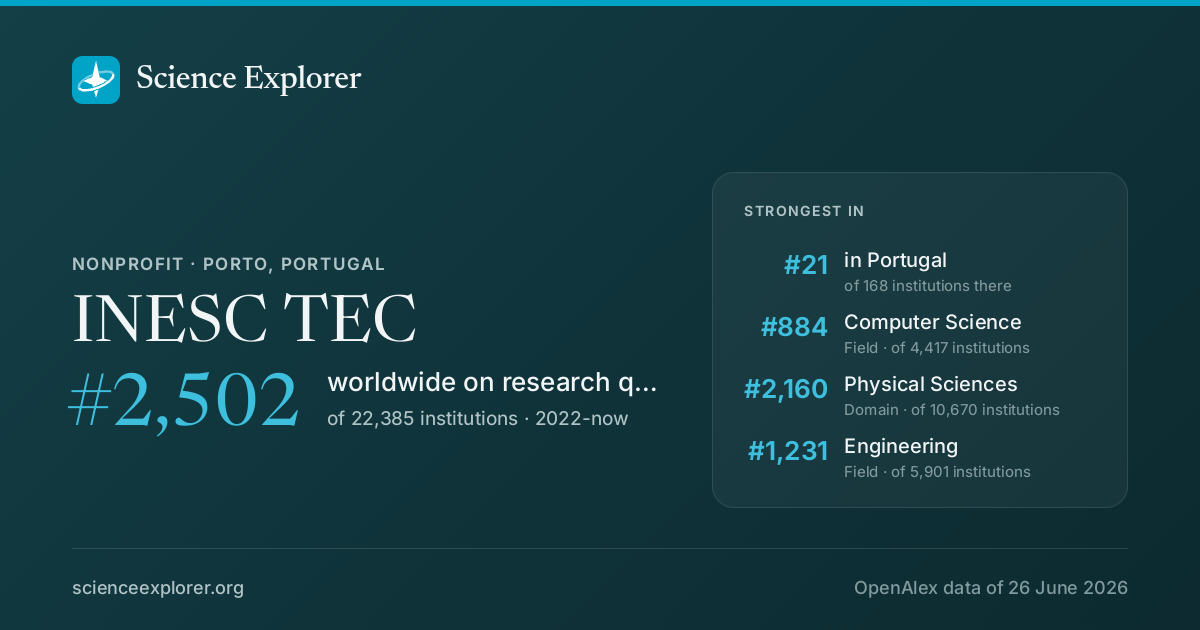
In research, INESC TEC stands highest in Computer Science (#884 of 4,417 worldwide), Physical Sciences (#2,160 of 10,670 worldwide) and Engineering (#1,231 of 5,901 worldwide), 2022-now. Relative to its size it is most specialised in Industrial and Manufacturing Engineering, Human-Computer Interaction and Computer Networks and Communications (Industrial and Manufacturing Engineering is 9.1× its share of world research).
- World rank, 2022-now
- #2,502 of 22,385 · #2,950 all time
- Rank in Portugal
- #21 of 168
- Research works
- 4.6k ▲ 7% vs 2018-21
- Citations
- 67k 14.3 per fractional work
- Top-10% rate
- 10.8% all institutions 10.0%
- vs its own fields
- 0.99× 1.00× is exactly expected
- Open access
- 51% world 40%
- International
- 28% world 18%
What is INESC TEC known for in research?
The fields where it stands highest, 2022-now, ranked among every institution above the floor in each field.
| Field | World rank | Where that sits | Top-10% rate | Works | All time |
|---|---|---|---|---|---|
| Computer ScienceField | #884 of 4,417 | 10.2% | 387 | #833 | |
| Physical SciencesDomain | #2,160 of 10,670 | 9.9% | 1,031 | #2408 | |
| EngineeringField | #1,231 of 5,901 | 9.8% | 506 | #1317 | |
| Business, Management and AccountingField | #1,061 of 2,581 | 15.2% | 99 | #1537 | |
| Social SciencesDomain | #3,948 of 9,585 | 14.3% | 270 | #5137 | |
| Electrical and Electronic EngineeringSubfield | #999 of 2,176 | 7.9% | 171 | #1058 | |
| Artificial IntelligenceSubfield | #910 of 1,862 | 8.5% | 123 | #972 | |
| Health SciencesDomain | #4,840 of 9,902 | 9.1% | 120 | #6018 | |
| Industrial and Manufacturing EngineeringSubfield | #157 of 316 | 15.6% | 71 | #352 | |
| Computer Vision and Pattern RecognitionSubfield | #553 of 963 | 10.0% | 75 | #668 |
Each strip is that field's whole ranked pool, with the notch where INESC TEC sits in it, in the colour of the band that rank falls in. The track under the rate is the rate itself: it carries no average mark, because the average differs by field (from about 6% in Dentistry to 21% in Economics).
Which of those standings moved
The same fields on both windows: where it stood over the whole record, and where it stands in 2022-now. The distance is the story, and it is the one thing the two rank columns above cannot show.
- Computer Science#833 #884
- Physical Sciences#2,408 #2,160
- Engineering#1,317 #1,231
- Business, Management and Accounting#1,537 #1,061
- Social Sciences#5,137 #3,948
- Electrical and Electronic Engineering#1,058 #999
- Artificial Intelligence#972 #910
- Health Sciences#6,018 #4,840
- Industrial and Manufacturing Engineering#352 #157
- Computer Vision and Pattern Recognition#668 #553
A dot further right is a better standing. Fields it was not ranked in over the whole record are left out.
Which fields of science does INESC TEC work in?
In 2022-now, 69% of research at INESC TEC is in Physical Sciences, 18% in Social Sciences. Its largest fields are Engineering (34%), Computer Science (26%), Medicine (7%). It does 1.8× the world's share of Physical Sciences.
Each ring splits the one inside it: the four domains of science, their fields, their subfields. Size is fractional works in 2022-now. Every slice is a page; the interactive view zooms down to single topics and colours each by how much more of it this institution does than the world.
Its 4 domains and 26 fields, with their numbers
- Physical Sciences1,13369.1%
- Engineering55233.7%
- Computer Science42225.7%
- Environmental Science654.0%
- Physics and Astronomy251.6%
- Energy221.3%
- Earth and Planetary Sciences201.2%
- Chemistry100.6%
- Materials Science80.5%
- Mathematics60.3%
- Chemical Engineering50.3%
- Social Sciences29117.8%
- Business, Management and Accounting1046.3%
- Social Sciences835.1%
- Psychology372.3%
- Decision Sciences352.1%
- Economics, Econometrics and Finance221.3%
- Arts and Humanities110.6%
- Health Sciences1348.2%
- Medicine1146.9%
- Health Professions171.0%
- Veterinary20.1%
- Nursing10.1%
- Dentistry10.1%
- Life Sciences804.9%
What does INESC TEC specialise in?
Where its research is concentrated relative to its size: Industrial and Manufacturing Engineering takes 9.1× the share of its output that it takes of world research.
- Industrial and Manufacturing EngineeringSubfield · 76.8 works9.1×
- Human-Computer InteractionSubfield · 23.3 works6.9×
- Computer Networks and CommunicationsSubfield · 61.1 works4.2×
Location quotient, a volume reading rather than an impact one. It surfaces small, lopsided specialities.
Field profile
Location quotient across every field it publishes in: outside the ring is more than an institution of this size would be expected to publish, inside it is less.
Rings at 0.5×, 1× and 2×. Widest outward: Computer Science, 3.3×. Every wedge is a field page.
All 26 fields, with their numbers
- Computer Science3.31×422 works
- Engineering2.25×552 works
- Decision Sciences2.20×35 works
- Business, Management and Accounting1.97×104 works
- Energy1.43×22 works
- Neuroscience0.84×22 works
- Chemical Engineering0.82×5 works
- Environmental Science0.80×65 works
- Earth and Planetary Sciences0.76×20 works
- Psychology0.74×37 works
- Physics and Astronomy0.70×25 works
- Veterinary0.67×2 works
- Economics, Econometrics and Finance0.63×22 works
- Agricultural and Biological Sciences0.48×37 works
- Social Sciences0.40×83 works
- Health Professions0.39×17 works
- Chemistry0.37×10 works
- Medicine0.36×114 works
- Mathematics0.30×6 works
- Biochemistry, Genetics and Molecular Biology0.22×19 works
- Arts and Humanities0.22×11 works
- Nursing0.18×1 works
- Materials Science0.14×8 works
- Dentistry0.13×1 works
- Pharmacology, Toxicology and Pharmaceutics0.12×1 works
- Immunology and Microbiology0.03×0 works
- Computer Science 3.3×
- Engineering 2.2×
- Decision Sciences 2.2×
- Business, Management and Accounting 2.0×
- Energy 1.4×
- Neuroscience 0.8×
- Chemical Engineering 0.8×
- Environmental Science 0.8×
- Earth and Planetary Sciences 0.8×
- Psychology 0.7×
- Physics and Astronomy 0.7×
- Veterinary 0.7×
- Economics, Econometrics and Finance 0.6×
- Agricultural and Biological Sciences 0.5×
- Social Sciences 0.4×
- Health Professions 0.4×
- Chemistry 0.4×
- Medicine 0.4×
- Mathematics 0.3×
- Biochemistry, Genetics and Molecular Biology 0.2×
- Arts and Humanities 0.2×
- Nursing 0.2×
- Materials Science 0.1×
- Dentistry 0.1×
- Pharmacology, Toxicology and Pharmaceutics 0.1×
- Immunology and Microbiology 0.0×
Who are the top researchers at INESC TEC?
Ranked on the quality score, João P. S. Catalào, Mohammad Sadegh Javadi and Ricardo Jorge Bessa lead among researchers whose main affiliation is INESC TEC.
- 1
João P. S. Catalào
 Portugal · #76,374 worldwide
39k citations · 1,144 works
- 2
Mohammad Sadegh Javadi
Portugal · #203,903 worldwide
6k citations · 226 works
- 3
Ricardo Jorge Bessa
Portugal · #256,070 worldwide
8.8k citations · 263 works
- 4
Sérgio Fernando Ferreira Santos
Portugal · #414,369 worldwide
3k citations · 111 works
- 5
Matthew B. Gough
Portugal · #574,402 worldwide
1.7k citations · 62 works
- 6
Filipe Joel Soares
Portugal · #756,940 worldwide
4.7k citations · 142 works
- 7
José Iria
Portugal · #849,473 worldwide
2.3k citations · 88 works
- 8
Mohamed Lotfi
Portugal · #912,932 worldwide
2.3k citations · 87 works
- 9
Saber Talari
Portugal · #963,854 worldwide
1.6k citations · 43 works
- 10
Fabien Gouyon
Portugal · #970,201 worldwide
3.5k citations · 114 works
Which keywords describe research at INESC TEC?
By fractional works in 2022-now, weighted toward what it does more of than the world: Deep Learning, Machine Learning, Renewable Energy, Smart Grid, Sustainability, Neural Networks, Renewable Energy Integration and Big Data.
- Mobile Robots
- Distributed Generation
- Path Planning
- Cloud Manufacturing
- Collision Avoidance
- Texture Analysis
- Classification
- Anomaly Detection
- Security
- Cyber-Physical Systems
- Electricity Markets
- Wireless Sensor Networks
- Energy Management
- Remote Sensing
- Renewable Energy Integration
- Internet of Things
- Supply Chain Management
- Smart Grid
- Sustainability
- Machine Learning
- Deep Learning
- Renewable Energy
- Neural Networks
- Big Data
- Convolutional Neural Networks
- Artificial Intelligence
- Game Theory
- Smart Home
- Feature Extraction
- Demand Response
- Energy Efficiency
- Medical Imaging
- Electric Vehicles
- Optimization
- Distributed Systems
- Digital Twin
- Time Series
- Smart Manufacturing
- Smart Grid Applications
- Energy Storage Systems
Size is fractional works in 2022-now in the topics tagged with each word; colour is the word's share of this institution's work against its share of the world's. The 40 words are chosen for being large and distinctive. Each links to the topic it comes from most.
All 40 words, with their numbers
- Deep Learning196▲ 3.5×75 topics
- Machine Learning153▲ 2.8×75 topics
- Renewable Energy101▲ 4.2×35 topics
- Sustainability94▲ 2.4×43 topics
- Neural Networks77▲ 3.1×33 topics
- Smart Grid62▲ 11×9 topics
- Big Data58▲ 3.7×22 topics
- Supply Chain Management50▲ 3.4×22 topics
- Convolutional Neural Networks47▲ 3.9×14 topics
- Internet of Things46▲ 3.3×18 topics
- Artificial Intelligence43▲ 1.85×31 topics
- Renewable Energy Integration42▲ 7.8×5 topics
- Game Theory39▲ 14×6 topics
- Remote Sensing37▲ 1.84×26 topics
- Smart Home37▲ 14×5 topics
- Energy Management36▲ 13×3 topics
- Feature Extraction34▲ 4.6×10 topics
- Wireless Sensor Networks34▲ 4.7×15 topics
- Demand Response34▲ 23×1 topic
- Electricity Markets34▲ 23×1 topic
- Energy Efficiency33▲ 2.2×29 topics
- Cyber-Physical Systems31▲ 7.1×6 topics
- Medical Imaging30▲ 3.5×8 topics
- Security30▲ 2.7×17 topics
- Electric Vehicles28▲ 5.9×4 topics
- Anomaly Detection25▲ 5.4×5 topics
- Optimization25▲ 3.4×17 topics
- Classification25▲ 3.3×10 topics
- Distributed Systems22▲ 7.9×6 topics
- Texture Analysis22▲ 6.1×3 topics
- Digital Twin21▲ 9.2×2 topics
- Collision Avoidance21▲ 6.9×4 topics
- Time Series20▲ 7.2×3 topics
- Cloud Manufacturing20▲ 13×1 topic
- Smart Manufacturing20▲ 13×1 topic
- Path Planning20▲ 9.6×3 topics
- Smart Grid Applications19▲ 9.2×2 topics
- Distributed Generation19▲ 14×3 topics
- Energy Storage Systems18▲ 8.0×2 topics
- Mobile Robots16▲ 10.0×3 topics
Which research topics does INESC TEC publish most on?
By volume in 2022-now: Smart Grid Energy Management, Digital Transformation in Industry, Microgrid Control and Optimization and Underwater Vehicles and Communication Systems.
Area is fractional works; colour is the subfield each topic belongs to.
- 1 Smart Grid Energy Management Electrical and Electronic Engineering 34 works
- 2 Digital Transformation in Industry Industrial and Manufacturing Engineering 20 works
- 3 Microgrid Control and Optimization Control and Systems Engineering 15 works
- 4 Underwater Vehicles and Communication Systems Ocean Engineering 14 works
- 5 Robotics and Sensor-Based Localization Aerospace Engineering 13 works
- 6 Radiomics and Machine Learning in Medical Imaging Radiology, Nuclear Medicine and Imaging 13 works
- 7 Optimal Power Flow Distribution Electrical and Electronic Engineering 13 works
- 8 Electric Vehicles and Infrastructure Electrical and Electronic Engineering 13 works
- 9 Advanced Manufacturing and Logistics Optimization Industrial and Manufacturing Engineering 12 works
- 10 Advanced Fiber Optic Sensors Electrical and Electronic Engineering 12 works
How open and international is its research?
Against the world's own shares: the tick on each track. Both are shares of its output, so they sit on one scale and can be read against each other as well as against the world.
World: 40% of research is openly available.
World: 18% is written across borders.
How has INESC TEC's research output changed?
Output in 2022-2025 was 7% higher than in 2018-2021.
The same series as a ribbon: one cell per year, darker for more. The line above answers how much; this answers when.
Its share of all research
Growing output can still be a shrinking share: all of science grows. This is INESC TEC as a percentage of every work published that year, 0.0071% in 2024.
Fractional works of INESC TEC over all fractional works that year. How the balance of science has shifted.
How much of it reaches the world top 10%
Year by year, against all institutions in the same year.
Of each year's output, the share that reached the world's 10% most cited for its field and year. Peak 14.8% in 2010.
Other research institutions in Porto
- Universidade do Porto
- Polytechnic Institute of Porto
- Rede de Química e Tecnologia
- Hospital de São João
- Centro Hospitalar do Porto
- Fernando Pessoa University
- Institute of Mechanical Engineering and Industrial Mangement
- Centre for Health Technology and Services Research

Share INESC TEC's ranking
Badges for a website1Each links back here and updates with every snapshot

Research measures only: rankings here say nothing about teaching, admissions or student experience. Comparable institutions and collaboration partners have tabs of their own, above.
Discussion
Ask a question or share a note about INESC TEC. Posts are plain text and can be reported.