Science Explorer Back to mapMap
Discussion
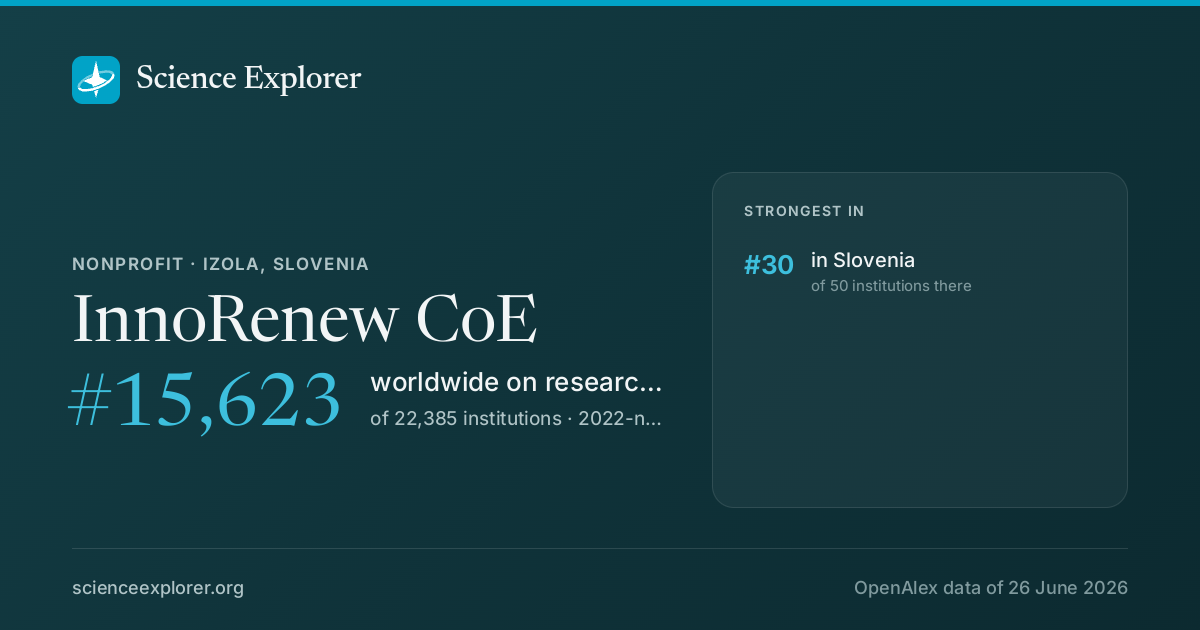
Nonprofit · Izola · Slovenia

InnoRenew CoE

World rank, 2022-now
#15,623
of 22,385 · #23,371 all time
Rank in Slovenia
#30
of 50
Research works
176
▼ 9% vs 2018-21
Citations
1.6k
9.3 per fractional work
Top-10% rate
10.9%
all institutions 10.0%
vs its own fields
0.94×
1.00× is exactly expected
Open access
90%
world 40%
International
40%
world 18%

Which fields of science does InnoRenew CoE work in?

In 2022-now, 48% of research at InnoRenew CoE is in Physical Sciences, 22% in Health Sciences. Its largest fields are Engineering (24%), Medicine (17%), Agricultural and Biological Sciences (8%).

Physical Sciences: 42 fractional works · 47.6% of its workEngineering: 21 fractional works · 23.9% of its workBuilding and Construction: 7 fractional works · 8.0% of its workBiomedical Engineering: 6 fractional works · 7.4% of its workMechanical Engineering: 2 fractional works · 1.9% of its workAutomotive Engineering: 2 fractional works · 1.8% of its workCivil and Structural Engineering: 1 fractional works · 1.4% of its workMechanics of Materials: 1 fractional works · 1.0% of its workIndustrial and Manufacturing Engineering: 1 fractional works · 0.9% of its workArchitecture: 1 fractional works · 0.7% of its workSafety, Risk, Reliability and Quality: 0 fractional works · 0.3% of its workControl and Systems Engineering: 0 fractional works · 0.2% of its workSmaller subfields together: 0 fractional works · 0.4% of its workComputer Science: 7 fractional works · 7.6% of its workArtificial Intelligence: 2 fractional works · 2.1% of its workInformation Systems: 2 fractional works · 2.0% of its workComputer Vision and Pattern Recognition: 1 fractional works · 1.0% of its workComputer Networks and Communications: 1 fractional works · 0.9% of its workComputer Graphics and Computer-Aided Design: 1 fractional works · 0.8% of its workHuman-Computer Interaction: 0 fractional works · 0.5% of its workSmaller subfields together: 0 fractional works · 0.5% of its workMaterials Science: 6 fractional works · 6.3% of its workBiomaterials: 3 fractional works · 3.2% of its workPolymers and Plastics: 2 fractional works · 2.1% of its workMaterials Chemistry: 1 fractional works · 0.8% of its workElectronic, Optical and Magnetic Materials: 0 fractional works · 0.3% of its workEnvironmental Science: 5 fractional works · 6.0% of its workEnvironmental Engineering: 2 fractional works · 2.6% of its workHealth, Toxicology and Mutagenesis: 1 fractional works · 1.2% of its workEcology: 0 fractional works · 0.5% of its workNature and Landscape Conservation: 0 fractional works · 0.5% of its workPollution: 0 fractional works · 0.4% of its workEnvironmental Chemistry: 0 fractional works · 0.3% of its workGlobal and Planetary Change: 0 fractional works · 0.2% of its workSmaller subfields together: 0 fractional works · 0.3% of its workEarth and Planetary Sciences: 1 fractional works · 1.6% of its workEarth-Surface Processes: 1 fractional works · 1.1% of its workGeology: 0 fractional works · 0.5% of its workChemistry: 1 fractional works · 1.5% of its workOrganic Chemistry: 1 fractional works · 0.8% of its workAnalytical Chemistry: 1 fractional works · 0.8% of its workPhysics and Astronomy: 0 fractional works · 0.5% of its workRadiation: 0 fractional works · 0.4% of its workSmaller subfields together: 0 fractional works · 0.1% of its workMathematics: 0 fractional works · 0.1% of its workEnergy: 0 fractional works · 0.1% of its workHealth Sciences: 19 fractional works · 21.6% of its workMedicine: 15 fractional works · 16.9% of its workOrthopedics and Sports Medicine: 8 fractional works · 8.9% of its workPhysiology: 1 fractional works · 1.7% of its workPublic Health, Environmental and Occupational Health: 1 fractional works · 1.2% of its workSurgery: 1 fractional works · 1.1% of its workPharmacology: 1 fractional works · 1.0% of its workComplementary and alternative medicine: 1 fractional works · 0.7% of its workCardiology and Cardiovascular Medicine: 0 fractional works · 0.6% of its workRehabilitation: 0 fractional works · 0.4% of its workRheumatology: 0 fractional works · 0.4% of its workEmergency Medicine: 0 fractional works · 0.3% of its workSmaller subfields together: 1 fractional works · 0.7% of its workHealth Professions: 4 fractional works · 4.4% of its workGeneral Health Professions: 1 fractional works · 1.4% of its workSpeech and Hearing: 1 fractional works · 1.2% of its workPhysical Therapy, Sports Therapy and Rehabilitation: 1 fractional works · 1.0% of its workOccupational Therapy: 1 fractional works · 0.7% of its workSmaller subfields together: 0 fractional works · 0.1% of its workNursing: 0 fractional works · 0.1% of its workVeterinary: 0 fractional works · 0.1% of its workLife Sciences: 14 fractional works · 15.7% of its workAgricultural and Biological Sciences: 7 fractional works · 8.3% of its workPlant Science: 4 fractional works · 5.1% of its workFood Science: 2 fractional works · 1.8% of its workGeneral Agricultural and Biological Sciences: 1 fractional works · 0.9% of its workEcology, Evolution, Behavior and Systematics: 0 fractional works · 0.2% of its workSmaller subfields together: 0 fractional works · 0.3% of its workBiochemistry, Genetics and Molecular Biology: 4 fractional works · 4.6% of its workMolecular Biology: 2 fractional works · 2.8% of its workCell Biology: 1 fractional works · 0.8% of its workGenetics: 0 fractional works · 0.4% of its workStructural Biology: 0 fractional works · 0.4% of its workSmaller subfields together: 0 fractional works · 0.3% of its workNeuroscience: 1 fractional works · 1.7% of its workCognitive Neuroscience: 1 fractional works · 1.2% of its workNeurology: 0 fractional works · 0.2% of its workSmaller subfields together: 0 fractional works · 0.2% of its workImmunology and Microbiology: 1 fractional works · 1.1% of its workMicrobiology: 1 fractional works · 1.1% of its workSocial Sciences: 13 fractional works · 15.1% of its workPsychology: 4 fractional works · 4.4% of its workSocial Psychology: 2 fractional works · 1.8% of its workExperimental and Cognitive Psychology: 1 fractional works · 0.9% of its workClinical Psychology: 1 fractional works · 0.7% of its workApplied Psychology: 0 fractional works · 0.6% of its workDevelopmental and Educational Psychology: 0 fractional works · 0.4% of its workSmaller subfields together: 0 fractional works · 0.0% of its workSocial Sciences: 3 fractional works · 3.7% of its workSociology and Political Science: 2 fractional works · 2.2% of its workTransportation: 0 fractional works · 0.4% of its workPolitical Science and International Relations: 0 fractional works · 0.4% of its workEducation: 0 fractional works · 0.3% of its workDemography: 0 fractional works · 0.2% of its workSmaller subfields together: 0 fractional works · 0.2% of its workBusiness, Management and Accounting: 2 fractional works · 2.6% of its workStrategy and Management: 1 fractional works · 1.5% of its workMarketing: 1 fractional works · 0.9% of its workManagement of Technology and Innovation: 0 fractional works · 0.2% of its workDecision Sciences: 2 fractional works · 2.1% of its workInformation Systems and Management: 1 fractional works · 1.4% of its workManagement Science and Operations Research: 0 fractional works · 0.6% of its workSmaller subfields together: 0 fractional works · 0.1% of its workArts and Humanities: 2 fractional works · 2.0% of its workArcheology: 1 fractional works · 0.8% of its workConservation: 0 fractional works · 0.5% of its workPhilosophy: 0 fractional works · 0.3% of its workSmaller subfields together: 0 fractional works · 0.4% of its workEconomics, Econometrics and Finance: 0 fractional works · 0.3% of its workALL ITS WORKInnoRenew CoE87fractional works, 2022-now
Life Sciences16%Physical Sciences48%Health Sciences22%Social Sciences15%

Each ring splits the one inside it: the four domains of science, their fields, their subfields. Size is fractional works in 2022-now. Every slice is a page; the interactive view zooms down to single topics and colours each by how much more of it this institution does than the world.

Its 4 domains and 23 fields, with their numbers
    1. Engineering2123.9%
    2. Computer Science77.6%
    3. Materials Science66.3%
    4. Environmental Science56.0%
    5. Earth and Planetary Sciences11.6%
    6. Chemistry11.5%
    7. Physics and Astronomy00.5%
    8. Mathematics00.1%
    9. Energy00.1%
    1. Medicine1516.9%
    2. Health Professions44.4%
    3. Nursing00.1%
    4. Veterinary00.1%
    1. Agricultural and Biological Sciences78.3%
    2. Biochemistry, Genetics and Molecular Biology44.6%
    3. Neuroscience11.7%
    4. Immunology and Microbiology11.1%
    1. Psychology44.4%
    2. Social Sciences33.7%
    3. Business, Management and Accounting22.6%
    4. Decision Sciences22.1%
    5. Arts and Humanities22.0%
    6. Economics, Econometrics and Finance00.3%
All of science, and how each field's share has moved since 1950: the Science domain explorer

Field profile

Location quotient across every field it publishes in: outside the ring is more than an institution of this size would be expected to publish, inside it is less.

Agricultural and Biological Sciences: 1.74× its world share, 7 worksAgricultural and Bio…Biochemistry, Genetics and Molecular Biology: 0.87× its world share, 4 worksBiochemistry, Geneti…Immunology and Microbiology: 1.14× its world share, 1 worksImmunology and Micro…Neuroscience: 1.04× its world share, 2 worksNeuroscienceChemistry: 0.97× its world share, 1 worksChemistryComputer Science: 0.98× its world share, 7 worksComputer ScienceEarth and Planetary Sciences: 1.02× its world share, 1 worksEarth and Planetary …Energy: 0.06× its world share, 0 worksEnergyEngineering: 1.59× its world share, 21 worksEngineeringEnvironmental Science: 1.20× its world share, 5 worksEnvironmental ScienceMaterials Science: 1.81× its world share, 6 worksMaterials ScienceMathematics: 0.08× its world share, 0 worksMathematicsPhysics and Astronomy: 0.22× its world share, 0 worksPhysics and AstronomyHealth Professions: 1.69× its world share, 4 worksHealth ProfessionsMedicine: 0.88× its world share, 15 worksMedicineNursing: 0.26× its world share, 0 worksNursingVeterinary: 0.56× its world share, 0 worksVeterinaryArts and Humanities: 0.69× its world share, 2 worksArts and HumanitiesBusiness, Management and Accounting: 0.81× its world share, 2 worksBusiness, Management…Decision Sciences: 2.16× its world share, 2 worksDecision SciencesEconomics, Econometrics and Finance: 0.16× its world share, 0 worksEconomics, Econometr…Psychology: 1.43× its world share, 4 worksPsychologySocial Sciences: 0.30× its world share, 3 worksSocial Sciences1×world share
more than its size predictsabout as predictedless

Rings at 0.5×, 1× and 2×. Widest outward: Decision Sciences, 2.2×. Every wedge is a field page.

All 23 fields, with their numbers
  1. Decision Sciences2.16×2 works
  2. Materials Science1.81×6 works
  3. Agricultural and Biological Sciences1.74×7 works
  4. Health Professions1.69×4 works
  5. Engineering1.59×21 works
  6. Psychology1.43×4 works
  7. Environmental Science1.20×5 works
  8. Immunology and Microbiology1.14×1 works
  9. Neuroscience1.04×2 works
  10. Earth and Planetary Sciences1.02×1 works
  11. Computer Science0.98×7 works
  12. Chemistry0.97×1 works
  13. Medicine0.88×15 works
  14. Biochemistry, Genetics and Molecular Biology0.87×4 works
  15. Business, Management and Accounting0.81×2 works
  16. Arts and Humanities0.69×2 works
  17. Veterinary0.56×0 works
  18. Social Sciences0.30×3 works
  19. Nursing0.26×0 works
  20. Physics and Astronomy0.22×0 works
  21. Economics, Econometrics and Finance0.16×0 works
  22. Mathematics0.08×0 works
  23. Energy0.06×0 works

Who are the top researchers at InnoRenew CoE?

Ranked on the quality score, Erwin M. Schau, Laetitia Marrot and Nežka Sajinčič lead among researchers whose main affiliation is InnoRenew CoE.

  1. 1 Erwin M. Schau Slovenia · #875,210 worldwide 1.9k citations · 26 works
  2. 2 Laetitia Marrot Slovenia · #1,506,984 worldwide 635 citations · 27 works
  3. 3 Nežka Sajinčič Slovenia · #1,611,101 worldwide 159 citations · 21 works
  4. 4 Faksawat Poohphajai Slovenia · #1,792,679 worldwide 193 citations · 23 works
  5. 5 Iztok Šušteršič Slovenia · #2,598,992 worldwide 273 citations · 25 works
  6. 6 Ana Slavec Slovenia · #2,607,059 worldwide 259 citations · 46 works
  7. 7 Mariem Zouari Slovenia · #2,806,535 worldwide 220 citations · 20 works
  8. 8 Kelly Peeters Slovenia · #3,476,847 worldwide 451 citations · 36 works
  9. 9 Uwe Kies Slovenia · #3,564,023 worldwide 234 citations · 77 works
  10. 10 Wojciech Pajerski Slovenia · #4,618,228 worldwide 295 citations · 41 works
All ranked researchers at InnoRenew CoE

What are the most cited papers from InnoRenew CoE?

The most cited paper from InnoRenew CoE is "Advances in microbial self-healing concrete: A critical review of mechanisms, developments, and future directions" (Pui Yan Wong, Joyabrata Mal, Anna Sandak et al., 2024), with 139 citations. Next come "Factors Affecting Attitudes towards COVID-19 Vaccination: An Online Survey in Slovenia" (108) and "Fractionation of lignin using organic solvents: A combined experimental and theoretical study" (105).

Most cited papers
#PaperReleasedCitations
1 Advances in microbial self-healing concrete: A critical review of mechanisms, developments, and future directions Pui Yan Wong, Joyabrata Mal, Anna Sandak et al. · The Science of The Total Environment Open access 5 Jul 2024 139
2 Factors Affecting Attitudes towards COVID-19 Vaccination: An Online Survey in Slovenia Luka Petravić, Rok Arh, Tina Gabrovec et al. · Vaccines Open access 12 Mar 2021 108
3 Fractionation of lignin using organic solvents: A combined experimental and theoretical study Veerapandian Ponnuchamy, Oihana Gordobil, René Herrera Diaz et al. · International Journal of Biological Macromolecules Open access 23 Nov 2020 105
4 HPLC-DAD-ESI-QTOF-MS Determination of Bioactive Compounds and Antioxidant Activity Comparison of the Hydroalcoholic and Water Extracts from Two Helichrysum italicum Species Katja Kramberger, Darja Barlič‐Maganja, Dunja Bandelj et al. · Metabolites Open access 12 Oct 2020 105
5 Diagnostic Balance Tests for Assessing Risk of Falls and Distinguishing Older Adult Fallers and Non-Fallers: A Systematic Review with Meta-Analysis Žiga Kozinc, Stefan Löfler, Christian C. Hofer et al. · Diagnostics ReviewOpen access 3 Sep 2020 80
All 60 most cited papers, with filters and sorting

Which keywords describe research at InnoRenew CoE?

By fractional works in 2022-now, weighted toward what it does more of than the world: Mechanical Properties, Injury Prevention, Athletic Training, Prevention, Muscle Injuries, Sports Injury, High-Intensity Interval Training and Physical Activity.

▲ more of its work than of the world's◆ about the world's share▼ less than the world's

Size is fractional works in 2022-now in the topics tagged with each word; colour is the word's share of this institution's work against its share of the world's. The 40 words are chosen for being large and distinctive. Each links to the topic it comes from most.

All 40 words, with their numbers
  1. Mechanical Properties6▲ 7.5×8 topics
  2. Epidemiology6▲ 1.76×8 topics
  3. Injury Prevention4▲ 40×3 topics
  4. Athletic Training4▲ 52×2 topics
  5. Prevention4▲ 11×2 topics
  6. Public Health4▲ 3.1×6 topics
  7. Risk Factors4▲ 4.1×2 topics
  8. Muscle Injuries4▲ 68×1 topic
  9. Sports Injury4▲ 68×1 topic
  10. High-Intensity Interval Training4▲ 38×2 topics
  11. Environmental Impact4▲ 2.3×8 topics
  12. Biomedical Applications3▲ 3.1×8 topics
  13. Physical Activity3▲ 7.5×6 topics
  14. FTIR Analysis3▲ 194×1 topic
  15. Performance Analysis3▲ 16×1 topic
  16. Phylogenetic Analysis3▲ 11×4 topics
  17. Resistance Training3▲ 38×2 topics
  18. Training Load3▲ 53×1 topic
  19. Wood Chemistry3▲ 194×1 topic
  20. Circular Economy3▲ 12×6 topics
  21. Health Effects2▲ 4.8×5 topics
  22. Natural Fibers2▲ 42×2 topics
  23. Vibration Control2▲ 45×2 topics
  24. Electrical Signals2▲ 234×1 topic
  25. Glutamate Receptor-Like Genes2▲ 234×1 topic
  26. Biomechanics2▲ 8.5×4 topics
  27. Sustainable Construction2▲ 33×3 topics
  28. Gait Analysis2▲ 26×2 topics
  29. Catalytic Transformation2▲ 71×1 topic
  30. Cultural Heritage2▲ 4.2×4 topics
  31. Lignin Valorization2▲ 71×1 topic
  32. Physical Fitness2▲ 16×3 topics
  33. Environmental Management2▲ 5.4×3 topics
  34. Biodegradable Polymers2▲ 10×3 topics
  35. Sustainable Architecture2▲ 77×2 topics
  36. Biomass2▲ 15×4 topics
  37. Bioremediation2▲ 14×2 topics
  38. Composites2▲ 22×1 topic
  39. Sound Quality2▲ 133×1 topic
  40. Transfer Path Analysis2▲ 133×1 topic

Which research topics does InnoRenew CoE publish most on?

By volume in 2022-now: Sports injuries and prevention, Wood Treatment and Properties, Sports Performance and Training and Plant and Biological Electrophysiology Studies.

  1. 1 Sports injuries and prevention Orthopedics and Sports Medicine 4 works
  2. 2 Wood Treatment and Properties Building and Construction 3 works
  3. 3 Sports Performance and Training Orthopedics and Sports Medicine 3 works
  4. 4 Plant and Biological Electrophysiology Studies Plant Science 2 works
  5. 5 Lignin and Wood Chemistry Biomedical Engineering 2 works
  6. 6 Vehicle Noise and Vibration Control Automotive Engineering 2 works
  7. 7 Natural Fiber Reinforced Composites Polymers and Plastics 2 works
  8. 8 Physical Activity and Health Physiology 1 works
  9. 9 Muscle activation and electromyography studies Biomedical Engineering 1 works
  10. 10 biodegradable polymer synthesis and properties Biomaterials 1 works

How open and international is its research?

Against the world's own shares: the tick on each track. Both are shares of its output, so they sit on one scale and can be read against each other as well as against the world.

openly available89.7%not open10.3%

World: 40% of research is openly available.

with international co-authors39.7%domestic only60.3%

World: 18% is written across borders.

How has InnoRenew CoE's research output changed?

Output in 2022-2025 was 9% lower than in 2018-2021.

still counting20202025
grewheldshrank

The same series as a ribbon: one cell per year, darker for more. The line above answers how much; this answers when.

Share InnoRenew CoE's ranking

InnoRenew CoE on Science Explorer

A card with InnoRenew CoE's standing and the fields it leads in, for a post or a slide. A link to this page previews as the same card.

Download the card

1200 × 630 PNG, sized for social posts, drawn from the latest snapshot.

Badges for a website1Each links back here and updates with every snapshot

Research measures only: rankings here say nothing about teaching, admissions or student experience. Comparable institutions and collaboration partners have tabs of their own, above.

Discussion

Ask a question or share a note about InnoRenew CoE. Posts are plain text and can be reported.