Science Explorer Back to mapMap
Discussion
University · Libreville · Gabon

Institut Africain d'Informatique

World rank, all time
#24,352
of 34,923
Rank in Gabon
#7
of 8
Research works
182
◆ 2% vs 2018-21
Citations
3.2k
17.4 per fractional work
Top-10% rate
5.8%
all institutions 10.0%
vs its own fields
0.91×
1.00× is exactly expected
Open access
61%
world 40%
International
55%
world 18%

Which fields of science does Institut Africain d'Informatique work in?

In 2022-now, 36% of research at Institut Africain d'Informatique is in Physical Sciences, 27% in Life Sciences. Its largest fields are Environmental Science (18%), Agricultural and Biological Sciences (17%), Medicine (16%). It does 1.7× the world's share of Life Sciences.

Physical Sciences: 17 fractional works · 35.8% of its workEnvironmental Science: 8 fractional works · 17.8% of its workEcology: 3 fractional works · 7.4% of its workGlobal and Planetary Change: 2 fractional works · 3.5% of its workNature and Landscape Conservation: 1 fractional works · 3.0% of its workManagement, Monitoring, Policy and Law: 1 fractional works · 1.2% of its workEnvironmental Engineering: 0 fractional works · 1.1% of its workEcological Modeling: 0 fractional works · 0.9% of its workWater Science and Technology: 0 fractional works · 0.6% of its workSmaller subfields together: 0 fractional works · 0.2% of its workComputer Science: 3 fractional works · 7.3% of its workInformation Systems: 1 fractional works · 2.1% of its workComputational Theory and Mathematics: 1 fractional works · 1.4% of its workComputer Vision and Pattern Recognition: 1 fractional works · 1.3% of its workComputer Networks and Communications: 0 fractional works · 0.9% of its workArtificial Intelligence: 0 fractional works · 0.6% of its workComputer Graphics and Computer-Aided Design: 0 fractional works · 0.5% of its workSignal Processing: 0 fractional works · 0.3% of its workEngineering: 3 fractional works · 5.8% of its workControl and Systems Engineering: 1 fractional works · 2.4% of its workComputational Mechanics: 1 fractional works · 1.4% of its workBiomedical Engineering: 1 fractional works · 1.2% of its workIndustrial and Manufacturing Engineering: 0 fractional works · 0.5% of its workSmaller subfields together: 0 fractional works · 0.3% of its workMathematics: 1 fractional works · 2.5% of its workApplied Mathematics: 1 fractional works · 1.4% of its workMathematical Physics: 0 fractional works · 0.4% of its workModeling and Simulation: 0 fractional works · 0.4% of its workStatistics and Probability: 0 fractional works · 0.4% of its workEarth and Planetary Sciences: 0 fractional works · 0.8% of its workAtmospheric Science: 0 fractional works · 0.4% of its workSmaller subfields together: 0 fractional works · 0.4% of its workEnergy: 0 fractional works · 0.6% of its workRenewable Energy, Sustainability and the Environment: 0 fractional works · 0.6% of its workPhysics and Astronomy: 0 fractional works · 0.4% of its workStatistical and Nonlinear Physics: 0 fractional works · 0.4% of its workSmaller subfields together: 0 fractional works · 0.0% of its workMaterials Science: 0 fractional works · 0.3% of its workBiomaterials: 0 fractional works · 0.3% of its workChemistry: 0 fractional works · 0.2% of its workLife Sciences: 13 fractional works · 27.3% of its workAgricultural and Biological Sciences: 8 fractional works · 16.7% of its workEcology, Evolution, Behavior and Systematics: 3 fractional works · 5.7% of its workPlant Science: 2 fractional works · 4.8% of its workInsect Science: 1 fractional works · 2.2% of its workForestry: 1 fractional works · 2.1% of its workAquatic Science: 0 fractional works · 0.8% of its workFood Science: 0 fractional works · 0.6% of its workSoil Science: 0 fractional works · 0.4% of its workSmaller subfields together: 0 fractional works · 0.2% of its workBiochemistry, Genetics and Molecular Biology: 4 fractional works · 7.8% of its workMolecular Biology: 1 fractional works · 3.2% of its workGenetics: 1 fractional works · 2.6% of its workBiotechnology: 0 fractional works · 0.7% of its workDevelopmental Biology: 0 fractional works · 0.6% of its workClinical Biochemistry: 0 fractional works · 0.4% of its workBiophysics: 0 fractional works · 0.2% of its workSmaller subfields together: 0 fractional works · 0.2% of its workImmunology and Microbiology: 1 fractional works · 2.2% of its workVirology: 0 fractional works · 1.1% of its workParasitology: 0 fractional works · 0.8% of its workImmunology: 0 fractional works · 0.2% of its workSmaller subfields together: 0 fractional works · 0.1% of its workPharmacology, Toxicology and Pharmaceutics: 0 fractional works · 0.5% of its workPharmacology: 0 fractional works · 0.5% of its workNeuroscience: 0 fractional works · 0.0% of its workHealth Sciences: 10 fractional works · 20.6% of its workMedicine: 8 fractional works · 16.4% of its workPublic Health, Environmental and Occupational Health: 2 fractional works · 4.1% of its workInfectious Diseases: 1 fractional works · 2.4% of its workPediatrics, Perinatology and Child Health: 1 fractional works · 2.1% of its workPulmonary and Respiratory Medicine: 1 fractional works · 1.8% of its workSurgery: 1 fractional works · 1.6% of its workEpidemiology: 1 fractional works · 1.1% of its workCardiology and Cardiovascular Medicine: 0 fractional works · 0.9% of its workRadiology, Nuclear Medicine and Imaging: 0 fractional works · 0.8% of its workObstetrics and Gynecology: 0 fractional works · 0.7% of its workEmergency Medicine: 0 fractional works · 0.3% of its workOphthalmology: 0 fractional works · 0.2% of its workPhysiology: 0 fractional works · 0.2% of its workSmaller subfields together: 0 fractional works · 0.2% of its workHealth Professions: 2 fractional works · 3.6% of its workGeneral Health Professions: 2 fractional works · 3.6% of its workNursing: 0 fractional works · 0.3% of its workNutrition and Dietetics: 0 fractional works · 0.3% of its workVeterinary: 0 fractional works · 0.2% of its workSmall Animals: 0 fractional works · 0.2% of its workSocial Sciences: 8 fractional works · 16.3% of its workSocial Sciences: 2 fractional works · 4.8% of its workAnthropology: 1 fractional works · 1.5% of its workSociology and Political Science: 1 fractional works · 1.2% of its workEducation: 0 fractional works · 0.7% of its workPolitical Science and International Relations: 0 fractional works · 0.4% of its workCultural Studies: 0 fractional works · 0.4% of its workHealth: 0 fractional works · 0.3% of its workGeography, Planning and Development: 0 fractional works · 0.3% of its workArts and Humanities: 2 fractional works · 3.6% of its workPhilosophy: 1 fractional works · 2.2% of its workLiterature and Literary Theory: 0 fractional works · 1.1% of its workLanguage and Linguistics: 0 fractional works · 0.4% of its workSmaller subfields together: 0 fractional works · 0.0% of its workPsychology: 2 fractional works · 3.3% of its workSocial Psychology: 1 fractional works · 3.2% of its workSmaller subfields together: 0 fractional works · 0.1% of its workBusiness, Management and Accounting: 1 fractional works · 2.4% of its workBusiness and International Management: 1 fractional works · 2.2% of its workStrategy and Management: 0 fractional works · 0.3% of its workEconomics, Econometrics and Finance: 1 fractional works · 2.1% of its workEconomics and Econometrics: 1 fractional works · 1.8% of its workGeneral Economics, Econometrics and Finance: 0 fractional works · 0.3% of its workALL ITS WORKInstitut Africaind'Informatique46fractional works, 2022-now
Life Sciences27%Physical Sciences36%Health Sciences21%Social Sciences16%

Each ring splits the one inside it: the four domains of science, their fields, their subfields. Size is fractional works in 2022-now. Every slice is a page; the interactive view zooms down to single topics and colours each by how much more of it this institution does than the world.

Its 4 domains and 23 fields, with their numbers
    1. Environmental Science817.8%
    2. Computer Science37.3%
    3. Engineering35.8%
    4. Mathematics12.5%
    5. Earth and Planetary Sciences00.8%
    6. Energy00.6%
    7. Physics and Astronomy00.4%
    8. Materials Science00.3%
    9. Chemistry00.2%
    1. Agricultural and Biological Sciences816.7%
    2. Biochemistry, Genetics and Molecular Biology47.8%
    3. Immunology and Microbiology12.2%
    4. Pharmacology, Toxicology and Pharmaceutics00.5%
    5. Neuroscience00.0%
    1. Medicine816.4%
    2. Health Professions23.6%
    3. Nursing00.3%
    4. Veterinary00.2%
    1. Social Sciences24.8%
    2. Arts and Humanities23.6%
    3. Psychology23.3%
    4. Business, Management and Accounting12.4%
    5. Economics, Econometrics and Finance12.1%
All of science, and how each field's share has moved since 1950: the Science domain explorer

Field profile

Location quotient across every field it publishes in: outside the ring is more than an institution of this size would be expected to publish, inside it is less.

Agricultural and Biological Sciences: 3.51× its world share, 8 worksAgricultural and Bio…Biochemistry, Genetics and Molecular Biology: 1.46× its world share, 4 worksBiochemistry, Geneti…Immunology and Microbiology: 2.22× its world share, 1 worksImmunology and Micro…Neuroscience: 0.03× its world share, 0 worksNeurosciencePharmacology, Toxicology and Pharmaceutics: 1.53× its world share, 0 worksPharmacology, Toxico…Chemistry: 0.12× its world share, 0 worksChemistryComputer Science: 0.94× its world share, 3 worksComputer ScienceEarth and Planetary Sciences: 0.51× its world share, 0 worksEarth and Planetary …Energy: 0.70× its world share, 0 worksEnergyEngineering: 0.39× its world share, 3 worksEngineeringEnvironmental Science: 3.59× its world share, 8 worksEnvironmental ScienceMaterials Science: 0.08× its world share, 0 worksMaterials ScienceMathematics: 2.14× its world share, 1 worksMathematicsPhysics and Astronomy: 0.18× its world share, 0 worksPhysics and AstronomyHealth Professions: 1.35× its world share, 2 worksHealth ProfessionsMedicine: 0.86× its world share, 8 worksMedicineNursing: 0.67× its world share, 0 worksNursingVeterinary: 1.80× its world share, 0 worksVeterinaryArts and Humanities: 1.26× its world share, 2 worksArts and HumanitiesBusiness, Management and Accounting: 0.75× its world share, 1 worksBusiness, Management…Economics, Econometrics and Finance: 0.98× its world share, 1 worksEconomics, Econometr…Psychology: 1.08× its world share, 2 worksPsychologySocial Sciences: 0.38× its world share, 2 worksSocial Sciences1×world share
more than its size predictsabout as predictedless

Rings at 0.5×, 1× and 2×. Widest outward: Environmental Science, 3.6×. Every wedge is a field page.

All 23 fields, with their numbers
  1. Environmental Science3.59×8 works
  2. Agricultural and Biological Sciences3.51×8 works
  3. Immunology and Microbiology2.22×1 works
  4. Mathematics2.14×1 works
  5. Veterinary1.80×0 works
  6. Pharmacology, Toxicology and Pharmaceutics1.53×0 works
  7. Biochemistry, Genetics and Molecular Biology1.46×4 works
  8. Health Professions1.35×2 works
  9. Arts and Humanities1.26×2 works
  10. Psychology1.08×2 works
  11. Economics, Econometrics and Finance0.98×1 works
  12. Computer Science0.94×3 works
  13. Medicine0.86×8 works
  14. Business, Management and Accounting0.75×1 works
  15. Energy0.70×0 works
  16. Nursing0.67×0 works
  17. Earth and Planetary Sciences0.51×0 works
  18. Engineering0.39×3 works
  19. Social Sciences0.38×2 works
  20. Physics and Astronomy0.18×0 works
  21. Chemistry0.12×0 works
  22. Materials Science0.08×0 works
  23. Neuroscience0.03×0 works

Who are the top researchers at Institut Africain d'Informatique?

Ranked on the quality score, Donald Midoko Iponga, Sally A. Lahm and Chimène Nze-Nkogue lead among researchers whose main affiliation is Institut Africain d'Informatique.

  1. 1 Donald Midoko Iponga Gabon · #704,431 worldwide 1.3k citations · 68 works
  2. 2 Sally A. Lahm Gabon · #1,597,243 worldwide 2k citations · 23 works
  3. 3 Chimène Nze-Nkogue Gabon · #2,466,945 worldwide 876 citations · 16 works
  4. 4 Christian Mikolo Yobo Gabon · #2,534,055 worldwide 173 citations · 24 works
  5. 5 L. Teillier Gabon · #3,151,290 worldwide 44 citations · 16 works
  6. 6 Ghislain Wilfried Ebang Ella Gabon · #3,625,602 worldwide 51 citations · 15 works
  7. 7 Etienne François Akomo-Okoue Gabon · #3,809,532 worldwide 305 citations · 42 works
  8. 8 Maroufath Lamidi Gabon · #4,175,064 worldwide 206 citations · 16 works
  9. 9 Line Edwige Mengome Gabon · #4,547,105 worldwide 114 citations · 19 works
  10. 10 Rodrigue Mintsa Nguéma Gabon · #4,777,829 worldwide 581 citations · 54 works
All ranked researchers at Institut Africain d'Informatique

What are the most cited papers from Institut Africain d'Informatique?

The most cited paper from Institut Africain d'Informatique is "Asynchronous carbon sink saturation in African and Amazonian tropical forests" (Wannes Hubau et al., 2020), with 968 citations. Next come "Catastrophic ape decline in western equatorial Africa" (690) and "Epidemiology and Burden of Human Papillomavirus and Related Diseases, Molecular Pathogenesis, and Vaccine Evaluation" (666).

Most cited papers
#PaperReleasedCitations
1 Asynchronous carbon sink saturation in African and Amazonian tropical forests Wannes Hubau et al. · Nature Open access106 authors 4 Mar 2020 968
2 Catastrophic ape decline in western equatorial Africa Peter D. Walsh et al. · Nature Apr 2003 690
3 Epidemiology and Burden of Human Papillomavirus and Related Diseases, Molecular Pathogenesis, and Vaccine Evaluation Arnaud John Kombe Kombe, Bofeng Li, Ayesha Zahid et al. · Frontiers in Public Health Open access 20 Jan 2021 666
4 Fruit characters as a basis of fruit choice and seed dispersal in a tropical forest vertebrate community A. Gautier-Hion, Jean-Marc Duplantier, René Quris et al. · Oecologia Feb 1985 661
5 Bushmeat hunting and extinction risk to the world's mammals William J. Ripple, Katharine A. Abernethy, Matthew G. Betts et al. · Royal Society Open Science Open access Oct 2016 641
All 60 most cited papers, with filters and sorting

Which keywords describe research at Institut Africain d'Informatique?

By fractional works in 2022-now, weighted toward what it does more of than the world: Climate Change, Biodiversity, Population Dynamics, Smallholder Farmers, Biodiversity Conservation, Evolution, Adaptation and Epidemiology.

▲ more of its work than of the world's◆ about the world's share▼ less than the world's

Size is fractional works in 2022-now in the topics tagged with each word; colour is the word's share of this institution's work against its share of the world's. The 40 words are chosen for being large and distinctive. Each links to the topic it comes from most.

All 40 words, with their numbers
  1. Climate Change5▲ 4.2×30 topics
  2. Epidemiology4▲ 2.1×26 topics
  3. Sustainability3▲ 2.5×11 topics
  4. Biodiversity3▲ 7.6×12 topics
  5. Population Dynamics2▲ 21×8 topics
  6. Smallholder Farmers2▲ 24×3 topics
  7. Biodiversity Conservation2▲ 12×8 topics
  8. Evolution2▲ 17×3 topics
  9. Adaptation2▲ 14×3 topics
  10. Invasive Species2▲ 9.8×11 topics
  11. Communication2▲ 12×2 topics
  12. Diversity2▲ 19×2 topics
  13. Deep Learning2◆ 0.95×12 topics
  14. Vector Control2▲ 27×4 topics
  15. Agroecology1▲ 21×2 topics
  16. Animal Movement1▲ 58×1 topic
  17. Conservation1▲ 7.2×9 topics
  18. Habitat Selection1▲ 42×2 topics
  19. Internet of Things1▲ 3.5×4 topics
  20. Occupancy Rates1▲ 58×1 topic
  21. Primates1▲ 160×1 topic
  22. Social Behavior1▲ 53×1 topic
  23. Vaccine Development1▲ 12×4 topics
  24. Agricultural Development1▲ 19×1 topic
  25. Livestock Farming1▲ 49×1 topic
  26. Global Change1▲ 10×4 topics
  27. Phylogeny1▲ 16×5 topics
  28. Public Health1▲ 1.72×8 topics
  29. Biomass Estimation1▲ 16×3 topics
  30. Climate Resilience1▲ 40×2 topics
  31. Cultural Studies1▲ 6.5×3 topics
  32. Ethics1▲ 4.5×6 topics
  33. Cross-Border E-Commerce1▲ 46×1 topic
  34. DNA Barcoding1▲ 13×5 topics
  35. Digital Technologies1▲ 17×2 topics
  36. Economic Development1▲ 2.8×2 topics
  37. Logistics1▲ 14×1 topic
  38. Smart Home System1▲ 213×1 topic
  39. Sustainable Agriculture1▲ 7.0×3 topics
  40. Wireless Sensor Networks1▲ 4.8×1 topic

Which research topics does Institut Africain d'Informatique publish most on?

By volume in 2022-now: Wildlife Ecology and Conservation, Primate Behavior and Ecology, Agriculture and Rural Development Research and African Botany and Ecology Studies.

  1. 1 Wildlife Ecology and Conservation Ecology 1 works
  2. 2 Primate Behavior and Ecology Social Psychology 1 works
  3. 3 Agriculture and Rural Development Research Ecology, Evolution, Behavior and Systematics 1 works
  4. 4 African Botany and Ecology Studies Forestry 1 works
  5. 5 E-commerce and Technology Innovations Business and International Management 1 works
  6. 6 Wireless Sensor Networks and IoT Control and Systems Engineering 1 works
  7. 7 Mosquito-borne diseases and control Public Health, Environmental and Occupational Health 1 works
  8. 8 Health, Medicine and Society General Health Professions 1 works
  9. 9 Navier-Stokes equation solutions Applied Mathematics 1 works
  10. 10 Fluid dynamics and aerodynamics studies Computational Mechanics 1 works

How open and international is its research?

Against the world's own shares: the tick on each track. Both are shares of its output, so they sit on one scale and can be read against each other as well as against the world.

openly available60.8%not open39.2%

World: 40% of research is openly available.

with international co-authors54.9%domestic only45.1%

World: 18% is written across borders.

How has Institut Africain d'Informatique's research output changed?

Output in 2022-2025 was 2% lower than in 2018-2021.

still counting1990200020102020
grewheldshrank

The same series as a ribbon: one cell per year, darker for more. The line above answers how much; this answers when.

Its share of all research

Growing output can still be a shrinking share: all of science grows. This is Institut Africain d'Informatique as a percentage of every work published that year, 0.00018% in 2024.

still counting0.00050%0.0010%Institut Africain d'Informatique0.000093% in 202519801990200020102020

Fractional works of Institut Africain d'Informatique over all fractional works that year. How the balance of science has shifted.

Other research institutions in Libreville

All research institutions in Libreville

Share Institut Africain d'Informatique's ranking
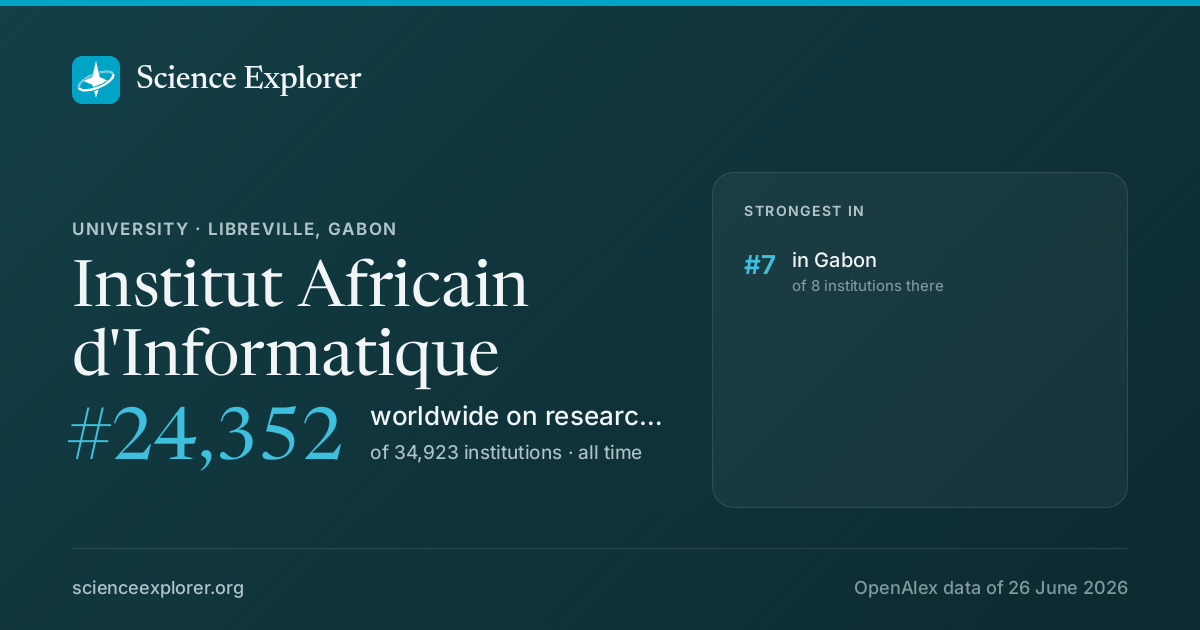
Institut Africain d'Informatique on Science Explorer

A card with Institut Africain d'Informatique's standing and the fields it leads in, for a post or a slide. A link to this page previews as the same card.

Download the card

1200 × 630 PNG, sized for social posts, drawn from the latest snapshot.

Badges for a website1Each links back here and updates with every snapshot

Research measures only: rankings here say nothing about teaching, admissions or student experience. Comparable institutions and collaboration partners have tabs of their own, above.

Discussion

Ask a question or share a note about Institut Africain d'Informatique. Posts are plain text and can be reported.