 Science in Gabon
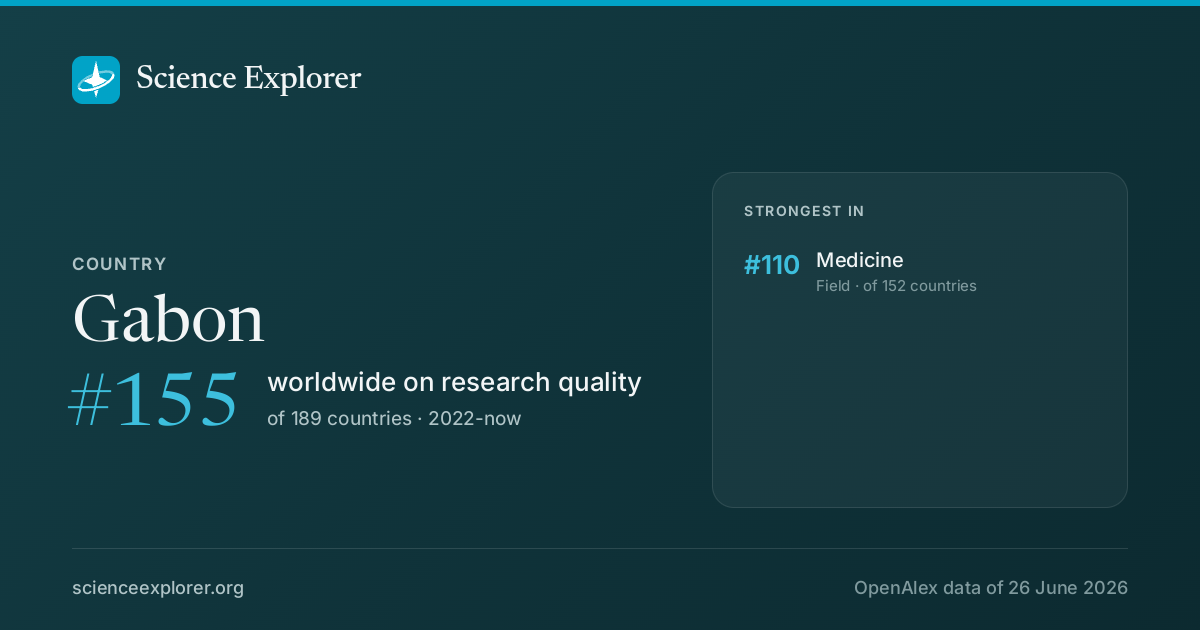
Gabon ranks #155 of 189 countries on research quality in 2022-now (#146 all time), with 782 research works and 5.4% of them in the world's top 10%.
- World rank, 2022-now
- #155 of 189 · #146 all time
- Works, 2022-now
- 782 ▲ 38% vs 2018-21
- Citations
- 46k 13.9 per fractional work, all time
- Top-10% rate
- 5.4% all institutions 10.0%
- vs its own fields
- 0.74× 1.00× is exactly expected
- In the world top 100
- 0 0 in the top 1,000
- Open access
- 60% world 40%
- International
- 47% world 18%
GabonWhat is Gabon strongest at in science?
On research quality in 2022-now, Gabon ranks highest in Medicine (#110 of 152). Relative to its size it is most specialised in Parasitology, Forestry and Virology.
| Field | World rank | Where that sits | Top-10% rate | Works | All time | Institutions |
|---|---|---|---|---|---|---|
| MedicineField | #110 of 152 | 3.9% | 329 | #112 | Institutions |
Where its research is concentrated
Location quotient: how much more (or less) of each node it does than its size predicts. Drawn around 1×, where "twice the world share" and "half of it" are the same distance apart in opposite directions. A volume reading, which on a country axis is largely population and industrial structure.
- ParasitologySubfield · 23.7 works · #88 of 211 active here23×
- ForestrySubfield · 12.3 works · #101 of 204 active here12×
- VirologySubfield · 6.2 works · #104 of 204 active here11×
- HorticultureSubfield · 1.3 works · #109 of 178 active here10.0×
- Infectious DiseasesSubfield · 66.8 works · #110 of 221 active here9.9×
- Applied Microbiology and BiotechnologySubfield · 3.1 works · #131 of 202 active here6.3×
- EndocrinologySubfield · 4.7 works · #126 of 203 active here6.1×
- Public Health, Environmental and Occupational HealthSubfield · 73.1 works · #128 of 224 active here5.6×
The whole field profile
All 26 fields at once. A specialist and a generalist produce the same ranked list and a completely different shape.
Rings at 0.5×, 1× and 2×. Widest outward: Immunology and Microbiology, 4.8×. Every wedge is a field page.
All 26 fields, with their numbers
- Immunology and Microbiology4.75×48 works
- Medicine2.31×441 works
- Veterinary2.10×3 works
- Health Professions1.86×49 works
- Agricultural and Biological Sciences1.55×73 works
- Economics, Econometrics and Finance1.44×31 works
- Mathematics1.29×15 works
- Pharmacology, Toxicology and Pharmaceutics1.10×4 works
- Nursing1.09×5 works
- Environmental Science1.08×53 works
- Biochemistry, Genetics and Molecular Biology0.94×50 works
- Arts and Humanities0.74×21 works
- Social Sciences0.70×88 works
- Psychology0.41×12 works
- Earth and Planetary Sciences0.37×6 works
- Computer Science0.34×26 works
- Business, Management and Accounting0.33×10 works
- Physics and Astronomy0.32×7 works
- Energy0.29×3 works
- Dentistry0.27×1 works
- Chemistry0.25×4 works
- Engineering0.22×33 works
- Decision Sciences0.20×2 works
- Chemical Engineering0.19×1 works
- Materials Science0.16×6 works
- Neuroscience0.11×2 works
Which fields of science does Gabon work in?
In 2022-now, 50% of research in Gabon is in Health Sciences, 18% in Life Sciences. Its largest fields are Medicine (44%), Social Sciences (9%), Agricultural and Biological Sciences (7%). It does 2.2× the world's share of Health Sciences.
Each ring splits the one inside it: the four domains of science, their fields, their subfields. Size is fractional works in 2022-now. Every slice is a page; the interactive view zooms down to single topics and colours each by how much more of it this country does than the world.
Its 4 domains and 26 fields, with their numbers
- Health Sciences50050.3%
- Medicine44144.4%
- Health Professions494.9%
- Nursing50.5%
- Veterinary30.3%
- Dentistry10.1%
- Life Sciences17617.7%
- Social Sciences16516.6%
- Social Sciences888.9%
- Economics, Econometrics and Finance313.1%
- Arts and Humanities212.1%
- Psychology121.2%
- Business, Management and Accounting101.1%
- Decision Sciences20.2%
- Physical Sciences15415.5%
- Environmental Science535.4%
- Engineering333.3%
- Computer Science262.7%
- Mathematics151.5%
- Physics and Astronomy70.7%
- Earth and Planetary Sciences60.6%
- Materials Science60.6%
- Chemistry40.4%
- Energy30.3%
- Chemical Engineering10.1%
Which keywords describe research in Gabon?
By fractional works in 2022-now, weighted toward what it does more of than the world: Epidemiology, Vaccine Development, Global Burden, Immune Response, Public Health, Vaccine, Insecticide Resistance and Helminth Infections.
- Agroecology
- Onchocerciasis
- Diversity
- ACE2 Receptor
- Soil-Transmitted Helminths
- Immunomodulation
- Immune Regulation
- Zoonotic Infections
- Zika Virus
- Global Epidemiology
- Biodiversity Conservation
- Vector Control
- Pathogenesis
- Plasmodium falciparum
- Genome Sequence
- Insecticide Resistance
- Vaccine
- Climate Change
- Global Burden
- Vaccine Development
- Epidemiology
- Public Health
- Immune Response
- Diagnosis
- Treatment
- Helminth Infections
- Artemisinin Resistance
- Smallholder Farmers
- Risk Factors
- Drug Resistance
- SARS-CoV-2
- Arboviral Diseases
- Disease Burden
- Adaptation
- Antiretroviral Therapy
- Schistosomiasis
- Ivermectin
- Agroforestry
- Lymphatic Filariasis
- Nutritional Value
Size is fractional works in 2022-now in the topics tagged with each word; colour is the word's share of this country's work against its share of the world's. The 40 words are chosen for being large and distinctive. Each links to the topic it comes from most.
All 40 words, with their numbers
- Epidemiology180▲ 4.5×116 topics
- Vaccine Development53▲ 21×11 topics
- Public Health51▲ 3.5×36 topics
- Global Burden47▲ 8.7×12 topics
- Immune Response41▲ 7.3×19 topics
- Climate Change39▲ 1.44×56 topics
- Diagnosis34▲ 3.7×37 topics
- Vaccine32▲ 8.1×11 topics
- Treatment32▲ 2.6×35 topics
- Insecticide Resistance31▲ 39×4 topics
- Helminth Infections29▲ 70×2 topics
- Genome Sequence28▲ 34×2 topics
- Artemisinin Resistance26▲ 79×1 topic
- Plasmodium falciparum26▲ 79×1 topic
- Smallholder Farmers26▲ 12×5 topics
- Pathogenesis25▲ 4.9×20 topics
- Risk Factors24▲ 2.2×25 topics
- Vector Control23▲ 20×4 topics
- Drug Resistance20▲ 7.0×9 topics
- Biodiversity Conservation18▲ 5.0×9 topics
- SARS-CoV-218▲ 6.0×5 topics
- Global Epidemiology17▲ 39×2 topics
- Arboviral Diseases17▲ 27×1 topic
- Zika Virus17▲ 27×1 topic
- Disease Burden17▲ 23×2 topics
- Zoonotic Infections17▲ 31×2 topics
- Adaptation17▲ 5.6×9 topics
- Immune Regulation16▲ 14×4 topics
- Antiretroviral Therapy16▲ 9.5×6 topics
- Immunomodulation16▲ 12×2 topics
- Schistosomiasis15▲ 55×1 topic
- Soil-Transmitted Helminths15▲ 55×1 topic
- Ivermectin15▲ 54×2 topics
- ACE2 Receptor14▲ 6.3×3 topics
- Agroforestry14▲ 20×3 topics
- Diversity14▲ 7.8×2 topics
- Lymphatic Filariasis14▲ 104×1 topic
- Onchocerciasis14▲ 104×1 topic
- Nutritional Value13▲ 12×3 topics
- Agroecology12▲ 8.8×2 topics
Which research topics does Gabon publish the most in?
Its largest topics in 2022-now are Malaria Research and Control, Mosquito-borne diseases and control, Parasites and Host Interactions.
Area is fractional works in 2022-now; colour is the subfield each topic belongs to. Every tile is a topic page.
- 1 Malaria Research and Control Public Health, Environmental and Occupational Health 26 works
- 2 Mosquito-borne diseases and control Public Health, Environmental and Occupational Health 17 works
- 3 Parasites and Host Interactions Parasitology 15 works
- 4 Parasitic Diseases Research and Treatment Infectious Diseases 13 works
- 5 Agriculture and Rural Development Research Ecology, Evolution, Behavior and Systematics 12 works
- 6 African Botany and Ecology Studies Forestry 12 works
- 7 Health, Medicine and Society General Health Professions 10 works
- 8 African Studies and Ethnography Sociology and Political Science 9 works
- 9 Healthcare Systems and Practices General Health Professions 9 works
- 10 French Urban and Social Studies Sociology and Political Science 8 works
- 11 COVID-19 Clinical Research Studies Infectious Diseases 7 works
- 12 Global Maternal and Child Health Pediatrics, Perinatology and Child Health 6 works
Which universities in Gabon lead research?
Omar Bongo University, Université des Sciences et Techniques de Masuku and Université des Sciences de la Santé rank highest in Gabon on research quality in 2022-now.
One dot per institution in the list below. The upper left is the interesting corner.
- 1Omar Bongo UniversityUniversity · Libreville · #11,233 worldwide5.6% top 10% · 170 works
- 2Université des Sciences et Techniques de MasukuUniversity · Franceville · #15,254 worldwide2.4% top 10% · 139 works
- 3Université des Sciences de la SantéUniversity · Libreville · #16,320 worldwide4.0% top 10% · 135 works
- 4Libreville HospitalHospital / health system · Libreville · #18,552 worldwide4.3% top 10% · 126 works
- 5Centre International de Recherches Médicales de FrancevilleInstitution · Franceville · #21,578 worldwide5.9% top 10% · 62 works
The track on each row is its top-10% rate; the tick is the average of all institutions, 10.0% (how it is set): teal above it, red below.
All ranked institutions in GabonWho are the top researchers in Gabon?
Sélidji Todagbé Agnandji, Eric Maurice Leroy and Vincent P. Medjibe rank highest among researchers based in Gabon.
- 1 Sélidji Todagbé Agnandji #147,661 worldwide 6.8k citations · 179 works
- 2 Eric Maurice Leroy #219,537 worldwide 24k citations · 321 works
- 3 Vincent P. Medjibe #255,842 worldwide 3.1k citations · 43 works
- 4 Dieudonné Nkoghe #290,691 worldwide 3.9k citations · 46 works
- 5 Pulchérie Bissiengou #307,381 worldwide 994 citations · 63 works
- 6 Fidèle Evouna Ondo #323,388 worldwide 1.8k citations · 21 works
- 7 Benjamin Ollomo #338,704 worldwide 3.2k citations · 63 works
- 8 Ghyslain Mombo‐Ngoma #344,598 worldwide 3.5k citations · 150 works
- 9 Ayôla Akim Adégnika #355,484 worldwide 11k citations · 382 works
- 10 Marguerite Massinga Loembé #587,561 worldwide 3.6k citations · 87 works
How open and international is Gabon's research?
60% of its research is openly available (world: 40%), and 47% is written with international co-authors (world: 18%).
World: 40% of research is openly available.
World: 18% is written across borders.
In 2022-now, 83% of its research is openly available (world 63%) and 46% is written with co-authors abroad (world 22%). Against what its own mix of topics predicts, that is 1.17× the expected open access and 1.55× the expected international share, which puts it #46 of 173 countries on openness.
How has Gabon's research grown?
Output in 2022-2025 was 38% higher than in 2018-2021.
The same series as a ribbon: one cell per year, darker for more. The line above answers how much; this answers when.
Its share of all research
Growing output can still be a shrinking share: all of science grows. This is Gabon as a percentage of every work published that year, 0.0037% in 2024.
Fractional works of Gabon over all fractional works that year. How the balance of science has shifted.
How much of it reaches the world top 10%
Over the whole record, 7.1% of its 3.3k works since 1950 reached the world top 10% for their field and year.
Of each year's output, the share that reached the world's 10% most cited for its field and year. Peak 16.3% in 1995.
Which countries have research most like Gabon's?
Central African Republic is Gabon's closest research twin: of all countries, its research is spread across the fields most like Gabon's, with both strong in Immunology and Microbiology.
- 1
 Central African RepublicBoth strong in Immunology and Microbiology, Medicine, Agricultural and Biological Sciences
0.84 Compare
- 2
 Republic of the CongoBoth strong in Health Professions, Immunology and Microbiology, Agricultural and Biological Sciences
0.82 Compare
- 3
 MaliBoth strong in Immunology and Microbiology, Medicine, Health Professions
0.80 Compare
- 4
 Burkina FasoBoth strong in Immunology and Microbiology, Veterinary, Agricultural and Biological Sciences
0.78 Compare
- 5
 French GuianaBoth strong in Immunology and Microbiology, Veterinary, Health Professions
0.78 Compare
Similarity is the correlation of each side's location quotients across every field it publishes in, on a log scale: 1 is the same shape of research, 0 is unrelated. It ignores size. How it is measured.
Compare Gabon with
 Faroe Islands
 Togo
 Armenia
 Azerbaijan
 French Polynesia
 Eswatini
Share Gabon's ranking
Badges for a website1Each links back here and updates with every snapshot

Research fields in Gabon
Discussion
Ask a question or share a note about Gabon. Posts are plain text and can be reported.