Institut National d'Optique
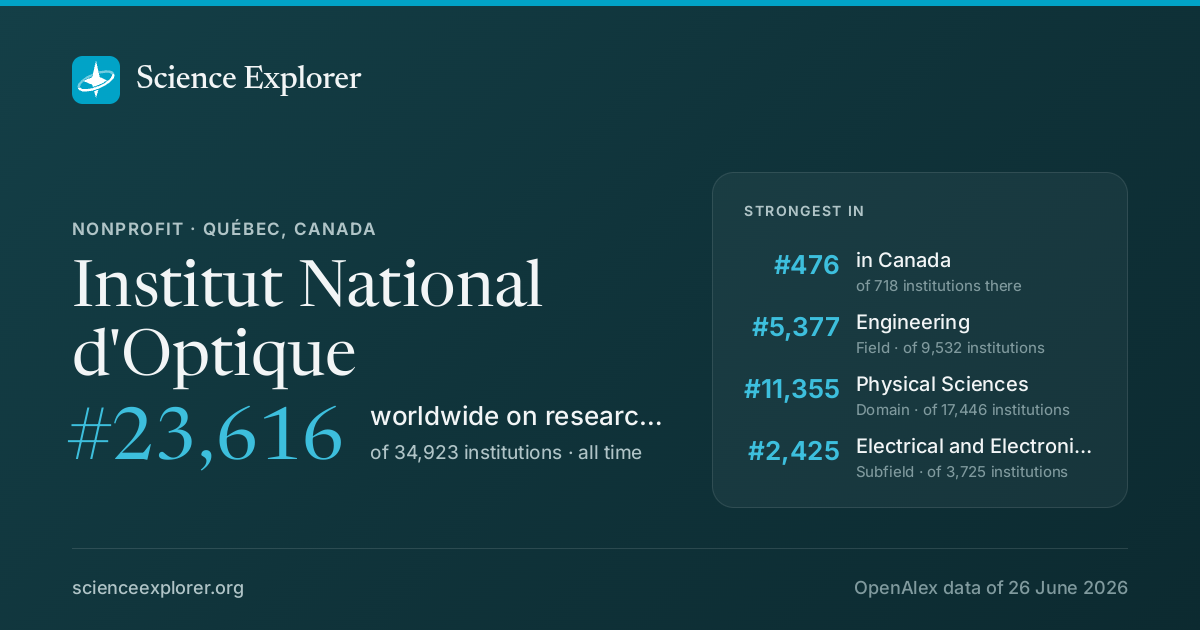
In research, Institut National d'Optique stands highest in Engineering (#5,377 of 9,532 worldwide), Physical Sciences (#11,355 of 17,446 worldwide) and Electrical and Electronic Engineering (#2,425 of 3,725 worldwide), over all time.
- World rank, all time
- #23,616 of 34,923
- Rank in Canada
- #476 of 718
- Research works
- 678 ▼ 47% vs 2018-21
- Citations
- 7.1k 10.5 per fractional work
- Top-10% rate
- 4.7% all institutions 10.0%
- vs its own fields
- 0.79× 1.00× is exactly expected
- Open access
- 11% world 40%
- International
- 14% world 18%
What is Institut National d'Optique known for in research?
The fields where it stands highest, over all time, ranked among every institution above the floor in each field.
| Field | World rank | Where that sits | Top-10% rate | Works |
|---|---|---|---|---|
| EngineeringField | #5,377 of 9,532 | 4.4% | 362 | |
| Physical SciencesDomain | #11,355 of 17,446 | 4.6% | 624 | |
| Electrical and Electronic EngineeringSubfield | #2,425 of 3,725 | 4.7% | 206 |
Each strip is that field's whole ranked pool, with the notch where Institut National d'Optique sits in it, in the colour of the band that rank falls in. The track under the rate is the rate itself: it carries no average mark, because the average differs by field (from about 6% in Dentistry to 21% in Economics).
Which fields of science does Institut National d'Optique work in?
In 2022-now, 77% of research at Institut National d'Optique is in Physical Sciences, 12% in Life Sciences. Its largest fields are Engineering (46%), Physics and Astronomy (14%), Materials Science (8%). It does 1.8× the world's share of Physical Sciences.
Each ring splits the one inside it: the four domains of science, their fields, their subfields. Size is fractional works in 2022-now. Every slice is a page; the interactive view zooms down to single topics and colours each by how much more of it this institution does than the world.
Its 4 domains and 16 fields, with their numbers
- Physical Sciences2176.7%
- Engineering1345.8%
- Physics and Astronomy413.5%
- Materials Science28.3%
- Computer Science13.0%
- Environmental Science11.8%
- Chemistry01.5%
- Earth and Planetary Sciences01.4%
- Chemical Engineering01.2%
- Energy00.2%
- Life Sciences311.6%
- Health Sciences28.0%
- Medicine27.0%
- Dentistry00.6%
- Veterinary00.4%
- Social Sciences13.7%
- Psychology13.7%
Field profile
Location quotient across every field it publishes in: outside the ring is more than an institution of this size would be expected to publish, inside it is less.
Rings at 0.5×, 1× and 2×. Widest outward: Physics and Astronomy, 6.1×. Every wedge is a field page.
All 16 fields, with their numbers
- Physics and Astronomy6.08×4 works
- Chemical Engineering3.42×0 works
- Engineering3.05×13 works
- Veterinary2.93×0 works
- Materials Science2.38×2 works
- Neuroscience1.67×1 works
- Biochemistry, Genetics and Molecular Biology1.23×2 works
- Dentistry1.23×0 works
- Psychology1.22×1 works
- Chemistry0.95×0 works
- Earth and Planetary Sciences0.86×0 works
- Agricultural and Biological Sciences0.48×1 works
- Computer Science0.38×1 works
- Environmental Science0.37×0 works
- Medicine0.36×2 works
- Energy0.22×0 works
- Physics and Astronomy 6.1×
- Chemical Engineering 3.4×
- Engineering 3.0×
- Veterinary 2.9×
- Materials Science 2.4×
- Neuroscience 1.7×
- Biochemistry, Genetics and Molecular Biology 1.2×
- Dentistry 1.2×
- Psychology 1.2×
- Chemistry 0.9×
- Earth and Planetary Sciences 0.9×
- Agricultural and Biological Sciences 0.5×
- Computer Science 0.4×
- Environmental Science 0.4×
- Medicine 0.4×
- Energy 0.2×
Who are the top researchers at Institut National d'Optique?
Ranked on the quality score, Alain Bergeron, André Croteau and Simon Turbide lead among researchers whose main affiliation is Institut National d'Optique.
- 1
Alain Bergeron
 Canada · #227,215 worldwide
44k citations · 307 works
- 2
André Croteau
Canada · #3,079,854 worldwide
366 citations · 21 works
- 3
Simon Turbide
Canada · #3,478,240 worldwide
1.2k citations · 41 works
- 4
Marc Girard
Canada · #3,652,951 worldwide
100 citations · 21 works
- 5
Ozzy Mermut
Canada · #3,757,726 worldwide
1.3k citations · 69 works
- 6
Bruno Bourliaguet
Canada · #3,986,592 worldwide
382 citations · 45 works
- 7
Isabelle Noiseux
Canada · #4,007,250 worldwide
482 citations · 28 works
- 8
Pierre Cottin
Canada · #4,099,428 worldwide
155 citations · 37 works
- 9
Kevin J. Snell
Canada · #4,129,628 worldwide
307 citations · 25 works
- 10
Patrice A. Topart
Canada · #4,148,877 worldwide
1.1k citations · 57 works
Which keywords describe research at Institut National d'Optique?
By fractional works in 2022-now, weighted toward what it does more of than the world: Fiber Lasers, Nonlinear Optics, Microresonators, Semiconductor, Optical Frequency Combs, Ultrafast Lasers, Crystal Growth and Imaging.
- Remote Monitoring
- Photonic Crystals
- Compound Eyes
- Adaptive Optics
- Optical Fiber
- Detection
- Optical
- Imaging
- Crystal Growth
- Optical Frequency Combs
- Semiconductor
- Nonlinear Optics
- Fiber Lasers
- Microresonators
- Remote Sensing
- Ultrafast Lasers
- High-Power Laser
- Laser
- Supercontinuum Generation
- Fiber Optic Sensors
- Raman Lasers
- Biosensors
- Freeform Optics
- Photoplethysmography
- Wavefront Sensing
Size is fractional works in 2022-now in the topics tagged with each word; colour is the word's share of this institution's work against its share of the world's. The 25 words are chosen for being large and distinctive. Each links to the topic it comes from most.
All 25 words, with their numbers
- Fiber Lasers3▲ 130×3 topics
- Nonlinear Optics3▲ 94×4 topics
- Microresonators2▲ 93×3 topics
- Semiconductor2▲ 17×2 topics
- Remote Sensing2▲ 4.5×6 topics
- Optical Frequency Combs1▲ 99×1 topic
- Ultrafast Lasers1▲ 99×1 topic
- Crystal Growth1▲ 17×3 topics
- High-Power Laser1▲ 236×1 topic
- Imaging1▲ 19×2 topics
- Laser1▲ 220×1 topic
- Optical1▲ 220×1 topic
- Supercontinuum Generation1▲ 236×1 topic
- Detection1▲ 14×4 topics
- Fiber Optic Sensors1▲ 82×1 topic
- Optical Fiber1▲ 40×1 topic
- Raman Lasers1▲ 36×2 topics
- Adaptive Optics1▲ 285×1 topic
- Biosensors1▲ 7.5×4 topics
- Compound Eyes1▲ 434×1 topic
- Freeform Optics1▲ 434×1 topic
- Photonic Crystals1▲ 30×5 topics
- Photoplethysmography1▲ 75×1 topic
- Remote Monitoring1▲ 32×1 topic
- Wavefront Sensing1▲ 285×1 topic
Which research topics does Institut National d'Optique publish most on?
By volume in 2022-now: Advanced Fiber Laser Technologies, Photonic Crystal and Fiber Optics, Optical Systems and Laser Technology and Advanced Fiber Optic Sensors.
Area is fractional works; colour is the subfield each topic belongs to.
- 1 Advanced Fiber Laser Technologies Atomic and Molecular Physics, and Optics 1 works
- 2 Photonic Crystal and Fiber Optics Electrical and Electronic Engineering 1 works
- 3 Optical Systems and Laser Technology Electrical and Electronic Engineering 1 works
- 4 Advanced Fiber Optic Sensors Electrical and Electronic Engineering 1 works
- 5 Advanced optical system design Biomedical Engineering 1 works
- 6 Adaptive optics and wavefront sensing Atomic and Molecular Physics, and Optics 1 works
- 7 Non-Invasive Vital Sign Monitoring Biomedical Engineering 1 works
- 8 Glass properties and applications Ceramics and Composites 1 works
- 9 Solid State Laser Technologies Electrical and Electronic Engineering 1 works
- 10 Thermal Analysis in Power Transmission Control and Systems Engineering 0 works
How open and international is its research?
Against the world's own shares: the tick on each track. Both are shares of its output, so they sit on one scale and can be read against each other as well as against the world.
World: 40% of research is openly available.
World: 18% is written across borders.
How has Institut National d'Optique's research output changed?
Output in 2022-2025 was 47% lower than in 2018-2021.
The same series as a ribbon: one cell per year, darker for more. The line above answers how much; this answers when.
Its share of all research
Growing output can still be a shrinking share: all of science grows. This is Institut National d'Optique as a percentage of every work published that year, 0.00018% in 2024.
Fractional works of Institut National d'Optique over all fractional works that year. How the balance of science has shifted.
How much of it reaches the world top 10%
Year by year, against all institutions in the same year.
Of each year's output, the share that reached the world's 10% most cited for its field and year. Peak 8.4% in 2012.
Other research institutions in Québec
- Université Laval
- Université du Québec
- Institut National de la Recherche Scientifique
- Musée de la Civilisation
- Centre hospitalier de l'Université Laval
- Institute of Infection and Immunity
- Centre hospitalier universitaire de Québec
- Ministère de l'Agriculture, des Pêcheries et de l'Alimentation


Share Institut National d'Optique's ranking
Badges for a website1Each links back here and updates with every snapshot

Research measures only: rankings here say nothing about teaching, admissions or student experience. Comparable institutions and collaboration partners have tabs of their own, above.
Discussion
Ask a question or share a note about Institut National d'Optique. Keep it to the research: no personal attacks, advertising or links. Any reader can report a post, which collapses it for everyone until it is opened.