Science Explorer Back to mapMap
Discussion
Company · Wrexham · United Kingdom

International Rectifier (United Kingdom)

World rank, all time
#33,689
of 34,923
Rank in United Kingdom
#1,802
of 1,844
Research works
141
▲ 17% vs 2018-21
Citations
1.3k
9.1 per fractional work
Top-10% rate
11.5%
all institutions 10.0%
vs its own fields
0.85×
1.00× is exactly expected
Open access
22%
world 40%
International
22%
world 18%

Which fields of science does International Rectifier (United Kingdom) work in?

In all years, 79% of research at International Rectifier (United Kingdom) is in Physical Sciences, 17% in Social Sciences. Its largest fields are Engineering (65%), Social Sciences (8%), Materials Science (6%). It does 1.9× the world's share of Physical Sciences.

Physical Sciences: 111 fractional works · 78.8% of its workEngineering: 92 fractional works · 64.9% of its workElectrical and Electronic Engineering: 61 fractional works · 43.4% of its workMechanical Engineering: 11 fractional works · 7.7% of its workControl and Systems Engineering: 6 fractional works · 4.1% of its workAerospace Engineering: 4 fractional works · 2.8% of its workIndustrial and Manufacturing Engineering: 2 fractional works · 1.4% of its workBiomedical Engineering: 2 fractional works · 1.3% of its workAutomotive Engineering: 1 fractional works · 0.9% of its workBuilding and Construction: 1 fractional works · 0.8% of its workComputational Mechanics: 1 fractional works · 0.7% of its workCivil and Structural Engineering: 1 fractional works · 0.6% of its workMechanics of Materials: 1 fractional works · 0.6% of its workSafety, Risk, Reliability and Quality: 1 fractional works · 0.5% of its workOcean Engineering: 0 fractional works · 0.2% of its workMaterials Science: 8 fractional works · 5.6% of its workMaterials Chemistry: 3 fractional works · 2.4% of its workElectronic, Optical and Magnetic Materials: 3 fractional works · 2.3% of its workBiomaterials: 0 fractional works · 0.2% of its workGeneral Materials Science: 0 fractional works · 0.2% of its workPolymers and Plastics: 0 fractional works · 0.2% of its workSurfaces, Coatings and Films: 0 fractional works · 0.2% of its workPhysics and Astronomy: 6 fractional works · 4.6% of its workAtomic and Molecular Physics, and Optics: 4 fractional works · 2.9% of its workAstronomy and Astrophysics: 2 fractional works · 1.3% of its workCondensed Matter Physics: 0 fractional works · 0.3% of its workSmaller subfields together: 0 fractional works · 0.1% of its workComputer Science: 4 fractional works · 2.6% of its workInformation Systems: 2 fractional works · 1.1% of its workComputer Networks and Communications: 1 fractional works · 0.5% of its workHardware and Architecture: 1 fractional works · 0.4% of its workComputational Theory and Mathematics: 0 fractional works · 0.4% of its workSmaller subfields together: 0 fractional works · 0.2% of its workEnvironmental Science: 1 fractional works · 0.8% of its workManagement, Monitoring, Policy and Law: 0 fractional works · 0.3% of its workGlobal and Planetary Change: 0 fractional works · 0.2% of its workIndustrial and Manufacturing Engineering: 0 fractional works · 0.2% of its workEnergy: 0 fractional works · 0.2% of its workEnergy Engineering and Power Technology: 0 fractional works · 0.2% of its workChemistry: 0 fractional works · 0.1% of its workSocial Sciences: 24 fractional works · 17.3% of its workSocial Sciences: 11 fractional works · 7.8% of its workSociology and Political Science: 4 fractional works · 2.8% of its workEducation: 3 fractional works · 1.9% of its workLaw: 1 fractional works · 0.7% of its workPolitical Science and International Relations: 1 fractional works · 0.6% of its workDemography: 1 fractional works · 0.6% of its workGeography, Planning and Development: 0 fractional works · 0.2% of its workUrban Studies: 0 fractional works · 0.2% of its workCultural Studies: 0 fractional works · 0.2% of its workSmaller subfields together: 1 fractional works · 0.5% of its workBusiness, Management and Accounting: 6 fractional works · 4.4% of its workStrategy and Management: 5 fractional works · 3.5% of its workAccounting: 1 fractional works · 0.5% of its workManagement Information Systems: 0 fractional works · 0.2% of its workSmaller subfields together: 0 fractional works · 0.2% of its workPsychology: 4 fractional works · 2.7% of its workClinical Psychology: 2 fractional works · 1.5% of its workSocial Psychology: 1 fractional works · 0.8% of its workDevelopmental and Educational Psychology: 0 fractional works · 0.3% of its workEconomics, Econometrics and Finance: 1 fractional works · 0.9% of its workFinance: 1 fractional works · 0.7% of its workSmaller subfields together: 0 fractional works · 0.3% of its workArts and Humanities: 1 fractional works · 0.8% of its workLiterature and Literary Theory: 1 fractional works · 0.5% of its workSmaller subfields together: 0 fractional works · 0.3% of its workDecision Sciences: 1 fractional works · 0.7% of its workManagement Science and Operations Research: 1 fractional works · 0.4% of its workInformation Systems and Management: 0 fractional works · 0.3% of its workHealth Sciences: 4 fractional works · 2.9% of its workMedicine: 3 fractional works · 1.8% of its workPublic Health, Environmental and Occupational Health: 1 fractional works · 0.4% of its workCardiology and Cardiovascular Medicine: 0 fractional works · 0.2% of its workEmergency Medicine: 0 fractional works · 0.2% of its workPhysiology: 0 fractional works · 0.2% of its workSmaller subfields together: 1 fractional works · 0.7% of its workHealth Professions: 2 fractional works · 1.1% of its workOccupational Therapy: 1 fractional works · 0.6% of its workGeneral Health Professions: 1 fractional works · 0.5% of its workLife Sciences: 1 fractional works · 1.0% of its workAgricultural and Biological Sciences: 1 fractional works · 0.6% of its workPlant Science: 0 fractional works · 0.3% of its workSmaller subfields together: 0 fractional works · 0.3% of its workBiochemistry, Genetics and Molecular Biology: 1 fractional works · 0.4% of its workBiochemistry: 0 fractional works · 0.2% of its workSmaller subfields together: 0 fractional works · 0.2% of its workImmunology and Microbiology: 0 fractional works · 0.1% of its workALL ITS WORKInternationalRectifier (Unite…141fractional works, all years
Life Sciences1%Physical Sciences79%Health Sciences3%Social Sciences17%

Each ring splits the one inside it: the four domains of science, their fields, their subfields. Size is fractional works in all years. Every slice is a page; the interactive view zooms down to single topics and colours each by how much more of it this institution does than the world.

Its 4 domains and 18 fields, with their numbers
    1. Engineering9264.9%
    2. Materials Science85.6%
    3. Physics and Astronomy64.6%
    4. Computer Science42.6%
    5. Environmental Science10.8%
    6. Energy00.2%
    7. Chemistry00.1%
    1. Social Sciences117.8%
    2. Business, Management and Accounting64.4%
    3. Psychology42.7%
    4. Economics, Econometrics and Finance10.9%
    5. Arts and Humanities10.8%
    6. Decision Sciences10.7%
    1. Medicine31.8%
    2. Health Professions21.1%
    1. Agricultural and Biological Sciences10.6%
    2. Biochemistry, Genetics and Molecular Biology10.4%
    3. Immunology and Microbiology00.1%
All of science, and how each field's share has moved since 1950: the Science domain explorer

Field profile

Location quotient across every field it publishes in: outside the ring is more than an institution of this size would be expected to publish, inside it is less.

Agricultural and Biological Sciences: 0.09× its world share, 0 worksAgricultural and Bio…Biochemistry, Genetics and Molecular Biology: 0.32× its world share, 0 worksBiochemistry, Geneti…Computer Science: 0.83× its world share, 1 worksComputer ScienceEngineering: 0.85× its world share, 2 worksEngineeringMaterials Science: 0.50× its world share, 0 worksMaterials ScienceHealth Professions: 2.46× its world share, 1 worksHealth ProfessionsMedicine: 0.21× its world share, 0 worksMedicineArts and Humanities: 0.56× its world share, 0 worksArts and HumanitiesBusiness, Management and Accounting: 2.42× its world share, 1 worksBusiness, Management…Psychology: 6.82× its world share, 3 worksPsychologySocial Sciences: 2.86× its world share, 5 worksSocial Sciences1×world share
more than its size predictsabout as predictedless

Rings at 0.5×, 1× and 2×. Widest outward: Psychology, 6.8×. Every wedge is a field page.

All 11 fields, with their numbers
  1. Psychology6.82×3 works
  2. Social Sciences2.86×5 works
  3. Health Professions2.46×1 works
  4. Business, Management and Accounting2.42×1 works
  5. Engineering0.85×2 works
  6. Computer Science0.83×1 works
  7. Arts and Humanities0.56×0 works
  8. Materials Science0.50×0 works
  9. Biochemistry, Genetics and Molecular Biology0.32×0 works
  10. Medicine0.21×0 works
  11. Agricultural and Biological Sciences0.09×0 works

Who are the top researchers at International Rectifier (United Kingdom)?

Ranked on the quality score, Amir S. Gohardani and Dan Kinzer lead among researchers whose main affiliation is International Rectifier (United Kingdom).

  1. 1 Amir S. Gohardani United Kingdom · #3,368,591 worldwide 800 citations · 34 works
  2. 2 Dan Kinzer United Kingdom · #3,739,263 worldwide 1.8k citations · 33 works
All ranked researchers at International Rectifier (United Kingdom)

What are the most cited papers from International Rectifier (United Kingdom)?

The most cited paper from International Rectifier (United Kingdom) is "A Resonant MOSFET Gate Driver With Efficient Energy Recovery" (Yi‐Jan Emery Chen, F.C. Lee, L. Amoroso et al., 2004), with 208 citations. Next come "Lattice misfits in four binary Ni-Base γ/γ1 alloys at ambient and elevated temperatures" (136) and "Characterization of $Cdv/dt$ Induced Power Loss in Synchronous Buck DC–DC Converters" (104).

Most cited papers
#PaperReleasedCitations
1 A Resonant MOSFET Gate Driver With Efficient Energy Recovery Yi‐Jan Emery Chen, F.C. Lee, L. Amoroso et al. · IEEE Transactions on Power Electronics Mar 2004 208
2 Lattice misfits in four binary Ni-Base γ/γ1 alloys at ambient and elevated temperatures A. B. Kamara, A.J. Ardell, Christian N. J. Wagner · Metallurgical and Materials Transactions A Oct 1996 136
3 Characterization of $Cdv/dt$ Induced Power Loss in Synchronous Buck DC–DC Converters Qun Zhao, Goran Stojcic · IEEE Transactions on Power Electronics Jul 2007 104
4 Investigation of Force Generation in a Permanent Magnet Synchronous Machine Weidong D. Zhu, Steve Pekarek, Babak Fahimi et al. · IEEE Transactions on Energy Conversion 22 Aug 2007 87
5 One-Cycle-Controlled Three-Phase Grid-Connected Inverters and Their Parallel Operation Yang Chen, Keyue Ma Smedley · IEEE Transactions on Industry Applications 2008 84
All 60 most cited papers, with filters and sorting

Which keywords describe research at International Rectifier (United Kingdom)?

By fractional works in all years, weighted toward what it does more of than the world: Power Electronics, Thermal Management, Reliability, Renewable Energy Integration, High-Temperature Electronics, Silicon Carbide, Wide Bandgap Semiconductors and Thermal Analysis.

▲ more of its work than of the world's◆ about the world's share▼ less than the world's

Size is fractional works in all years in the topics tagged with each word; colour is the word's share of this institution's work against its share of the world's. The 40 words are chosen for being large and distinctive. Each links to the topic it comes from most.

All 40 words, with their numbers
  1. Power Electronics22▲ 56×7 topics
  2. Thermal Management15▲ 38×6 topics
  3. Reliability14▲ 106×3 topics
  4. Renewable Energy Integration13▲ 36×4 topics
  5. High-Temperature Electronics13▲ 128×2 topics
  6. Silicon Carbide12▲ 169×1 topic
  7. Wide Bandgap Semiconductors12▲ 187×1 topic
  8. Electric Vehicle Charging9▲ 90×2 topics
  9. Thermal Analysis9▲ 41×4 topics
  10. DC-DC Converters8▲ 124×1 topic
  11. High-Frequency Power Conversion8▲ 124×1 topic
  12. Process Variation6▲ 43×2 topics
  13. Efficiency Optimization5▲ 93×2 topics
  14. Fault Tolerance5▲ 18×3 topics
  15. Nanoelectronics5▲ 23×2 topics
  16. Photovoltaic Systems5▲ 54×2 topics
  17. Energy Efficiency5▲ 4.2×6 topics
  18. Induction Heating5▲ 180×1 topic
  19. Resonant Inverters5▲ 180×1 topic
  20. Solar Cells5▲ 11×4 topics
  21. Nanowire Transistors4▲ 50×1 topic
  22. Tunnel Field-Effect Transistors4▲ 50×1 topic
  23. CMOS Technology4▲ 26×3 topics
  24. Semiconductor Devices4▲ 23×2 topics
  25. Renewable Energy4▲ 3.0×8 topics
  26. Atomic Layer Deposition4▲ 20×1 topic
  27. High-k Dielectrics4▲ 20×1 topic
  28. Model Predictive Control4▲ 11×1 topic
  29. Multilevel Converters4▲ 58×1 topic
  30. Induction Motors3▲ 46×2 topics
  31. Energy Storage3▲ 5.9×4 topics
  32. Control Systems3▲ 7.9×3 topics
  33. Smart Grid3▲ 7.0×4 topics
  34. Arbitration3▲ 61×2 topics
  35. Electric Drives3▲ 45×2 topics
  36. Lithium-ion Batteries2▲ 7.0×3 topics
  37. State Sovereignty2▲ 33×2 topics
  38. EMI2▲ 57×1 topic
  39. Electromagnetic Compatibility2▲ 57×1 topic
  40. Bilateral Investment Treaties2▲ 79×1 topic

Which research topics does International Rectifier (United Kingdom) publish most on?

By volume in 2022-now: Psychiatric care and mental health services, Digital Transformation in Industry, Legal Issues in South Africa and Technology Use by Older Adults.

  1. 1 Psychiatric care and mental health services Clinical Psychology 1 works
  2. 2 Digital Transformation in Industry Industrial and Manufacturing Engineering 1 works
  3. 3 Legal Issues in South Africa Law 1 works
  4. 4 Technology Use by Older Adults Demography 0 works
  5. 5 Assistive Technology in Communication and Mobility Occupational Therapy 0 works
  6. 6 Psychology of Development and Education Developmental and Educational Psychology 0 works
  7. 7 Posttraumatic Stress Disorder Research Clinical Psychology 0 works
  8. 8 Religious Tourism and Spaces Geography, Planning and Development 0 works
  9. 9 Urban and sociocultural dynamics Urban Studies 0 works
  10. 10 Corporate Governance and Law Strategy and Management 0 works

How open and international is its research?

Against the world's own shares: the tick on each track. Both are shares of its output, so they sit on one scale and can be read against each other as well as against the world.

openly available21.6%not open78.4%

World: 40% of research is openly available.

with international co-authors22.0%domestic only78.0%

World: 18% is written across borders.

How has International Rectifier (United Kingdom)'s research output changed?

Output in 2022-2025 was 17% higher than in 2018-2021.

still counting1990200020102020
grewheldshrank

The same series as a ribbon: one cell per year, darker for more. The line above answers how much; this answers when.

Its share of all research

Growing output can still be a shrinking share: all of science grows. This is International Rectifier (United Kingdom) as a percentage of every work published that year, 0.000028% in 2024.

still counting0.0010%0.0020%0.0030%International Rectifier (United Kingdom)0.000061% in 202519801990200020102020

Fractional works of International Rectifier (United Kingdom) over all fractional works that year. How the balance of science has shifted.

Other research institutions in Wrexham

All research institutions in Wrexham

Share International Rectifier (United Kingdom)'s ranking
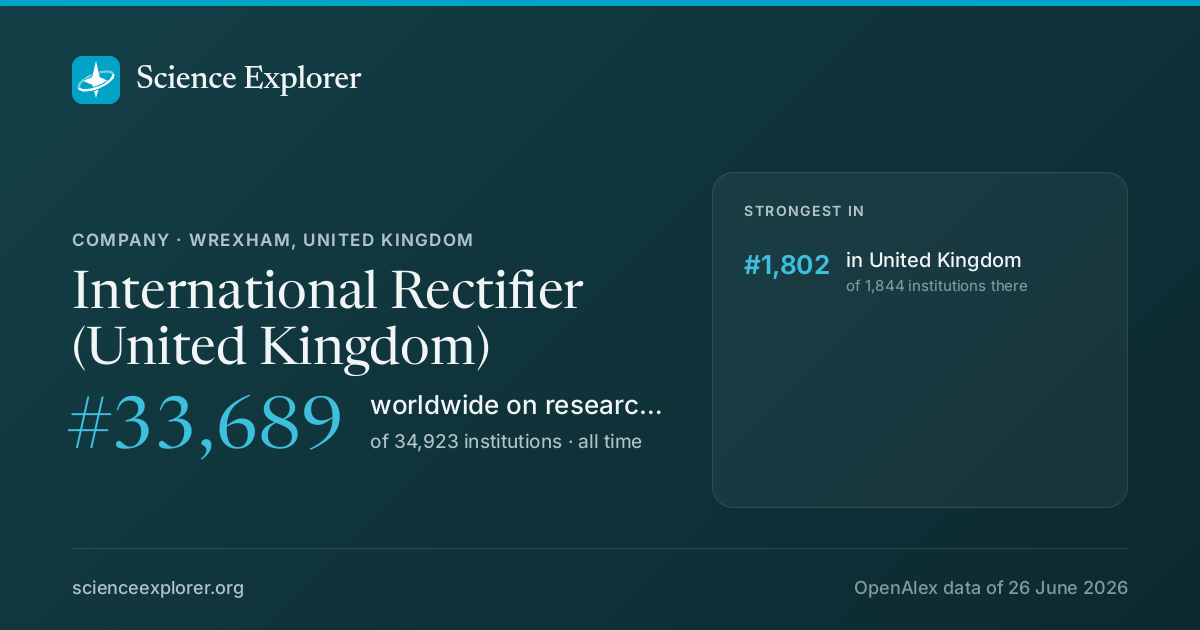
International Rectifier (United Kingdom) on Science Explorer

A card with International Rectifier (United Kingdom)'s standing and the fields it leads in, for a post or a slide. A link to this page previews as the same card.

Download the card

1200 × 630 PNG, sized for social posts, drawn from the latest snapshot.

Badges for a website1Each links back here and updates with every snapshot

Research measures only: rankings here say nothing about teaching, admissions or student experience. Comparable institutions and collaboration partners have tabs of their own, above.

Discussion

Ask a question or share a note about International Rectifier (United Kingdom). Keep it to the research: no personal attacks, advertising or links. Any reader can report a post, which collapses it for everyone until it is opened.