IR Dynamics (United States)
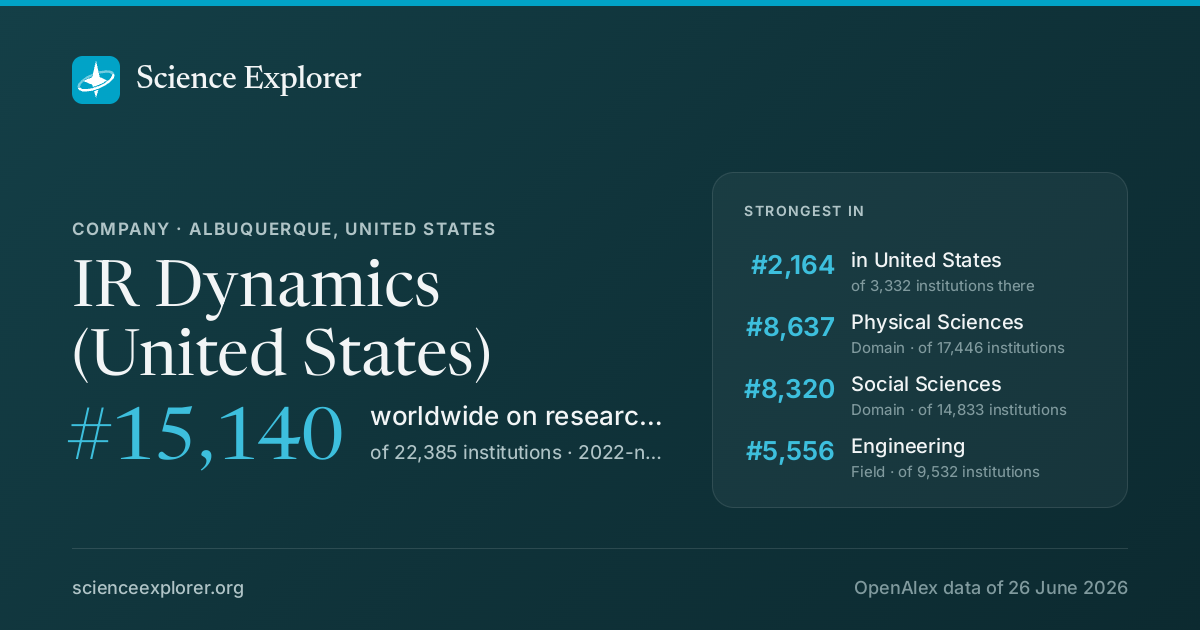
In research, IR Dynamics (United States) stands highest in Physical Sciences (#8,637 of 17,446 worldwide), Social Sciences (#8,320 of 14,833 worldwide) and Engineering (#5,556 of 9,532 worldwide), over all time. Relative to its size it is most specialised in Physics and Astronomy (Physics and Astronomy is 8.4× its share of world research).
- World rank, 2022-now
- #15,140 of 22,385 · #11,464 all time
- Rank in United States
- #2,164 of 3,332
- Research works
- 754 ▼ 19% vs 2018-21
- Citations
- 6.3k 8.4 per fractional work
- Top-10% rate
- 4.5% all institutions 10.0%
- vs its own fields
- 0.95× 1.00× is exactly expected
- Open access
- 45% world 40%
- International
- 28% world 18%
What is IR Dynamics (United States) known for in research?
The fields where it stands highest, over all time, ranked among every institution above the floor in each field.
| Field | World rank | Where that sits | Top-10% rate | Works |
|---|---|---|---|---|
| Physical SciencesDomain | #8,637 of 17,446 | 4.8% | 396 | |
| Social SciencesDomain | #8,320 of 14,833 | 2.9% | 269 | |
| EngineeringField | #5,556 of 9,532 | 5.1% | 213 | |
| Social SciencesField | #7,059 of 9,330 | 2.4% | 154 |
Each strip is that field's whole ranked pool, with the notch where IR Dynamics (United States) sits in it, in the colour of the band that rank falls in. The track under the rate is the rate itself: it carries no average mark, because the average differs by field (from about 6% in Dentistry to 21% in Economics).
Which fields of science does IR Dynamics (United States) work in?
In 2022-now, 62% of research at IR Dynamics (United States) is in Physical Sciences, 23% in Social Sciences. Its largest fields are Computer Science (19%), Physics and Astronomy (19%), Engineering (13%). It does 1.6× the world's share of Physical Sciences.
Each ring splits the one inside it: the four domains of science, their fields, their subfields. Size is fractional works in 2022-now. Every slice is a page; the interactive view zooms down to single topics and colours each by how much more of it this institution does than the world.
Its 4 domains and 25 fields, with their numbers
- Physical Sciences12762.0%
- Computer Science3919.2%
- Physics and Astronomy3818.6%
- Engineering2713.3%
- Environmental Science104.7%
- Earth and Planetary Sciences63.0%
- Materials Science21.2%
- Mathematics21.1%
- Chemistry10.5%
- Energy10.3%
- Chemical Engineering00.1%
- Social Sciences4622.6%
- Social Sciences199.4%
- Psychology105.1%
- Arts and Humanities104.7%
- Economics, Econometrics and Finance41.8%
- Decision Sciences20.9%
- Business, Management and Accounting20.8%
- Health Sciences209.6%
- Medicine168.1%
- Health Professions20.9%
- Dentistry10.5%
- Nursing00.1%
- Veterinary00.1%
- Life Sciences125.7%
What does IR Dynamics (United States) specialise in?
Where its research is concentrated relative to its size: Physics and Astronomy takes 8.4× the share of its output that it takes of world research.
- Physics and AstronomyField · 38.1 works8.4×
Location quotient, a volume reading rather than an impact one. It surfaces small, lopsided specialities.
Field profile
Location quotient across every field it publishes in: outside the ring is more than an institution of this size would be expected to publish, inside it is less.
Rings at 0.5×, 1× and 2×. Widest outward: Physics and Astronomy, 8.4×. Every wedge is a field page.
All 25 fields, with their numbers
- Physics and Astronomy8.37×38 works
- Computer Science2.47×39 works
- Earth and Planetary Sciences1.94×6 works
- Psychology1.68×10 works
- Arts and Humanities1.64×10 works
- Neuroscience1.45×5 works
- Dentistry1.01×1 works
- Environmental Science0.95×10 works
- Mathematics0.95×2 works
- Decision Sciences0.90×2 works
- Engineering0.89×27 works
- Immunology and Microbiology0.84×2 works
- Economics, Econometrics and Finance0.84×4 works
- Social Sciences0.74×19 works
- Medicine0.42×16 works
- Veterinary0.40×0 works
- Health Professions0.36×2 works
- Biochemistry, Genetics and Molecular Biology0.34×4 works
- Materials Science0.34×2 works
- Energy0.32×1 works
- Chemistry0.29×1 works
- Business, Management and Accounting0.24×2 works
- Chemical Engineering0.16×0 works
- Agricultural and Biological Sciences0.15×1 works
- Nursing0.15×0 works
- Physics and Astronomy 8.4×
- Computer Science 2.5×
- Earth and Planetary Sciences 1.9×
- Psychology 1.7×
- Arts and Humanities 1.6×
- Neuroscience 1.4×
- Dentistry 1.0×
- Environmental Science 0.9×
- Mathematics 0.9×
- Decision Sciences 0.9×
- Engineering 0.9×
- Immunology and Microbiology 0.8×
- Economics, Econometrics and Finance 0.8×
- Social Sciences 0.7×
- Medicine 0.4×
- Veterinary 0.4×
- Health Professions 0.4×
- Biochemistry, Genetics and Molecular Biology 0.3×
- Materials Science 0.3×
- Energy 0.3×
- Chemistry 0.3×
- Business, Management and Accounting 0.2×
- Chemical Engineering 0.2×
- Agricultural and Biological Sciences 0.1×
- Nursing 0.1×
Who are the top researchers at IR Dynamics (United States)?
Ranked on the quality score, A. Muszyńska, Edward Samuel Jones and Peter Birkelund Andersen lead among researchers whose main affiliation is IR Dynamics (United States).
- 1
A. Muszyńska
 United States · #1,577,943 worldwide
1.6k citations · 74 works
- 2
Edward Samuel Jones
United States · #1,846,637 worldwide
246 citations · 45 works
- 3
Peter Birkelund Andersen
United States · #2,406,693 worldwide
2.3k citations · 161 works
- 4
Cameisha Smith
United States · #2,491,607 worldwide
0 citations · 59 works
- 5
Vashti Williams
United States · #2,837,691 worldwide
0 citations · 30 works
- 6
Esther Fihl
United States · #3,152,794 worldwide
38 citations · 106 works
- 7
CRAIG G GILLATT
United States · #3,219,473 worldwide
0 citations · 15 works
- 8
Alan Melkman
United States · #3,286,689 worldwide
17 citations · 29 works
- 9
Manpreet K. Janeja
United States · #3,396,432 worldwide
124 citations · 20 works
- 9
Jens Dahl
United States · #3,396,432 worldwide
103 citations · 20 works
Which keywords describe research at IR Dynamics (United States)?
By fractional works in 2022-now, weighted toward what it does more of than the world: Entanglement, Quantum Information, Bell Inequality, Decoherence, Model Checking, Astrobiology, Temporal Logic and Satisfiability Modulo Theories.
- Constraint Optimization
- Biofield
- Spirituality
- Fault Tolerance
- Predictive Brain Theory
- Microbial Ecology
- Embodied Cognition
- Dynamics
- Consciousness
- Quantum Gravity
- Computation
- Extraterrestrial Life
- Cosmological Parameters
- Superconducting Circuits
- Symbolic Model Checker
- Temporal Logic
- Global Warming
- Decoherence
- Machine Learning
- Quantum Information
- Entanglement
- Climate Change
- Bell Inequality
- Model Checking
- Astrobiology
- Satisfiability Modulo Theories
- Dark Energy
- Cosmic Microwave Background
- Security
- SETI
- Complex Adaptive Systems
- Social Cognition
- Cryptography
- Earth Systems Science
- Gaia Hypothesis
- Neuroscience
- Quantum
- Renormalization Group
- Black Holes
- Biophoton
Size is fractional works in 2022-now in the topics tagged with each word; colour is the word's share of this institution's work against its share of the world's. The 40 words are chosen for being large and distinctive. Each links to the topic it comes from most.
All 40 words, with their numbers
- Entanglement14▲ 46×4 topics
- Quantum Information11▲ 45×2 topics
- Climate Change10▲ 1.77×29 topics
- Machine Learning8▲ 1.21×17 topics
- Bell Inequality8▲ 107×1 topic
- Decoherence8▲ 107×1 topic
- Model Checking7▲ 70×3 topics
- Global Warming6▲ 6.6×9 topics
- Astrobiology5▲ 84×2 topics
- Temporal Logic5▲ 79×2 topics
- Satisfiability Modulo Theories5▲ 143×1 topic
- Symbolic Model Checker5▲ 143×1 topic
- Dark Energy5▲ 38×2 topics
- Superconducting Circuits5▲ 33×2 topics
- Cosmic Microwave Background4▲ 39×1 topic
- Cosmological Parameters4▲ 39×1 topic
- Security4▲ 3.1×4 topics
- Extraterrestrial Life4▲ 92×1 topic
- SETI4▲ 92×1 topic
- Computation4▲ 27×2 topics
- Complex Adaptive Systems3▲ 57×2 topics
- Quantum Gravity3▲ 20×3 topics
- Social Cognition3▲ 9.0×2 topics
- Consciousness3▲ 22×2 topics
- Cryptography3▲ 14×1 topic
- Dynamics3▲ 36×3 topics
- Earth Systems Science3▲ 253×1 topic
- Embodied Cognition3▲ 106×1 topic
- Gaia Hypothesis3▲ 253×1 topic
- Microbial Ecology3▲ 9.3×2 topics
- Neuroscience3▲ 5.3×2 topics
- Predictive Brain Theory3▲ 106×1 topic
- Quantum3▲ 21×1 topic
- Fault Tolerance3▲ 9.5×2 topics
- Renormalization Group3▲ 26×2 topics
- Spirituality3▲ 14×2 topics
- Black Holes3▲ 14×2 topics
- Biofield3▲ 132×1 topic
- Biophoton3▲ 132×1 topic
- Constraint Optimization3▲ 151×1 topic
Which research topics does IR Dynamics (United States) publish most on?
By volume in 2022-now: Quantum Mechanics and Applications, Formal Methods in Verification, Cosmology and Gravitation Theories and Space Science and Extraterrestrial Life.
Area is fractional works; colour is the subfield each topic belongs to.
- 1 Quantum Mechanics and Applications Atomic and Molecular Physics, and Optics 8 works
- 2 Formal Methods in Verification Computational Theory and Mathematics 5 works
- 3 Cosmology and Gravitation Theories Astronomy and Astrophysics 4 works
- 4 Space Science and Extraterrestrial Life Astronomy and Astrophysics 4 works
- 5 Earth Systems and Cosmic Evolution Atmospheric Science 3 works
- 6 Quantum Information and Cryptography Artificial Intelligence 3 works
- 7 Embodied and Extended Cognition Cognitive Neuroscience 3 works
- 8 Quantum Computing Algorithms and Architecture Artificial Intelligence 3 works
- 9 Biofield Effects and Biophysics Physiology 3 works
- 10 Constraint Satisfaction and Optimization Computer Networks and Communications 3 works
How open and international is its research?
Against the world's own shares: the tick on each track. Both are shares of its output, so they sit on one scale and can be read against each other as well as against the world.
World: 40% of research is openly available.
World: 18% is written across borders.
How has IR Dynamics (United States)'s research output changed?
Output in 2022-2025 was 19% lower than in 2018-2021.
The same series as a ribbon: one cell per year, darker for more. The line above answers how much; this answers when.
Its share of all research
Growing output can still be a shrinking share: all of science grows. This is IR Dynamics (United States) as a percentage of every work published that year, 0.00036% in 2024.
Fractional works of IR Dynamics (United States) over all fractional works that year. How the balance of science has shifted.
How much of it reaches the world top 10%
Year by year, against all institutions in the same year.
Of each year's output, the share that reached the world's 10% most cited for its field and year. Peak 7.7% in 2025.
Other research institutions in Albuquerque
- University of New Mexico
- Sandia National Laboratories
- Presbyterian Hospital
- Radiology Associates of Albuquerque
- Management Sciences (United States)
- Youth Development
- Lovelace Respiratory Research Institute
- Behavior Therapy Associates
Share IR Dynamics (United States)'s ranking
Badges for a website1Each links back here and updates with every snapshot

Research measures only: rankings here say nothing about teaching, admissions or student experience. Comparable institutions and collaboration partners have tabs of their own, above.
Discussion
Ask a question or share a note about IR Dynamics (United States). Posts are plain text and can be reported.