Science Explorer Back to mapMap

Kommunedata (Denmark)

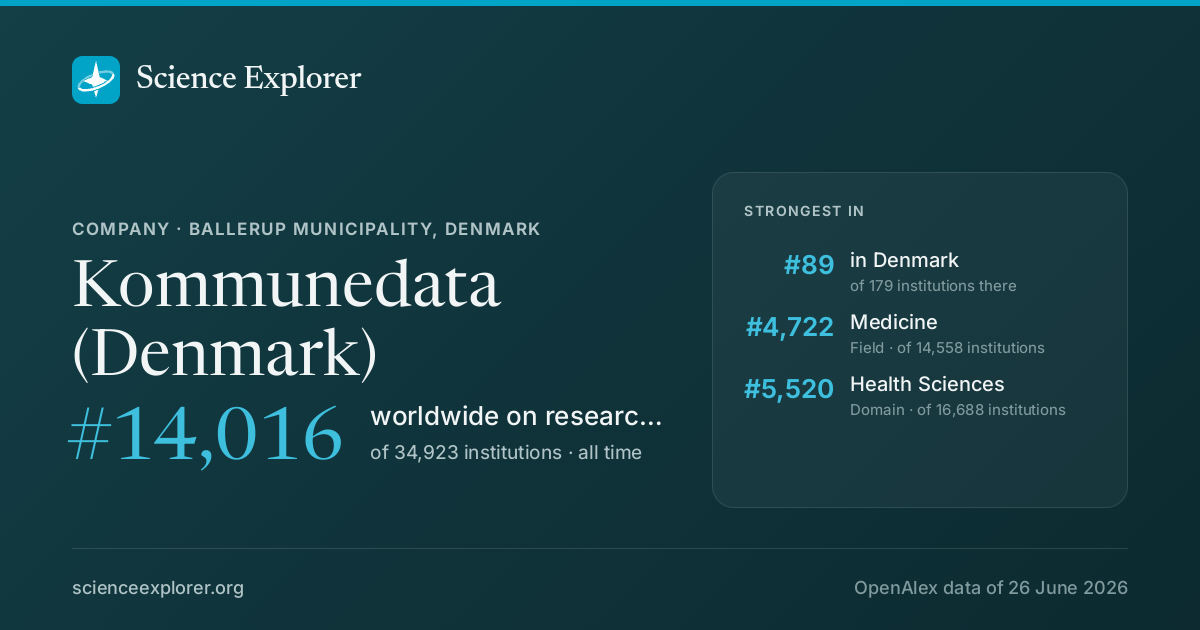
In research, Kommunedata (Denmark) stands highest in Medicine (#4,722 of 14,558 worldwide) and Health Sciences (#5,520 of 16,688 worldwide), over all time.

World rank, all time
#14,016
of 34,923
Rank in Denmark
#89
of 179
Research works
498
▲ 44% vs 2018-21
Citations
17k
34.6 per fractional work
Top-10% rate
8.4%
all institutions 10.0%
vs its own fields
1.07×
1.00× is exactly expected
Open access
20%
world 40%
International
16%
world 18%

What is Kommunedata (Denmark) known for in research?

The fields where it stands highest, over all time, ranked among every institution above the floor in each field.

FieldWorld rankWhere that sitsTop-10% rateWorks
MedicineField #4,722 of 14,558 13.0%253
Health SciencesDomain #5,520 of 16,688 12.8%281

Each strip is that field's whole ranked pool, with the notch where Kommunedata (Denmark) sits in it, in the colour of the band that rank falls in. The track under the rate is the rate itself: it carries no average mark, because the average differs by field (from about 6% in Dentistry to 21% in Economics).

Which fields of science does Kommunedata (Denmark) work in?

In 2022-now, 50% of research at Kommunedata (Denmark) is in Social Sciences, 30% in Physical Sciences. Its largest fields are Social Sciences (32%), Engineering (14%), Medicine (10%). It does 1.7× the world's share of Social Sciences.

Social Sciences: 14 fractional works · 49.9% of its workSocial Sciences: 9 fractional works · 31.5% of its workEducation: 6 fractional works · 20.8% of its workSociology and Political Science: 1 fractional works · 2.9% of its workPolitical Science and International Relations: 1 fractional works · 2.7% of its workAnthropology: 1 fractional works · 2.1% of its workDemography: 0 fractional works · 1.2% of its workUrban Studies: 0 fractional works · 0.8% of its workHealth: 0 fractional works · 0.5% of its workSafety Research: 0 fractional works · 0.4% of its workPsychology: 2 fractional works · 7.3% of its workSocial Psychology: 1 fractional works · 5.2% of its workDevelopmental and Educational Psychology: 0 fractional works · 1.2% of its workClinical Psychology: 0 fractional works · 0.8% of its workSmaller subfields together: 0 fractional works · 0.2% of its workArts and Humanities: 2 fractional works · 6.9% of its workPhilosophy: 1 fractional works · 2.5% of its workArcheology: 0 fractional works · 1.2% of its workMusic: 0 fractional works · 0.9% of its workVisual Arts and Performing Arts: 0 fractional works · 0.9% of its workHistory: 0 fractional works · 0.6% of its workHistory and Philosophy of Science: 0 fractional works · 0.6% of its workSmaller subfields together: 0 fractional works · 0.1% of its workBusiness, Management and Accounting: 1 fractional works · 3.2% of its workManagement of Technology and Innovation: 0 fractional works · 1.5% of its workStrategy and Management: 0 fractional works · 0.8% of its workManagement Information Systems: 0 fractional works · 0.7% of its workMarketing: 0 fractional works · 0.3% of its workDecision Sciences: 0 fractional works · 0.9% of its workInformation Systems and Management: 0 fractional works · 0.9% of its workPhysical Sciences: 8 fractional works · 30.4% of its workEngineering: 4 fractional works · 13.9% of its workMechanical Engineering: 1 fractional works · 5.2% of its workControl and Systems Engineering: 0 fractional works · 1.5% of its workAerospace Engineering: 0 fractional works · 1.4% of its workElectrical and Electronic Engineering: 0 fractional works · 1.2% of its workMechanics of Materials: 0 fractional works · 1.2% of its workBuilding and Construction: 0 fractional works · 0.7% of its workIndustrial and Manufacturing Engineering: 0 fractional works · 0.7% of its workArchitecture: 0 fractional works · 0.6% of its workCivil and Structural Engineering: 0 fractional works · 0.6% of its workBiomedical Engineering: 0 fractional works · 0.3% of its workSmaller subfields together: 0 fractional works · 0.4% of its workComputer Science: 2 fractional works · 7.7% of its workComputational Theory and Mathematics: 1 fractional works · 2.5% of its workArtificial Intelligence: 1 fractional works · 2.0% of its workSoftware: 0 fractional works · 1.2% of its workInformation Systems: 0 fractional works · 0.7% of its workComputer Vision and Pattern Recognition: 0 fractional works · 0.6% of its workSignal Processing: 0 fractional works · 0.6% of its workEarth and Planetary Sciences: 2 fractional works · 6.7% of its workGeophysics: 1 fractional works · 4.9% of its workAtmospheric Science: 0 fractional works · 0.7% of its workEarth-Surface Processes: 0 fractional works · 0.7% of its workOceanography: 0 fractional works · 0.3% of its workSmaller subfields together: 0 fractional works · 0.1% of its workEnvironmental Science: 1 fractional works · 2.0% of its workWater Science and Technology: 0 fractional works · 0.7% of its workManagement, Monitoring, Policy and Law: 0 fractional works · 0.6% of its workEcology: 0 fractional works · 0.4% of its workSmaller subfields together: 0 fractional works · 0.2% of its workMathematics: 0 fractional works · 0.1% of its workHealth Sciences: 5 fractional works · 16.9% of its workMedicine: 3 fractional works · 9.9% of its workPulmonary and Respiratory Medicine: 0 fractional works · 1.5% of its workGeriatrics and Gerontology: 0 fractional works · 1.4% of its workPublic Health, Environmental and Occupational Health: 0 fractional works · 1.2% of its workPhysiology: 0 fractional works · 1.2% of its workSurgery: 0 fractional works · 1.0% of its workCritical Care and Intensive Care Medicine: 0 fractional works · 0.6% of its workNephrology: 0 fractional works · 0.6% of its workTransplantation: 0 fractional works · 0.6% of its workOncology: 0 fractional works · 0.4% of its workGastroenterology: 0 fractional works · 0.4% of its workEpidemiology: 0 fractional works · 0.3% of its workInfectious Diseases: 0 fractional works · 0.3% of its workRehabilitation: 0 fractional works · 0.3% of its workSmaller subfields together: 0 fractional works · 0.1% of its workHealth Professions: 2 fractional works · 7.0% of its workGeneral Health Professions: 2 fractional works · 6.5% of its workSpeech and Hearing: 0 fractional works · 0.6% of its workLife Sciences: 1 fractional works · 2.8% of its workAgricultural and Biological Sciences: 0 fractional works · 1.0% of its workEcology, Evolution, Behavior and Systematics: 0 fractional works · 0.7% of its workAquatic Science: 0 fractional works · 0.3% of its workSmaller subfields together: 0 fractional works · 0.0% of its workBiochemistry, Genetics and Molecular Biology: 0 fractional works · 0.9% of its workGenetics: 0 fractional works · 0.6% of its workPhysiology: 0 fractional works · 0.3% of its workImmunology and Microbiology: 0 fractional works · 0.7% of its workApplied Microbiology and Biotechnology: 0 fractional works · 0.7% of its workNeuroscience: 0 fractional works · 0.1% of its workALL ITS WORKKommunedata(Denmark)27fractional works, 2022-now
Life Sciences3%Physical Sciences30%Health Sciences17%Social Sciences50%

Each ring splits the one inside it: the four domains of science, their fields, their subfields. Size is fractional works in 2022-now. Every slice is a page; the interactive view zooms down to single topics and colours each by how much more of it this institution does than the world.

Its 4 domains and 16 fields, with their numbers
    1. Social Sciences931.5%
    2. Psychology27.3%
    3. Arts and Humanities26.9%
    4. Business, Management and Accounting13.2%
    5. Decision Sciences00.9%
    1. Engineering413.9%
    2. Computer Science27.7%
    3. Earth and Planetary Sciences26.7%
    4. Environmental Science12.0%
    5. Mathematics00.1%
    1. Medicine39.9%
    2. Health Professions27.0%
    1. Agricultural and Biological Sciences01.0%
    2. Biochemistry, Genetics and Molecular Biology00.9%
    3. Immunology and Microbiology00.7%
    4. Neuroscience00.1%
All of science, and how each field's share has moved since 1950: the Science domain explorer

Field profile

Location quotient across every field it publishes in: outside the ring is more than an institution of this size would be expected to publish, inside it is less.

Agricultural and Biological Sciences: 0.22× its world share, 0 worksAgricultural and Bio…Biochemistry, Genetics and Molecular Biology: 0.17× its world share, 0 worksBiochemistry, Geneti…Immunology and Microbiology: 0.73× its world share, 0 worksImmunology and Micro…Neuroscience: 0.04× its world share, 0 worksNeuroscienceComputer Science: 0.98× its world share, 2 worksComputer ScienceEarth and Planetary Sciences: 4.24× its world share, 2 worksEarth and Planetary …Engineering: 0.93× its world share, 4 worksEngineeringEnvironmental Science: 0.40× its world share, 0 worksEnvironmental ScienceMathematics: 0.13× its world share, 0 worksMathematicsHealth Professions: 2.66× its world share, 2 worksHealth ProfessionsMedicine: 0.52× its world share, 3 worksMedicineArts and Humanities: 2.40× its world share, 2 worksArts and HumanitiesBusiness, Management and Accounting: 1.01× its world share, 1 worksBusiness, Management…Decision Sciences: 0.95× its world share, 0 worksDecision SciencesPsychology: 2.41× its world share, 2 worksPsychologySocial Sciences: 2.49× its world share, 9 worksSocial Sciences1×world share
more than its size predictsabout as predictedless

Rings at 0.5×, 1× and 2×. Widest outward: Earth and Planetary Sciences, 4.2×. Every wedge is a field page.

All 16 fields, with their numbers
  1. Earth and Planetary Sciences4.24×2 works
  2. Health Professions2.66×2 works
  3. Social Sciences2.49×9 works
  4. Psychology2.41×2 works
  5. Arts and Humanities2.40×2 works
  6. Business, Management and Accounting1.01×1 works
  7. Computer Science0.98×2 works
  8. Decision Sciences0.95×0 works
  9. Engineering0.93×4 works
  10. Immunology and Microbiology0.73×0 works
  11. Medicine0.52×3 works
  12. Environmental Science0.40×0 works
  13. Agricultural and Biological Sciences0.22×0 works
  14. Biochemistry, Genetics and Molecular Biology0.17×0 works
  15. Mathematics0.13×0 works
  16. Neuroscience0.04×0 works

Who are the top researchers at Kommunedata (Denmark)?

Ranked on the quality score, C. O. Povlsen, Hans‐Eric Jensen and Egill Jensen lead among researchers whose main affiliation is Kommunedata (Denmark).

  1. 1 C. O. Povlsen Denmark · #1,888,826 worldwide 817 citations · 23 works
  2. 2 Hans‐Eric Jensen Denmark · #3,807,393 worldwide 774 citations · 27 works
  3. 3 Egill Jensen Denmark · #3,913,185 worldwide 170 citations · 16 works
  4. 4 Axel Brock Denmark · #4,995,178 worldwide 249 citations · 25 works
  5. 5 Torkild Kodahl Denmark · #5,091,493 worldwide 36 citations · 19 works
  6. 6 W Højer-Pedersen Denmark · #5,438,320 worldwide 28 citations · 21 works
All ranked researchers at Kommunedata (Denmark)

What are the most cited papers from Kommunedata (Denmark)?

The most cited paper from Kommunedata (Denmark) is "Microalbuminuria Predicts Clinical Proteinuria and Early Mortality in Maturity-Onset Diabetes" (Carl Erik Mogensen, 1984), with 1,930 citations. Next come "APPLANATION TONOMETRY AND CENTRAL CORNEAL THICKNESS" (947) and "Recommended Methods for the Determination of Four Enzymes in Blood" (848).

Most cited papers
#PaperReleasedCitations
1 Microalbuminuria Predicts Clinical Proteinuria and Early Mortality in Maturity-Onset Diabetes Carl Erik Mogensen · New England Journal of Medicine 9 Feb 1984 1,930
2 APPLANATION TONOMETRY AND CENTRAL CORNEAL THICKNESS Niels Ehlers, Thorkild Bramsen, STEFFEN SPERLING · Acta Ophthalmologica Mar 1975 947
3 Recommended Methods for the Determination of Four Enzymes in Blood R. Keiding, Mogens Hørder, W. Gerhardt Denmark et al. · Scandinavian Journal of Clinical and Laboratory Investigation 1974 848
4 The Association Between Duration of Breastfeeding and Adult Intelligence Erik Lykke Mortensen · JAMA 8 May 2002 462
5 Parental neglect during childhood and increased risk of obesity in young adulthood Inge Lissau, Inge Lissau, T. I. A. Sørensen et al. · The Lancet Feb 1994 458
All 60 most cited papers, with filters and sorting

Which keywords describe research at Kommunedata (Denmark)?

By fractional works in 2022-now, weighted toward what it does more of than the world: Pedagogy, Education, Qualitative Research, Social Sciences, Ethics, Communication, Learning and Methodology.

▲ more of its work than of the world's◆ about the world's share▼ less than the world's

Size is fractional works in 2022-now in the topics tagged with each word; colour is the word's share of this institution's work against its share of the world's. The 12 words are chosen for being large and distinctive. Each links to the topic it comes from most.

All 12 words, with their numbers
  1. Pedagogy4▲ 28×3 topics
  2. Education4▲ 7.9×4 topics
  3. Qualitative Research4▲ 15×3 topics
  4. Social Sciences3▲ 87×2 topics
  5. Ethics2▲ 17×3 topics
  6. Communication2▲ 21×2 topics
  7. Healthcare2▲ 5.7×2 topics
  8. Learning2▲ 22×1 topic
  9. Methodology2▲ 133×1 topic
  10. Family Dynamics2▲ 48×1 topic
  11. Phenomenology2▲ 57×1 topic
  12. Globalization1▲ 1.98×6 topics

Which research topics does Kommunedata (Denmark) publish most on?

By volume in 2022-now: Social and Educational Sciences, Research in Social Sciences, Education, Healthcare and Sociology Research and Early Childhood Education and Development.

  1. 1 Social and Educational Sciences Education 2 works
  2. 2 Research in Social Sciences Education 2 works
  3. 3 Education, Healthcare and Sociology Research Social Psychology 1 works
  4. 4 Early Childhood Education and Development Education 1 works
  5. 5 Workplace Health and Well-being General Health Professions 0 works
  6. 6 earthquake and tectonic studies Geophysics 0 works
  7. 7 Health, psychology, and well-being General Health Professions 0 works
  8. 8 Geriatric Care and Nursing Homes General Health Professions 0 works
  9. 9 Refrigeration and Air Conditioning Technologies Mechanical Engineering 0 works
  10. 10 Educational Leadership and Innovation Education 0 works

How open and international is its research?

Against the world's own shares: the tick on each track. Both are shares of its output, so they sit on one scale and can be read against each other as well as against the world.

openly available19.5%not open80.5%

World: 40% of research is openly available.

with international co-authors16.3%domestic only83.7%

World: 18% is written across borders.

How has Kommunedata (Denmark)'s research output changed?

Output in 2022-2025 was 44% higher than in 2018-2021.

still counting1990200020102020
grewheldshrank

The same series as a ribbon: one cell per year, darker for more. The line above answers how much; this answers when.

Its share of all research

Growing output can still be a shrinking share: all of science grows. This is Kommunedata (Denmark) as a percentage of every work published that year, 0.000095% in 2024.

still counting0.0025%0.0050%0.0075%Kommunedata (Denmark)0.00012% in 202519801990200020102020

Fractional works of Kommunedata (Denmark) over all fractional works that year. How the balance of science has shifted.

Other research institutions in Ballerup Municipality

All research institutions in Ballerup Municipality

Share Kommunedata (Denmark)'s ranking

Kommunedata (Denmark) on Science Explorer

A card with Kommunedata (Denmark)'s standing and the fields it leads in, for a post or a slide. A link to this page previews as the same card.

Download the card

1200 × 630 PNG, sized for social posts, drawn from the latest snapshot.

Badges for a website1Each links back here and updates with every snapshot

Research measures only: rankings here say nothing about teaching, admissions or student experience. Comparable institutions and collaboration partners have tabs of their own, above.

Discussion

Ask a question or share a note about Kommunedata (Denmark). Posts are plain text and can be reported.