Science Explorer Back to mapMap
Discussion
Government institution · Malmo · Sweden

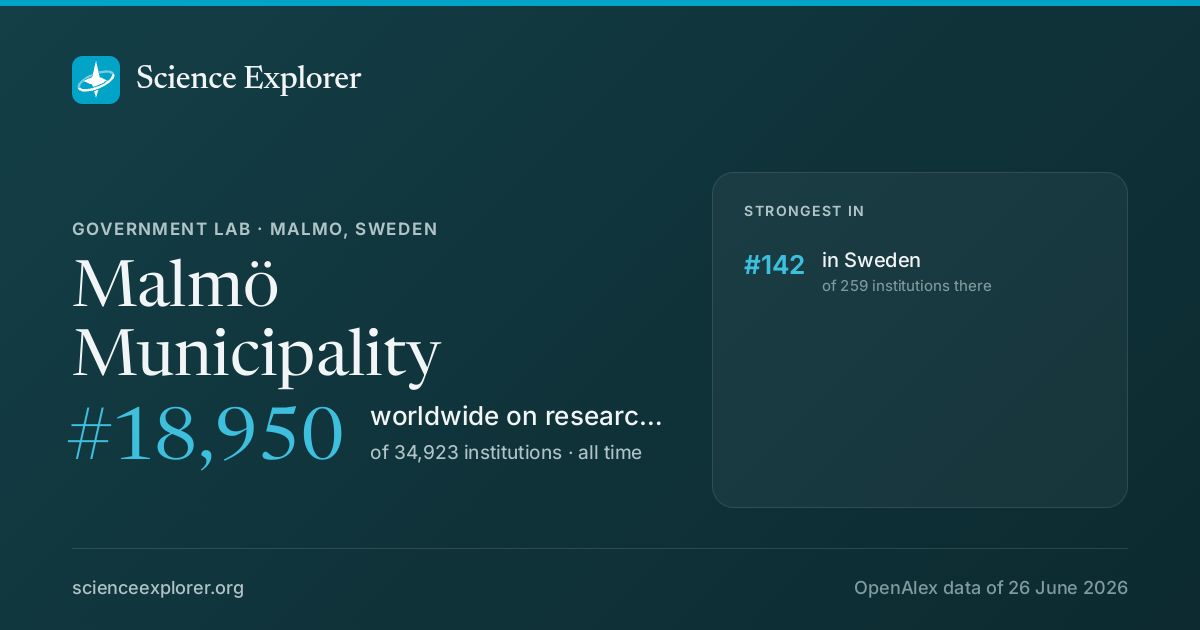
Malmö Municipality

World rank, all time
#18,950
of 34,923
Rank in Sweden
#142
of 259
Research works
220
▼ 25% vs 2018-21
Citations
3.9k
17.8 per fractional work
Top-10% rate
8.7%
all institutions 10.0%
vs its own fields
0.98×
1.00× is exactly expected
Open access
34%
world 40%
International
16%
world 18%

Which fields of science does Malmö Municipality work in?

In 2022-now, 36% of research at Malmö Municipality is in Social Sciences, 29% in Health Sciences. Its largest fields are Medicine (22%), Social Sciences (18%), Environmental Science (12%). It does 1.3× the world's share of Social Sciences.

Social Sciences: 11 fractional works · 35.8% of its workSocial Sciences: 6 fractional works · 18.3% of its workSociology and Political Science: 3 fractional works · 8.5% of its workEducation: 1 fractional works · 4.4% of its workPolitical Science and International Relations: 0 fractional works · 1.3% of its workLaw: 0 fractional works · 0.9% of its workSafety Research: 0 fractional works · 0.9% of its workGender Studies: 0 fractional works · 0.7% of its workAnthropology: 0 fractional works · 0.5% of its workUrban Studies: 0 fractional works · 0.5% of its workGeography, Planning and Development: 0 fractional works · 0.3% of its workPsychology: 3 fractional works · 8.6% of its workClinical Psychology: 2 fractional works · 5.7% of its workSocial Psychology: 1 fractional works · 1.7% of its workDevelopmental and Educational Psychology: 0 fractional works · 0.8% of its workApplied Psychology: 0 fractional works · 0.3% of its workArts and Humanities: 2 fractional works · 6.9% of its workVisual Arts and Performing Arts: 1 fractional works · 2.3% of its workLiterature and Literary Theory: 1 fractional works · 2.1% of its workPhilosophy: 1 fractional works · 2.1% of its workHistory and Philosophy of Science: 0 fractional works · 0.3% of its workBusiness, Management and Accounting: 1 fractional works · 1.8% of its workStrategy and Management: 0 fractional works · 1.0% of its workOrganizational Behavior and Human Resource Management: 0 fractional works · 0.8% of its workEconomics, Econometrics and Finance: 0 fractional works · 0.2% of its workHealth Sciences: 9 fractional works · 29.0% of its workMedicine: 7 fractional works · 21.9% of its workEpidemiology: 2 fractional works · 6.8% of its workPublic Health, Environmental and Occupational Health: 2 fractional works · 5.1% of its workEndocrinology, Diabetes and Metabolism: 1 fractional works · 1.7% of its workRadiology, Nuclear Medicine and Imaging: 0 fractional works · 1.6% of its workPhysiology: 0 fractional works · 1.1% of its workNeurology: 0 fractional works · 1.0% of its workSurgery: 0 fractional works · 0.9% of its workEmergency Medicine: 0 fractional works · 0.5% of its workOrthopedics and Sports Medicine: 0 fractional works · 0.5% of its workRehabilitation: 0 fractional works · 0.5% of its workPulmonary and Respiratory Medicine: 0 fractional works · 0.4% of its workAnesthesiology and Pain Medicine: 0 fractional works · 0.3% of its workPediatrics, Perinatology and Child Health: 0 fractional works · 0.3% of its workPharmacology: 0 fractional works · 0.3% of its workTransplantation: 0 fractional works · 0.3% of its workPsychiatry and Mental health: 0 fractional works · 0.2% of its workSmaller subfields together: 0 fractional works · 0.3% of its workHealth Professions: 2 fractional works · 5.7% of its workSpeech and Hearing: 1 fractional works · 1.9% of its workGeneral Health Professions: 1 fractional works · 1.6% of its workOccupational Therapy: 0 fractional works · 0.5% of its workPharmacy: 0 fractional works · 0.5% of its workRadiological and Ultrasound Technology: 0 fractional works · 0.5% of its workEmergency Medical Services: 0 fractional works · 0.3% of its workComplementary and Manual Therapy: 0 fractional works · 0.2% of its workNursing: 0 fractional works · 0.9% of its workResearch and Theory: 0 fractional works · 0.9% of its workVeterinary: 0 fractional works · 0.5% of its workSmall Animals: 0 fractional works · 0.5% of its workPhysical Sciences: 7 fractional works · 21.4% of its workEnvironmental Science: 4 fractional works · 11.8% of its workHealth, Toxicology and Mutagenesis: 2 fractional works · 5.7% of its workEnvironmental Engineering: 1 fractional works · 2.4% of its workEcology: 1 fractional works · 1.7% of its workGlobal and Planetary Change: 0 fractional works · 0.9% of its workIndustrial and Manufacturing Engineering: 0 fractional works · 0.5% of its workPollution: 0 fractional works · 0.5% of its workEngineering: 2 fractional works · 6.4% of its workBuilding and Construction: 1 fractional works · 1.8% of its workBiomedical Engineering: 0 fractional works · 1.1% of its workAerospace Engineering: 0 fractional works · 1.0% of its workOcean Engineering: 0 fractional works · 1.0% of its workAutomotive Engineering: 0 fractional works · 0.8% of its workSmaller subfields together: 0 fractional works · 0.5% of its workEarth and Planetary Sciences: 0 fractional works · 1.6% of its workAtmospheric Science: 0 fractional works · 0.7% of its workGeology: 0 fractional works · 0.6% of its workGeochemistry and Petrology: 0 fractional works · 0.3% of its workSmaller subfields together: 0 fractional works · 0.0% of its workComputer Science: 0 fractional works · 1.3% of its workInformation Systems: 0 fractional works · 0.5% of its workArtificial Intelligence: 0 fractional works · 0.3% of its workHuman-Computer Interaction: 0 fractional works · 0.3% of its workSmaller subfields together: 0 fractional works · 0.2% of its workChemical Engineering: 0 fractional works · 0.3% of its workProcess Chemistry and Technology: 0 fractional works · 0.3% of its workLife Sciences: 4 fractional works · 13.8% of its workBiochemistry, Genetics and Molecular Biology: 2 fractional works · 7.7% of its workMolecular Biology: 1 fractional works · 3.4% of its workGenetics: 1 fractional works · 3.2% of its workBiochemistry: 0 fractional works · 1.0% of its workAgricultural and Biological Sciences: 1 fractional works · 4.1% of its workPlant Science: 1 fractional works · 1.7% of its workGeneral Agricultural and Biological Sciences: 0 fractional works · 1.6% of its workFood Science: 0 fractional works · 0.5% of its workEcology, Evolution, Behavior and Systematics: 0 fractional works · 0.3% of its workNeuroscience: 0 fractional works · 0.8% of its workCognitive Neuroscience: 0 fractional works · 0.7% of its workSmaller subfields together: 0 fractional works · 0.2% of its workImmunology and Microbiology: 0 fractional works · 0.7% of its workImmunology: 0 fractional works · 0.4% of its workParasitology: 0 fractional works · 0.3% of its workPharmacology, Toxicology and Pharmaceutics: 0 fractional works · 0.5% of its workToxicology: 0 fractional works · 0.5% of its workALL ITS WORKMalmöMunicipality31fractional works, 2022-now
Life Sciences14%Physical Sciences21%Health Sciences29%Social Sciences36%

Each ring splits the one inside it: the four domains of science, their fields, their subfields. Size is fractional works in 2022-now. Every slice is a page; the interactive view zooms down to single topics and colours each by how much more of it this institution does than the world.

Its 4 domains and 19 fields, with their numbers
    1. Social Sciences618.3%
    2. Psychology38.6%
    3. Arts and Humanities26.9%
    4. Business, Management and Accounting11.8%
    5. Economics, Econometrics and Finance00.2%
    1. Medicine721.9%
    2. Health Professions25.7%
    3. Nursing00.9%
    4. Veterinary00.5%
    1. Environmental Science411.8%
    2. Engineering26.4%
    3. Earth and Planetary Sciences01.6%
    4. Computer Science01.3%
    5. Chemical Engineering00.3%
    1. Biochemistry, Genetics and Molecular Biology27.7%
    2. Agricultural and Biological Sciences14.1%
    3. Neuroscience00.8%
    4. Immunology and Microbiology00.7%
    5. Pharmacology, Toxicology and Pharmaceutics00.5%
All of science, and how each field's share has moved since 1950: the Science domain explorer

Field profile

Location quotient across every field it publishes in: outside the ring is more than an institution of this size would be expected to publish, inside it is less.

Agricultural and Biological Sciences: 0.86× its world share, 1 worksAgricultural and Bio…Biochemistry, Genetics and Molecular Biology: 1.44× its world share, 2 worksBiochemistry, Geneti…Immunology and Microbiology: 0.70× its world share, 0 worksImmunology and Micro…Neuroscience: 0.51× its world share, 0 worksNeurosciencePharmacology, Toxicology and Pharmaceutics: 1.50× its world share, 0 worksPharmacology, Toxico…Chemical Engineering: 1.01× its world share, 0 worksChemical EngineeringComputer Science: 0.17× its world share, 0 worksComputer ScienceEarth and Planetary Sciences: 1.00× its world share, 0 worksEarth and Planetary …Engineering: 0.42× its world share, 2 worksEngineeringEnvironmental Science: 2.37× its world share, 4 worksEnvironmental ScienceHealth Professions: 2.14× its world share, 2 worksHealth ProfessionsMedicine: 1.14× its world share, 7 worksMedicineNursing: 1.80× its world share, 0 worksNursingVeterinary: 3.90× its world share, 0 worksVeterinaryArts and Humanities: 2.39× its world share, 2 worksArts and HumanitiesBusiness, Management and Accounting: 0.58× its world share, 1 worksBusiness, Management…Economics, Econometrics and Finance: 0.07× its world share, 0 worksEconomics, Econometr…Psychology: 2.82× its world share, 3 worksPsychologySocial Sciences: 1.45× its world share, 6 worksSocial Sciences1×world share
more than its size predictsabout as predictedless

Rings at 0.5×, 1× and 2×. Widest outward: Veterinary, 3.9×. Every wedge is a field page.

All 19 fields, with their numbers
  1. Veterinary3.90×0 works
  2. Psychology2.82×3 works
  3. Arts and Humanities2.39×2 works
  4. Environmental Science2.37×4 works
  5. Health Professions2.14×2 works
  6. Nursing1.80×0 works
  7. Pharmacology, Toxicology and Pharmaceutics1.50×0 works
  8. Social Sciences1.45×6 works
  9. Biochemistry, Genetics and Molecular Biology1.44×2 works
  10. Medicine1.14×7 works
  11. Chemical Engineering1.01×0 works
  12. Earth and Planetary Sciences1.00×0 works
  13. Agricultural and Biological Sciences0.86×1 works
  14. Immunology and Microbiology0.70×0 works
  15. Business, Management and Accounting0.58×1 works
  16. Neuroscience0.51×0 works
  17. Engineering0.42×2 works
  18. Computer Science0.17×0 works
  19. Economics, Econometrics and Finance0.07×0 works

Who are the top researchers at Malmö Municipality?

Ranked on the quality score, Carl Cronquist and Gunnar Bergendal lead among researchers whose main affiliation is Malmö Municipality.

  1. 1 Carl Cronquist Sweden · #2,722,204 worldwide 36 citations · 27 works
  2. 2 Gunnar Bergendal Sweden · #3,992,439 worldwide 54 citations · 17 works
All ranked researchers at Malmö Municipality

What are the most cited papers from Malmö Municipality?

The most cited paper from Malmö Municipality is "A validated decision model for treating the anaemia of myelodysplastic syndromes with erythropoietin + granulocyte colony‐stimulating factor: significant effects on quality of life" (Eva Hellström‐Lindberg et al., 2003), with 456 citations. Next come "Combining climate change adaptation and mitigation measures at the local level" (378) and "Problems of Acute Deep Venous Thrombosis" (326).

Most cited papers
#PaperReleasedCitations
1 A validated decision model for treating the anaemia of myelodysplastic syndromes with erythropoietin + granulocyte colony‐stimulating factor: significant effects on quality of life Eva Hellström‐Lindberg et al. · British Journal of Haematology Open access Mar 2003 456
2 Combining climate change adaptation and mitigation measures at the local level Julia Laukkonen, Paola Kim Blanco, Jennifer Lenhart et al. · Habitat International 21 Nov 2008 378
3 Problems of Acute Deep Venous Thrombosis Knut H.M. Haeger, Allmänna Sjukhuset · Angiology Apr 1969 326
4 Using chemometrics for navigating in the large data sets of genomics, proteomics, and metabonomics (gpm) Lennart Eriksson, Henrik Antti, Johan Gottfries et al. · Analytical and Bioanalytical Chemistry 21 Sep 2004 284
5 Insulin-like growth factor I (IGF-I) stimulates regeneration of the rat sciatic nerve Martin Kanje, Anna Skottner, Jacob Sjo ̈berg et al. · Brain Research May 1989 280
All 62 most cited papers, with filters and sorting

Which keywords describe research at Malmö Municipality?

By fractional works in 2022-now, weighted toward what it does more of than the world: Global Burden of Disease, Substance Use Disorders, Health Effects, Impulsivity, Particulate Matter, Public Health, Epidemiology and Prevalence.

▲ more of its work than of the world's◆ about the world's share▼ less than the world's

Size is fractional works in 2022-now in the topics tagged with each word; colour is the word's share of this institution's work against its share of the world's. The 21 words are chosen for being large and distinctive. Each links to the topic it comes from most.

All 21 words, with their numbers
  1. Epidemiology3▲ 2.1×14 topics
  2. Global Burden of Disease2▲ 24×2 topics
  3. Public Health2▲ 4.2×9 topics
  4. Substance Use Disorders2▲ 75×2 topics
  5. Health Effects2▲ 8.8×4 topics
  6. Globalization2▲ 2.5×8 topics
  7. Impulsivity2▲ 90×2 topics
  8. Mental Health1▲ 3.0×7 topics
  9. Particulate Matter1▲ 31×2 topics
  10. Cardiovascular Disease1▲ 3.6×3 topics
  11. Mortality1▲ 6.4×2 topics
  12. Education1▲ 2.1×4 topics
  13. Identity1▲ 5.0×5 topics
  14. Prevalence1▲ 8.9×4 topics
  15. Psychiatric Disorders1▲ 26×2 topics
  16. Qualitative Research1▲ 4.1×4 topics
  17. Behavioral Interventions1▲ 40×2 topics
  18. Climate Change1▲ 1.20×7 topics
  19. Gene Therapy1▲ 17×2 topics
  20. Oxidative Stress1▲ 1.98×3 topics
  21. Treatment1▲ 2.6×5 topics

Which research topics does Malmö Municipality publish most on?

By volume in 2022-now: Substance Abuse Treatment and Outcomes, Air Quality and Health Impacts, Opioid Use Disorder Treatment and Virus-based gene therapy research.

  1. 1 Substance Abuse Treatment and Outcomes Epidemiology 1 works
  2. 2 Air Quality and Health Impacts Health, Toxicology and Mutagenesis 1 works
  3. 3 Opioid Use Disorder Treatment Public Health, Environmental and Occupational Health 1 works
  4. 4 Virus-based gene therapy research Genetics 1 works
  5. 5 HIV, Drug Use, Sexual Risk Epidemiology 1 works
  6. 6 Gambling Behavior and Treatments Clinical Psychology 1 works
  7. 7 Air Quality Monitoring and Forecasting Environmental Engineering 0 works
  8. 8 Social and Educational Sciences Education 0 works
  9. 9 Monoclonal and Polyclonal Antibodies Research Radiology, Nuclear Medicine and Imaging 0 works
  10. 10 Noise Effects and Management Speech and Hearing 0 works

How open and international is its research?

Against the world's own shares: the tick on each track. Both are shares of its output, so they sit on one scale and can be read against each other as well as against the world.

openly available34.0%not open66.0%

World: 40% of research is openly available.

with international co-authors15.6%domestic only84.4%

World: 18% is written across borders.

How has Malmö Municipality's research output changed?

Output in 2022-2025 was 25% lower than in 2018-2021.

still counting1990200020102020
grewheldshrank

The same series as a ribbon: one cell per year, darker for more. The line above answers how much; this answers when.

Its share of all research

Growing output can still be a shrinking share: all of science grows. This is Malmö Municipality as a percentage of every work published that year, 0.00010% in 2024.

still counting0.00050%0.0010%0.0015%Malmö Municipality0.00017% in 202519801990200020102020

Fractional works of Malmö Municipality over all fractional works that year. How the balance of science has shifted.

Other research institutions in Malmo

All research institutions in Malmo

Share Malmö Municipality's ranking

Malmö Municipality on Science Explorer

A card with Malmö Municipality's standing and the fields it leads in, for a post or a slide. A link to this page previews as the same card.

Download the card

1200 × 630 PNG, sized for social posts, drawn from the latest snapshot.

Badges for a website1Each links back here and updates with every snapshot

Research measures only: rankings here say nothing about teaching, admissions or student experience. Comparable institutions and collaboration partners have tabs of their own, above.

Discussion

Ask a question or share a note about Malmö Municipality. Posts are plain text and can be reported.