
Science Explorer Back to mapMap
Discussion
Company · Irvine · United States

Masimo (United States)

World rank, 2022-now
#19,923
of 22,385 · #26,644 all time
Rank in United States
#2,953
of 3,332
Research works
141
▲ 116% vs 2018-21
Citations
911
6.5 per fractional work
Top-10% rate
4.1%
all institutions 10.0%
vs its own fields
0.94×
1.00× is exactly expected
Open access
68%
world 40%
International
60%
world 18%

Which fields of science does Masimo (United States) work in?

In 2022-now, 57% of research at Masimo (United States) is in Social Sciences, 26% in Physical Sciences. Its largest fields are Social Sciences (32%), Engineering (16%), Arts and Humanities (15%). It does 2.1× the world's share of Social Sciences.

Social Sciences: 35 fractional works · 56.9% of its workSocial Sciences: 20 fractional works · 31.8% of its workCommunication: 6 fractional works · 8.9% of its workEducation: 5 fractional works · 7.9% of its workCultural Studies: 2 fractional works · 3.6% of its workSociology and Political Science: 2 fractional works · 3.4% of its workLaw: 2 fractional works · 2.7% of its workPolitical Science and International Relations: 1 fractional works · 2.1% of its workUrban Studies: 1 fractional works · 0.9% of its workGeneral Social Sciences: 0 fractional works · 0.5% of its workDemography: 0 fractional works · 0.3% of its workDevelopment: 0 fractional works · 0.3% of its workHealth: 0 fractional works · 0.3% of its workLinguistics and Language: 0 fractional works · 0.3% of its workSafety Research: 0 fractional works · 0.3% of its workTransportation: 0 fractional works · 0.3% of its workGender Studies: 0 fractional works · 0.2% of its workArts and Humanities: 9 fractional works · 14.5% of its workLanguage and Linguistics: 7 fractional works · 11.5% of its workLiterature and Literary Theory: 1 fractional works · 2.1% of its workMuseology: 0 fractional works · 0.7% of its workSmaller subfields together: 0 fractional works · 0.3% of its workBusiness, Management and Accounting: 2 fractional works · 3.5% of its workStrategy and Management: 2 fractional works · 2.7% of its workAccounting: 0 fractional works · 0.4% of its workOrganizational Behavior and Human Resource Management: 0 fractional works · 0.4% of its workPsychology: 2 fractional works · 3.1% of its workExperimental and Cognitive Psychology: 1 fractional works · 1.7% of its workDevelopmental and Educational Psychology: 1 fractional works · 0.9% of its workClinical Psychology: 0 fractional works · 0.4% of its workSmaller subfields together: 0 fractional works · 0.1% of its workDecision Sciences: 2 fractional works · 2.4% of its workInformation Systems and Management: 1 fractional works · 1.1% of its workStatistics, Probability and Uncertainty: 1 fractional works · 1.1% of its workManagement Science and Operations Research: 0 fractional works · 0.3% of its workEconomics, Econometrics and Finance: 1 fractional works · 1.6% of its workEconomics and Econometrics: 1 fractional works · 1.0% of its workFinance: 0 fractional works · 0.4% of its workSmaller subfields together: 0 fractional works · 0.2% of its workPhysical Sciences: 16 fractional works · 26.2% of its workEngineering: 10 fractional works · 15.6% of its workElectrical and Electronic Engineering: 3 fractional works · 5.4% of its workMechanical Engineering: 3 fractional works · 4.3% of its workCivil and Structural Engineering: 2 fractional works · 3.2% of its workBiomedical Engineering: 1 fractional works · 1.3% of its workAerospace Engineering: 1 fractional works · 1.1% of its workOcean Engineering: 0 fractional works · 0.3% of its workComputer Science: 6 fractional works · 9.1% of its workInformation Systems: 3 fractional works · 4.1% of its workArtificial Intelligence: 2 fractional works · 3.3% of its workComputer Science Applications: 0 fractional works · 0.7% of its workComputer Vision and Pattern Recognition: 0 fractional works · 0.4% of its workComputer Networks and Communications: 0 fractional works · 0.3% of its workHuman-Computer Interaction: 0 fractional works · 0.3% of its workSmaller subfields together: 0 fractional works · 0.2% of its workEnvironmental Science: 0 fractional works · 0.5% of its workHealth, Toxicology and Mutagenesis: 0 fractional works · 0.3% of its workSmaller subfields together: 0 fractional works · 0.3% of its workEnergy: 0 fractional works · 0.5% of its workFuel Technology: 0 fractional works · 0.3% of its workNuclear Energy and Engineering: 0 fractional works · 0.3% of its workMaterials Science: 0 fractional works · 0.2% of its workPhysics and Astronomy: 0 fractional works · 0.2% of its workHealth Sciences: 8 fractional works · 12.3% of its workMedicine: 5 fractional works · 8.8% of its workSurgery: 1 fractional works · 1.7% of its workCardiology and Cardiovascular Medicine: 1 fractional works · 0.9% of its workPulmonary and Respiratory Medicine: 1 fractional works · 0.9% of its workPhysiology: 0 fractional works · 0.8% of its workPediatrics, Perinatology and Child Health: 0 fractional works · 0.7% of its workAnatomy: 0 fractional works · 0.5% of its workNeurology: 0 fractional works · 0.5% of its workPathology and Forensic Medicine: 0 fractional works · 0.5% of its workRadiology, Nuclear Medicine and Imaging: 0 fractional works · 0.5% of its workDermatology: 0 fractional works · 0.4% of its workPublic Health, Environmental and Occupational Health: 0 fractional works · 0.3% of its workPharmacology: 0 fractional works · 0.3% of its workEpidemiology: 0 fractional works · 0.3% of its workOphthalmology: 0 fractional works · 0.3% of its workAnesthesiology and Pain Medicine: 0 fractional works · 0.2% of its workHealth Professions: 2 fractional works · 3.4% of its workPhysical Therapy, Sports Therapy and Rehabilitation: 1 fractional works · 1.6% of its workGeneral Health Professions: 1 fractional works · 1.2% of its workRadiological and Ultrasound Technology: 0 fractional works · 0.3% of its workSmaller subfields together: 0 fractional works · 0.3% of its workLife Sciences: 3 fractional works · 4.6% of its workAgricultural and Biological Sciences: 2 fractional works · 2.9% of its workFood Science: 1 fractional works · 0.9% of its workPlant Science: 0 fractional works · 0.8% of its workSoil Science: 0 fractional works · 0.6% of its workInsect Science: 0 fractional works · 0.4% of its workSmaller subfields together: 0 fractional works · 0.2% of its workNeuroscience: 1 fractional works · 1.4% of its workCognitive Neuroscience: 1 fractional works · 1.3% of its workSmaller subfields together: 0 fractional works · 0.2% of its workPharmacology, Toxicology and Pharmaceutics: 0 fractional works · 0.3% of its workPharmacology: 0 fractional works · 0.2% of its workSmaller subfields together: 0 fractional works · 0.1% of its workBiochemistry, Genetics and Molecular Biology: 0 fractional works · 0.1% of its workALL ITS WORKMasimo (UnitedStates)62fractional works, 2022-now
Life Sciences5%Physical Sciences26%Health Sciences12%Social Sciences57%

Each ring splits the one inside it: the four domains of science, their fields, their subfields. Size is fractional works in 2022-now. Every slice is a page; the interactive view zooms down to single topics and colours each by how much more of it this institution does than the world.

Its 4 domains and 18 fields, with their numbers
    1. Social Sciences2031.8%
    2. Arts and Humanities914.5%
    3. Business, Management and Accounting23.5%
    4. Psychology23.1%
    5. Decision Sciences22.4%
    6. Economics, Econometrics and Finance11.6%
    1. Engineering1015.6%
    2. Computer Science69.1%
    3. Environmental Science00.5%
    4. Energy00.5%
    5. Materials Science00.2%
    6. Physics and Astronomy00.2%
    1. Medicine58.8%
    2. Health Professions23.4%
    1. Agricultural and Biological Sciences22.9%
    2. Neuroscience11.4%
    3. Pharmacology, Toxicology and Pharmaceutics00.3%
    4. Biochemistry, Genetics and Molecular Biology00.1%
All of science, and how each field's share has moved since 1950: the Science domain explorer

Field profile

Location quotient across every field it publishes in: outside the ring is more than an institution of this size would be expected to publish, inside it is less.

Agricultural and Biological Sciences: 0.60× its world share, 2 worksAgricultural and Bio…Biochemistry, Genetics and Molecular Biology: 0.01× its world share, 0 worksBiochemistry, Geneti…Neuroscience: 0.89× its world share, 1 worksNeurosciencePharmacology, Toxicology and Pharmaceutics: 0.76× its world share, 0 worksPharmacology, Toxico…Computer Science: 1.17× its world share, 6 worksComputer ScienceEnergy: 0.58× its world share, 0 worksEnergyEngineering: 1.04× its world share, 10 worksEngineeringEnvironmental Science: 0.11× its world share, 0 worksEnvironmental ScienceMaterials Science: 0.05× its world share, 0 worksMaterials SciencePhysics and Astronomy: 0.08× its world share, 0 worksPhysics and AstronomyHealth Professions: 1.31× its world share, 2 worksHealth ProfessionsMedicine: 0.46× its world share, 6 worksMedicineArts and Humanities: 5.04× its world share, 9 worksArts and HumanitiesBusiness, Management and Accounting: 1.08× its world share, 2 worksBusiness, Management…Decision Sciences: 2.50× its world share, 2 worksDecision SciencesEconomics, Econometrics and Finance: 0.73× its world share, 1 worksEconomics, Econometr…Psychology: 1.01× its world share, 2 worksPsychologySocial Sciences: 2.52× its world share, 20 worksSocial Sciences1×world share
more than its size predictsabout as predictedless

Rings at 0.5×, 1× and 2×. Widest outward: Arts and Humanities, 5.0×. Every wedge is a field page.

All 18 fields, with their numbers
  1. Arts and Humanities5.04×9 works
  2. Social Sciences2.52×20 works
  3. Decision Sciences2.50×2 works
  4. Health Professions1.31×2 works
  5. Computer Science1.17×6 works
  6. Business, Management and Accounting1.08×2 works
  7. Engineering1.04×10 works
  8. Psychology1.01×2 works
  9. Neuroscience0.89×1 works
  10. Pharmacology, Toxicology and Pharmaceutics0.76×0 works
  11. Economics, Econometrics and Finance0.73×1 works
  12. Agricultural and Biological Sciences0.60×2 works
  13. Energy0.58×0 works
  14. Medicine0.46×6 works
  15. Environmental Science0.11×0 works
  16. Physics and Astronomy0.08×0 works
  17. Materials Science0.05×0 works
  18. Biochemistry, Genetics and Molecular Biology0.01×0 works

What are the most cited papers from Masimo (United States)?

The most cited paper from Masimo (United States) is "Masimo Signal Extraction Pulse Oximetry" (Julian M. Goldman, Michael T. Petterson, Robert J. Kopotic et al., 2000), with 269 citations. Next come "The Effect of Motion on Pulse Oximetry and Its Clinical Significance" (179) and "“Motion-Resistant” Pulse Oximetry: A Comparison of New and Old Models" (176).

Most cited papers
#PaperReleasedCitations
1 Masimo Signal Extraction Pulse Oximetry Julian M. Goldman, Michael T. Petterson, Robert J. Kopotic et al. · Journal of Clinical Monitoring and Computing Sep 2000 269
2 The Effect of Motion on Pulse Oximetry and Its Clinical Significance Michael T. Petterson, Valerie L. Begnoche, John M. Graybeal · Anesthesia & Analgesia Dec 2007 179
3 “Motion-Resistant” Pulse Oximetry: A Comparison of New and Old Models Steven J. Barker · Anesthesia & Analgesia Oct 2002 176
4 The pulse oximeter perfusion index as a predictor for high illness severity in neonates Claudio De Felice, Giuseppe Latini, Paola Vacca et al. · European Journal of Pediatrics 3 Sep 2002 148
5 In vivowater state measurements in breast cancer using broadband diffuse optical spectroscopy So Hyun Chung, Albert E. Cerussi, Catherine S. Klifa et al. · Physics in Medicine and Biology Open access 7 Nov 2008 128
All 62 most cited papers, with filters and sorting

Which keywords describe research at Masimo (United States)?

By fractional works in 2022-now, weighted toward what it does more of than the world: Language, Globalization, Cross-Cultural Communication, Education, Cultural Competence, Business, Intercultural Communication and Corpus Linguistics.

▲ more of its work than of the world's◆ about the world's share▼ less than the world's

Size is fractional works in 2022-now in the topics tagged with each word; colour is the word's share of this institution's work against its share of the world's. The 40 words are chosen for being large and distinctive. Each links to the topic it comes from most.

All 40 words, with their numbers
  1. Language10▲ 66×5 topics
  2. Globalization10▲ 8.3×10 topics
  3. Cross-Cultural Communication8▲ 140×2 topics
  4. Education7▲ 6.3×9 topics
  5. Cultural Competence5▲ 67×2 topics
  6. Business5▲ 235×1 topic
  7. Educational Technology5▲ 7.1×5 topics
  8. Intercultural Communication5▲ 183×1 topic
  9. Corpus Linguistics5▲ 39×5 topics
  10. E-Learning5▲ 7.8×4 topics
  11. Online Learning4▲ 8.8×6 topics
  12. Wireless Power Transfer3▲ 60×2 topics
  13. Discourse Analysis3▲ 20×5 topics
  14. Student Engagement3▲ 12×2 topics
  15. Phraseology3▲ 62×3 topics
  16. Piezoelectric Materials3▲ 130×2 topics
  17. Digital Competence3▲ 49×1 topic
  18. Distance Education3▲ 22×1 topic
  19. Energy Conversion3▲ 21×2 topics
  20. Translation3▲ 25×1 topic
  21. Translator Competence3▲ 97×1 topic
  22. Energy Scavenging2▲ 188×1 topic
  23. Sensor Networks2▲ 17×2 topics
  24. Wireless Sensor Nodes2▲ 188×1 topic
  25. Linguistics2▲ 24×2 topics
  26. Media2▲ 26×2 topics
  27. Cultural Communication2▲ 105×1 topic
  28. Higher Education2▲ 7.1×5 topics
  29. Pandemic2▲ 3.7×1 topic
  30. Teacher Training2▲ 6.1×6 topics
  31. Pedagogy2▲ 6.4×3 topics
  32. Digital Transformation2▲ 5.8×5 topics
  33. Ontologies2▲ 53×2 topics
  34. Information Transfer2▲ 48×1 topic
  35. Lexicography2▲ 34×2 topics
  36. Wireless Energy Harvesting2▲ 48×1 topic
  37. Specialized Language2▲ 162×1 topic
  38. Terminology2▲ 132×1 topic
  39. Dictionaries2▲ 77×1 topic
  40. Digitalization2▲ 12×2 topics

Which research topics does Masimo (United States) publish most on?

By volume in 2022-now: Language, Communication, and Linguistic Studies, Foreign Language Teaching Methods, Translation Studies and Practices and Innovative Energy Harvesting Technologies.

  1. 1 Language, Communication, and Linguistic Studies Communication 5 works
  2. 2 Foreign Language Teaching Methods Education 3 works
  3. 3 Translation Studies and Practices Language and Linguistics 3 works
  4. 4 Innovative Energy Harvesting Technologies Mechanical Engineering 2 works
  5. 5 Discourse Analysis and Cultural Communication Cultural Studies 2 works
  6. 6 Energy Harvesting in Wireless Networks Electrical and Electronic Engineering 2 works
  7. 7 linguistics and terminology studies Language and Linguistics 2 works
  8. 8 Lexicography and Language Studies Language and Linguistics 2 works
  9. 9 Wireless Power Transfer Systems Electrical and Electronic Engineering 2 works
  10. 10 Educational Innovations and Challenges Information Systems 1 works

How open and international is its research?

Against the world's own shares: the tick on each track. Both are shares of its output, so they sit on one scale and can be read against each other as well as against the world.

openly available67.7%not open32.3%

World: 40% of research is openly available.

with international co-authors60.2%domestic only39.8%

World: 18% is written across borders.

How has Masimo (United States)'s research output changed?

Output in 2022-2025 was 116% higher than in 2018-2021.

still counting1990200020102020
grewheldshrank

The same series as a ribbon: one cell per year, darker for more. The line above answers how much; this answers when.

Its share of all research

Growing output can still be a shrinking share: all of science grows. This is Masimo (United States) as a percentage of every work published that year, 0.00045% in 2024.

still counting0.00020%0.00040%0.00060%Masimo (United States)0.000095% in 20251990200020102020

Fractional works of Masimo (United States) over all fractional works that year. How the balance of science has shifted.

Other research institutions in Irvine

All research institutions in Irvine

Share Masimo (United States)'s ranking
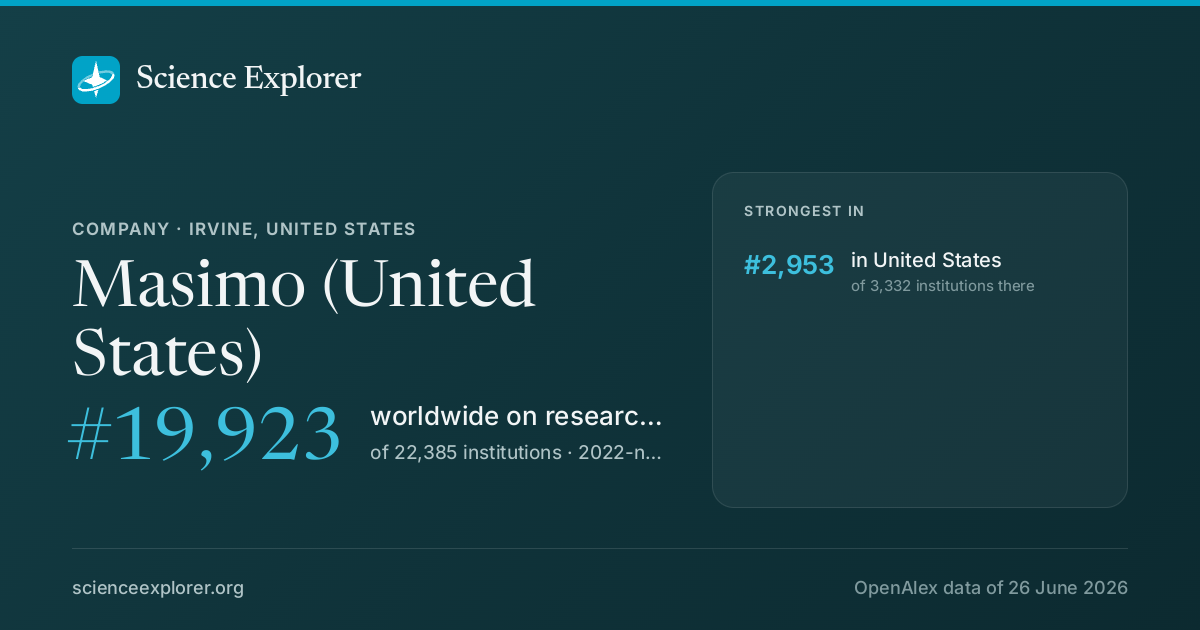
Masimo (United States) on Science Explorer

A card with Masimo (United States)'s standing and the fields it leads in, for a post or a slide. A link to this page previews as the same card.

Download the card

1200 × 630 PNG, sized for social posts, drawn from the latest snapshot.

Badges for a website1Each links back here and updates with every snapshot

Research measures only: rankings here say nothing about teaching, admissions or student experience. Comparable institutions and collaboration partners have tabs of their own, above.

Discussion

Ask a question or share a note about Masimo (United States). Posts are plain text and can be reported.