Matsunami General Hospital
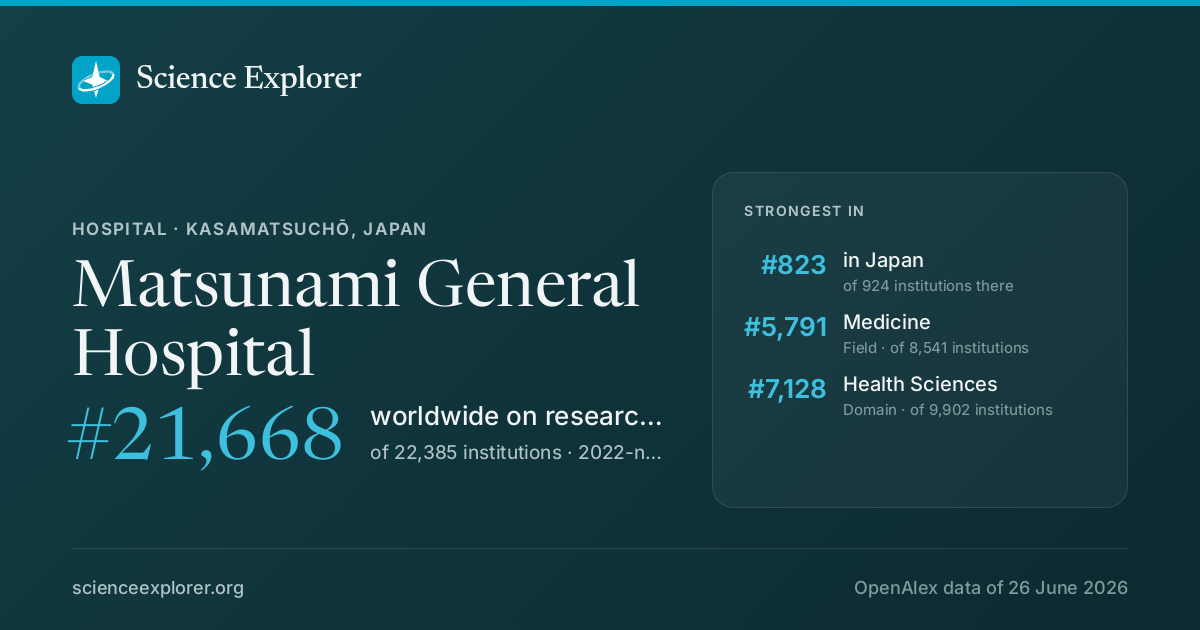
In research, Matsunami General Hospital stands highest in Medicine (#5,791 of 8,541 worldwide) and Health Sciences (#7,128 of 9,902 worldwide), 2022-now.
- World rank, 2022-now
- #21,668 of 22,385 · #30,198 all time
- Rank in Japan
- #823 of 924
- Research works
- 452 ▲ 69% vs 2018-21
- Citations
- 3.9k 8.6 per fractional work
- Top-10% rate
- 5.2% all institutions 10.0%
- vs its own fields
- 0.90× 1.00× is exactly expected
- Open access
- 59% world 40%
- International
- 4% world 18%
What is Matsunami General Hospital known for in research?
The fields where it stands highest, 2022-now, ranked among every institution above the floor in each field.
| Field | World rank | Where that sits | Top-10% rate | Works | All time |
|---|---|---|---|---|---|
| MedicineField | #5,791 of 8,541 | 5.5% | 95 | #8879 | |
| Health SciencesDomain | #7,128 of 9,902 | 5.7% | 98 | #10894 |
Each strip is that field's whole ranked pool, with the notch where Matsunami General Hospital sits in it, in the colour of the band that rank falls in. The track under the rate is the rate itself: it carries no average mark, because the average differs by field (from about 6% in Dentistry to 21% in Economics).
Which fields of science does Matsunami General Hospital work in?
In 2022-now, 91% of research at Matsunami General Hospital is in Health Sciences, 7% in Life Sciences. Its largest fields are Medicine (90%), Biochemistry, Genetics and Molecular Biology (5%), Immunology and Microbiology (2%). It does 3.7× the world's share of Health Sciences.
Each ring splits the one inside it: the four domains of science, their fields, their subfields. Size is fractional works in 2022-now. Every slice is a page; the interactive view zooms down to single topics and colours each by how much more of it this institution does than the world.
Its 4 domains and 14 fields, with their numbers
- Health Sciences12091.5%
- Medicine11789.6%
- Health Professions10.6%
- Nursing10.6%
- Dentistry10.6%
- Veterinary00.1%
- Life Sciences107.4%
- Physical Sciences10.6%
- Engineering00.4%
- Chemistry00.3%
- Social Sciences10.5%
- Psychology10.5%
- Economics, Econometrics and Finance00.0%
- Social Sciences00.0%
Field profile
Location quotient across every field it publishes in: outside the ring is more than an institution of this size would be expected to publish, inside it is less.
Rings at 0.5×, 1× and 2×. Widest outward: Medicine, 4.7×. Every wedge is a field page.
All 13 fields, with their numbers
- Medicine4.66×118 works
- Immunology and Microbiology1.75×2 works
- Nursing1.21×1 works
- Dentistry1.17×1 works
- Veterinary0.94×0 works
- Biochemistry, Genetics and Molecular Biology0.85×6 works
- Neuroscience0.35×1 works
- Health Professions0.24×1 works
- Chemistry0.16×0 works
- Psychology0.16×1 works
- Agricultural and Biological Sciences0.11×1 works
- Engineering0.03×0 works
- Economics, Econometrics and Finance0.01×0 works
- Medicine 4.7×
- Immunology and Microbiology 1.8×
- Nursing 1.2×
- Dentistry 1.2×
- Veterinary 0.9×
- Biochemistry, Genetics and Molecular Biology 0.8×
- Neuroscience 0.3×
- Health Professions 0.2×
- Chemistry 0.2×
- Psychology 0.2×
- Agricultural and Biological Sciences 0.1×
- Engineering 0.0×
- Economics, Econometrics and Finance 0.0×
Who are the top researchers at Matsunami General Hospital?
Ranked on the quality score, Takeshige Kunieda, Norihiko Morita and Kei Fujita lead among researchers whose main affiliation is Matsunami General Hospital.
- 1
Takeshige Kunieda
 Japan · #1,412,249 worldwide
3.3k citations · 42 works
- 2
Norihiko Morita
Japan · #2,579,277 worldwide
770 citations · 27 works
- 3
Kei Fujita
Japan · #2,697,549 worldwide
421 citations · 54 works
- 4
Hidetoshi Matsunami
Japan · #2,940,884 worldwide
4.2k citations · 96 works
- 5
Kumiko Yajima
Japan · #3,016,495 worldwide
419 citations · 24 works
- 6
Takahiro Yajima
Japan · #3,263,387 worldwide
597 citations · 48 works
- 7
Naoya Tsuji
Japan · #3,347,796 worldwide
234 citations · 18 works
- 8
Katsumi Ueno
Japan · #3,629,448 worldwide
1.5k citations · 57 works
- 9
Yuki Segi
Japan · #4,259,070 worldwide
10 citations · 19 works
- 10
Kimihiro Yamaguchi
Japan · #4,277,064 worldwide
102 citations · 17 works
Which keywords describe research at Matsunami General Hospital?
By fractional works in 2022-now, weighted toward what it does more of than the world: Inflammation, Epidemiology, Chemotherapy, Prognostic Factors, Aging, Cardiovascular Disease, Muscle Mass and Chronic Kidney Disease.
- Rituximab
- Uterine Leiomyoma
- Echocardiography
- Genetic Susceptibility
- Health-related Quality of Life
- Angioplasty
- Hemodialysis
- PET Imaging
- Mechanical Ventilation
- Immunotherapy
- Surgical Management
- Cancer Cachexia
- Clinical Practice Guidelines
- Prognosis
- Chronic Kidney Disease
- Aging
- Diagnosis
- Treatment
- Prognostic Factors
- Inflammation
- Epidemiology
- Chemotherapy
- Cardiovascular Disease
- Quality of Life
- Risk Factors
- Muscle Mass
- Complications
- Guidelines
- Mortality
- Sarcopenia
- Nutrition
- Diabetes
- Atherosclerosis
- Dialysis
- Revascularization
- Neoadjuvant Therapy
- Molecular Profiling
- Cholangiocarcinoma
- Uterine Fibroids
- Hypothermia
Size is fractional works in 2022-now in the topics tagged with each word; colour is the word's share of this institution's work against its share of the world's. The 40 words are chosen for being large and distinctive. Each links to the topic it comes from most.
All 40 words, with their numbers
- Epidemiology16▲ 3.1×47 topics
- Inflammation15▲ 5.3×22 topics
- Chemotherapy8▲ 9.2×16 topics
- Prognostic Factors8▲ 13×10 topics
- Cardiovascular Disease7▲ 4.9×14 topics
- Treatment7▲ 4.5×19 topics
- Quality of Life7▲ 3.6×13 topics
- Diagnosis6▲ 5.3×19 topics
- Risk Factors6▲ 4.5×14 topics
- Aging6▲ 8.4×5 topics
- Muscle Mass6▲ 39×2 topics
- Chronic Kidney Disease6▲ 17×4 topics
- Complications6▲ 8.4×11 topics
- Prognosis5▲ 12×4 topics
- Guidelines5▲ 8.2×9 topics
- Clinical Practice Guidelines5▲ 6.9×12 topics
- Mortality5▲ 6.5×7 topics
- Cancer Cachexia5▲ 41×1 topic
- Sarcopenia5▲ 41×1 topic
- Surgical Management5▲ 8.7×10 topics
- Nutrition4▲ 7.5×3 topics
- Immunotherapy4▲ 4.4×14 topics
- Diabetes4▲ 6.2×7 topics
- Mechanical Ventilation4▲ 28×2 topics
- Atherosclerosis4▲ 11×5 topics
- PET Imaging4▲ 18×2 topics
- Dialysis4▲ 57×1 topic
- Hemodialysis4▲ 35×1 topic
- Revascularization4▲ 18×3 topics
- Angioplasty3▲ 41×2 topics
- Neoadjuvant Therapy3▲ 9.8×5 topics
- Health-related Quality of Life3▲ 9.7×3 topics
- Molecular Profiling3▲ 24×3 topics
- Genetic Susceptibility3▲ 23×3 topics
- Cholangiocarcinoma3▲ 26×2 topics
- Echocardiography3▲ 7.6×6 topics
- Uterine Fibroids3▲ 73×1 topic
- Uterine Leiomyoma3▲ 73×1 topic
- Hypothermia3▲ 28×2 topics
- Rituximab3▲ 14×2 topics
Which research topics does Matsunami General Hospital publish most on?
By volume in 2022-now: Nutrition and Health in Aging, Dialysis and Renal Disease Management, Uterine Myomas and Treatments and Peripheral Artery Disease Management.
Area is fractional works; colour is the subfield each topic belongs to.
- 1 Nutrition and Health in Aging Physiology 5 works
- 2 Dialysis and Renal Disease Management Nephrology 4 works
- 3 Uterine Myomas and Treatments Obstetrics and Gynecology 3 works
- 4 Peripheral Artery Disease Management Surgery 3 works
- 5 Respiratory Support and Mechanisms Pulmonary and Respiratory Medicine 2 works
- 6 Airway Management and Intubation Techniques Anesthesiology and Pain Medicine 2 works
- 7 Lymphoma Diagnosis and Treatment Pathology and Forensic Medicine 2 works
- 8 Gastrointestinal Tumor Research and Treatment Gastroenterology 2 works
- 9 Gallbladder and Bile Duct Disorders Pulmonary and Respiratory Medicine 2 works
- 10 Thermal Regulation in Medicine Critical Care and Intensive Care Medicine 2 works
How open and international is its research?
Against the world's own shares: the tick on each track. Both are shares of its output, so they sit on one scale and can be read against each other as well as against the world.
World: 40% of research is openly available.
World: 18% is written across borders.
How has Matsunami General Hospital's research output changed?
Output in 2022-2025 was 69% higher than in 2018-2021.
The same series as a ribbon: one cell per year, darker for more. The line above answers how much; this answers when.
Its share of all research
Growing output can still be a shrinking share: all of science grows. This is Matsunami General Hospital as a percentage of every work published that year, 0.00037% in 2024.
Fractional works of Matsunami General Hospital over all fractional works that year. How the balance of science has shifted.
Other research institutions in Kasamatsuchō
Share Matsunami General Hospital's ranking
Badges for a website1Each links back here and updates with every snapshot

Research measures only: rankings here say nothing about teaching, admissions or student experience. Comparable institutions and collaboration partners have tabs of their own, above.
Discussion
Ask a question or share a note about Matsunami General Hospital. Keep it to the research: no personal attacks, advertising or links. Any reader can report a post, which collapses it for everyone until it is opened.