Medias Klinikum
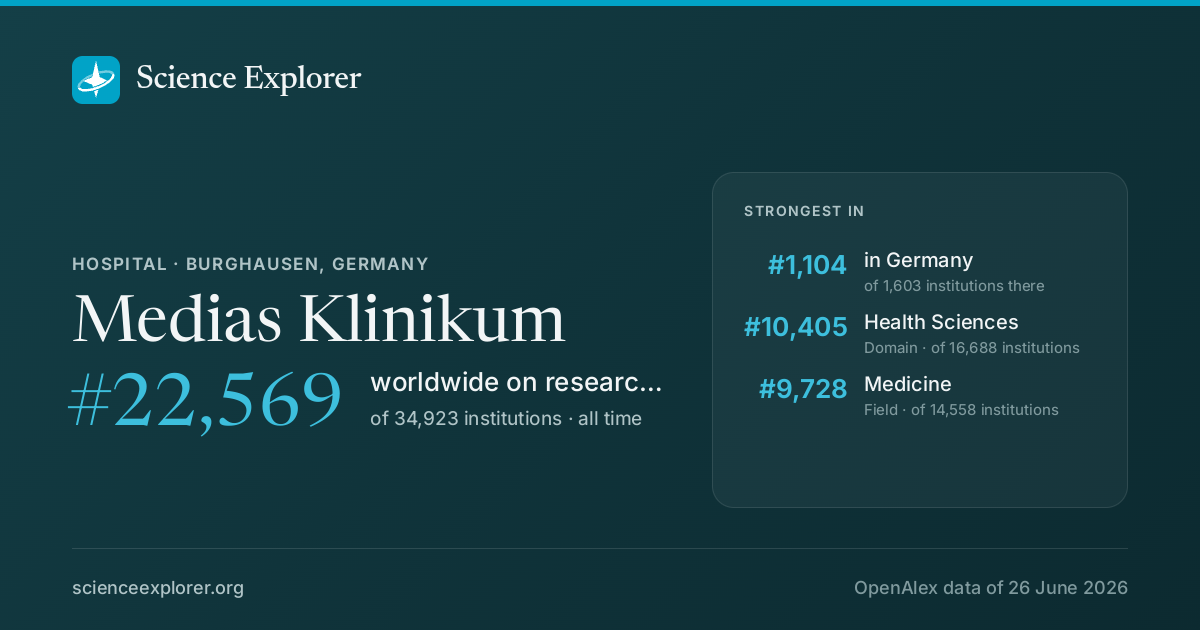
In research, Medias Klinikum stands highest in Health Sciences (#10,405 of 16,688 worldwide) and Medicine (#9,728 of 14,558 worldwide), over all time.
- World rank, all time
- #22,569 of 34,923
- Rank in Germany
- #1,104 of 1,603
- Research works
- 256 ◆ 1% vs 2018-21
- Citations
- 1.1k 4.3 per fractional work
- Top-10% rate
- 3.3% all institutions 10.0%
- vs its own fields
- 0.94× 1.00× is exactly expected
- Open access
- 15% world 40%
- International
- 13% world 18%
What is Medias Klinikum known for in research?
The fields where it stands highest, over all time, ranked among every institution above the floor in each field.
| Field | World rank | Where that sits | Top-10% rate | Works |
|---|---|---|---|---|
| Health SciencesDomain | #10,405 of 16,688 | 2.2% | 178 | |
| MedicineField | #9,728 of 14,558 | 2.3% | 169 |
Each strip is that field's whole ranked pool, with the notch where Medias Klinikum sits in it, in the colour of the band that rank falls in. The track under the rate is the rate itself: it carries no average mark, because the average differs by field (from about 6% in Dentistry to 21% in Economics).
Which fields of science does Medias Klinikum work in?
In 2022-now, 80% of research at Medias Klinikum is in Health Sciences, 10% in Life Sciences. Its largest fields are Medicine (77%), Biochemistry, Genetics and Molecular Biology (7%), Engineering (4%). It does 3.0× the world's share of Health Sciences.
Each ring splits the one inside it: the four domains of science, their fields, their subfields. Size is fractional works in 2022-now. Every slice is a page; the interactive view zooms down to single topics and colours each by how much more of it this institution does than the world.
Its 4 domains and 18 fields, with their numbers
- Health Sciences4580.2%
- Medicine4376.6%
- Health Professions23.5%
- Life Sciences69.8%
- Physical Sciences58.7%
- Engineering24.0%
- Materials Science11.8%
- Energy11.2%
- Chemistry00.4%
- Environmental Science00.4%
- Physics and Astronomy00.3%
- Chemical Engineering00.3%
- Earth and Planetary Sciences00.3%
- Social Sciences11.3%
- Social Sciences00.6%
- Decision Sciences00.4%
- Economics, Econometrics and Finance00.2%
- Psychology00.1%
Field profile
Location quotient across every field it publishes in: outside the ring is more than an institution of this size would be expected to publish, inside it is less.
Rings at 0.5×, 1× and 2×. Widest outward: Medicine, 4.0×. Every wedge is a field page.
All 18 fields, with their numbers
- Medicine3.99×43 works
- Immunology and Microbiology2.51×1 works
- Health Professions1.35×2 works
- Biochemistry, Genetics and Molecular Biology1.31×4 works
- Energy1.29×1 works
- Chemical Engineering0.84×0 works
- Materials Science0.51×1 works
- Decision Sciences0.41×0 works
- Engineering0.27×2 works
- Chemistry0.25×0 works
- Earth and Planetary Sciences0.19×0 works
- Physics and Astronomy0.14×0 works
- Economics, Econometrics and Finance0.12×0 works
- Environmental Science0.08×0 works
- Neuroscience0.06×0 works
- Agricultural and Biological Sciences0.04×0 works
- Social Sciences0.04×0 works
- Psychology0.03×0 works
- Medicine 4.0×
- Immunology and Microbiology 2.5×
- Health Professions 1.4×
- Biochemistry, Genetics and Molecular Biology 1.3×
- Energy 1.3×
- Chemical Engineering 0.8×
- Materials Science 0.5×
- Decision Sciences 0.4×
- Engineering 0.3×
- Chemistry 0.2×
- Earth and Planetary Sciences 0.2×
- Physics and Astronomy 0.1×
- Economics, Econometrics and Finance 0.1×
- Environmental Science 0.1×
- Neuroscience 0.1×
- Agricultural and Biological Sciences 0.0×
- Social Sciences 0.0×
- Psychology 0.0×
Who are the top researchers at Medias Klinikum?
Ranked on the quality score, Martin Feuchtenberger, Sebastian Reichenberger and R. Grundmann lead among researchers whose main affiliation is Medias Klinikum.
- 1
Martin Feuchtenberger
 Germany · #1,407,842 worldwide
1.5k citations · 85 works
- 2
Sebastian Reichenberger
Germany · #1,739,628 worldwide
231 citations · 18 works
- 3
R. Grundmann
Germany · #4,370,481 worldwide
91 citations · 17 works
- 4
Emir Selak
Germany · #5,115,508 worldwide
82 citations · 28 works
- 5
Sabine Gailhofer
Germany · #5,441,035 worldwide
136 citations · 33 works
- 6
Kornelia Aigner
Germany · #6,117,510 worldwide
684 citations · 111 works
- 7
Karl Reinhard Aigner
Germany · #6,640,336 worldwide
1.5k citations · 215 works
Which keywords describe research at Medias Klinikum?
By fractional works in 2022-now, weighted toward what it does more of than the world: Risk Factors, Clinical Practice Guidelines, Revascularization, Endovascular Repair, Diabetes, Guidelines, Angioplasty and Chemotherapy.
- Wound Healing
- Inferior Vena Cava
- Carotid Artery Stenosis
- Clinical Outcomes
- Surgical Management
- Survival Analysis
- Soft Tissue Sarcoma
- Chronic Venous Insufficiency
- Mesenteric Ischemia
- CT Diagnosis
- Radiotherapy
- Prognostic Factors
- Atherosclerosis
- Aneurysm Screening
- Matrix Metalloproteinases
- Chemotherapy
- Treatment
- Angioplasty
- Endovascular Repair
- Clinical Practice Guidelines
- Risk Factors
- Revascularization
- Diabetes
- Guidelines
- Epidemiology
- Quality of Life
- Aneurysm Rupture
- Deep Vein Thrombosis
- Peripheral Arterial Disease
- Diagnosis
- Antithrombotic Therapy
- Venous Thromboembolism
- Visceral Artery Aneurysms
- Osteosarcoma
- Stroke Prevention
- Varicose Veins
- Ultrasound
- Palliative Treatment
- Endarterectomy
- Superior Mesenteric Artery Syndrome
Size is fractional works in 2022-now in the topics tagged with each word; colour is the word's share of this institution's work against its share of the world's. The 40 words are chosen for being large and distinctive. Each links to the topic it comes from most.
All 40 words, with their numbers
- Risk Factors10▲ 16×5 topics
- Clinical Practice Guidelines8▲ 25×8 topics
- Revascularization6▲ 70×3 topics
- Endovascular Repair4▲ 88×2 topics
- Diabetes4▲ 15×5 topics
- Angioplasty4▲ 120×2 topics
- Guidelines4▲ 15×5 topics
- Treatment4▲ 5.9×7 topics
- Epidemiology4▲ 1.75×16 topics
- Chemotherapy4▲ 9.5×7 topics
- Quality of Life4▲ 4.5×8 topics
- Matrix Metalloproteinases4▲ 43×2 topics
- Aneurysm Rupture3▲ 194×1 topic
- Aneurysm Screening3▲ 194×1 topic
- Deep Vein Thrombosis3▲ 80×2 topics
- Atherosclerosis3▲ 21×1 topic
- Peripheral Arterial Disease3▲ 158×1 topic
- Prognostic Factors3▲ 13×7 topics
- Diagnosis3▲ 5.9×7 topics
- Radiotherapy3▲ 13×5 topics
- Antithrombotic Therapy2▲ 45×1 topic
- CT Diagnosis2▲ 123×2 topics
- Venous Thromboembolism2▲ 59×1 topic
- Mesenteric Ischemia2▲ 246×1 topic
- Visceral Artery Aneurysms2▲ 246×1 topic
- Chronic Venous Insufficiency2▲ 150×1 topic
- Osteosarcoma2▲ 70×1 topic
- Soft Tissue Sarcoma2▲ 62×1 topic
- Stroke Prevention2▲ 26×2 topics
- Survival Analysis2▲ 11×5 topics
- Varicose Veins2▲ 150×1 topic
- Surgical Management2▲ 7.3×5 topics
- Ultrasound2▲ 27×2 topics
- Clinical Outcomes2▲ 12×3 topics
- Palliative Treatment2▲ 41×2 topics
- Carotid Artery Stenosis1▲ 53×1 topic
- Endarterectomy1▲ 53×1 topic
- Inferior Vena Cava1▲ 152×1 topic
- Superior Mesenteric Artery Syndrome1▲ 152×1 topic
- Wound Healing1▲ 9.6×4 topics
Which research topics does Medias Klinikum publish most on?
By volume in 2022-now: Aortic aneurysm repair treatments, Peripheral Artery Disease Management, Venous Thromboembolism Diagnosis and Management and Abdominal vascular conditions and treatments.
Area is fractional works; colour is the subfield each topic belongs to.
- 1 Aortic aneurysm repair treatments Pulmonary and Respiratory Medicine 3 works
- 2 Peripheral Artery Disease Management Surgery 3 works
- 3 Venous Thromboembolism Diagnosis and Management Internal Medicine 2 works
- 4 Abdominal vascular conditions and treatments Surgery 2 works
- 5 Sarcoma Diagnosis and Treatment Pulmonary and Respiratory Medicine 2 works
- 6 Diagnosis and Treatment of Venous Diseases Surgery 2 works
- 7 Vascular anomalies and interventions Surgery 1 works
- 8 Cerebrovascular and Carotid Artery Diseases Pulmonary and Respiratory Medicine 1 works
- 9 Vascular Procedures and Complications Pulmonary and Respiratory Medicine 1 works
- 10 Microbial Inactivation Methods Biotechnology 1 works
How open and international is its research?
Against the world's own shares: the tick on each track. Both are shares of its output, so they sit on one scale and can be read against each other as well as against the world.
World: 40% of research is openly available.
World: 18% is written across borders.
How has Medias Klinikum's research output changed?
Output in 2022-2025 was 1% lower than in 2018-2021.
The same series as a ribbon: one cell per year, darker for more. The line above answers how much; this answers when.
Its share of all research
Growing output can still be a shrinking share: all of science grows. This is Medias Klinikum as a percentage of every work published that year, 0.00017% in 2024.
Fractional works of Medias Klinikum over all fractional works that year. How the balance of science has shifted.
Share Medias Klinikum's ranking
Badges for a website1Each links back here and updates with every snapshot

Research measures only: rankings here say nothing about teaching, admissions or student experience. Comparable institutions and collaboration partners have tabs of their own, above.
Discussion
Ask a question or share a note about Medias Klinikum. Keep it to the research: no personal attacks, advertising or links. Any reader can report a post, which collapses it for everyone until it is opened.