Science Explorer Back to mapMap
Discussion
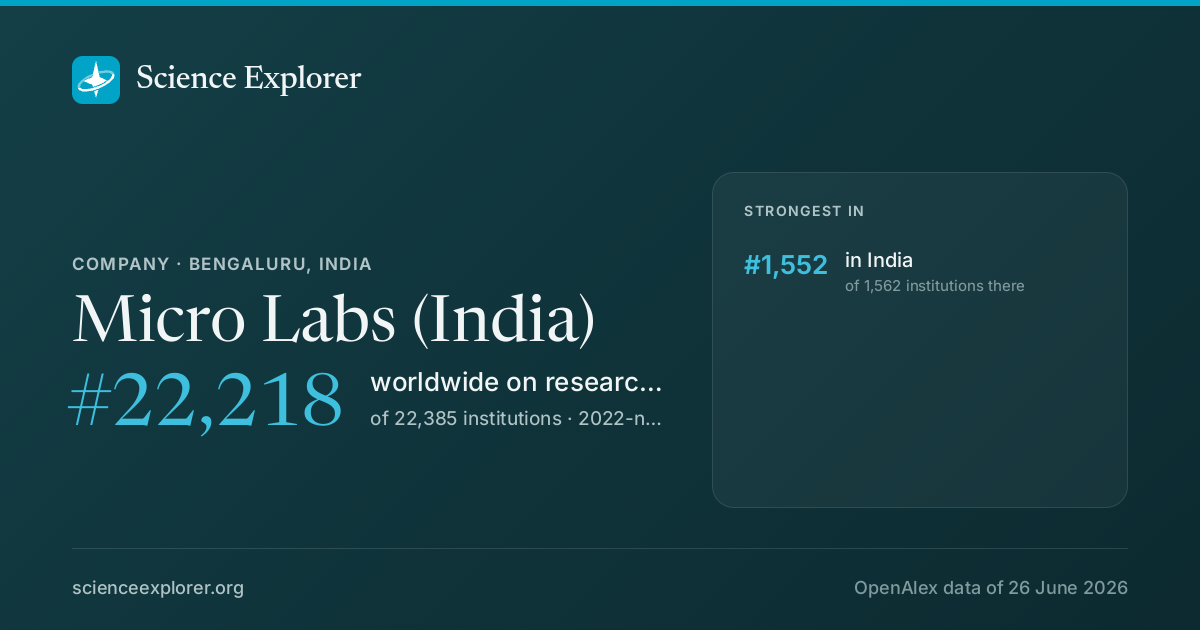
Company · Bengaluru · India

Micro Labs (India)

World rank, 2022-now
#22,218
of 22,385 · #34,472 all time
Rank in India
#1,552
of 1,562
Research works
136
▲ 256% vs 2018-21
Citations
652
4.8 per fractional work
Top-10% rate
0.4%
all institutions 10.0%
vs its own fields
0.89×
1.00× is exactly expected
Open access
60%
world 40%
International
6%
world 18%

Which fields of science does Micro Labs (India) work in?

In 2022-now, 78% of research at Micro Labs (India) is in Health Sciences, 14% in Life Sciences. Its largest fields are Medicine (75%), Biochemistry, Genetics and Molecular Biology (5%), Pharmacology, Toxicology and Pharmaceutics (4%). It does 3.0× the world's share of Health Sciences.

Health Sciences: 58 fractional works · 78.0% of its workMedicine: 55 fractional works · 74.8% of its workEndocrinology, Diabetes and Metabolism: 9 fractional works · 11.8% of its workPharmacology: 4 fractional works · 6.1% of its workEpidemiology: 4 fractional works · 4.9% of its workImmunology and Allergy: 3 fractional works · 4.6% of its workPhysiology: 3 fractional works · 4.3% of its workSurgery: 3 fractional works · 3.6% of its workPublic Health, Environmental and Occupational Health: 2 fractional works · 3.3% of its workRheumatology: 2 fractional works · 3.3% of its workCardiology and Cardiovascular Medicine: 2 fractional works · 3.2% of its workHematology: 2 fractional works · 2.9% of its workDermatology: 2 fractional works · 2.7% of its workOphthalmology: 2 fractional works · 2.6% of its workUrology: 2 fractional works · 2.5% of its workPulmonary and Respiratory Medicine: 2 fractional works · 2.3% of its workPathology and Forensic Medicine: 1 fractional works · 1.9% of its workEmergency Medicine: 1 fractional works · 1.3% of its workGastroenterology: 1 fractional works · 1.3% of its workPediatrics, Perinatology and Child Health: 1 fractional works · 1.3% of its workGeriatrics and Gerontology: 1 fractional works · 1.2% of its workInfectious Diseases: 1 fractional works · 1.1% of its workFamily Practice: 1 fractional works · 1.0% of its workReproductive Medicine: 1 fractional works · 1.0% of its workCritical Care and Intensive Care Medicine: 1 fractional works · 0.9% of its workPsychiatry and Mental health: 1 fractional works · 0.9% of its workRehabilitation: 1 fractional works · 0.9% of its workRadiology, Nuclear Medicine and Imaging: 1 fractional works · 0.8% of its workGenetics: 0 fractional works · 0.7% of its workComplementary and alternative medicine: 0 fractional works · 0.6% of its workBiochemistry: 0 fractional works · 0.6% of its workOncology: 0 fractional works · 0.5% of its workInternal Medicine: 0 fractional works · 0.4% of its workHealth Professions: 1 fractional works · 1.9% of its workGeneral Health Professions: 1 fractional works · 1.9% of its workNursing: 1 fractional works · 1.3% of its workNutrition and Dietetics: 1 fractional works · 1.3% of its workLife Sciences: 10 fractional works · 13.7% of its workBiochemistry, Genetics and Molecular Biology: 4 fractional works · 4.9% of its workMolecular Biology: 1 fractional works · 1.8% of its workMolecular Medicine: 1 fractional works · 1.3% of its workCell Biology: 1 fractional works · 1.1% of its workGenetics: 0 fractional works · 0.4% of its workBiochemistry: 0 fractional works · 0.2% of its workPharmacology, Toxicology and Pharmaceutics: 3 fractional works · 4.4% of its workPharmaceutical Science: 3 fractional works · 3.9% of its workPharmacology: 0 fractional works · 0.4% of its workImmunology and Microbiology: 2 fractional works · 3.1% of its workApplied Microbiology and Biotechnology: 2 fractional works · 2.3% of its workImmunology: 0 fractional works · 0.4% of its workMicrobiology: 0 fractional works · 0.4% of its workAgricultural and Biological Sciences: 1 fractional works · 0.8% of its workAgronomy and Crop Science: 0 fractional works · 0.4% of its workFood Science: 0 fractional works · 0.2% of its workSmaller subfields together: 0 fractional works · 0.1% of its workNeuroscience: 0 fractional works · 0.4% of its workCellular and Molecular Neuroscience: 0 fractional works · 0.4% of its workPhysical Sciences: 4 fractional works · 5.0% of its workChemistry: 1 fractional works · 1.9% of its workOrganic Chemistry: 1 fractional works · 1.3% of its workPhysical and Theoretical Chemistry: 0 fractional works · 0.2% of its workSmaller subfields together: 0 fractional works · 0.4% of its workEngineering: 1 fractional works · 1.1% of its workMechanical Engineering: 0 fractional works · 0.4% of its workElectrical and Electronic Engineering: 0 fractional works · 0.3% of its workBiomedical Engineering: 0 fractional works · 0.3% of its workSmaller subfields together: 0 fractional works · 0.1% of its workComputer Science: 0 fractional works · 0.7% of its workComputer Networks and Communications: 0 fractional works · 0.4% of its workComputer Vision and Pattern Recognition: 0 fractional works · 0.2% of its workMaterials Science: 0 fractional works · 0.7% of its workMaterials Chemistry: 0 fractional works · 0.7% of its workEnvironmental Science: 0 fractional works · 0.4% of its workHealth, Toxicology and Mutagenesis: 0 fractional works · 0.4% of its workEarth and Planetary Sciences: 0 fractional works · 0.2% of its workAtmospheric Science: 0 fractional works · 0.2% of its workSocial Sciences: 2 fractional works · 3.3% of its workSocial Sciences: 1 fractional works · 1.3% of its workHealth: 1 fractional works · 1.3% of its workPsychology: 1 fractional works · 0.7% of its workExperimental and Cognitive Psychology: 0 fractional works · 0.5% of its workSmaller subfields together: 0 fractional works · 0.2% of its workEconomics, Econometrics and Finance: 0 fractional works · 0.7% of its workEconomics and Econometrics: 0 fractional works · 0.7% of its workDecision Sciences: 0 fractional works · 0.3% of its workManagement Science and Operations Research: 0 fractional works · 0.3% of its workBusiness, Management and Accounting: 0 fractional works · 0.2% of its workManagement of Technology and Innovation: 0 fractional works · 0.2% of its workALL ITS WORKMicro Labs(India)74fractional works, 2022-now
Life Sciences14%Physical Sciences5%Health Sciences78%Social Sciences3%

Each ring splits the one inside it: the four domains of science, their fields, their subfields. Size is fractional works in 2022-now. Every slice is a page; the interactive view zooms down to single topics and colours each by how much more of it this institution does than the world.

Its 4 domains and 19 fields, with their numbers
    1. Medicine5574.8%
    2. Health Professions11.9%
    3. Nursing11.3%
    1. Biochemistry, Genetics and Molecular Biology44.9%
    2. Pharmacology, Toxicology and Pharmaceutics34.4%
    3. Immunology and Microbiology23.1%
    4. Agricultural and Biological Sciences10.8%
    5. Neuroscience00.4%
    1. Chemistry11.9%
    2. Engineering11.1%
    3. Computer Science00.7%
    4. Materials Science00.7%
    5. Environmental Science00.4%
    6. Earth and Planetary Sciences00.2%
    1. Social Sciences11.3%
    2. Psychology10.7%
    3. Economics, Econometrics and Finance00.7%
    4. Decision Sciences00.3%
    5. Business, Management and Accounting00.2%
All of science, and how each field's share has moved since 1950: the Science domain explorer

Field profile

Location quotient across every field it publishes in: outside the ring is more than an institution of this size would be expected to publish, inside it is less.

Agricultural and Biological Sciences: 0.17× its world share, 1 worksAgricultural and Bio…Biochemistry, Genetics and Molecular Biology: 0.91× its world share, 4 worksBiochemistry, Geneti…Immunology and Microbiology: 3.13× its world share, 2 worksImmunology and Micro…Neuroscience: 0.28× its world share, 0 worksNeurosciencePharmacology, Toxicology and Pharmaceutics: 12.44× its world share, 3 worksPharmacology, Toxico…Chemistry: 1.24× its world share, 1 worksChemistryComputer Science: 0.09× its world share, 0 worksComputer ScienceEarth and Planetary Sciences: 0.14× its world share, 0 worksEarth and Planetary …Engineering: 0.07× its world share, 1 worksEngineeringEnvironmental Science: 0.09× its world share, 0 worksEnvironmental ScienceMaterials Science: 0.19× its world share, 0 worksMaterials ScienceHealth Professions: 0.70× its world share, 1 worksHealth ProfessionsMedicine: 3.89× its world share, 56 worksMedicineNursing: 2.75× its world share, 1 worksNursingBusiness, Management and Accounting: 0.07× its world share, 0 worksBusiness, Management…Decision Sciences: 0.35× its world share, 0 worksDecision SciencesEconomics, Econometrics and Finance: 0.32× its world share, 0 worksEconomics, Econometr…Psychology: 0.24× its world share, 0 worksPsychologySocial Sciences: 0.11× its world share, 1 worksSocial Sciences1×world share
more than its size predictsabout as predictedless

Rings at 0.5×, 1× and 2×. Widest outward: Pharmacology, Toxicology and Pharmaceutics, 12.4×. Every wedge is a field page.

All 19 fields, with their numbers
  1. Pharmacology, Toxicology and Pharmaceutics12.44×3 works
  2. Medicine3.89×56 works
  3. Immunology and Microbiology3.13×2 works
  4. Nursing2.75×1 works
  5. Chemistry1.24×1 works
  6. Biochemistry, Genetics and Molecular Biology0.91×4 works
  7. Health Professions0.70×1 works
  8. Decision Sciences0.35×0 works
  9. Economics, Econometrics and Finance0.32×0 works
  10. Neuroscience0.28×0 works
  11. Psychology0.24×0 works
  12. Materials Science0.19×0 works
  13. Agricultural and Biological Sciences0.17×1 works
  14. Earth and Planetary Sciences0.14×0 works
  15. Social Sciences0.11×1 works
  16. Computer Science0.09×0 works
  17. Environmental Science0.09×0 works
  18. Engineering0.07×1 works
  19. Business, Management and Accounting0.07×0 works

Who are the top researchers at Micro Labs (India)?

Ranked on the quality score, S Manjula, S Manjula and Mohit Jain lead among researchers whose main affiliation is Micro Labs (India).

  1. 1 S Manjula India · #3,040,178 worldwide 7k citations · 122 works
  2. 2 S Manjula India · #5,004,381 worldwide 25 citations · 15 works
  3. 3 Mohit Jain India · #5,350,620 worldwide 216 citations · 28 works
  4. 4 Krishna Kumar M. India · #5,443,644 worldwide 12 citations · 19 works
  5. 5 S Manjula India · #6,173,594 worldwide 19 citations · 32 works
  6. 6 Krishna Kumar M India · #7,269,221 worldwide 12 citations · 79 works
  7. 7 Krishna Kumar M India · #7,335,935 worldwide 36 citations · 79 works
  8. 8 Pramod Kumar India · #7,574,100 worldwide 1.3k citations · 146 works
All ranked researchers at Micro Labs (India)

What are the most cited papers from Micro Labs (India)?

The most cited paper from Micro Labs (India) is "Hydnocarpus alpina Wt extract mediated green synthesis of ZnO nanoparticle and screening of its anti-microbial, free radical scavenging, and photocatalytic activity" (Mani Ganesh, Sung Gil Lee, Jayabalan Jayaprakash et al., 2019), with 98 citations. Next come "A Multi-centric, Double-blind, Placebo-controlled, Randomized, Prospective Study to Evaluate the Efficacy and Safety of Carica papaya Leaf Extract, as Empirical Therapy for Thrombocytopenia associated with Dengue Fever." (58) and "Quantitative Determination of Metformin Hydrochloride in Tablet Formulation Containing Croscarmellose Sodium as Disintegrant by HPLC and UV Spectrophotometry" (53).

Most cited papers
#PaperReleasedCitations
1 Hydnocarpus alpina Wt extract mediated green synthesis of ZnO nanoparticle and screening of its anti-microbial, free radical scavenging, and photocatalytic activity Mani Ganesh, Sung Gil Lee, Jayabalan Jayaprakash et al. · Biocatalysis and Agricultural Biotechnology 19 Apr 2019 98
2 A Multi-centric, Double-blind, Placebo-controlled, Randomized, Prospective Study to Evaluate the Efficacy and Safety of Carica papaya Leaf Extract, as Empirical Therapy for Thrombocytopenia associated with Dengue Fever. Prabhu Nagnathappa Kasture, K H Nagabhushan, Kumar Maria Arun · PubMed Jun 2016 58
3 Quantitative Determination of Metformin Hydrochloride in Tablet Formulation Containing Croscarmellose Sodium as Disintegrant by HPLC and UV Spectrophotometry Periasamy Umapathi, J Ayyappan, S. Darlin Quine · Tropical Journal of Pharmaceutical Research Open access 12 Mar 2012 53
4 A top-down technique to improve the solubility and bioavailability of aceclofenac: in vitro and in vivo studies Reema Narayan, Abhyuday Pednekar, Dipshikha Bhuyan et al. · International Journal of Nanomedicine Open access Jul 2017 49
5 Synthesis, characterization and studies on antioxidant and molecular docking of metal complexes of 1-(benzo[d]thiazol-2-yl)thiourea Yapati Harinath, Subba Rao Devineni, SURESH CHIRUMAMILLA et al. · Journal of Chemical Sciences 2016 42
All 60 most cited papers, with filters and sorting

Which keywords describe research at Micro Labs (India)?

By fractional works in 2022-now, weighted toward what it does more of than the world: Epidemiology, Inflammation, Cardiovascular Disease, Glycemic Control, Insulin Therapy, Diabetes, Clinical Guidelines and Asthma.

▲ more of its work than of the world's◆ about the world's share▼ less than the world's

Size is fractional works in 2022-now in the topics tagged with each word; colour is the word's share of this institution's work against its share of the world's. The 40 words are chosen for being large and distinctive. Each links to the topic it comes from most.

All 40 words, with their numbers
  1. Epidemiology17▲ 5.7×22 topics
  2. Inflammation12▲ 7.7×21 topics
  3. Cardiovascular Disease8▲ 10×10 topics
  4. Glycemic Control7▲ 61×4 topics
  5. Insulin Therapy6▲ 67×3 topics
  6. Diabetes6▲ 15×5 topics
  7. Clinical Guidelines5▲ 25×3 topics
  8. Treatment5▲ 5.7×6 topics
  9. Asthma5▲ 66×2 topics
  10. Oxidative Stress4▲ 3.5×11 topics
  11. Antibiotic Resistance4▲ 14×5 topics
  12. Heart Failure4▲ 12×4 topics
  13. Complications4▲ 10×2 topics
  14. Genetics4▲ 7.1×4 topics
  15. Diagnosis3▲ 5.0×7 topics
  16. Quality of Life3▲ 3.2×3 topics
  17. Risk Factors3▲ 4.1×4 topics
  18. Type 1 Diabetes3▲ 55×2 topics
  19. Antimicrobial Resistance3▲ 21×3 topics
  20. Obesity3▲ 5.5×5 topics
  21. Continuous Glucose Monitoring3▲ 91×1 topic
  22. Hypoglycemia3▲ 91×1 topic
  23. Clinical Trials3▲ 6.0×5 topics
  24. Type 2 Diabetes3▲ 17×2 topics
  25. Cardiovascular Outcomes3▲ 67×1 topic
  26. Glucose Control3▲ 67×1 topic
  27. Allergen-specific Immunotherapy3▲ 119×1 topic
  28. Pollen Allergy3▲ 119×1 topic
  29. Global Burden3▲ 6.4×4 topics
  30. Cardiovascular Disease Prevention2▲ 36×3 topics
  31. Drug Resistance2▲ 11×2 topics
  32. Pathogenesis2▲ 6.2×5 topics
  33. Anemia2▲ 30×2 topics
  34. Iron Deficiency2▲ 56×2 topics
  35. Insulin Resistance2▲ 6.2×4 topics
  36. Allergic Diseases2▲ 47×1 topic
  37. Diabetes Mellitus2▲ 13×5 topics
  38. Eosinophils2▲ 47×1 topic
  39. Atherosclerosis2▲ 9.2×3 topics
  40. Hepcidin2▲ 64×1 topic

Which research topics does Micro Labs (India) publish most on?

By volume in 2022-now: Diabetes Management and Research, Diabetes Treatment and Management, Allergic Rhinitis and Sensitization and Asthma and respiratory diseases.

  1. 1 Diabetes Management and Research Endocrinology, Diabetes and Metabolism 3 works
  2. 2 Diabetes Treatment and Management Endocrinology, Diabetes and Metabolism 3 works
  3. 3 Allergic Rhinitis and Sensitization Immunology and Allergy 3 works
  4. 4 Asthma and respiratory diseases Physiology 2 works
  5. 5 Iron Metabolism and Disorders Hematology 2 works
  6. 6 Antibiotic Use and Resistance Applied Microbiology and Biotechnology 2 works
  7. 7 Pneumonia and Respiratory Infections Epidemiology 2 works
  8. 8 Urinary Bladder and Prostate Research Urology 2 works
  9. 9 Advanced Drug Delivery Systems Pharmaceutical Science 1 works
  10. 10 Glaucoma and retinal disorders Ophthalmology 1 works

How open and international is its research?

Against the world's own shares: the tick on each track. Both are shares of its output, so they sit on one scale and can be read against each other as well as against the world.

openly available59.6%not open40.4%

World: 40% of research is openly available.

with international co-authors5.6%domestic only94.4%

World: 18% is written across borders.

How has Micro Labs (India)'s research output changed?

Output in 2022-2025 was 256% higher than in 2018-2021.

still counting200020102020
grewheldshrank

The same series as a ribbon: one cell per year, darker for more. The line above answers how much; this answers when.

Its share of all research

Growing output can still be a shrinking share: all of science grows. This is Micro Labs (India) as a percentage of every work published that year, 0.00085% in 2024.

still counting0.00050%0.0010%Micro Labs (India)0.00029% in 2025200020102020

Fractional works of Micro Labs (India) over all fractional works that year. How the balance of science has shifted.

Other research institutions in Bengaluru

All research institutions in Bengaluru

Share Micro Labs (India)'s ranking

Micro Labs (India) on Science Explorer

A card with Micro Labs (India)'s standing and the fields it leads in, for a post or a slide. A link to this page previews as the same card.

Download the card

1200 × 630 PNG, sized for social posts, drawn from the latest snapshot.

Badges for a website1Each links back here and updates with every snapshot

Research measures only: rankings here say nothing about teaching, admissions or student experience. Comparable institutions and collaboration partners have tabs of their own, above.

Discussion

Ask a question or share a note about Micro Labs (India). Keep it to the research: no personal attacks, advertising or links. Any reader can report a post, which collapses it for everyone until it is opened.