Minnesota Eye Consultants
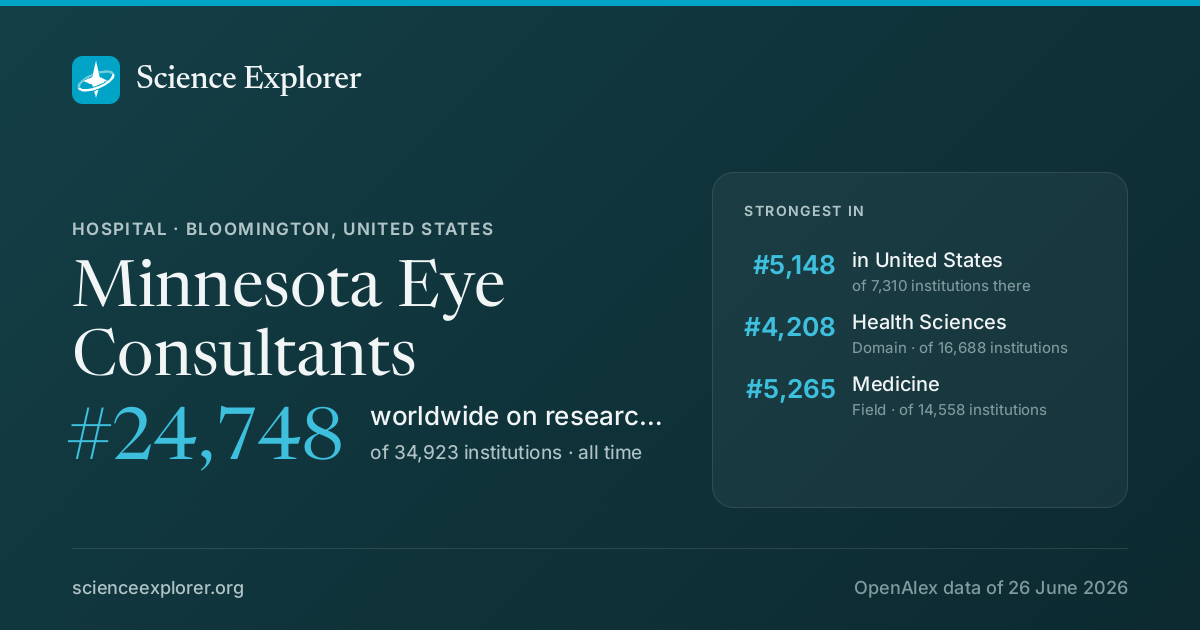
In research, Minnesota Eye Consultants stands highest in Health Sciences (#4,208 of 16,688 worldwide) and Medicine (#5,265 of 14,558 worldwide), over all time. Relative to its size it is most specialised in Medicine and Health Sciences (Medicine is 4.2× its share of world research).
- World rank, all time
- #24,748 of 34,923
- Rank in United States
- #5,148 of 7,310
- Research works
- 201 ▼ 26% vs 2018-21
- Citations
- 4.8k 23.7 per fractional work
- Top-10% rate
- 14.9% all institutions 10.0%
- vs its own fields
- 1.11× 1.00× is exactly expected
- Open access
- 30% world 40%
- International
- 13% world 18%
What is Minnesota Eye Consultants known for in research?
The fields where it stands highest, over all time, ranked among every institution above the floor in each field.
| Field | World rank | Where that sits | Top-10% rate | Works |
|---|---|---|---|---|
| Health SciencesDomain | #4,208 of 16,688 | 12.0% | 177 | |
| MedicineField | #5,265 of 14,558 | 12.5% | 167 |
Each strip is that field's whole ranked pool, with the notch where Minnesota Eye Consultants sits in it, in the colour of the band that rank falls in. The track under the rate is the rate itself: it carries no average mark, because the average differs by field (from about 6% in Dentistry to 21% in Economics).
Which fields of science does Minnesota Eye Consultants work in?
In 2022-now, 88% of research at Minnesota Eye Consultants is in Health Sciences, 7% in Life Sciences. Its largest fields are Medicine (81%), Biochemistry, Genetics and Molecular Biology (5%), Health Professions (5%). It does 3.0× the world's share of Health Sciences.
Each ring splits the one inside it: the four domains of science, their fields, their subfields. Size is fractional works in 2022-now. Every slice is a page; the interactive view zooms down to single topics and colours each by how much more of it this institution does than the world.
Its 4 domains and 15 fields, with their numbers
- Health Sciences2788.0%
- Medicine2581.2%
- Health Professions14.5%
- Dentistry11.8%
- Veterinary00.4%
- Life Sciences27.1%
- Physical Sciences12.8%
- Engineering01.2%
- Computer Science01.1%
- Environmental Science00.5%
- Social Sciences12.2%
What does Minnesota Eye Consultants specialise in?
Where its research is concentrated relative to its size: Medicine takes 4.2× the share of its output that it takes of world research.
- MedicineField · 25.2 works4.2×
- Health SciencesDomain · 27.2 works3.8×
Location quotient, a volume reading rather than an impact one. It surfaces small, lopsided specialities.
Field profile
Location quotient across every field it publishes in: outside the ring is more than an institution of this size would be expected to publish, inside it is less.
Rings at 0.5×, 1× and 2×. Widest outward: Medicine, 4.2×. Every wedge is a field page.
All 15 fields, with their numbers
- Medicine4.23×25 works
- Dentistry3.77×1 works
- Veterinary2.64×0 works
- Health Professions1.71×1 works
- Pharmacology, Toxicology and Pharmaceutics1.60×0 works
- Biochemistry, Genetics and Molecular Biology1.01×2 works
- Neuroscience0.46×0 works
- Economics, Econometrics and Finance0.25×0 works
- Psychology0.24×0 works
- Computer Science0.14×0 works
- Environmental Science0.10×0 works
- Agricultural and Biological Sciences0.08×0 works
- Engineering0.08×0 works
- Business, Management and Accounting0.07×0 works
- Social Sciences0.06×0 works
- Medicine 4.2×
- Dentistry 3.8×
- Veterinary 2.6×
- Health Professions 1.7×
- Pharmacology, Toxicology and Pharmaceutics 1.6×
- Biochemistry, Genetics and Molecular Biology 1.0×
- Neuroscience 0.5×
- Economics, Econometrics and Finance 0.2×
- Psychology 0.2×
- Computer Science 0.1×
- Environmental Science 0.1×
- Agricultural and Biological Sciences 0.1×
- Engineering 0.1×
- Business, Management and Accounting 0.1×
- Social Sciences 0.1×
Who are the top researchers at Minnesota Eye Consultants?
Ranked on the quality score, Thomas W. Samuelson, David R. Hardten and Kenneth W. Olander lead among researchers whose main affiliation is Minnesota Eye Consultants.
- 1
Thomas W. Samuelson
 United States · #333,306 worldwide
5.3k citations · 151 works
- 2
David R. Hardten
United States · #1,613,259 worldwide
3.8k citations · 221 works
- 3
Kenneth W. Olander
United States · #1,826,083 worldwide
980 citations · 28 works
- 4
Gordon T. Brown
United States · #2,713,467 worldwide
646 citations · 27 works
- 5
Richard Lindstrom
United States · #2,912,690 worldwide
221 citations · 28 works
- 6
NJ Anderson
United States · #3,361,444 worldwide
360 citations · 18 works
- 7
Nicole J. Anderson
United States · #4,225,274 worldwide
330 citations · 16 works
Which keywords describe research at Minnesota Eye Consultants?
By fractional works in 2022-now, weighted toward what it does more of than the world: Intraocular Pressure, Glaucoma, Epidemiology, Myopia, Intravitreal Injection, Optical Coherence Tomography, Optic Nerve and Ocular Hypertension.
- Visual Impairment
- Medical Interpreters
- Health Disparities
- Complications
- Ocular Infections
- Antibiotic Resistance
- Choroidal Thickness
- Vitreoretinal Surgery
- Inflammation
- Ocular Surface
- Femtosecond Laser
- Dry Eye Disease
- Vascular Endothelial Growth Factor
- Ocular Hypertension
- Corneal Biomechanics
- Optic Nerve
- Intravitreal Injection
- Intraocular Pressure
- Epidemiology
- Glaucoma
- Myopia
- Optical Coherence Tomography
- Keratoconus
- Retinal Ganglion Cells
- Oxidative Stress
- Endophthalmitis
- Intraocular Lens Implantation
- Macular Degeneration
- Macular Hole
- Diabetic Retinopathy
- Retinal Pigment Epithelium
- Keratitis
- Cultural Competence
- Genetic Mutations
- Language Barriers
- Refractive Error
- Anatomy
Size is fractional works in 2022-now in the topics tagged with each word; colour is the word's share of this institution's work against its share of the world's. The 37 words are chosen for being large and distinctive. Each links to the topic it comes from most.
All 37 words, with their numbers
- Epidemiology5▲ 3.8×9 topics
- Intraocular Pressure4▲ 161×2 topics
- Glaucoma4▲ 93×3 topics
- Intravitreal Injection3▲ 128×2 topics
- Myopia3▲ 139×2 topics
- Optic Nerve2▲ 78×2 topics
- Optical Coherence Tomography2▲ 77×3 topics
- Corneal Biomechanics2▲ 190×1 topic
- Keratoconus2▲ 190×1 topic
- Ocular Hypertension2▲ 139×1 topic
- Retinal Ganglion Cells2▲ 66×1 topic
- Vascular Endothelial Growth Factor2▲ 76×2 topics
- Oxidative Stress2▲ 3.9×2 topics
- Dry Eye Disease2▲ 177×1 topic
- Endophthalmitis2▲ 165×2 topics
- Femtosecond Laser2▲ 118×1 topic
- Intraocular Lens Implantation2▲ 207×1 topic
- Ocular Surface2▲ 177×1 topic
- Macular Degeneration2▲ 46×3 topics
- Inflammation2▲ 2.6×3 topics
- Macular Hole2▲ 225×1 topic
- Vitreoretinal Surgery2▲ 225×1 topic
- Diabetic Retinopathy2▲ 52×2 topics
- Choroidal Thickness2▲ 88×1 topic
- Retinal Pigment Epithelium2▲ 88×1 topic
- Antibiotic Resistance1▲ 12×2 topics
- Keratitis1▲ 248×1 topic
- Ocular Infections1▲ 248×1 topic
- Cultural Competence1▲ 32×2 topics
- Complications1▲ 8.0×3 topics
- Genetic Mutations1▲ 8.6×3 topics
- Health Disparities1▲ 15×2 topics
- Language Barriers1▲ 202×1 topic
- Medical Interpreters1▲ 202×1 topic
- Refractive Error1▲ 91×1 topic
- Visual Impairment1▲ 73×1 topic
- Anatomy1▲ 47×2 topics
Which research topics does Minnesota Eye Consultants publish most on?
By volume in 2022-now: Glaucoma and retinal disorders, Corneal surgery and disorders, Intraocular Surgery and Lenses and Ocular Surface and Contact Lens.
Area is fractional works; colour is the subfield each topic belongs to.
- 1 Glaucoma and retinal disorders Ophthalmology 2 works
- 2 Corneal surgery and disorders Radiology, Nuclear Medicine and Imaging 2 works
- 3 Intraocular Surgery and Lenses Ophthalmology 2 works
- 4 Ocular Surface and Contact Lens Public Health, Environmental and Occupational Health 2 works
- 5 Retinal and Macular Surgery Radiology, Nuclear Medicine and Imaging 2 works
- 6 Retinal Diseases and Treatments Ophthalmology 2 works
- 7 Ocular Infections and Treatments Ophthalmology 1 works
- 8 Interpreting and Communication in Healthcare General Health Professions 1 works
- 9 Ophthalmology and Visual Impairment Studies Epidemiology 1 works
- 10 Ocular Disorders and Treatments Genetics 1 works
How open and international is its research?
Against the world's own shares: the tick on each track. Both are shares of its output, so they sit on one scale and can be read against each other as well as against the world.
World: 40% of research is openly available.
World: 18% is written across borders.
How has Minnesota Eye Consultants's research output changed?
Output in 2022-2025 was 26% lower than in 2018-2021.
The same series as a ribbon: one cell per year, darker for more. The line above answers how much; this answers when.
Its share of all research
Growing output can still be a shrinking share: all of science grows. This is Minnesota Eye Consultants as a percentage of every work published that year, 0.00016% in 2024.
Fractional works of Minnesota Eye Consultants over all fractional works that year. How the balance of science has shifted.
Other research institutions in Bloomington
- Donaldson (United States)
- Northwestern Health Sciences University
- TRIA Orthopaedic Center
- Rasmussen College
- ImmunoChemistry Technologies (United States)
- Species360
- Normandale Community College
- ClearWay Minnesota

Share Minnesota Eye Consultants's ranking
Badges for a website1Each links back here and updates with every snapshot

Research measures only: rankings here say nothing about teaching, admissions or student experience. Comparable institutions and collaboration partners have tabs of their own, above.
Discussion
Ask a question or share a note about Minnesota Eye Consultants. Keep it to the research: no personal attacks, advertising or links. Any reader can report a post, which collapses it for everyone until it is opened.