Science Explorer Back to mapMap
Discussion
Hospital / health system · Bulawayo · Zimbabwe

Mpilo Central Hospital

In research, Mpilo Central Hospital stands highest in Health Sciences (#10,831 of 16,688 worldwide) and Medicine (#9,783 of 14,558 worldwide), over all time.

World rank, all time
#27,771
of 34,923
Rank in Zimbabwe
#18
of 23
Research works
251
▼ 35% vs 2018-21
Citations
2.1k
8.6 per fractional work
Top-10% rate
7.8%
all institutions 10.0%
vs its own fields
0.83×
1.00× is exactly expected
Open access
41%
world 40%
International
17%
world 18%

What is Mpilo Central Hospital known for in research?

The fields where it stands highest, over all time, ranked among every institution above the floor in each field.

FieldWorld rankWhere that sitsTop-10% rateWorks
Health SciencesDomain #10,831 of 16,688 3.0%188
MedicineField #9,783 of 14,558 3.2%167

Each strip is that field's whole ranked pool, with the notch where Mpilo Central Hospital sits in it, in the colour of the band that rank falls in. The track under the rate is the rate itself: it carries no average mark, because the average differs by field (from about 6% in Dentistry to 21% in Economics).

Which fields of science does Mpilo Central Hospital work in?

In 2022-now, 44% of research at Mpilo Central Hospital is in Health Sciences, 38% in Social Sciences. Its largest fields are Medicine (35%), Social Sciences (26%), Health Professions (8%). It does 1.6× the world's share of Health Sciences.

Health Sciences: 10 fractional works · 43.6% of its workMedicine: 8 fractional works · 34.8% of its workPediatrics, Perinatology and Child Health: 2 fractional works · 11.3% of its workInfectious Diseases: 1 fractional works · 3.1% of its workCardiology and Cardiovascular Medicine: 1 fractional works · 2.8% of its workRadiology, Nuclear Medicine and Imaging: 1 fractional works · 2.5% of its workPathology and Forensic Medicine: 1 fractional works · 2.3% of its workPsychiatry and Mental health: 0 fractional works · 1.9% of its workObstetrics and Gynecology: 0 fractional works · 1.8% of its workPublic Health, Environmental and Occupational Health: 0 fractional works · 1.6% of its workNeurology: 0 fractional works · 1.5% of its workPulmonary and Respiratory Medicine: 0 fractional works · 1.5% of its workOncology: 0 fractional works · 1.0% of its workSurgery: 0 fractional works · 0.6% of its workAnesthesiology and Pain Medicine: 0 fractional works · 0.5% of its workRheumatology: 0 fractional works · 0.5% of its workEpidemiology: 0 fractional works · 0.4% of its workFamily Practice: 0 fractional works · 0.4% of its workOrthopedics and Sports Medicine: 0 fractional works · 0.3% of its workRehabilitation: 0 fractional works · 0.3% of its workSmaller subfields together: 0 fractional works · 0.5% of its workHealth Professions: 2 fractional works · 8.3% of its workGeneral Health Professions: 1 fractional works · 6.0% of its workEmergency Medical Services: 0 fractional works · 1.3% of its workOccupational Therapy: 0 fractional works · 1.0% of its workSmaller subfields together: 0 fractional works · 0.0% of its workNursing: 0 fractional works · 0.5% of its workNutrition and Dietetics: 0 fractional works · 0.5% of its workSocial Sciences: 8 fractional works · 38.3% of its workSocial Sciences: 6 fractional works · 25.5% of its workSociology and Political Science: 2 fractional works · 11.2% of its workEducation: 1 fractional works · 6.6% of its workSafety Research: 0 fractional works · 1.6% of its workPublic Administration: 0 fractional works · 1.5% of its workPolitical Science and International Relations: 0 fractional works · 1.3% of its workHealth: 0 fractional works · 1.0% of its workGender Studies: 0 fractional works · 0.8% of its workDemography: 0 fractional works · 0.5% of its workLaw: 0 fractional works · 0.5% of its workUrban Studies: 0 fractional works · 0.5% of its workPsychology: 2 fractional works · 6.9% of its workClinical Psychology: 1 fractional works · 6.5% of its workSocial Psychology: 0 fractional works · 0.4% of its workSmaller subfields together: 0 fractional works · 0.0% of its workEconomics, Econometrics and Finance: 1 fractional works · 2.7% of its workEconomics and Econometrics: 0 fractional works · 1.9% of its workGeneral Economics, Econometrics and Finance: 0 fractional works · 0.8% of its workArts and Humanities: 0 fractional works · 1.5% of its workReligious studies: 0 fractional works · 1.5% of its workBusiness, Management and Accounting: 0 fractional works · 1.3% of its workManagement Information Systems: 0 fractional works · 0.5% of its workStrategy and Management: 0 fractional works · 0.5% of its workOrganizational Behavior and Human Resource Management: 0 fractional works · 0.3% of its workDecision Sciences: 0 fractional works · 0.4% of its workManagement Science and Operations Research: 0 fractional works · 0.3% of its workSmaller subfields together: 0 fractional works · 0.1% of its workPhysical Sciences: 3 fractional works · 12.7% of its workEngineering: 1 fractional works · 4.9% of its workBiomedical Engineering: 0 fractional works · 1.7% of its workMechanical Engineering: 0 fractional works · 0.8% of its workCivil and Structural Engineering: 0 fractional works · 0.7% of its workMedia Technology: 0 fractional works · 0.5% of its workAerospace Engineering: 0 fractional works · 0.4% of its workBuilding and Construction: 0 fractional works · 0.4% of its workIndustrial and Manufacturing Engineering: 0 fractional works · 0.4% of its workSmaller subfields together: 0 fractional works · 0.0% of its workEnvironmental Science: 1 fractional works · 4.3% of its workWater Science and Technology: 0 fractional works · 1.3% of its workIndustrial and Manufacturing Engineering: 0 fractional works · 1.3% of its workManagement, Monitoring, Policy and Law: 0 fractional works · 0.8% of its workEnvironmental Chemistry: 0 fractional works · 0.4% of its workEnvironmental Engineering: 0 fractional works · 0.3% of its workGlobal and Planetary Change: 0 fractional works · 0.3% of its workComputer Science: 0 fractional works · 1.5% of its workInformation Systems: 0 fractional works · 1.1% of its workComputer Vision and Pattern Recognition: 0 fractional works · 0.4% of its workChemistry: 0 fractional works · 0.8% of its workOrganic Chemistry: 0 fractional works · 0.5% of its workPhysical and Theoretical Chemistry: 0 fractional works · 0.3% of its workMathematics: 0 fractional works · 0.5% of its workModeling and Simulation: 0 fractional works · 0.5% of its workEarth and Planetary Sciences: 0 fractional works · 0.4% of its workPaleontology: 0 fractional works · 0.4% of its workEnergy: 0 fractional works · 0.3% of its workRenewable Energy, Sustainability and the Environment: 0 fractional works · 0.3% of its workLife Sciences: 1 fractional works · 5.4% of its workAgricultural and Biological Sciences: 1 fractional works · 2.5% of its workAnimal Science and Zoology: 0 fractional works · 1.1% of its workEcology, Evolution, Behavior and Systematics: 0 fractional works · 0.5% of its workGeneral Agricultural and Biological Sciences: 0 fractional works · 0.5% of its workFood Science: 0 fractional works · 0.3% of its workSmaller subfields together: 0 fractional works · 0.0% of its workImmunology and Microbiology: 0 fractional works · 2.1% of its workImmunology: 0 fractional works · 1.5% of its workParasitology: 0 fractional works · 0.3% of its workVirology: 0 fractional works · 0.3% of its workBiochemistry, Genetics and Molecular Biology: 0 fractional works · 0.6% of its workEndocrinology: 0 fractional works · 0.5% of its workSmaller subfields together: 0 fractional works · 0.1% of its workNeuroscience: 0 fractional works · 0.1% of its workALL ITS WORKMpilo CentralHospital22fractional works, 2022-now
Life Sciences5%Physical Sciences13%Health Sciences44%Social Sciences38%

Each ring splits the one inside it: the four domains of science, their fields, their subfields. Size is fractional works in 2022-now. Every slice is a page; the interactive view zooms down to single topics and colours each by how much more of it this institution does than the world.

Its 4 domains and 20 fields, with their numbers
    1. Medicine834.8%
    2. Health Professions28.3%
    3. Nursing00.5%
    1. Social Sciences625.5%
    2. Psychology26.9%
    3. Economics, Econometrics and Finance12.7%
    4. Arts and Humanities01.5%
    5. Business, Management and Accounting01.3%
    6. Decision Sciences00.4%
    1. Engineering14.9%
    2. Environmental Science14.3%
    3. Computer Science01.5%
    4. Chemistry00.8%
    5. Mathematics00.5%
    6. Earth and Planetary Sciences00.4%
    7. Energy00.3%
    1. Agricultural and Biological Sciences12.5%
    2. Immunology and Microbiology02.1%
    3. Biochemistry, Genetics and Molecular Biology00.6%
    4. Neuroscience00.1%
All of science, and how each field's share has moved since 1950: the Science domain explorer

Field profile

Location quotient across every field it publishes in: outside the ring is more than an institution of this size would be expected to publish, inside it is less.

Agricultural and Biological Sciences: 0.53× its world share, 0 worksAgricultural and Bio…Biochemistry, Genetics and Molecular Biology: 0.11× its world share, 0 worksBiochemistry, Geneti…Immunology and Microbiology: 2.11× its world share, 0 worksImmunology and Micro…Neuroscience: 0.09× its world share, 0 worksNeuroscienceChemistry: 0.49× its world share, 0 worksChemistryComputer Science: 0.20× its world share, 0 worksComputer ScienceEarth and Planetary Sciences: 0.27× its world share, 0 worksEarth and Planetary …Energy: 0.33× its world share, 0 worksEnergyEngineering: 0.32× its world share, 1 worksEngineeringEnvironmental Science: 0.88× its world share, 1 worksEnvironmental ScienceMathematics: 0.43× its world share, 0 worksMathematicsHealth Professions: 3.16× its world share, 2 worksHealth ProfessionsMedicine: 1.81× its world share, 8 worksMedicineNursing: 1.04× its world share, 0 worksNursingArts and Humanities: 0.53× its world share, 0 worksArts and HumanitiesBusiness, Management and Accounting: 0.41× its world share, 0 worksBusiness, Management…Decision Sciences: 0.36× its world share, 0 worksDecision SciencesEconomics, Econometrics and Finance: 1.24× its world share, 1 worksEconomics, Econometr…Psychology: 2.26× its world share, 2 worksPsychologySocial Sciences: 2.02× its world share, 6 worksSocial Sciences1×world share
more than its size predictsabout as predictedless

Rings at 0.5×, 1× and 2×. Widest outward: Health Professions, 3.2×. Every wedge is a field page.

All 20 fields, with their numbers
  1. Health Professions3.16×2 works
  2. Psychology2.26×2 works
  3. Immunology and Microbiology2.11×0 works
  4. Social Sciences2.02×6 works
  5. Medicine1.81×8 works
  6. Economics, Econometrics and Finance1.24×1 works
  7. Nursing1.04×0 works
  8. Environmental Science0.88×1 works
  9. Agricultural and Biological Sciences0.53×0 works
  10. Arts and Humanities0.53×0 works
  11. Chemistry0.49×0 works
  12. Mathematics0.43×0 works
  13. Business, Management and Accounting0.41×0 works
  14. Decision Sciences0.36×0 works
  15. Energy0.33×0 works
  16. Engineering0.32×1 works
  17. Earth and Planetary Sciences0.27×0 works
  18. Computer Science0.20×0 works
  19. Biochemistry, Genetics and Molecular Biology0.11×0 works
  20. Neuroscience0.09×0 works

Who are the top researchers at Mpilo Central Hospital?

Ranked on the quality score, Wedu Ndebele, Frederic Philip Mennell and James C. Shee lead among researchers whose main affiliation is Mpilo Central Hospital.

  1. 1 Wedu Ndebele Zimbabwe · #1,980,355 worldwide 375 citations · 23 works
  2. 2 Frederic Philip Mennell Zimbabwe · #2,597,599 worldwide 74 citations · 32 works
  3. 3 James C. Shee Zimbabwe · #3,241,139 worldwide 280 citations · 37 works
  4. 4 Solwayo Ngwenya Zimbabwe · #3,933,391 worldwide 712 citations · 67 works
  5. 5 Bart Wolf Zimbabwe · #4,293,916 worldwide 509 citations · 30 works
  6. 6 G I Muguti Zimbabwe · #4,739,517 worldwide 87 citations · 19 works
  7. 7 M H Cotton Zimbabwe · #4,840,060 worldwide 120 citations · 27 works
  8. 8 G I Muguti Zimbabwe · #5,130,081 worldwide 233 citations · 24 works
  9. 9 William Houston Zimbabwe · #5,656,954 worldwide 137 citations · 39 works
  10. 10 D. A. A. VERKUYL Zimbabwe · #5,705,813 worldwide 414 citations · 46 works
All ranked researchers at Mpilo Central Hospital

What are the most cited papers from Mpilo Central Hospital?

The most cited paper from Mpilo Central Hospital is "Stability of elemental carbon in a savanna soil" (Michael I. Bird, C.S. Moyo, ELMAR M. VEENENDAAL et al., 1999), with 294 citations. Next come "Breast cancer survival in sub‐Saharan Africa by age, stage at diagnosis and human development index: A population‐based registry study" (271) and "Global patterns in endemicity and vulnerability of soil fungi" (161).

Most cited papers
#PaperReleasedCitations
1 Stability of elemental carbon in a savanna soil Michael I. Bird, C.S. Moyo, ELMAR M. VEENENDAAL et al. · Global Biogeochemical Cycles Open access Dec 1999 294
2 Breast cancer survival in sub‐Saharan Africa by age, stage at diagnosis and human development index: A population‐based registry study Walburga Yvonne Joko-Fru et al. · International Journal of Cancer Open access 14 May 2019 271
3 Global patterns in endemicity and vulnerability of soil fungi Leho Tedersoo et al. · Global Change Biology Open access104 authors 19 Aug 2022 161
4 Postpartum hemorrhage: incidence, risk factors, and outcomes in a low-resource setting Solwayo Ngwenya · International Journal of Women s Health Open access Nov 2016 142
5 Pulmonary manifestations in HIV seropositivity and malnutrition in Zimbabwe M O Ikeogu, Bart Wolf, Syndhia Mathé · Archives of Disease in Childhood Open access Feb 1997 134
All 62 most cited papers, with filters and sorting

Which keywords describe research at Mpilo Central Hospital?

By fractional works in 2022-now, weighted toward what it does more of than the world: Community Empowerment, Development, Religion, Faith-Based Organizations, Social Services, Social Justice, Maternal Health and Mental Health.

▲ more of its work than of the world's◆ about the world's share▼ less than the world's

Size is fractional works in 2022-now in the topics tagged with each word; colour is the word's share of this institution's work against its share of the world's. The 11 words are chosen for being large and distinctive. Each links to the topic it comes from most.

All 11 words, with their numbers
  1. Community Empowerment2▲ 11×2 topics
  2. Development2▲ 19×2 topics
  3. Epidemiology2▲ 1.72×11 topics
  4. Religion2▲ 15×2 topics
  5. Faith-Based Organizations1▲ 206×1 topic
  6. Mental Health1▲ 4.3×6 topics
  7. Social Services1▲ 140×1 topic
  8. Maternal Health1▲ 19×2 topics
  9. Social Justice1▲ 8.5×2 topics
  10. Child Nutrition1▲ 25×1 topic
  11. Stunting1▲ 25×1 topic

Which research topics does Mpilo Central Hospital publish most on?

By volume in 2022-now: Religion, Society, and Development, Public Health and Nutrition, Child and Adolescent Psychosocial and Emotional Development and Community Health and Development.

  1. 1 Religion, Society, and Development Sociology and Political Science 1 works
  2. 2 Public Health and Nutrition Pediatrics, Perinatology and Child Health 1 works
  3. 3 Child and Adolescent Psychosocial and Emotional Development Clinical Psychology 1 works
  4. 4 Community Health and Development General Health Professions 1 works
  5. 5 Parental Involvement in Education Education 1 works
  6. 6 Advances in Oncology and Radiotherapy Radiology, Nuclear Medicine and Imaging 1 works
  7. 7 Global Maternal and Child Health Pediatrics, Perinatology and Child Health 0 works
  8. 8 Cerebral Palsy and Movement Disorders Psychiatry and Mental health 0 works
  9. 9 Adolescent Sexual and Reproductive Health General Health Professions 0 works
  10. 10 HIV/AIDS Research and Interventions Infectious Diseases 0 works

How open and international is its research?

Against the world's own shares: the tick on each track. Both are shares of its output, so they sit on one scale and can be read against each other as well as against the world.

openly available41.4%not open58.6%

World: 40% of research is openly available.

with international co-authors16.6%domestic only83.4%

World: 18% is written across borders.

How has Mpilo Central Hospital's research output changed?

Output in 2022-2025 was 35% lower than in 2018-2021.

still counting1990200020102020
grewheldshrank

The same series as a ribbon: one cell per year, darker for more. The line above answers how much; this answers when.

Its share of all research

Growing output can still be a shrinking share: all of science grows. This is Mpilo Central Hospital as a percentage of every work published that year, 0.000077% in 2024.

still counting0.0010%0.0020%0.0030%Mpilo Central Hospital0.00012% in 202519801990200020102020

Fractional works of Mpilo Central Hospital over all fractional works that year. How the balance of science has shifted.

Other research institutions in Bulawayo

All research institutions in Bulawayo

Share Mpilo Central Hospital's ranking
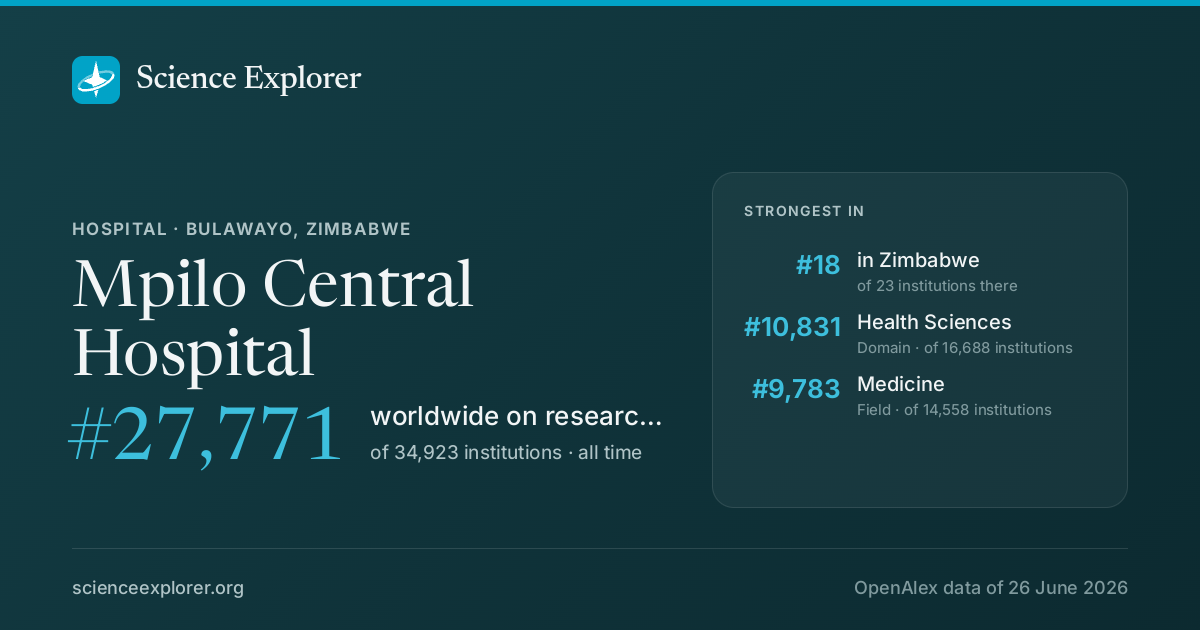
Mpilo Central Hospital on Science Explorer

A card with Mpilo Central Hospital's standing and the fields it leads in, for a post or a slide. A link to this page previews as the same card.

Download the card

1200 × 630 PNG, sized for social posts, drawn from the latest snapshot.

Badges for a website1Each links back here and updates with every snapshot

Research measures only: rankings here say nothing about teaching, admissions or student experience. Comparable institutions and collaboration partners have tabs of their own, above.

Discussion

Ask a question or share a note about Mpilo Central Hospital. Posts are plain text and can be reported.