Science Explorer Back to mapMap
World rank, all time
#31,264
of 34,923
Rank in United States
#6,616
of 7,310
Research works
125
▼ 9% vs 2018-21
Citations
243
1.9 per fractional work
Top-10% rate
11.5%
all institutions 10.0%
vs its own fields
0.96×
1.00× is exactly expected
Open access
12%
world 40%
International
7%
world 18%

Which fields of science does My25 work in?

In all years, 62% of research at My25 is in Social Sciences, 26% in Physical Sciences. Its largest fields are Social Sciences (30%), Psychology (13%), Arts and Humanities (12%). It does 2.7× the world's share of Social Sciences.

Social Sciences: 77 fractional works · 61.6% of its workSocial Sciences: 37 fractional works · 29.8% of its workPolitical Science and International Relations: 13 fractional works · 10.6% of its workLaw: 9 fractional works · 7.3% of its workSociology and Political Science: 6 fractional works · 4.6% of its workEducation: 4 fractional works · 3.3% of its workDemography: 1 fractional works · 0.8% of its workUrban Studies: 1 fractional works · 0.8% of its workSafety Research: 1 fractional works · 0.7% of its workCultural Studies: 1 fractional works · 0.5% of its workHealth: 0 fractional works · 0.4% of its workGender Studies: 0 fractional works · 0.3% of its workGeography, Planning and Development: 0 fractional works · 0.3% of its workLibrary and Information Sciences: 0 fractional works · 0.3% of its workPsychology: 16 fractional works · 12.5% of its workSocial Psychology: 12 fractional works · 9.4% of its workClinical Psychology: 2 fractional works · 1.7% of its workDevelopmental and Educational Psychology: 1 fractional works · 1.1% of its workExperimental and Cognitive Psychology: 0 fractional works · 0.4% of its workArts and Humanities: 15 fractional works · 11.8% of its workHistory and Philosophy of Science: 8 fractional works · 6.0% of its workVisual Arts and Performing Arts: 2 fractional works · 1.5% of its workPhilosophy: 2 fractional works · 1.2% of its workLiterature and Literary Theory: 1 fractional works · 1.1% of its workHistory: 1 fractional works · 0.9% of its workConservation: 0 fractional works · 0.3% of its workReligious studies: 0 fractional works · 0.3% of its workSmaller subfields together: 1 fractional works · 0.5% of its workBusiness, Management and Accounting: 4 fractional works · 3.1% of its workManagement of Technology and Innovation: 1 fractional works · 1.1% of its workAccounting: 1 fractional works · 0.8% of its workStrategy and Management: 1 fractional works · 0.5% of its workManagement Information Systems: 0 fractional works · 0.4% of its workOrganizational Behavior and Human Resource Management: 0 fractional works · 0.3% of its workDecision Sciences: 3 fractional works · 2.6% of its workManagement Science and Operations Research: 2 fractional works · 1.3% of its workStatistics, Probability and Uncertainty: 1 fractional works · 0.9% of its workInformation Systems and Management: 0 fractional works · 0.4% of its workEconomics, Econometrics and Finance: 2 fractional works · 1.8% of its workFinance: 1 fractional works · 0.8% of its workEconomics and Econometrics: 1 fractional works · 0.6% of its workGeneral Economics, Econometrics and Finance: 0 fractional works · 0.4% of its workPhysical Sciences: 33 fractional works · 26.1% of its workEngineering: 13 fractional works · 10.7% of its workComputational Mechanics: 6 fractional works · 4.9% of its workElectrical and Electronic Engineering: 3 fractional works · 2.2% of its workBiomedical Engineering: 2 fractional works · 1.4% of its workMedia Technology: 1 fractional works · 0.9% of its workControl and Systems Engineering: 1 fractional works · 0.7% of its workMechanical Engineering: 1 fractional works · 0.5% of its workSmaller subfields together: 0 fractional works · 0.2% of its workMathematics: 7 fractional works · 5.9% of its workStatistics and Probability: 7 fractional works · 5.3% of its workGeometry and Topology: 0 fractional works · 0.3% of its workModeling and Simulation: 0 fractional works · 0.3% of its workPhysics and Astronomy: 4 fractional works · 3.4% of its workAtomic and Molecular Physics, and Optics: 2 fractional works · 1.7% of its workStatistical and Nonlinear Physics: 1 fractional works · 1.1% of its workAstronomy and Astrophysics: 1 fractional works · 0.5% of its workSmaller subfields together: 0 fractional works · 0.1% of its workComputer Science: 2 fractional works · 1.9% of its workComputer Vision and Pattern Recognition: 1 fractional works · 1.1% of its workInformation Systems: 1 fractional works · 0.5% of its workHardware and Architecture: 0 fractional works · 0.3% of its workChemistry: 2 fractional works · 1.6% of its workPhysical and Theoretical Chemistry: 1 fractional works · 1.1% of its workAnalytical Chemistry: 0 fractional works · 0.3% of its workInorganic Chemistry: 0 fractional works · 0.3% of its workEnvironmental Science: 2 fractional works · 1.6% of its workManagement, Monitoring, Policy and Law: 1 fractional works · 0.7% of its workGlobal and Planetary Change: 1 fractional works · 0.5% of its workEnvironmental Chemistry: 0 fractional works · 0.3% of its workSmaller subfields together: 0 fractional works · 0.1% of its workMaterials Science: 1 fractional works · 0.8% of its workMaterials Chemistry: 0 fractional works · 0.4% of its workSmaller subfields together: 0 fractional works · 0.4% of its workEarth and Planetary Sciences: 0 fractional works · 0.3% of its workOceanography: 0 fractional works · 0.3% of its workSmaller subfields together: 0 fractional works · 0.1% of its workHealth Sciences: 12 fractional works · 9.5% of its workMedicine: 9 fractional works · 7.1% of its workPublic Health, Environmental and Occupational Health: 2 fractional works · 1.2% of its workSurgery: 1 fractional works · 1.2% of its workPulmonary and Respiratory Medicine: 1 fractional works · 0.8% of its workRehabilitation: 1 fractional works · 0.8% of its workPharmacology: 1 fractional works · 0.8% of its workPathology and Forensic Medicine: 1 fractional works · 0.5% of its workCardiology and Cardiovascular Medicine: 0 fractional works · 0.4% of its workEmergency Medicine: 0 fractional works · 0.3% of its workOrthopedics and Sports Medicine: 0 fractional works · 0.2% of its workRadiology, Nuclear Medicine and Imaging: 0 fractional works · 0.2% of its workSmaller subfields together: 1 fractional works · 0.8% of its workHealth Professions: 3 fractional works · 2.1% of its workPhysical Therapy, Sports Therapy and Rehabilitation: 1 fractional works · 1.2% of its workGeneral Health Professions: 1 fractional works · 0.5% of its workComplementary and Manual Therapy: 0 fractional works · 0.3% of its workSmaller subfields together: 0 fractional works · 0.2% of its workDentistry: 0 fractional works · 0.3% of its workOrthodontics: 0 fractional works · 0.3% of its workSmaller subfields together: 0 fractional works · 0.1% of its workLife Sciences: 3 fractional works · 2.8% of its workBiochemistry, Genetics and Molecular Biology: 2 fractional works · 1.4% of its workMolecular Biology: 1 fractional works · 0.7% of its workSmaller subfields together: 1 fractional works · 0.6% of its workNeuroscience: 1 fractional works · 0.7% of its workCognitive Neuroscience: 0 fractional works · 0.4% of its workSmaller subfields together: 0 fractional works · 0.3% of its workAgricultural and Biological Sciences: 1 fractional works · 0.5% of its workGeneral Agricultural and Biological Sciences: 0 fractional works · 0.3% of its workSmaller subfields together: 0 fractional works · 0.2% of its workImmunology and Microbiology: 0 fractional works · 0.3% of its workImmunology: 0 fractional works · 0.3% of its workALL ITS WORKMy25125fractional works, all years
Life Sciences3%Physical Sciences26%Health Sciences9%Social Sciences62%

Each ring splits the one inside it: the four domains of science, their fields, their subfields. Size is fractional works in all years. Every slice is a page; the interactive view zooms down to single topics and colours each by how much more of it this institution does than the world.

Its 4 domains and 21 fields, with their numbers
    1. Social Sciences3729.8%
    2. Psychology1612.5%
    3. Arts and Humanities1511.8%
    4. Business, Management and Accounting43.1%
    5. Decision Sciences32.6%
    6. Economics, Econometrics and Finance21.8%
    1. Engineering1310.7%
    2. Mathematics75.9%
    3. Physics and Astronomy43.4%
    4. Computer Science21.9%
    5. Chemistry21.6%
    6. Environmental Science21.6%
    7. Materials Science10.8%
    8. Earth and Planetary Sciences00.3%
    1. Medicine97.1%
    2. Health Professions32.1%
    3. Dentistry00.3%
    1. Biochemistry, Genetics and Molecular Biology21.4%
    2. Neuroscience10.7%
    3. Agricultural and Biological Sciences10.5%
    4. Immunology and Microbiology00.3%
All of science, and how each field's share has moved since 1950: the Science domain explorer

Field profile

Location quotient across every field it publishes in: outside the ring is more than an institution of this size would be expected to publish, inside it is less.

Biochemistry, Genetics and Molecular Biology: 0.24× its world share, 0 worksBiochemistry, Geneti…Computer Science: 0.44× its world share, 1 worksComputer ScienceEarth and Planetary Sciences: 0.22× its world share, 0 worksEarth and Planetary …Engineering: 0.71× its world share, 2 worksEngineeringEnvironmental Science: 0.34× its world share, 0 worksEnvironmental ScienceMaterials Science: 0.49× its world share, 0 worksMaterials SciencePhysics and Astronomy: 0.79× its world share, 0 worksPhysics and AstronomyDentistry: 0.78× its world share, 0 worksDentistryHealth Professions: 0.56× its world share, 0 worksHealth ProfessionsMedicine: 0.99× its world share, 4 worksMedicineArts and Humanities: 0.59× its world share, 0 worksArts and HumanitiesBusiness, Management and Accounting: 2.11× its world share, 1 worksBusiness, Management…Decision Sciences: 7.05× its world share, 1 worksDecision SciencesEconomics, Econometrics and Finance: 2.63× its world share, 1 worksEconomics, Econometr…Psychology: 2.31× its world share, 1 worksPsychologySocial Sciences: 2.39× its world share, 6 worksSocial Sciences1×world share
more than its size predictsabout as predictedless

Rings at 0.5×, 1× and 2×. Widest outward: Decision Sciences, 7.0×. Every wedge is a field page.

All 16 fields, with their numbers
  1. Decision Sciences7.05×1 works
  2. Economics, Econometrics and Finance2.63×1 works
  3. Social Sciences2.39×6 works
  4. Psychology2.31×1 works
  5. Business, Management and Accounting2.11×1 works
  6. Medicine0.99×4 works
  7. Physics and Astronomy0.79×0 works
  8. Dentistry0.78×0 works
  9. Engineering0.71×2 works
  10. Arts and Humanities0.59×0 works
  11. Health Professions0.56×0 works
  12. Materials Science0.49×0 works
  13. Computer Science0.44×1 works
  14. Environmental Science0.34×0 works
  15. Biochemistry, Genetics and Molecular Biology0.24×0 works
  16. Earth and Planetary Sciences0.22×0 works

Who are the top researchers at My25?

Ranked on the quality score, Christopher J. Chiaverina and James F. Marran lead among researchers whose main affiliation is My25.

  1. 1 Christopher J. Chiaverina United States · #3,513,853 worldwide 72 citations · 50 works
  2. 2 James F. Marran United States · #5,125,195 worldwide 59 citations · 34 works
All ranked researchers at My25

What are the most cited papers from My25?

The most cited paper from My25 is "Nanofountain Probe Electroporation (NFP-E) of Single Cells" (Wonmo Kang, Fazel Yavari, Majid Minary‐Jolandan et al., 2013), with 116 citations. Next come "Multilevel Examination of Health Disparity: The Role of Policy Implementation in Neighborhood Context, in Patient Resources, and in Healthcare Facilities on Later Stage of Breast Cancer Diagnosis" (64) and "A cephalometric study of the clinical use of the mandibular labial bumper" (41).

Most cited papers
#PaperReleasedCitations
1 Nanofountain Probe Electroporation (NFP-E) of Single Cells Wonmo Kang, Fazel Yavari, Majid Minary‐Jolandan et al. · Nano Letters Open access 7 May 2013 116
2 Multilevel Examination of Health Disparity: The Role of Policy Implementation in Neighborhood Context, in Patient Resources, and in Healthcare Facilities on Later Stage of Breast Cancer Diagnosis Richard B. Warnecke, Richard T. Campbell, Ganga Vijayasiri et al. · Cancer Epidemiology Biomarkers & Prevention Open access 23 Oct 2018 64
3 A cephalometric study of the clinical use of the mandibular labial bumper Earl O. Bergersen · American Journal of Orthodontics Jun 1972 41
4 Monster Masculinity: Honey, I'll Be In The Garage Reasserting My Manhood PETER TRAGOS · The Journal of Popular Culture Jun 2009 25
5 EFFECT OF OXYTETRACYCLINE THERAPY OF STREPTOCOCCAL SORE THROAT ON THE INCIDENCE OF ACUTE RHEUMATIC FEVER Francis J. Catanzaro, Loring Brock, Robert Chamovitz et al. · Annals of Internal Medicine Feb 1955 24
All 86 most cited papers, with filters and sorting

Which keywords describe research at My25?

By fractional works in all years, weighted toward what it does more of than the world: Human Rights, Education, Judicial Review, Constitutionalism, European Legal Systems, Ethical Guidelines, Interactional Expertise and Tacit Knowledge.

▲ more of its work than of the world's◆ about the world's share▼ less than the world's

Size is fractional works in all years in the topics tagged with each word; colour is the word's share of this institution's work against its share of the world's. The 40 words are chosen for being large and distinctive. Each links to the topic it comes from most.

All 40 words, with their numbers
  1. Human Rights21▲ 19×8 topics
  2. Education14▲ 8.9×14 topics
  3. Judicial Review11▲ 83×2 topics
  4. Constitutionalism11▲ 78×1 topic
  5. European Legal Systems11▲ 201×1 topic
  6. Ethical Guidelines10▲ 141×2 topics
  7. Interactional Expertise10▲ 456×1 topic
  8. Tacit Knowledge10▲ 126×1 topic
  9. European Union8▲ 26×3 topics
  10. Sustainability8▲ 3.6×7 topics
  11. Healthcare7▲ 8.4×4 topics
  12. Cultural Values7▲ 104×2 topics
  13. International Law7▲ 21×3 topics
  14. Governance7▲ 19×2 topics
  15. Judicial Independence7▲ 249×2 topics
  16. Data Protection7▲ 308×1 topic
  17. Legal Framework7▲ 129×1 topic
  18. Statistical Analysis7▲ 41×4 topics
  19. Engineering6▲ 52×2 topics
  20. Materials Science6▲ 63×2 topics
  21. Regression Analysis6▲ 89×2 topics
  22. Vibration Analysis6▲ 16×2 topics
  23. Fluid Dynamics6▲ 32×1 topic
  24. Multicollinearity6▲ 134×1 topic
  25. Outlier Detection6▲ 56×1 topic
  26. Physical Training6▲ 442×1 topic
  27. Renewable Energy6▲ 4.8×1 topic
  28. Research6▲ 42×1 topic
  29. Ethics3▲ 5.0×6 topics
  30. Meta-Analysis3▲ 3.9×5 topics
  31. Technology2▲ 4.3×3 topics
  32. Emotion2▲ 9.1×3 topics
  33. Health Promotion2▲ 5.7×3 topics
  34. Cultural History2▲ 11×3 topics
  35. Social Sciences2▲ 8.9×2 topics
  36. Gender Studies2▲ 8.1×3 topics
  37. Interdisciplinary Collaboration2▲ 17×2 topics
  38. Physical Education2▲ 14×2 topics
  39. Color Psychology2▲ 35×1 topic
  40. Low Back Pain2▲ 7.5×2 topics

Which research topics does My25 publish most on?

By volume in 2022-now: European and International Law Studies, Education, Healthcare and Sociology Research, Semiconductor Lasers and Optical Devices and Sustainable Finance and Green Bonds.

  1. 1 European and International Law Studies Political Science and International Relations 2 works
  2. 2 Education, Healthcare and Sociology Research Social Psychology 1 works
  3. 3 Semiconductor Lasers and Optical Devices Electrical and Electronic Engineering 1 works
  4. 4 Sustainable Finance and Green Bonds Finance 1 works
  5. 5 Stock Market Forecasting Methods Management Science and Operations Research 1 works
  6. 6 Musculoskeletal pain and rehabilitation Pharmacology 1 works
  7. 7 European and International Contract Law Law 1 works
  8. 8 Spine and Intervertebral Disc Pathology Pathology and Forensic Medicine 1 works
  9. 9 Digital Innovation in Industries Management of Technology and Innovation 0 works
  10. 10 Comparative and International Law Studies Law 0 works

How open and international is its research?

Against the world's own shares: the tick on each track. Both are shares of its output, so they sit on one scale and can be read against each other as well as against the world.

openly available12.4%not open87.6%

World: 40% of research is openly available.

with international co-authors7.1%domestic only92.9%

World: 18% is written across borders.

How has My25's research output changed?

Output in 2022-2025 was 9% lower than in 2018-2021.

still counting1990200020102020
grewheldshrank

The same series as a ribbon: one cell per year, darker for more. The line above answers how much; this answers when.

Its share of all research

Growing output can still be a shrinking share: all of science grows. This is My25 as a percentage of every work published that year, 0.00011% in 2024.

still counting0.00050%0.0010%My250.00015% in 202519801990200020102020

Fractional works of My25 over all fractional works that year. How the balance of science has shifted.

Share My25's ranking
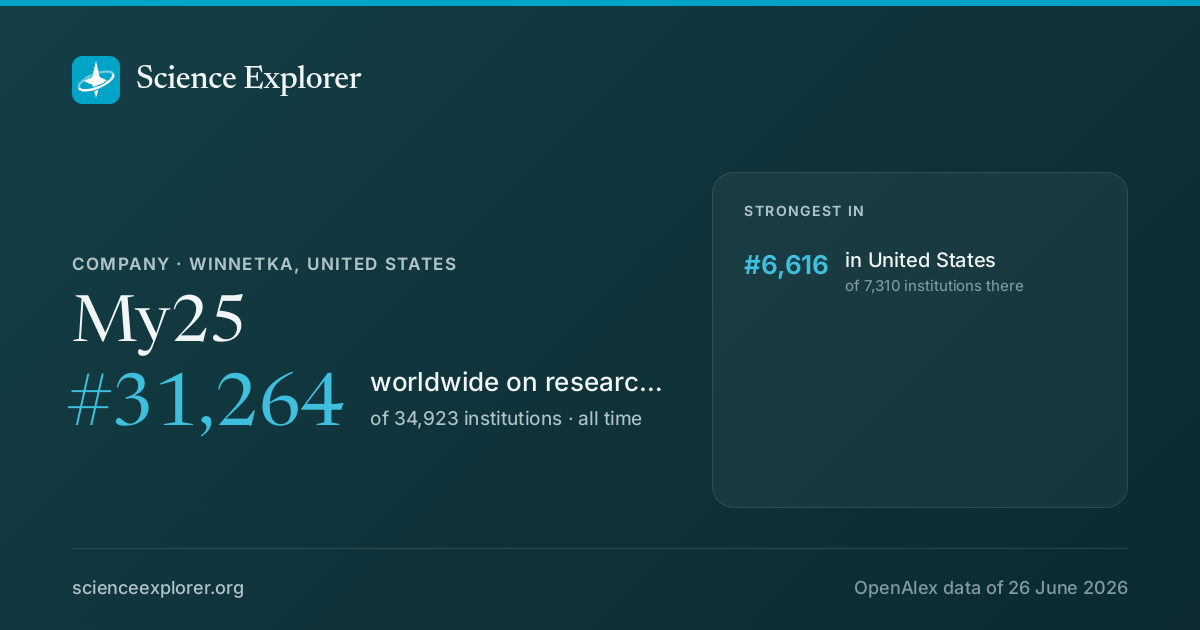
My25 on Science Explorer

A card with My25's standing and the fields it leads in, for a post or a slide. A link to this page previews as the same card.

Download the card

1200 × 630 PNG, sized for social posts, drawn from the latest snapshot.

Badges for a website1Each links back here and updates with every snapshot

Research measures only: rankings here say nothing about teaching, admissions or student experience. Comparable institutions and collaboration partners have tabs of their own, above.

Discussion

Ask a question or share a note about My25. Keep it to the research: no personal attacks, advertising or links. Any reader can report a post, which collapses it for everyone until it is opened.
