Science Explorer Back to mapMap
Discussion
Research facility · Nagano · Japan

Nagano Prefecture Forestry Research Center

World rank, all time
#29,410
of 34,923
Rank in Japan
#1,261
of 1,923
Research works
194
◆ 2% vs 2018-21
Citations
2.6k
13.3 per fractional work
Top-10% rate
5.3%
all institutions 10.0%
vs its own fields
0.83×
1.00× is exactly expected
Open access
53%
world 40%
International
19%
world 18%
Nagano Prefecture Forestry Research Center

Which fields of science does Nagano Prefecture Forestry Research Center work in?

In 2022-now, 44% of research at Nagano Prefecture Forestry Research Center is in Life Sciences, 38% in Physical Sciences. Its largest fields are Agricultural and Biological Sciences (27%), Engineering (18%), Biochemistry, Genetics and Molecular Biology (17%). It does 2.2× the world's share of Life Sciences.

Life Sciences: 10 fractional works · 44.2% of its workAgricultural and Biological Sciences: 6 fractional works · 26.6% of its workPlant Science: 4 fractional works · 18.9% of its workInsect Science: 1 fractional works · 2.8% of its workAgronomy and Crop Science: 0 fractional works · 1.6% of its workEcology, Evolution, Behavior and Systematics: 0 fractional works · 1.2% of its workSoil Science: 0 fractional works · 0.8% of its workFood Science: 0 fractional works · 0.5% of its workAnimal Science and Zoology: 0 fractional works · 0.3% of its workHorticulture: 0 fractional works · 0.3% of its workForestry: 0 fractional works · 0.2% of its workBiochemistry, Genetics and Molecular Biology: 4 fractional works · 16.8% of its workMolecular Biology: 2 fractional works · 7.1% of its workCell Biology: 1 fractional works · 4.4% of its workGenetics: 1 fractional works · 4.2% of its workEndocrinology: 0 fractional works · 0.7% of its workCancer Research: 0 fractional works · 0.3% of its workNeuroscience: 0 fractional works · 0.6% of its workNeurology: 0 fractional works · 0.6% of its workPharmacology, Toxicology and Pharmaceutics: 0 fractional works · 0.3% of its workPharmacology: 0 fractional works · 0.3% of its workPhysical Sciences: 9 fractional works · 37.5% of its workEngineering: 4 fractional works · 18.3% of its workMechanical Engineering: 1 fractional works · 4.8% of its workElectrical and Electronic Engineering: 1 fractional works · 3.3% of its workIndustrial and Manufacturing Engineering: 0 fractional works · 1.9% of its workOcean Engineering: 0 fractional works · 1.9% of its workAutomotive Engineering: 0 fractional works · 1.6% of its workBiomedical Engineering: 0 fractional works · 1.6% of its workComputational Mechanics: 0 fractional works · 1.4% of its workAerospace Engineering: 0 fractional works · 1.0% of its workMechanics of Materials: 0 fractional works · 0.5% of its workSafety, Risk, Reliability and Quality: 0 fractional works · 0.3% of its workEnvironmental Science: 2 fractional works · 10.0% of its workNature and Landscape Conservation: 1 fractional works · 4.7% of its workEcology: 1 fractional works · 2.4% of its workGlobal and Planetary Change: 0 fractional works · 1.1% of its workManagement, Monitoring, Policy and Law: 0 fractional works · 0.8% of its workEnvironmental Chemistry: 0 fractional works · 0.5% of its workHealth, Toxicology and Mutagenesis: 0 fractional works · 0.3% of its workSmaller subfields together: 0 fractional works · 0.2% of its workEarth and Planetary Sciences: 1 fractional works · 3.5% of its workGeochemistry and Petrology: 0 fractional works · 1.9% of its workGeophysics: 0 fractional works · 0.9% of its workAtmospheric Science: 0 fractional works · 0.3% of its workPaleontology: 0 fractional works · 0.3% of its workSmaller subfields together: 0 fractional works · 0.0% of its workComputer Science: 1 fractional works · 2.7% of its workHuman-Computer Interaction: 0 fractional works · 0.7% of its workInformation Systems: 0 fractional works · 0.7% of its workSoftware: 0 fractional works · 0.7% of its workArtificial Intelligence: 0 fractional works · 0.5% of its workMaterials Science: 0 fractional works · 1.9% of its workMaterials Chemistry: 0 fractional works · 1.4% of its workCeramics and Composites: 0 fractional works · 0.5% of its workChemical Engineering: 0 fractional works · 0.7% of its workCatalysis: 0 fractional works · 0.7% of its workChemistry: 0 fractional works · 0.3% of its workOrganic Chemistry: 0 fractional works · 0.3% of its workHealth Sciences: 3 fractional works · 14.5% of its workMedicine: 3 fractional works · 11.6% of its workPhysiology: 0 fractional works · 1.5% of its workEpidemiology: 0 fractional works · 1.4% of its workPulmonary and Respiratory Medicine: 0 fractional works · 1.1% of its workCritical Care and Intensive Care Medicine: 0 fractional works · 1.1% of its workObstetrics and Gynecology: 0 fractional works · 1.0% of its workDermatology: 0 fractional works · 0.7% of its workRadiology, Nuclear Medicine and Imaging: 0 fractional works · 0.7% of its workNephrology: 0 fractional works · 0.5% of its workOncology: 0 fractional works · 0.5% of its workRehabilitation: 0 fractional works · 0.5% of its workSurgery: 0 fractional works · 0.5% of its workGastroenterology: 0 fractional works · 0.3% of its workInfectious Diseases: 0 fractional works · 0.3% of its workOrthopedics and Sports Medicine: 0 fractional works · 0.3% of its workPublic Health, Environmental and Occupational Health: 0 fractional works · 0.3% of its workCardiology and Cardiovascular Medicine: 0 fractional works · 0.3% of its workBiochemistry: 0 fractional works · 0.3% of its workSmaller subfields together: 0 fractional works · 0.2% of its workHealth Professions: 0 fractional works · 1.3% of its workSpeech and Hearing: 0 fractional works · 1.2% of its workSmaller subfields together: 0 fractional works · 0.1% of its workNursing: 0 fractional works · 1.1% of its workNutrition and Dietetics: 0 fractional works · 1.1% of its workVeterinary: 0 fractional works · 0.5% of its workSmall Animals: 0 fractional works · 0.5% of its workSocial Sciences: 1 fractional works · 3.8% of its workSocial Sciences: 1 fractional works · 2.4% of its workGeography, Planning and Development: 0 fractional works · 1.1% of its workTransportation: 0 fractional works · 0.5% of its workAnthropology: 0 fractional works · 0.3% of its workSmaller subfields together: 0 fractional works · 0.5% of its workPsychology: 0 fractional works · 0.9% of its workClinical Psychology: 0 fractional works · 0.9% of its workArts and Humanities: 0 fractional works · 0.5% of its workArcheology: 0 fractional works · 0.5% of its workALL ITS WORKNagano PrefectureForestry Researc…23fractional works, 2022-now
Life Sciences44%Physical Sciences38%Health Sciences14%Social Sciences4%

Each ring splits the one inside it: the four domains of science, their fields, their subfields. Size is fractional works in 2022-now. Every slice is a page; the interactive view zooms down to single topics and colours each by how much more of it this institution does than the world.

Its 4 domains and 18 fields, with their numbers
    1. Agricultural and Biological Sciences626.6%
    2. Biochemistry, Genetics and Molecular Biology416.8%
    3. Neuroscience00.6%
    4. Pharmacology, Toxicology and Pharmaceutics00.3%
    1. Engineering418.3%
    2. Environmental Science210.0%
    3. Earth and Planetary Sciences13.5%
    4. Computer Science12.7%
    5. Materials Science01.9%
    6. Chemical Engineering00.7%
    7. Chemistry00.3%
    1. Medicine311.6%
    2. Health Professions01.3%
    3. Nursing01.1%
    4. Veterinary00.5%
    1. Social Sciences12.4%
    2. Psychology00.9%
    3. Arts and Humanities00.5%
All of science, and how each field's share has moved since 1950: the Science domain explorer

Field profile

Location quotient across every field it publishes in: outside the ring is more than an institution of this size would be expected to publish, inside it is less.

Agricultural and Biological Sciences: 5.60× its world share, 6 worksAgricultural and Bio…Biochemistry, Genetics and Molecular Biology: 3.14× its world share, 4 worksBiochemistry, Geneti…Neuroscience: 0.36× its world share, 0 worksNeurosciencePharmacology, Toxicology and Pharmaceutics: 0.82× its world share, 0 worksPharmacology, Toxico…Chemical Engineering: 2.08× its world share, 0 worksChemical EngineeringChemistry: 0.19× its world share, 0 worksChemistryComputer Science: 0.34× its world share, 1 worksComputer ScienceEarth and Planetary Sciences: 2.25× its world share, 1 worksEarth and Planetary …Engineering: 1.22× its world share, 4 worksEngineeringEnvironmental Science: 2.01× its world share, 2 worksEnvironmental ScienceMaterials Science: 0.55× its world share, 0 worksMaterials ScienceHealth Professions: 0.49× its world share, 0 worksHealth ProfessionsMedicine: 0.60× its world share, 3 worksMedicineNursing: 2.22× its world share, 0 worksNursingVeterinary: 3.56× its world share, 0 worksVeterinaryArts and Humanities: 0.17× its world share, 0 worksArts and HumanitiesPsychology: 0.31× its world share, 0 worksPsychologySocial Sciences: 0.19× its world share, 0 worksSocial Sciences1×world share
more than its size predictsabout as predictedless

Rings at 0.5×, 1× and 2×. Widest outward: Agricultural and Biological Sciences, 5.6×. Every wedge is a field page.

All 18 fields, with their numbers
  1. Agricultural and Biological Sciences5.60×6 works
  2. Veterinary3.56×0 works
  3. Biochemistry, Genetics and Molecular Biology3.14×4 works
  4. Earth and Planetary Sciences2.25×1 works
  5. Nursing2.22×0 works
  6. Chemical Engineering2.08×0 works
  7. Environmental Science2.01×2 works
  8. Engineering1.22×4 works
  9. Pharmacology, Toxicology and Pharmaceutics0.82×0 works
  10. Medicine0.60×3 works
  11. Materials Science0.55×0 works
  12. Health Professions0.49×0 works
  13. Neuroscience0.36×0 works
  14. Computer Science0.34×1 works
  15. Psychology0.31×0 works
  16. Chemistry0.19×0 works
  17. Social Sciences0.19×0 works
  18. Arts and Humanities0.17×0 works

Who are the top researchers at Nagano Prefecture Forestry Research Center?

Ranked on the quality score, 真潔 川上, 敦子 叶内 and 宏明 内田 lead among researchers whose main affiliation is Nagano Prefecture Forestry Research Center.

  1. 1 真潔 川上 Japan · #3,653,627 worldwide 2 citations · 41 works
  2. 2 敦子 叶内 Japan · #4,315,143 worldwide 0 citations · 15 works
  3. 3 宏明 内田 Japan · #4,497,585 worldwide 0 citations · 18 works
  4. 4 Yasuhiro Koyama Japan · #4,536,120 worldwide 590 citations · 48 works
  5. 5 Motoyoshi Ikeda Japan · #4,632,615 worldwide 110 citations · 15 works
  6. 6 重夫 杉原 Japan · #7,137,332 worldwide 12 citations · 129 works
All ranked researchers at Nagano Prefecture Forestry Research Center

What are the most cited papers from Nagano Prefecture Forestry Research Center?

The most cited paper from Nagano Prefecture Forestry Research Center is "Vitamin K2 (Menatetrenone) Effectively Prevents Fractures and Sustains Lumbar Bone Mineral Density in Osteoporosis" (Masataka Shiraki, Yumiko Shiraki, Choju Aoki et al., 2000), with 411 citations. Next come "Forest Bathing Enhances Human Natural Killer Activity and Expression of Anti-Cancer Proteins" (311) and "Productivity and soil response to plastic film mulching durations for spring wheat on entisols in the semiarid Loess Plateau of China" (215).

Most cited papers
#PaperReleasedCitations
1 Vitamin K2 (Menatetrenone) Effectively Prevents Fractures and Sustains Lumbar Bone Mineral Density in Osteoporosis Masataka Shiraki, Yumiko Shiraki, Choju Aoki et al. · Journal of Bone and Mineral Research Mar 2000 411
2 Forest Bathing Enhances Human Natural Killer Activity and Expression of Anti-Cancer Proteins Q. Li, Kanehisa Morimoto, Ari Nakadai et al. · International Journal of Immunopathology and Pharmacology Open access Apr 2007 311
3 Productivity and soil response to plastic film mulching durations for spring wheat on entisols in the semiarid Loess Plateau of China Feng‐Min Li, Jun Wang, Jin-Zhang Xu et al. · Soil and Tillage Research Open access 17 Mar 2004 215
4 Association of Bone Mineral Density with Apolipoprotein E Phenotype Masataka Shiraki, Yumiko Shiraki, Choju Aoki et al. · Journal of Bone and Mineral Research Sep 1997 200
5 Emissions of malodorous compounds and greenhouse gases from composting swine feces Kazutaka Kuroda, Takashi Osada, Mitihiro Yonaga et al. · Bioresource Technology May 1996 127
All 61 most cited papers, with filters and sorting

Which research topics does Nagano Prefecture Forestry Research Center publish most on?

By volume in 2022-now: Plant Pathogens and Fungal Diseases, Plant Reproductive Biology, Genetic Mapping and Diversity in Plants and Animals and Plant-Microbe Interactions and Immunity.

  1. 1 Plant Pathogens and Fungal Diseases Cell Biology 1 works
  2. 2 Plant Reproductive Biology Molecular Biology 1 works
  3. 3 Genetic Mapping and Diversity in Plants and Animals Genetics 1 works
  4. 4 Plant-Microbe Interactions and Immunity Plant Science 0 works
  5. 5 Plant Molecular Biology Research Plant Science 0 works
  6. 6 Evacuation and Crowd Dynamics Ocean Engineering 0 works
  7. 7 Plant Pathogenic Bacteria Studies Plant Science 0 works
  8. 8 Seedling growth and survival studies Nature and Landscape Conservation 0 works
  9. 9 Forest ecology and management Nature and Landscape Conservation 0 works
  10. 10 Mineralogy and Gemology Studies Geochemistry and Petrology 0 works

How open and international is its research?

Against the world's own shares: the tick on each track. Both are shares of its output, so they sit on one scale and can be read against each other as well as against the world.

openly available53.2%not open46.8%

World: 40% of research is openly available.

with international co-authors19.0%domestic only81.0%

World: 18% is written across borders.

How has Nagano Prefecture Forestry Research Center's research output changed?

Output in 2022-2025 was 2% lower than in 2018-2021.

still counting1990200020102020
grewheldshrank

The same series as a ribbon: one cell per year, darker for more. The line above answers how much; this answers when.

Its share of all research

Growing output can still be a shrinking share: all of science grows. This is Nagano Prefecture Forestry Research Center as a percentage of every work published that year, 0.00010% in 2024.

still counting0.00050%0.0010%0.0015%Nagano Prefecture Forestry Research Center0.000066% in 202519801990200020102020

Fractional works of Nagano Prefecture Forestry Research Center over all fractional works that year. How the balance of science has shifted.

Other research institutions in Nagano

All research institutions in Nagano

Share Nagano Prefecture Forestry Research Center's ranking
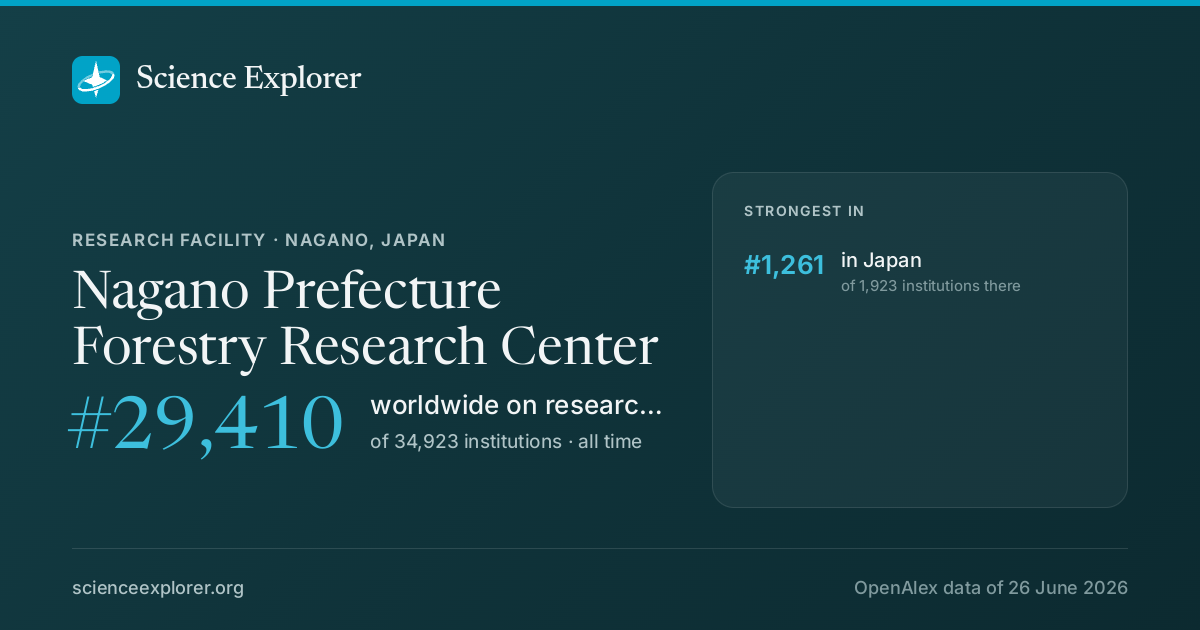
Nagano Prefecture Forestry Research Center on Science Explorer

A card with Nagano Prefecture Forestry Research Center's standing and the fields it leads in, for a post or a slide. A link to this page previews as the same card.

Download the card

1200 × 630 PNG, sized for social posts, drawn from the latest snapshot.

Badges for a website1Each links back here and updates with every snapshot

Research measures only: rankings here say nothing about teaching, admissions or student experience. Comparable institutions and collaboration partners have tabs of their own, above.

Discussion

Ask a question or share a note about Nagano Prefecture Forestry Research Center. Keep it to the research: no personal attacks, advertising or links. Any reader can report a post, which collapses it for everyone until it is opened.
