NKT Holding (Denmark)
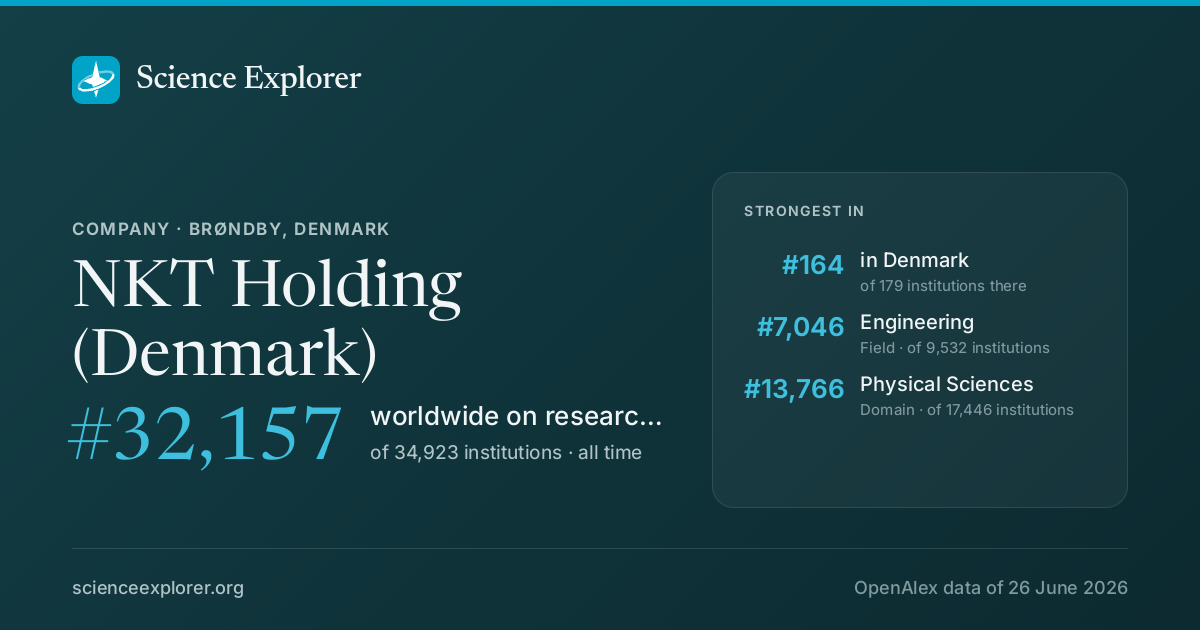
In research, NKT Holding (Denmark) stands highest in Engineering (#7,046 of 9,532 worldwide) and Physical Sciences (#13,766 of 17,446 worldwide), over all time.
- World rank, all time
- #32,157 of 34,923
- Rank in Denmark
- #164 of 179
- Research works
- 265 ▼ 61% vs 2018-21
- Citations
- 3.9k 14.8 per fractional work
- Top-10% rate
- 8.4% all institutions 10.0%
- vs its own fields
- 1.06× 1.00× is exactly expected
- Open access
- 26% world 40%
- International
- 33% world 18%
What is NKT Holding (Denmark) known for in research?
The fields where it stands highest, over all time, ranked among every institution above the floor in each field.
| Field | World rank | Where that sits | Top-10% rate | Works |
|---|---|---|---|---|
| EngineeringField | #7,046 of 9,532 | 10.1% | 156 | |
| Physical SciencesDomain | #13,766 of 17,446 | 10.1% | 244 |
Each strip is that field's whole ranked pool, with the notch where NKT Holding (Denmark) sits in it, in the colour of the band that rank falls in. The track under the rate is the rate itself: it carries no average mark, because the average differs by field (from about 6% in Dentistry to 21% in Economics).
Which fields of science does NKT Holding (Denmark) work in?
In all years, 92% of research at NKT Holding (Denmark) is in Physical Sciences, 3% in Life Sciences. Its largest fields are Engineering (59%), Physics and Astronomy (22%), Materials Science (7%). It does 2.2× the world's share of Physical Sciences.
Each ring splits the one inside it: the four domains of science, their fields, their subfields. Size is fractional works in all years. Every slice is a page; the interactive view zooms down to single topics and colours each by how much more of it this institution does than the world.
Its 4 domains and 21 fields, with their numbers
- Physical Sciences24491.9%
- Engineering15659.0%
- Physics and Astronomy5721.5%
- Materials Science197.2%
- Chemistry52.0%
- Computer Science20.6%
- Earth and Planetary Sciences10.5%
- Chemical Engineering10.5%
- Environmental Science10.5%
- Life Sciences83.0%
- Social Sciences72.7%
- Social Sciences51.7%
- Arts and Humanities10.5%
- Economics, Econometrics and Finance10.4%
- Decision Sciences00.0%
- Psychology00.0%
- Health Sciences62.4%
- Medicine41.5%
- Health Professions10.5%
- Dentistry10.3%
- Nursing00.0%
Field profile
Location quotient across every field it publishes in: outside the ring is more than an institution of this size would be expected to publish, inside it is less.
Rings at 0.5×, 1× and 2×. Widest outward: Physics and Astronomy, 8.2×. Every wedge is a field page.
All 11 fields, with their numbers
- Physics and Astronomy8.21×3 works
- Chemistry3.77×1 works
- Engineering2.91×8 works
- Economics, Econometrics and Finance1.81×1 works
- Biochemistry, Genetics and Molecular Biology1.35×1 works
- Social Sciences1.22×3 works
- Environmental Science0.26×0 works
- Computer Science0.17×0 works
- Materials Science0.14×0 works
- Health Professions0.12×0 works
- Medicine0.12×0 works
Who are the top researchers at NKT Holding (Denmark)?
Ranked on the quality score, Torsten Freltoft, Jens Kristian Lyngsø and Martin D. Maack lead among researchers whose main affiliation is NKT Holding (Denmark).
- 1
Torsten Freltoft
 Denmark · #1,779,278 worldwide
2.2k citations · 57 works
- 2
Jens Kristian Lyngsø
Denmark · #1,856,408 worldwide
1.3k citations · 46 works
- 3
Martin D. Maack
Denmark · #2,994,047 worldwide
456 citations · 22 works
- 4
Y.Q. Shen
Denmark · #3,629,272 worldwide
619 citations · 29 works
- 5
M. Däumling
Denmark · #4,197,408 worldwide
1.2k citations · 63 works
- 6
Per Vase
Denmark · #4,534,716 worldwide
1k citations · 53 works
- 7
R. Kromann
Denmark · #5,029,711 worldwide
1.2k citations · 16 works
- 8
D. Willén
Denmark · #5,066,369 worldwide
708 citations · 47 works
- 9
A. Geschiere
Denmark · #5,464,294 worldwide
87 citations · 17 works
- 10
I. M. Mel'nik
Denmark · #5,498,333 worldwide
47 citations · 16 works
Which keywords describe research at NKT Holding (Denmark)?
By fractional works in all years, weighted toward what it does more of than the world: Nonlinear Optics, Fiber Lasers, Optical Fiber, Gas Sensing, High-Power Laser, Supercontinuum Generation, Microwave Photonics and Microresonators.
- HVDC Transmission
- Optical Interconnects
- Control Strategies
- Microcavities
- Silicon Photonics
- Raman Lasers
- Retinal Blood Flow
- Cancer Detection
- Optical Coherence Tomography
- Nb3Sn Conductor
- Critical Current Density
- High-Temperature Superconductivity
- Electronic Structure Calculations
- Fiber Optic Sensors
- Coherent Detection
- Ultrafast Lasers
- Microresonators
- Supercontinuum Generation
- Gas Sensing
- Fiber Lasers
- Nonlinear Optics
- Optical Fiber
- High-Power Laser
- Microwave Photonics
- Optical Frequency Combs
- Digital Signal Processing
- Nonlinear Effects
- Sensor Technology
- Cuprate Superconductors
- Biomedical Applications
- In Vivo Imaging
- Superconducting Magnets
- High-Resolution Imaging
- Integrated Circuits
- Spectral-Domain OCT
- Biosensors
- Optical Modulators
- Nanophotonic Waveguides
- Superconductivity
- Semiconductor Lasers
Size is fractional works in all years in the topics tagged with each word; colour is the word's share of this institution's work against its share of the world's. The 40 words are chosen for being large and distinctive. Each links to the topic it comes from most.
All 40 words, with their numbers
- Nonlinear Optics62▲ 135×4 topics
- Fiber Lasers59▲ 156×3 topics
- Optical Fiber42▲ 120×3 topics
- Gas Sensing36▲ 168×2 topics
- High-Power Laser33▲ 548×1 topic
- Supercontinuum Generation33▲ 548×1 topic
- Microwave Photonics29▲ 92×2 topics
- Microresonators26▲ 78×3 topics
- Optical Frequency Combs26▲ 127×1 topic
- Ultrafast Lasers26▲ 127×1 topic
- Digital Signal Processing22▲ 114×2 topics
- Coherent Detection22▲ 133×1 topic
- Nonlinear Effects22▲ 133×1 topic
- Fiber Optic Sensors20▲ 127×1 topic
- Sensor Technology20▲ 127×1 topic
- Electronic Structure Calculations15▲ 26×2 topics
- Cuprate Superconductors15▲ 59×1 topic
- High-Temperature Superconductivity15▲ 59×1 topic
- Biomedical Applications14▲ 5.1×10 topics
- Critical Current Density12▲ 83×2 topics
- In Vivo Imaging11▲ 44×2 topics
- Nb3Sn Conductor10▲ 90×1 topic
- Superconducting Magnets10▲ 90×1 topic
- Optical Coherence Tomography7▲ 23×2 topics
- High-Resolution Imaging7▲ 42×2 topics
- Cancer Detection7▲ 36×2 topics
- Integrated Circuits7▲ 11×3 topics
- Retinal Blood Flow7▲ 118×1 topic
- Spectral-Domain OCT7▲ 118×1 topic
- Raman Lasers7▲ 15×2 topics
- Biosensors6▲ 4.2×4 topics
- Silicon Photonics6▲ 15×2 topics
- Optical Modulators6▲ 11×2 topics
- Microcavities6▲ 14×1 topic
- Nanophotonic Waveguides6▲ 16×1 topic
- Control Strategies6▲ 17×2 topics
- Superconductivity5▲ 6.4×6 topics
- Optical Interconnects5▲ 22×1 topic
- Semiconductor Lasers5▲ 18×1 topic
- HVDC Transmission4▲ 36×1 topic
Which research topics does NKT Holding (Denmark) publish most on?
By volume in 2022-now: Advanced Fiber Laser Technologies, Photonic Crystal and Fiber Optics, Optical Coherence Tomography Applications and Education, Innovation and Language Studies.
Area is fractional works; colour is the subfield each topic belongs to.
- 1 Advanced Fiber Laser Technologies Atomic and Molecular Physics, and Optics 2 works
- 2 Photonic Crystal and Fiber Optics Electrical and Electronic Engineering 2 works
- 3 Optical Coherence Tomography Applications Biomedical Engineering 1 works
- 4 Education, Innovation and Language Studies Education 1 works
- 5 Advanced Fiber Optic Sensors Electrical and Electronic Engineering 1 works
- 6 Photoacoustic and Ultrasonic Imaging Biomedical Engineering 1 works
- 7 Medical, Sociocultural, and Biopolitical Studies Political Science and International Relations 1 works
- 8 Economic and Industrial Development Economics and Econometrics 1 works
- 9 Advanced Fluorescence Microscopy Techniques Biophysics 1 works
- 10 Optical Network Technologies Electrical and Electronic Engineering 1 works
How open and international is its research?
Against the world's own shares: the tick on each track. Both are shares of its output, so they sit on one scale and can be read against each other as well as against the world.
World: 40% of research is openly available.
World: 18% is written across borders.
How has NKT Holding (Denmark)'s research output changed?
Output in 2022-2025 was 61% lower than in 2018-2021.
The same series as a ribbon: one cell per year, darker for more. The line above answers how much; this answers when.
Its share of all research
Growing output can still be a shrinking share: all of science grows. This is NKT Holding (Denmark) as a percentage of every work published that year, 0.00011% in 2024.
Fractional works of NKT Holding (Denmark) over all fractional works that year. How the balance of science has shifted.
Other research institutions in Brøndby
- FORCE Technology (Denmark)
- Optical Fiber Solutions (Denmark)
- Prolog Development Center
- Wikimedia Danmark
- Danish Football Association
Share NKT Holding (Denmark)'s ranking
Badges for a website1Each links back here and updates with every snapshot

Research measures only: rankings here say nothing about teaching, admissions or student experience. Comparable institutions and collaboration partners have tabs of their own, above.
Discussion
Ask a question or share a note about NKT Holding (Denmark). Keep it to the research: no personal attacks, advertising or links. Any reader can report a post, which collapses it for everyone until it is opened.