FORCE Technology (Denmark)
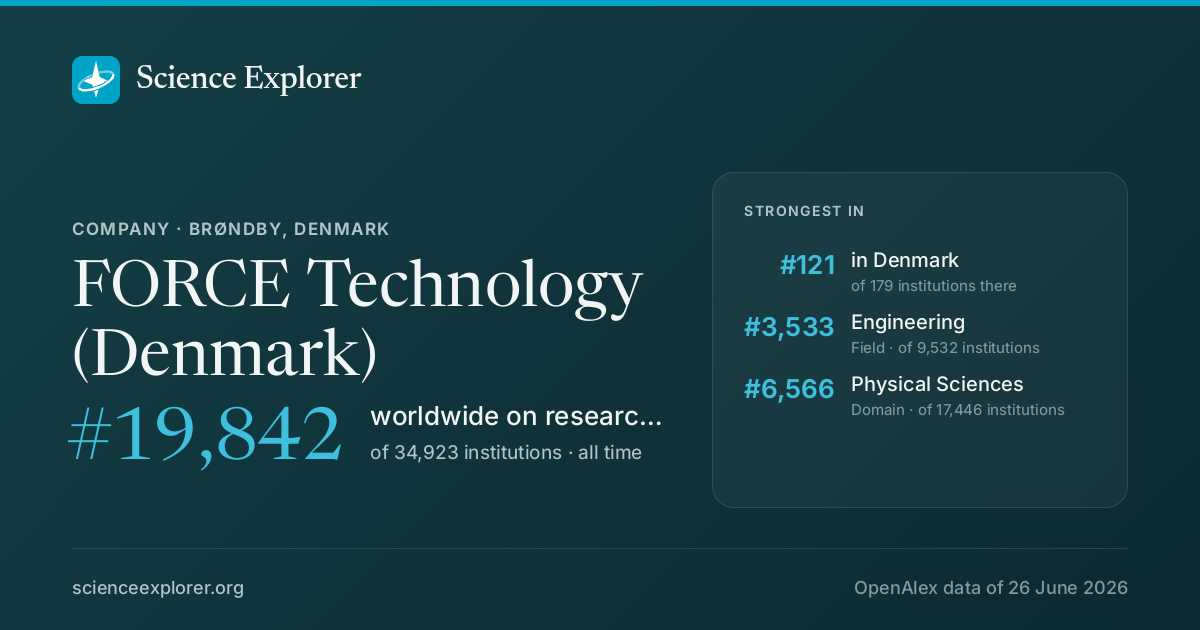
In research, FORCE Technology (Denmark) stands highest in Engineering (#3,533 of 9,532 worldwide) and Physical Sciences (#6,566 of 17,446 worldwide), over all time.
- World rank, all time
- #19,842 of 34,923
- Rank in Denmark
- #121 of 179
- Research works
- 257 ▲ 49% vs 2018-21
- Citations
- 5.6k 21.8 per fractional work
- Top-10% rate
- 9.9% all institutions 10.0%
- vs its own fields
- 1.11× 1.00× is exactly expected
- Open access
- 33% world 40%
- International
- 35% world 18%
What is FORCE Technology (Denmark) known for in research?
The fields where it stands highest, over all time, ranked among every institution above the floor in each field.
| Field | World rank | Where that sits | Top-10% rate | Works |
|---|---|---|---|---|
| EngineeringField | #3,533 of 9,532 | 15.0% | 139 | |
| Physical SciencesDomain | #6,566 of 17,446 | 14.6% | 224 |
Each strip is that field's whole ranked pool, with the notch where FORCE Technology (Denmark) sits in it, in the colour of the band that rank falls in. The track under the rate is the rate itself: it carries no average mark, because the average differs by field (from about 6% in Dentistry to 21% in Economics).
Which fields of science does FORCE Technology (Denmark) work in?
In 2022-now, 84% of research at FORCE Technology (Denmark) is in Physical Sciences, 7% in Social Sciences. Its largest fields are Engineering (54%), Materials Science (8%), Environmental Science (6%). It does 2.0× the world's share of Physical Sciences.
Each ring splits the one inside it: the four domains of science, their fields, their subfields. Size is fractional works in 2022-now. Every slice is a page; the interactive view zooms down to single topics and colours each by how much more of it this institution does than the world.
Its 4 domains and 22 fields, with their numbers
- Physical Sciences4883.8%
- Engineering3153.9%
- Materials Science58.3%
- Environmental Science46.3%
- Physics and Astronomy35.5%
- Computer Science34.8%
- Earth and Planetary Sciences23.6%
- Chemistry00.7%
- Energy00.5%
- Chemical Engineering00.2%
- Social Sciences46.6%
- Health Sciences35.0%
- Medicine12.5%
- Health Professions12.0%
- Nursing00.4%
- Dentistry00.1%
- Life Sciences34.6%
Field profile
Location quotient across every field it publishes in: outside the ring is more than an institution of this size would be expected to publish, inside it is less.
Rings at 0.5×, 1× and 2×. Widest outward: Engineering, 3.6×. Every wedge is a field page.
All 22 fields, with their numbers
- Engineering3.59×31 works
- Physics and Astronomy2.49×3 works
- Materials Science2.37×5 works
- Earth and Planetary Sciences2.31×2 works
- Environmental Science1.27×4 works
- Neuroscience1.00×1 works
- Nursing0.85×0 works
- Business, Management and Accounting0.85×2 works
- Health Professions0.75×1 works
- Economics, Econometrics and Finance0.69×1 works
- Computer Science0.61×3 works
- Decision Sciences0.59×0 works
- Energy0.58×0 works
- Chemical Engineering0.56×0 works
- Arts and Humanities0.51×1 works
- Chemistry0.45×0 works
- Agricultural and Biological Sciences0.30×1 works
- Biochemistry, Genetics and Molecular Biology0.26×1 works
- Dentistry0.24×0 works
- Immunology and Microbiology0.19×0 works
- Medicine0.13×1 works
- Psychology0.10×0 works
- Engineering 3.6×
- Physics and Astronomy 2.5×
- Materials Science 2.4×
- Earth and Planetary Sciences 2.3×
- Environmental Science 1.3×
- Neuroscience 1.0×
- Nursing 0.8×
- Business, Management and Accounting 0.8×
- Health Professions 0.8×
- Economics, Econometrics and Finance 0.7×
- Computer Science 0.6×
- Decision Sciences 0.6×
- Energy 0.6×
- Chemical Engineering 0.6×
- Arts and Humanities 0.5×
- Chemistry 0.5×
- Agricultural and Biological Sciences 0.3×
- Biochemistry, Genetics and Molecular Biology 0.3×
- Dentistry 0.2×
- Immunology and Microbiology 0.2×
- Medicine 0.1×
- Psychology 0.1×
Who are the top researchers at FORCE Technology (Denmark)?
Ranked on the quality score, Charlès M. Hansen, Allan Astrup Jensen and Torben Veng lead among researchers whose main affiliation is FORCE Technology (Denmark).
- 1
Charlès M. Hansen
 Denmark · #491,182 worldwide
10k citations · 98 works
- 2
Allan Astrup Jensen
Denmark · #1,262,103 worldwide
7.7k citations · 62 works
- 3
Torben Veng
Denmark · #2,554,902 worldwide
696 citations · 29 works
- 4
S.N. Knudsen
Denmark · #2,648,041 worldwide
1.1k citations · 43 works
- 5
Karsten Fuglsang
Denmark · #3,074,368 worldwide
216 citations · 16 works
- 6
Nicolas Guéninchault
Denmark · #3,078,419 worldwide
510 citations · 27 works
- 7
Niels H. Krebs
Denmark · #3,632,357 worldwide
246 citations · 17 works
- 8
Jun Sheng Sun
Denmark · #3,951,692 worldwide
867 citations · 68 works
- 9
Hans Arup
Denmark · #4,015,450 worldwide
211 citations · 27 works
- 10
Thomas Koester
Denmark · #4,420,971 worldwide
260 citations · 32 works
Which keywords describe research at FORCE Technology (Denmark)?
By fractional works in 2022-now, weighted toward what it does more of than the world: Mechanical Properties, Grain Refinement, Grain Boundary Engineering, Tomography, Numerical Simulation, CFD Simulations, Ship Maneuvering and Vibration Control.
- Uncertainty Analysis
- Price Discrimination
- Geological Modeling
- Environmental Noise
- Turbulent Flow
- Microstructure
- Hydrogen Embrittlement
- Acoustic Metamaterials
- X-ray Imaging
- Pitting Corrosion
- Air Quality
- Public Health
- Maritime Transportation
- Nanocrystalline Materials
- Fluid-Structure Interaction
- Vibration Control
- Environmental Impact
- Machine Learning
- Tomography
- Grain Refinement
- Mechanical Properties
- Grain Boundary Engineering
- Numerical Simulation
- CFD Simulations
- Ship Maneuvering
- Corrosion Behavior
- Health Effects
- Severe Plastic Deformation
- Microstructural Evolution
- Wave Propagation
- Phase Retrieval
- Risk Assessment
- Nanoparticles
- Emissions
- Material Characterization
- Phononic Crystals
- Defect Detection
- Noise Pollution
- Passive Films
- Stainless Steels
Size is fractional works in 2022-now in the topics tagged with each word; colour is the word's share of this institution's work against its share of the world's. The 40 words are chosen for being large and distinctive. Each links to the topic it comes from most.
All 40 words, with their numbers
- Mechanical Properties4▲ 7.2×13 topics
- Grain Refinement3▲ 44×3 topics
- Grain Boundary Engineering3▲ 71×2 topics
- Tomography2▲ 25×4 topics
- Numerical Simulation2▲ 14×6 topics
- Machine Learning2◆ 1.13×9 topics
- CFD Simulations2▲ 239×1 topic
- Environmental Impact2▲ 1.93×6 topics
- Ship Maneuvering2▲ 239×1 topic
- Vibration Control2▲ 52×2 topics
- Corrosion Behavior2▲ 40×2 topics
- Fluid-Structure Interaction2▲ 21×4 topics
- Health Effects2▲ 5.2×5 topics
- Nanocrystalline Materials2▲ 92×1 topic
- Severe Plastic Deformation2▲ 92×1 topic
- Maritime Transportation2▲ 52×2 topics
- Microstructural Evolution2▲ 19×2 topics
- Public Health2▲ 1.79×4 topics
- Wave Propagation2▲ 23×2 topics
- Air Quality1▲ 13×4 topics
- Phase Retrieval1▲ 162×1 topic
- Pitting Corrosion1▲ 48×2 topics
- Risk Assessment1▲ 3.6×5 topics
- X-ray Imaging1▲ 72×1 topic
- Nanoparticles1▲ 1.76×6 topics
- Acoustic Metamaterials1▲ 60×1 topic
- Emissions1▲ 10×3 topics
- Hydrogen Embrittlement1▲ 25×2 topics
- Material Characterization1▲ 18×2 topics
- Microstructure1▲ 4.2×5 topics
- Phononic Crystals1▲ 60×1 topic
- Turbulent Flow1▲ 18×4 topics
- Defect Detection1▲ 15×2 topics
- Environmental Noise1▲ 46×1 topic
- Noise Pollution1▲ 46×1 topic
- Geological Modeling1▲ 119×1 topic
- Passive Films1▲ 52×1 topic
- Price Discrimination1▲ 48×2 topics
- Stainless Steels1▲ 52×1 topic
- Uncertainty Analysis1▲ 119×1 topic
Which research topics does FORCE Technology (Denmark) publish most on?
By volume in 2022-now: Ship Hydrodynamics and Maneuverability, Microstructure and mechanical properties, Advanced X-ray Imaging Techniques and Acoustic Wave Phenomena Research.
Area is fractional works; colour is the subfield each topic belongs to.
- 1 Ship Hydrodynamics and Maneuverability Ocean Engineering 2 works
- 2 Microstructure and mechanical properties Materials Chemistry 2 works
- 3 Advanced X-ray Imaging Techniques Radiation 1 works
- 4 Acoustic Wave Phenomena Research Biomedical Engineering 1 works
- 5 Noise Effects and Management Speech and Hearing 1 works
- 6 Fluid Dynamics Simulations and Interactions Computational Mechanics 1 works
- 7 Hydrogen embrittlement and corrosion behaviors in metals Metals and Alloys 1 works
- 8 Geological Modeling and Analysis Geochemistry and Petrology 1 works
- 9 Aluminum Alloy Microstructure Properties Aerospace Engineering 1 works
- 10 Maritime Transport Emissions and Efficiency Environmental Engineering 1 works
How open and international is its research?
Against the world's own shares: the tick on each track. Both are shares of its output, so they sit on one scale and can be read against each other as well as against the world.
World: 40% of research is openly available.
World: 18% is written across borders.
How has FORCE Technology (Denmark)'s research output changed?
Output in 2022-2025 was 49% higher than in 2018-2021.
The same series as a ribbon: one cell per year, darker for more. The line above answers how much; this answers when.
Its share of all research
Growing output can still be a shrinking share: all of science grows. This is FORCE Technology (Denmark) as a percentage of every work published that year, 0.00023% in 2024.
Fractional works of FORCE Technology (Denmark) over all fractional works that year. How the balance of science has shifted.
Other research institutions in Brøndby
- NKT Holding (Denmark)
- Optical Fiber Solutions (Denmark)
- Prolog Development Center
- Wikimedia Danmark
- Danish Football Association
Share FORCE Technology (Denmark)'s ranking
Badges for a website1Each links back here and updates with every snapshot

Research measures only: rankings here say nothing about teaching, admissions or student experience. Comparable institutions and collaboration partners have tabs of their own, above.
Discussion
Ask a question or share a note about FORCE Technology (Denmark). Keep it to the research: no personal attacks, advertising or links. Any reader can report a post, which collapses it for everyone until it is opened.