Observatoire Cantonal de Neuchâtel
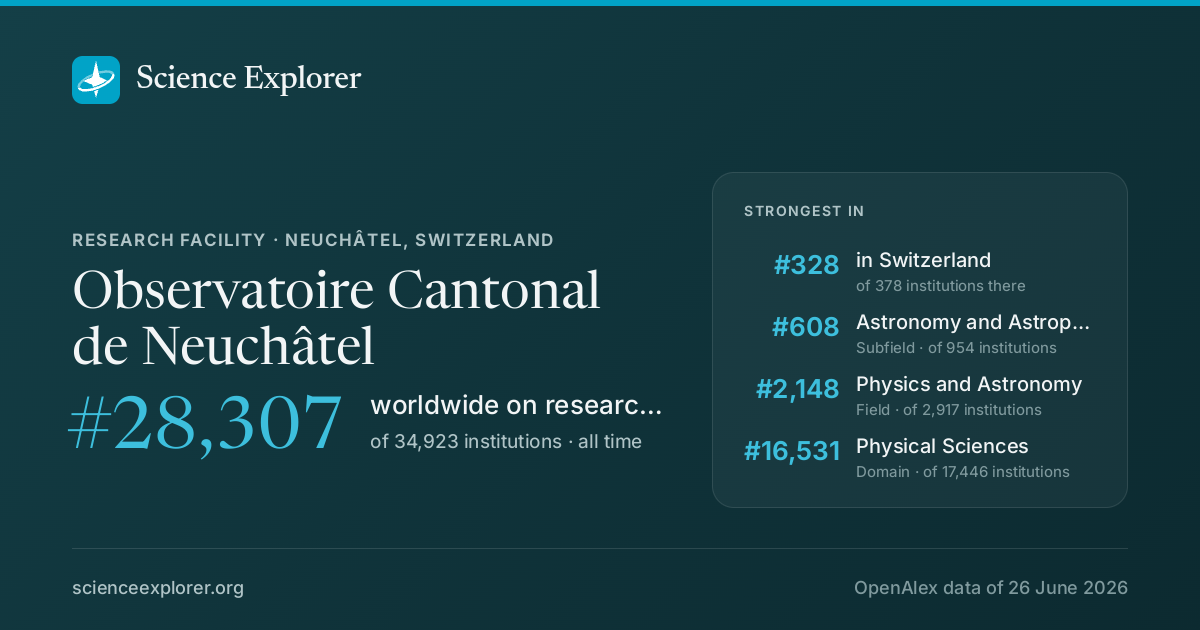
In research, Observatoire Cantonal de Neuchâtel stands highest in Astronomy and Astrophysics (#608 of 954 worldwide), Physics and Astronomy (#2,148 of 2,917 worldwide) and Physical Sciences (#16,531 of 17,446 worldwide), over all time.
- World rank, all time
- #28,307 of 34,923
- Rank in Switzerland
- #328 of 378
- Research works
- 534 ▼ 32% vs 2018-21
- Citations
- 20k 37.2 per fractional work
- Top-10% rate
- 10.3% all institutions 10.0%
- vs its own fields
- 0.84× 1.00× is exactly expected
- Open access
- 42% world 40%
- International
- 37% world 18%
What is Observatoire Cantonal de Neuchâtel known for in research?
The fields where it stands highest, over all time, ranked among every institution above the floor in each field.
| Field | World rank | Where that sits | Top-10% rate | Works |
|---|---|---|---|---|
| Astronomy and AstrophysicsSubfield | #608 of 954 | 20.3% | 163 | |
| Physics and AstronomyField | #2,148 of 2,917 | 15.5% | 285 | |
| Physical SciencesDomain | #16,531 of 17,446 | 14.3% | 426 |
Each strip is that field's whole ranked pool, with the notch where Observatoire Cantonal de Neuchâtel sits in it, in the colour of the band that rank falls in. The track under the rate is the rate itself: it carries no average mark, because the average differs by field (from about 6% in Dentistry to 21% in Economics).
Which fields of science does Observatoire Cantonal de Neuchâtel work in?
In all years, 80% of research at Observatoire Cantonal de Neuchâtel is in Physical Sciences, 14% in Social Sciences. Its largest fields are Physics and Astronomy (53%), Engineering (12%), Arts and Humanities (6%). It does 2.0× the world's share of Physical Sciences.
Each ring splits the one inside it: the four domains of science, their fields, their subfields. Size is fractional works in all years. Every slice is a page; the interactive view zooms down to single topics and colours each by how much more of it this institution does than the world.
Its 4 domains and 25 fields, with their numbers
- Physical Sciences42679.8%
- Physics and Astronomy28553.4%
- Engineering6412.1%
- Earth and Planetary Sciences285.3%
- Environmental Science152.8%
- Chemistry112.1%
- Materials Science101.9%
- Computer Science71.2%
- Mathematics30.6%
- Chemical Engineering30.5%
- Social Sciences7313.8%
- Health Sciences183.3%
- Medicine122.2%
- Health Professions50.9%
- Dentistry10.1%
- Veterinary00.1%
- Nursing00.0%
- Life Sciences173.1%
Field profile
Location quotient across every field it publishes in: outside the ring is more than an institution of this size would be expected to publish, inside it is less.
Rings at 0.5×, 1× and 2×. Widest outward: Arts and Humanities, 8.7×. Every wedge is a field page.
All 14 fields, with their numbers
- Arts and Humanities8.68×4 works
- Physics and Astronomy7.91×3 works
- Health Professions3.89×2 works
- Earth and Planetary Sciences1.54×0 works
- Social Sciences1.39×3 works
- Biochemistry, Genetics and Molecular Biology0.69×1 works
- Nursing0.63×0 works
- Medicine0.61×2 works
- Psychology0.46×0 works
- Engineering0.41×1 works
- Computer Science0.24×0 works
- Chemistry0.20×0 works
- Environmental Science0.19×0 works
- Agricultural and Biological Sciences0.15×0 works
- Arts and Humanities 8.7×
- Physics and Astronomy 7.9×
- Health Professions 3.9×
- Earth and Planetary Sciences 1.5×
- Social Sciences 1.4×
- Biochemistry, Genetics and Molecular Biology 0.7×
- Nursing 0.6×
- Medicine 0.6×
- Psychology 0.5×
- Engineering 0.4×
- Computer Science 0.2×
- Chemistry 0.2×
- Environmental Science 0.2×
- Agricultural and Biological Sciences 0.1×
Who are the top researchers at Observatoire Cantonal de Neuchâtel?
Ranked on the quality score, M. Burnet, Valentin Mitev and Regula Bigler lead among researchers whose main affiliation is Observatoire Cantonal de Neuchâtel.
- 1
M. Burnet
 Switzerland · #3,183,820 worldwide
3k citations · 68 works
- 2
Valentin Mitev
Switzerland · #3,269,814 worldwide
3.7k citations · 159 works
- 3
Regula Bigler
Switzerland · #3,612,315 worldwide
6 citations · 59 works
- 4
F. Kienzle
Switzerland · #3,890,943 worldwide
402 citations · 26 works
- 5
Marcel E. Golay
Switzerland · #4,527,930 worldwide
2.5k citations · 96 works
- 6
Sophie Piccard
Switzerland · #4,612,457 worldwide
105 citations · 31 works
- 7
Dufay
Switzerland · #4,955,353 worldwide
1 citations · 15 works
- 8
Andre Blecha
Switzerland · #5,227,520 worldwide
855 citations · 66 works
- 9
P. Kartaschoff
Switzerland · #5,286,081 worldwide
292 citations · 30 works
- 10
M. Grenon
Switzerland · #5,290,537 worldwide
2.1k citations · 251 works
Which keywords describe research at Observatoire Cantonal de Neuchâtel?
By fractional works in all years, weighted toward what it does more of than the world: Exoplanets, Stellar Astrophysics, Star Formation, Astronomical Instrumentation, Spectrograph, Accretion Disks, Magnetic Fields and Turbulence.
- X-ray Photoelectron Spectroscopy
- Historical Figures
- Position-Sensitive Detector
- Radio Astronomy
- Air Quality
- Ultracold Gases
- Quantum Information
- Cultural Impact
- Galaxies
- Dark Matter
- Mechanical Properties
- Atomic Magnetometer
- Black Holes
- Atomic Clocks
- Terrestrial Planets
- Turbulence
- Molecular Clouds
- Accretion Disks
- Astronomical Instrumentation
- Stellar Astrophysics
- Exoplanets
- Star Formation
- Spectrograph
- Magnetic Fields
- Protoplanetary Disks
- Solar System Abundances
- Geodesy
- Optical Clocks
- Magnetic Resonance Imaging
- Hyperpolarized Gases
- Spectroscopy
- Cosmology
- Stellar Populations
- Superfluidity
- Quantum Simulation
- Satellite Observations
- Structural Health Monitoring
- Optical 3D Laser Measurement
- Nucleosynthesis
- Geophysical Surveys
Size is fractional works in all years in the topics tagged with each word; colour is the word's share of this institution's work against its share of the world's. The 40 words are chosen for being large and distinctive. Each links to the topic it comes from most.
All 40 words, with their numbers
- Exoplanets66▲ 169×1 topic
- Stellar Astrophysics66▲ 169×1 topic
- Star Formation42▲ 84×2 topics
- Astronomical Instrumentation39▲ 141×1 topic
- Spectrograph39▲ 141×1 topic
- Accretion Disks36▲ 84×2 topics
- Magnetic Fields36▲ 65×2 topics
- Molecular Clouds31▲ 120×1 topic
- Protoplanetary Disks31▲ 120×1 topic
- Turbulence31▲ 41×2 topics
- Solar System Abundances26▲ 58×1 topic
- Terrestrial Planets26▲ 58×1 topic
- Geodesy21▲ 186×2 topics
- Atomic Clocks20▲ 313×1 topic
- Optical Clocks20▲ 313×1 topic
- Black Holes16▲ 20×2 topics
- Magnetic Resonance Imaging15▲ 7.6×2 topics
- Atomic Magnetometer15▲ 55×1 topic
- Hyperpolarized Gases15▲ 55×1 topic
- Mechanical Properties14▲ 2.8×9 topics
- Spectroscopy13▲ 7.8×5 topics
- Dark Matter11▲ 11×3 topics
- Cosmology11▲ 23×3 topics
- Galaxies10▲ 45×1 topic
- Stellar Populations10▲ 45×1 topic
- Cultural Impact10▲ 27×2 topics
- Superfluidity10▲ 19×2 topics
- Quantum Information10▲ 14×2 topics
- Quantum Simulation10▲ 21×1 topic
- Ultracold Gases10▲ 34×1 topic
- Satellite Observations9▲ 15×3 topics
- Air Quality9▲ 8.7×3 topics
- Structural Health Monitoring8▲ 15×3 topics
- Radio Astronomy8▲ 41×2 topics
- Optical 3D Laser Measurement8▲ 76×1 topic
- Position-Sensitive Detector8▲ 76×1 topic
- Nucleosynthesis8▲ 14×3 topics
- Historical Figures8▲ 38×2 topics
- Geophysical Surveys8▲ 20×2 topics
- X-ray Photoelectron Spectroscopy8▲ 10×2 topics
Which research topics does Observatoire Cantonal de Neuchâtel publish most on?
By volume in 2022-now: Workplace Health and Well-being, Smoking Behavior and Cessation, German Literature and Culture Studies and Historical and Literary Studies.
Area is fractional works; colour is the subfield each topic belongs to.
- 1 Workplace Health and Well-being General Health Professions 1 works
- 2 Smoking Behavior and Cessation Physiology 1 works
- 3 German Literature and Culture Studies Literature and Literary Theory 1 works
- 4 Historical and Literary Studies Anthropology 0 works
- 5 Historical Studies and Socio-cultural Analysis History and Philosophy of Science 0 works
- 6 Healthcare Systems and Practices General Health Professions 0 works
- 7 Galaxies: Formation, Evolution, Phenomena Astronomy and Astrophysics 0 works
- 8 Historical Linguistics and Language Studies Language and Linguistics 0 works
- 9 Solar and Space Plasma Dynamics Astronomy and Astrophysics 0 works
- 10 Tendon Structure and Treatment Orthopedics and Sports Medicine 0 works
How open and international is its research?
Against the world's own shares: the tick on each track. Both are shares of its output, so they sit on one scale and can be read against each other as well as against the world.
World: 40% of research is openly available.
World: 18% is written across borders.
How has Observatoire Cantonal de Neuchâtel's research output changed?
Output in 2022-2025 was 32% lower than in 2018-2021.
The same series as a ribbon: one cell per year, darker for more. The line above answers how much; this answers when.
Its share of all research
Growing output can still be a shrinking share: all of science grows. This is Observatoire Cantonal de Neuchâtel as a percentage of every work published that year, 0.000072% in 2024.
Fractional works of Observatoire Cantonal de Neuchâtel over all fractional works that year. How the balance of science has shifted.
How much of it reaches the world top 10%
Year by year, against all institutions in the same year.
Of each year's output, the share that reached the world's 10% most cited for its field and year. Peak 25.8% in 2005.
Other research institutions in Neuchâtel
- University of Neuchâtel
- Victoria School of Management
- Swiss Center for Electronics and Microtechnology (Switzerland)
- Hospital Neuchâtel
- Federal Statistical Office
- info fauna
- Alpes Lasers (Switzerland)
- Hôpital de la Providence

Share Observatoire Cantonal de Neuchâtel's ranking
Badges for a website1Each links back here and updates with every snapshot

Research measures only: rankings here say nothing about teaching, admissions or student experience. Comparable institutions and collaboration partners have tabs of their own, above.
Discussion
Ask a question or share a note about Observatoire Cantonal de Neuchâtel. Posts are plain text and can be reported.