Science Explorer Back to mapMap
Discussion
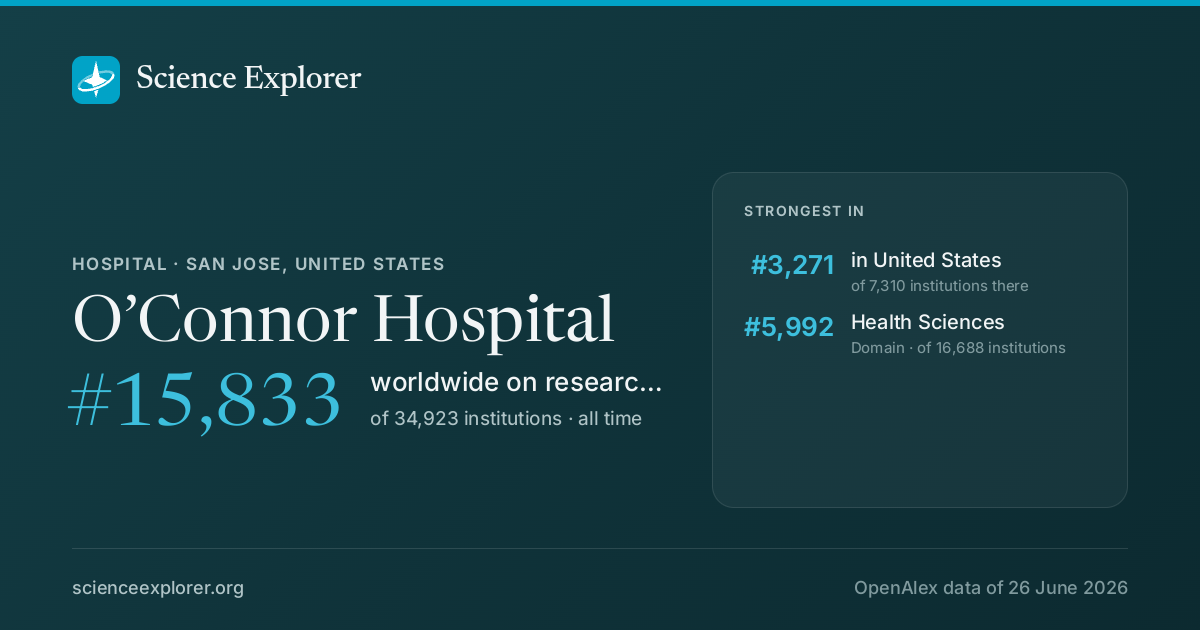
Hospital / health system · San Jose · United States

O’Connor Hospital

In research, O’Connor Hospital stands highest in Health Sciences (#5,992 of 16,688 worldwide), over all time.

World rank, all time
#15,833
of 34,923
Rank in United States
#3,271
of 7,310
Research works
243
▼ 9% vs 2018-21
Citations
5.3k
21.8 per fractional work
Top-10% rate
10.8%
all institutions 10.0%
vs its own fields
1.13×
1.00× is exactly expected
Open access
24%
world 40%
International
20%
world 18%

What is O’Connor Hospital known for in research?

The fields where it stands highest, over all time, ranked among every institution above the floor in each field.

FieldWorld rankWhere that sitsTop-10% rateWorks
Health SciencesDomain #5,992 of 16,688 11.2%137

Each strip is that field's whole ranked pool, with the notch where O’Connor Hospital sits in it, in the colour of the band that rank falls in. The track under the rate is the rate itself: it carries no average mark, because the average differs by field (from about 6% in Dentistry to 21% in Economics).

Which fields of science does O’Connor Hospital work in?

In 2022-now, 53% of research at O’Connor Hospital is in Health Sciences, 26% in Social Sciences. Its largest fields are Medicine (42%), Psychology (12%), Health Professions (10%). It does 1.8× the world's share of Health Sciences.

Health Sciences: 13 fractional works · 52.8% of its workMedicine: 11 fractional works · 42.4% of its workSurgery: 2 fractional works · 7.9% of its workNeurology: 1 fractional works · 4.1% of its workPublic Health, Environmental and Occupational Health: 1 fractional works · 3.9% of its workPsychiatry and Mental health: 1 fractional works · 3.7% of its workEpidemiology: 1 fractional works · 3.6% of its workPathology and Forensic Medicine: 1 fractional works · 2.3% of its workCardiology and Cardiovascular Medicine: 1 fractional works · 2.1% of its workPhysiology: 0 fractional works · 1.7% of its workEmergency Medicine: 0 fractional works · 1.5% of its workOncology: 0 fractional works · 1.4% of its workPediatrics, Perinatology and Child Health: 0 fractional works · 1.3% of its workOrthopedics and Sports Medicine: 0 fractional works · 0.9% of its workRehabilitation: 0 fractional works · 0.9% of its workEndocrinology, Diabetes and Metabolism: 0 fractional works · 0.9% of its workCritical Care and Intensive Care Medicine: 0 fractional works · 0.7% of its workDermatology: 0 fractional works · 0.7% of its workObstetrics and Gynecology: 0 fractional works · 0.6% of its workPharmacology: 0 fractional works · 0.6% of its workUrology: 0 fractional works · 0.6% of its workAnesthesiology and Pain Medicine: 0 fractional works · 0.4% of its workBiochemistry: 0 fractional works · 0.4% of its workGenetics: 0 fractional works · 0.4% of its workPulmonary and Respiratory Medicine: 0 fractional works · 0.4% of its workRadiology, Nuclear Medicine and Imaging: 0 fractional works · 0.4% of its workComplementary and alternative medicine: 0 fractional works · 0.3% of its workTransplantation: 0 fractional works · 0.3% of its workSmaller subfields together: 0 fractional works · 0.2% of its workHealth Professions: 3 fractional works · 10.0% of its workGeneral Health Professions: 1 fractional works · 5.2% of its workRadiological and Ultrasound Technology: 1 fractional works · 2.4% of its workEmergency Medical Services: 0 fractional works · 1.1% of its workOccupational Therapy: 0 fractional works · 0.5% of its workPharmacy: 0 fractional works · 0.4% of its workPhysical Therapy, Sports Therapy and Rehabilitation: 0 fractional works · 0.3% of its workNursing: 0 fractional works · 0.3% of its workNutrition and Dietetics: 0 fractional works · 0.3% of its workSocial Sciences: 7 fractional works · 25.9% of its workPsychology: 3 fractional works · 12.3% of its workClinical Psychology: 3 fractional works · 10.0% of its workSocial Psychology: 0 fractional works · 1.0% of its workDevelopmental and Educational Psychology: 0 fractional works · 0.7% of its workExperimental and Cognitive Psychology: 0 fractional works · 0.4% of its workSocial Sciences: 2 fractional works · 7.7% of its workSociology and Political Science: 1 fractional works · 4.8% of its workHealth: 0 fractional works · 2.0% of its workDemography: 0 fractional works · 0.7% of its workGender Studies: 0 fractional works · 0.4% of its workArts and Humanities: 1 fractional works · 3.5% of its workLiterature and Literary Theory: 0 fractional works · 2.0% of its workPhilosophy: 0 fractional works · 1.3% of its workSmaller subfields together: 0 fractional works · 0.2% of its workDecision Sciences: 0 fractional works · 1.6% of its workStatistics, Probability and Uncertainty: 0 fractional works · 1.3% of its workManagement Science and Operations Research: 0 fractional works · 0.3% of its workEconomics, Econometrics and Finance: 0 fractional works · 0.8% of its workFinance: 0 fractional works · 0.7% of its workSmaller subfields together: 0 fractional works · 0.2% of its workLife Sciences: 4 fractional works · 14.6% of its workNeuroscience: 2 fractional works · 8.5% of its workCognitive Neuroscience: 1 fractional works · 4.2% of its workBehavioral Neuroscience: 1 fractional works · 2.7% of its workBiological Psychiatry: 0 fractional works · 1.0% of its workDevelopmental Neuroscience: 0 fractional works · 0.3% of its workCellular and Molecular Neuroscience: 0 fractional works · 0.3% of its workBiochemistry, Genetics and Molecular Biology: 1 fractional works · 3.7% of its workGenetics: 0 fractional works · 1.7% of its workMolecular Biology: 0 fractional works · 1.5% of its workEndocrinology: 0 fractional works · 0.4% of its workImmunology and Microbiology: 1 fractional works · 2.3% of its workVirology: 0 fractional works · 1.3% of its workImmunology: 0 fractional works · 0.6% of its workMicrobiology: 0 fractional works · 0.4% of its workSmaller subfields together: 0 fractional works · 0.0% of its workPhysical Sciences: 2 fractional works · 6.8% of its workEngineering: 1 fractional works · 4.9% of its workBuilding and Construction: 0 fractional works · 1.3% of its workCivil and Structural Engineering: 0 fractional works · 1.0% of its workAerospace Engineering: 0 fractional works · 0.7% of its workElectrical and Electronic Engineering: 0 fractional works · 0.7% of its workBiomedical Engineering: 0 fractional works · 0.4% of its workOcean Engineering: 0 fractional works · 0.4% of its workSafety, Risk, Reliability and Quality: 0 fractional works · 0.4% of its workEnvironmental Science: 0 fractional works · 1.5% of its workGlobal and Planetary Change: 0 fractional works · 0.4% of its workNature and Landscape Conservation: 0 fractional works · 0.4% of its workWater Science and Technology: 0 fractional works · 0.4% of its workHealth, Toxicology and Mutagenesis: 0 fractional works · 0.2% of its workChemical Engineering: 0 fractional works · 0.4% of its workChemical Health and Safety: 0 fractional works · 0.4% of its workALL ITS WORKO’Connor Hospital25fractional works, 2022-now
Life Sciences15%Physical Sciences7%Health Sciences53%Social Sciences26%

Each ring splits the one inside it: the four domains of science, their fields, their subfields. Size is fractional works in 2022-now. Every slice is a page; the interactive view zooms down to single topics and colours each by how much more of it this institution does than the world.

Its 4 domains and 14 fields, with their numbers
    1. Medicine1142.4%
    2. Health Professions310.0%
    3. Nursing00.3%
    1. Psychology312.3%
    2. Social Sciences27.7%
    3. Arts and Humanities13.5%
    4. Decision Sciences01.6%
    5. Economics, Econometrics and Finance00.8%
    1. Neuroscience28.5%
    2. Biochemistry, Genetics and Molecular Biology13.7%
    3. Immunology and Microbiology12.3%
    1. Engineering14.9%
    2. Environmental Science01.5%
    3. Chemical Engineering00.4%
All of science, and how each field's share has moved since 1950: the Science domain explorer

Field profile

Location quotient across every field it publishes in: outside the ring is more than an institution of this size would be expected to publish, inside it is less.

Biochemistry, Genetics and Molecular Biology: 0.70× its world share, 1 worksBiochemistry, Geneti…Immunology and Microbiology: 2.30× its world share, 1 worksImmunology and Micro…Neuroscience: 5.24× its world share, 2 worksNeuroscienceChemical Engineering: 1.25× its world share, 0 worksChemical EngineeringEngineering: 0.32× its world share, 1 worksEngineeringEnvironmental Science: 0.31× its world share, 0 worksEnvironmental ScienceHealth Professions: 3.80× its world share, 2 worksHealth ProfessionsMedicine: 2.21× its world share, 11 worksMedicineNursing: 0.67× its world share, 0 worksNursingArts and Humanities: 1.20× its world share, 1 worksArts and HumanitiesDecision Sciences: 1.64× its world share, 0 worksDecision SciencesEconomics, Econometrics and Finance: 0.39× its world share, 0 worksEconomics, Econometr…Psychology: 4.02× its world share, 3 worksPsychologySocial Sciences: 0.61× its world share, 2 worksSocial Sciences1×world share
more than its size predictsabout as predictedless

Rings at 0.5×, 1× and 2×. Widest outward: Neuroscience, 5.2×. Every wedge is a field page.

All 14 fields, with their numbers
  1. Neuroscience5.24×2 works
  2. Psychology4.02×3 works
  3. Health Professions3.80×2 works
  4. Immunology and Microbiology2.30×1 works
  5. Medicine2.21×11 works
  6. Decision Sciences1.64×0 works
  7. Chemical Engineering1.25×0 works
  8. Arts and Humanities1.20×1 works
  9. Biochemistry, Genetics and Molecular Biology0.70×1 works
  10. Nursing0.67×0 works
  11. Social Sciences0.61×2 works
  12. Economics, Econometrics and Finance0.39×0 works
  13. Engineering0.32×1 works
  14. Environmental Science0.31×0 works

Who are the top researchers at O’Connor Hospital?

Ranked on the quality score, William H. Graham, Hossein Shenasa and M. James Whitelaw lead among researchers whose main affiliation is O’Connor Hospital.

  1. 1 William H. Graham United States · #2,254,715 worldwide 955 citations · 38 works
  2. 2 Hossein Shenasa United States · #3,546,361 worldwide 557 citations · 22 works
  3. 3 M. James Whitelaw United States · #5,513,427 worldwide 496 citations · 56 works
  4. 4 Mohammad Shenasa United States · #5,550,897 worldwide 2.5k citations · 157 works
All ranked researchers at O’Connor Hospital

What are the most cited papers from O’Connor Hospital?

The most cited paper from O’Connor Hospital is "2021 AHA/ACC/ASE/CHEST/SAEM/SCCT/SCMR Guideline for the Evaluation and Diagnosis of Chest Pain: A Report of the American College of Cardiology/American Heart Association Joint Committee on Clinical Practice Guidelines" (Martha Gulati et al., 2021), with 1,609 citations. Next come "Part 1: Executive Summary" (1,053) and "Epigenetic Signatures of Cigarette Smoking" (1,037).

Most cited papers
#PaperReleasedCitations
1 2021 AHA/ACC/ASE/CHEST/SAEM/SCCT/SCMR Guideline for the Evaluation and Diagnosis of Chest Pain: A Report of the American College of Cardiology/American Heart Association Joint Committee on Clinical Practice Guidelines Martha Gulati et al. · Circulation 28 Oct 2021 1,609
2 Part 1: Executive Summary John M. Field et al. · Circulation 18 Oct 2010 1,053
3 Epigenetic Signatures of Cigarette Smoking Roby Joehanes et al. · Circulation Cardiovascular Genetics Open access 20 Sep 2016 1,037
4 Treatment of Hypertension in the Prevention and Management of Ischemic Heart Disease Clive Rosendorff, Henry Richard Black, Christopher Paul Cannon et al. · Circulation 14 May 2007 763
5 Part 1: Executive Summary Robert W. Neumar et al. · Circulation Open access 15 Oct 2015 721
All 58 most cited papers, with filters and sorting

Which keywords describe research at O’Connor Hospital?

By fractional works in 2022-now, weighted toward what it does more of than the world: Emotion Regulation, Depression, Neuroscience, Well-being, Stress Reduction, Mindfulness, Self-Compassion and Anxiety.

▲ more of its work than of the world's◆ about the world's share▼ less than the world's

Size is fractional works in 2022-now in the topics tagged with each word; colour is the word's share of this institution's work against its share of the world's. The 14 words are chosen for being large and distinctive. Each links to the topic it comes from most.

All 14 words, with their numbers
  1. Epidemiology2▲ 2.3×20 topics
  2. Depression2▲ 8.8×8 topics
  3. Emotion Regulation2▲ 25×3 topics
  4. Neuroscience2▲ 24×2 topics
  5. Well-being2▲ 19×2 topics
  6. Stress Reduction2▲ 101×2 topics
  7. Mindfulness2▲ 168×1 topic
  8. Self-Compassion2▲ 168×1 topic
  9. Anxiety1▲ 12×8 topics
  10. Racial Disparities1▲ 86×2 topics
  11. Risk Perception1▲ 16×3 topics
  12. Criminal Justice1▲ 18×1 topic
  13. Mass Incarceration1▲ 135×1 topic
  14. Treatment1▲ 3.4×7 topics

Which research topics does O’Connor Hospital publish most on?

By volume in 2022-now: Mindfulness and Compassion Interventions, Criminal Justice and Corrections Analysis, Stress Responses and Cortisol and Occupational Health and Safety Research.

  1. 1 Mindfulness and Compassion Interventions Clinical Psychology 2 works
  2. 2 Criminal Justice and Corrections Analysis Sociology and Political Science 1 works
  3. 3 Stress Responses and Cortisol Behavioral Neuroscience 1 works
  4. 4 Occupational Health and Safety Research Radiological and Ultrasound Technology 1 works
  5. 5 Hallucinations in medical conditions Cognitive Neuroscience 0 works
  6. 6 Psychosomatic Disorders and Their Treatments Psychiatry and Mental health 0 works
  7. 7 Patient-Provider Communication in Healthcare General Health Professions 0 works
  8. 8 Vaccine Coverage and Hesitancy Health 0 works
  9. 9 Mental Health and Psychiatry Philosophy 0 works
  10. 10 Vascular Malformations Diagnosis and Treatment Neurology 0 works

How open and international is its research?

Against the world's own shares: the tick on each track. Both are shares of its output, so they sit on one scale and can be read against each other as well as against the world.

openly available24.4%not open75.6%

World: 40% of research is openly available.

with international co-authors19.7%domestic only80.3%

World: 18% is written across borders.

How has O’Connor Hospital's research output changed?

Output in 2022-2025 was 9% lower than in 2018-2021.

still counting1990200020102020
grewheldshrank

The same series as a ribbon: one cell per year, darker for more. The line above answers how much; this answers when.

Its share of all research

Growing output can still be a shrinking share: all of science grows. This is O’Connor Hospital as a percentage of every work published that year, 0.00014% in 2024.

still counting0.0010%0.0020%O’Connor Hospital0.000071% in 202519801990200020102020

Fractional works of O’Connor Hospital over all fractional works that year. How the balance of science has shifted.

Other research institutions in San Jose

All research institutions in San Jose

Share O’Connor Hospital's ranking

O’Connor Hospital on Science Explorer

A card with O’Connor Hospital's standing and the fields it leads in, for a post or a slide. A link to this page previews as the same card.

Download the card

1200 × 630 PNG, sized for social posts, drawn from the latest snapshot.

Badges for a website1Each links back here and updates with every snapshot

Research measures only: rankings here say nothing about teaching, admissions or student experience. Comparable institutions and collaboration partners have tabs of their own, above.

Discussion

Ask a question or share a note about O’Connor Hospital. Keep it to the research: no personal attacks, advertising or links. Any reader can report a post, which collapses it for everyone until it is opened.