Ørsted (Denmark)
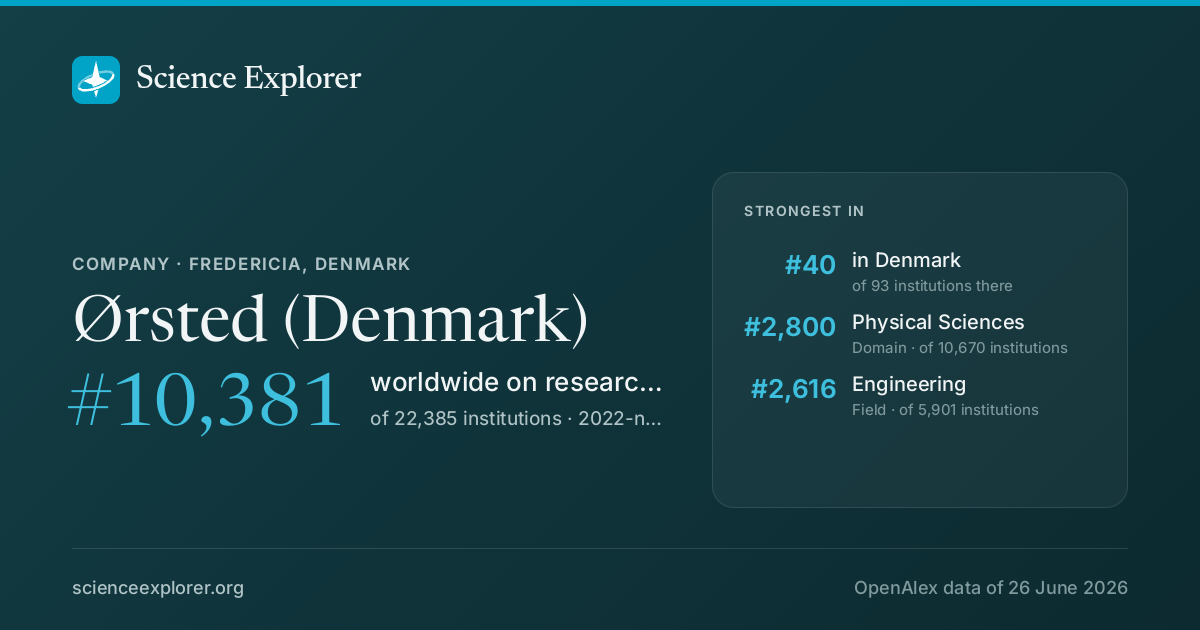
In research, Ørsted (Denmark) stands highest in Physical Sciences (#2,800 of 10,670 worldwide) and Engineering (#2,616 of 5,901 worldwide), 2022-now.
- World rank, 2022-now
- #10,381 of 22,385 · #9,224 all time
- Rank in Denmark
- #40 of 93
- Research works
- 2.9k ▼ 30% vs 2018-21
- Citations
- 86k 29.4 per fractional work
- Top-10% rate
- 13.1% all institutions 10.0%
- vs its own fields
- 1.13× 1.00× is exactly expected
- Open access
- 27% world 40%
- International
- 27% world 18%
What is Ørsted (Denmark) known for in research?
The fields where it stands highest, 2022-now, ranked among every institution above the floor in each field.
| Field | World rank | Where that sits | Top-10% rate | Works | All time |
|---|---|---|---|---|---|
| Physical SciencesDomain | #2,800 of 10,670 | 13.4% | 117 | #3980 | |
| EngineeringField | #2,616 of 5,901 | 13.6% | 71 | #2668 |
Each strip is that field's whole ranked pool, with the notch where Ørsted (Denmark) sits in it, in the colour of the band that rank falls in. The track under the rate is the rate itself: it carries no average mark, because the average differs by field (from about 6% in Dentistry to 21% in Economics).
Which fields of science does Ørsted (Denmark) work in?
In 2022-now, 78% of research at Ørsted (Denmark) is in Physical Sciences, 11% in Life Sciences. Its largest fields are Engineering (46%), Physics and Astronomy (10%), Materials Science (7%). It does 2.0× the world's share of Physical Sciences.
Each ring splits the one inside it: the four domains of science, their fields, their subfields. Size is fractional works in 2022-now. Every slice is a page; the interactive view zooms down to single topics and colours each by how much more of it this institution does than the world.
Its 4 domains and 25 fields, with their numbers
- Physical Sciences12178.2%
- Engineering7246.5%
- Physics and Astronomy159.7%
- Materials Science117.2%
- Environmental Science74.3%
- Earth and Planetary Sciences63.7%
- Computer Science53.5%
- Energy31.6%
- Chemistry21.4%
- Chemical Engineering00.2%
- Life Sciences1811.4%
- Health Sciences117.4%
- Medicine95.6%
- Health Professions21.5%
- Veterinary00.2%
- Dentistry00.1%
- Nursing00.1%
- Social Sciences53.0%
Field profile
Location quotient across every field it publishes in: outside the ring is more than an institution of this size would be expected to publish, inside it is less.
Rings at 0.5×, 1× and 2×. Widest outward: Physics and Astronomy, 4.4×. Every wedge is a field page.
All 25 fields, with their numbers
- Physics and Astronomy4.37×15 works
- Engineering3.10×72 works
- Earth and Planetary Sciences2.39×6 works
- Materials Science2.05×11 works
- Pharmacology, Toxicology and Pharmaceutics1.87×1 works
- Energy1.77×2 works
- Neuroscience1.55×4 works
- Veterinary1.33×0 works
- Biochemistry, Genetics and Molecular Biology1.00×8 works
- Chemistry0.92×2 works
- Environmental Science0.86×7 works
- Decision Sciences0.80×1 works
- Health Professions0.58×2 works
- Agricultural and Biological Sciences0.51×4 works
- Chemical Engineering0.50×0 works
- Immunology and Microbiology0.46×1 works
- Computer Science0.45×5 works
- Medicine0.29×9 works
- Psychology0.29×1 works
- Dentistry0.22×0 works
- Nursing0.17×0 works
- Arts and Humanities0.17×1 works
- Economics, Econometrics and Finance0.16×0 works
- Business, Management and Accounting0.08×0 works
- Social Sciences0.02×0 works
- Physics and Astronomy 4.4×
- Engineering 3.1×
- Earth and Planetary Sciences 2.4×
- Materials Science 2.0×
- Pharmacology, Toxicology and Pharmaceutics 1.9×
- Energy 1.8×
- Neuroscience 1.6×
- Veterinary 1.3×
- Biochemistry, Genetics and Molecular Biology 1.0×
- Chemistry 0.9×
- Environmental Science 0.9×
- Decision Sciences 0.8×
- Health Professions 0.6×
- Agricultural and Biological Sciences 0.5×
- Chemical Engineering 0.5×
- Immunology and Microbiology 0.5×
- Computer Science 0.5×
- Medicine 0.3×
- Psychology 0.3×
- Dentistry 0.2×
- Nursing 0.2×
- Arts and Humanities 0.2×
- Economics, Econometrics and Finance 0.2×
- Business, Management and Accounting 0.1×
- Social Sciences 0.0×
Who are the top researchers at Ørsted (Denmark)?
Ranked on the quality score, N. Krog, Jens Kai Holm and Leo E. Jensen lead among researchers whose main affiliation is Ørsted (Denmark).
- 1
N. Krog
 Denmark · #530,950 worldwide
2.8k citations · 48 works
- 2
Jens Kai Holm
Denmark · #1,422,036 worldwide
2.9k citations · 40 works
- 3
Leo E. Jensen
Denmark · #1,546,731 worldwide
2.3k citations · 25 works
- 4
K. Bechgaard
Denmark · #1,548,392 worldwide
20k citations · 562 works
- 5
Lars Henrik Hansen
Denmark · #2,253,009 worldwide
2.1k citations · 51 works
- 6
Jacob Nygaard Knudsen
Denmark · #2,371,842 worldwide
2.2k citations · 34 works
- 7
Kristian Edlund
Denmark · #2,939,506 worldwide
659 citations · 23 works
- 8
Jens Jensen
Denmark · #2,945,478 worldwide
3.4k citations · 124 works
- 9
Duy Michael Le
Denmark · #2,984,933 worldwide
538 citations · 17 works
- 10
Henrik Smith
Denmark · #3,139,489 worldwide
1.3k citations · 32 works
Which keywords describe research at Ørsted (Denmark)?
By fractional works in 2022-now, weighted toward what it does more of than the world: Biosensors, Optical Modulators, Power Electronics, Microcavities, Integrated Circuits, Nanophotonic Waveguides, Silicon Photonics and Renewable Energy.
- Subwavelength Imaging
- Pitting Corrosion
- Risk Analysis
- Metamaterials
- Microgrid Control
- Vibration Analysis
- Smart Grid Applications
- Nonlinear Optics
- Finite Element Analysis
- Corrosion
- Nonlinear Dynamics
- Photonic Crystals
- Optical Fiber
- Renewable Energy Integration
- CFD Simulation
- Control Strategies
- Silicon Photonics
- Microcavities
- Power Electronics
- Renewable Energy
- Biosensors
- Optical Modulators
- Integrated Circuits
- Nanophotonic Waveguides
- Biomedical Applications
- Entanglement
- Decentralized Control
- Turbulent Flow
- Pipeline
- Microwave Photonics
- Smart Grid
- Energy Storage Systems
- Large-Eddy Simulation
- Fiber Lasers
- Offshore Wind Farms
- Distributed Power Generation
- Slow Light
- Wind Power
- Vibration Control
- Reliability Assessment
Size is fractional works in 2022-now in the topics tagged with each word; colour is the word's share of this institution's work against its share of the world's. The 40 words are chosen for being large and distinctive. Each links to the topic it comes from most.
All 40 words, with their numbers
- Biosensors12▲ 16×10 topics
- Renewable Energy8▲ 3.7×12 topics
- Optical Modulators7▲ 33×2 topics
- Power Electronics6▲ 13×6 topics
- Integrated Circuits6▲ 27×2 topics
- Microcavities6▲ 38×2 topics
- Nanophotonic Waveguides6▲ 43×1 topic
- Silicon Photonics6▲ 39×1 topic
- Biomedical Applications6▲ 3.1×24 topics
- Control Strategies4▲ 16×5 topics
- Entanglement3▲ 14×3 topics
- CFD Simulation3▲ 18×2 topics
- Decentralized Control3▲ 18×2 topics
- Renewable Energy Integration3▲ 6.5×5 topics
- Turbulent Flow3▲ 18×3 topics
- Optical Fiber3▲ 20×3 topics
- Pipeline3▲ 20×2 topics
- Photonic Crystals3▲ 16×4 topics
- Microwave Photonics3▲ 23×2 topics
- Nonlinear Dynamics3▲ 8.8×4 topics
- Smart Grid3▲ 5.3×6 topics
- Corrosion3▲ 15×2 topics
- Energy Storage Systems3▲ 14×2 topics
- Finite Element Analysis3▲ 8.2×3 topics
- Large-Eddy Simulation3▲ 10×2 topics
- Nonlinear Optics3▲ 18×3 topics
- Fiber Lasers3▲ 20×2 topics
- Smart Grid Applications3▲ 14×2 topics
- Offshore Wind Farms3▲ 28×2 topics
- Vibration Analysis3▲ 6.5×5 topics
- Distributed Power Generation3▲ 17×1 topic
- Microgrid Control3▲ 17×1 topic
- Slow Light3▲ 35×2 topics
- Metamaterials2▲ 12×5 topics
- Wind Power2▲ 17×3 topics
- Risk Analysis2▲ 15×2 topics
- Vibration Control2▲ 23×2 topics
- Pitting Corrosion2▲ 28×1 topic
- Reliability Assessment2▲ 34×1 topic
- Subwavelength Imaging2▲ 33×2 topics
Which research topics does Ørsted (Denmark) publish most on?
By volume in 2022-now: Photonic and Optical Devices, Microgrid Control and Optimization, Structural Integrity and Reliability Analysis and Advanced Fiber Laser Technologies.
Area is fractional works; colour is the subfield each topic belongs to.
- 1 Photonic and Optical Devices Electrical and Electronic Engineering 6 works
- 2 Microgrid Control and Optimization Control and Systems Engineering 3 works
- 3 Structural Integrity and Reliability Analysis Mechanical Engineering 2 works
- 4 Advanced Fiber Laser Technologies Atomic and Molecular Physics, and Optics 2 works
- 5 Mechanical and Optical Resonators Atomic and Molecular Physics, and Optics 2 works
- 6 Acoustic Wave Phenomena Research Biomedical Engineering 2 works
- 7 Wind and Air Flow Studies Environmental Engineering 2 works
- 8 Geotechnical Engineering and Soil Mechanics Civil and Structural Engineering 2 works
- 9 Photonic Crystals and Applications Atomic and Molecular Physics, and Optics 2 works
- 10 Optical Network Technologies Electrical and Electronic Engineering 2 works
How open and international is its research?
Against the world's own shares: the tick on each track. Both are shares of its output, so they sit on one scale and can be read against each other as well as against the world.
World: 40% of research is openly available.
World: 18% is written across borders.
How has Ørsted (Denmark)'s research output changed?
Output in 2022-2025 was 30% lower than in 2018-2021.
The same series as a ribbon: one cell per year, darker for more. The line above answers how much; this answers when.
Its share of all research
Growing output can still be a shrinking share: all of science grows. This is Ørsted (Denmark) as a percentage of every work published that year, 0.00083% in 2024.
Fractional works of Ørsted (Denmark) over all fractional works that year. How the balance of science has shifted.
How much of it reaches the world top 10%
Year by year, against all institutions in the same year.
Of each year's output, the share that reached the world's 10% most cited for its field and year. Peak 23.3% in 2010.
Other research institutions in Fredericia
Share Ørsted (Denmark)'s ranking
Badges for a website1Each links back here and updates with every snapshot

Research measures only: rankings here say nothing about teaching, admissions or student experience. Comparable institutions and collaboration partners have tabs of their own, above.
Discussion
Ask a question or share a note about Ørsted (Denmark). Posts are plain text and can be reported.