Science Explorer Back to mapMap
Discussion
Institution · Leicester · United Kingdom

Paint Research Association

World rank, all time
#31,984
of 34,923
Rank in United Kingdom
#1,723
of 1,844
Research works
134
▲ 1224% vs 2018-21
Citations
3.1k
23.0 per fractional work
Top-10% rate
18.0%
all institutions 10.0%
vs its own fields
0.99×
1.00× is exactly expected
Open access
10%
world 40%
International
7%
world 18%

Which fields of science does Paint Research Association work in?

In all years, 75% of research at Paint Research Association is in Physical Sciences, 14% in Social Sciences. Its largest fields are Engineering (29%), Materials Science (18%), Chemistry (14%). It does 1.8× the world's share of Physical Sciences.

Physical Sciences: 101 fractional works · 75.4% of its workEngineering: 39 fractional works · 29.3% of its workCivil and Structural Engineering: 8 fractional works · 5.6% of its workMechanical Engineering: 7 fractional works · 5.6% of its workBiomedical Engineering: 6 fractional works · 4.1% of its workMechanics of Materials: 5 fractional works · 3.9% of its workComputational Mechanics: 4 fractional works · 2.6% of its workBuilding and Construction: 3 fractional works · 2.2% of its workElectrical and Electronic Engineering: 2 fractional works · 1.9% of its workAerospace Engineering: 2 fractional works · 1.3% of its workIndustrial and Manufacturing Engineering: 1 fractional works · 0.7% of its workSafety, Risk, Reliability and Quality: 1 fractional works · 0.7% of its workAutomotive Engineering: 1 fractional works · 0.4% of its workControl and Systems Engineering: 0 fractional works · 0.2% of its workMaterials Science: 24 fractional works · 18.1% of its workMaterials Chemistry: 9 fractional works · 6.7% of its workCeramics and Composites: 7 fractional works · 5.1% of its workPolymers and Plastics: 5 fractional works · 3.9% of its workSurfaces, Coatings and Films: 2 fractional works · 1.1% of its workBiomaterials: 1 fractional works · 0.9% of its workElectronic, Optical and Magnetic Materials: 1 fractional works · 0.5% of its workChemistry: 19 fractional works · 14.0% of its workOrganic Chemistry: 8 fractional works · 6.0% of its workSpectroscopy: 5 fractional works · 3.5% of its workInorganic Chemistry: 3 fractional works · 2.2% of its workAnalytical Chemistry: 2 fractional works · 1.4% of its workPhysical and Theoretical Chemistry: 1 fractional works · 1.0% of its workEarth and Planetary Sciences: 7 fractional works · 5.0% of its workEarth-Surface Processes: 4 fractional works · 3.0% of its workGeochemistry and Petrology: 1 fractional works · 1.0% of its workGeology: 1 fractional works · 0.7% of its workGeophysics: 0 fractional works · 0.2% of its workPhysics and Astronomy: 4 fractional works · 3.1% of its workAtomic and Molecular Physics, and Optics: 4 fractional works · 2.9% of its workRadiation: 0 fractional works · 0.2% of its workEnvironmental Science: 4 fractional works · 2.9% of its workIndustrial and Manufacturing Engineering: 2 fractional works · 1.1% of its workPollution: 1 fractional works · 0.7% of its workGlobal and Planetary Change: 1 fractional works · 0.5% of its workHealth, Toxicology and Mutagenesis: 1 fractional works · 0.5% of its workSmaller subfields together: 0 fractional works · 0.1% of its workChemical Engineering: 2 fractional works · 1.5% of its workBioengineering: 1 fractional works · 0.6% of its workFluid Flow and Transfer Processes: 1 fractional works · 0.6% of its workCatalysis: 0 fractional works · 0.2% of its workComputer Science: 2 fractional works · 1.2% of its workComputer Networks and Communications: 1 fractional works · 0.7% of its workArtificial Intelligence: 1 fractional works · 0.5% of its workMathematics: 0 fractional works · 0.1% of its workSocial Sciences: 18 fractional works · 13.6% of its workArts and Humanities: 11 fractional works · 8.4% of its workArcheology: 9 fractional works · 7.0% of its workHistory and Philosophy of Science: 1 fractional works · 0.7% of its workConservation: 0 fractional works · 0.2% of its workVisual Arts and Performing Arts: 0 fractional works · 0.2% of its workSmaller subfields together: 0 fractional works · 0.1% of its workSocial Sciences: 4 fractional works · 3.1% of its workSociology and Political Science: 2 fractional works · 1.7% of its workAnthropology: 1 fractional works · 0.5% of its workArcheology: 0 fractional works · 0.2% of its workSmaller subfields together: 1 fractional works · 0.6% of its workBusiness, Management and Accounting: 1 fractional works · 1.0% of its workStrategy and Management: 1 fractional works · 0.7% of its workAccounting: 0 fractional works · 0.2% of its workPsychology: 1 fractional works · 0.6% of its workSocial Psychology: 1 fractional works · 0.6% of its workDecision Sciences: 1 fractional works · 0.5% of its workStatistics, Probability and Uncertainty: 1 fractional works · 0.5% of its workEconomics, Econometrics and Finance: 0 fractional works · 0.1% of its workHealth Sciences: 9 fractional works · 6.7% of its workMedicine: 7 fractional works · 5.2% of its workPulmonary and Respiratory Medicine: 2 fractional works · 1.6% of its workAnesthesiology and Pain Medicine: 1 fractional works · 0.5% of its workPharmacology: 1 fractional works · 0.4% of its workPediatrics, Perinatology and Child Health: 0 fractional works · 0.4% of its workPhysiology: 0 fractional works · 0.4% of its workRheumatology: 0 fractional works · 0.3% of its workNephrology: 0 fractional works · 0.2% of its workPublic Health, Environmental and Occupational Health: 0 fractional works · 0.2% of its workReproductive Medicine: 0 fractional works · 0.2% of its workSurgery: 0 fractional works · 0.2% of its workSmaller subfields together: 1 fractional works · 0.6% of its workHealth Professions: 1 fractional works · 0.7% of its workEmergency Medical Services: 0 fractional works · 0.2% of its workGeneral Health Professions: 0 fractional works · 0.2% of its workSmaller subfields together: 0 fractional works · 0.2% of its workNursing: 1 fractional works · 0.5% of its workNutrition and Dietetics: 1 fractional works · 0.5% of its workVeterinary: 0 fractional works · 0.2% of its workSmall Animals: 0 fractional works · 0.2% of its workDentistry: 0 fractional works · 0.1% of its workLife Sciences: 6 fractional works · 4.3% of its workAgricultural and Biological Sciences: 4 fractional works · 2.9% of its workFood Science: 3 fractional works · 2.0% of its workEcology, Evolution, Behavior and Systematics: 1 fractional works · 0.6% of its workPlant Science: 0 fractional works · 0.3% of its workBiochemistry, Genetics and Molecular Biology: 1 fractional works · 0.9% of its workGenetics: 1 fractional works · 0.5% of its workMolecular Biology: 0 fractional works · 0.3% of its workSmaller subfields together: 0 fractional works · 0.1% of its workNeuroscience: 1 fractional works · 0.6% of its workCognitive Neuroscience: 0 fractional works · 0.2% of its workEndocrine and Autonomic Systems: 0 fractional works · 0.2% of its workSmaller subfields together: 0 fractional works · 0.1% of its workALL ITS WORKPaint ResearchAssociation134fractional works, all years
Life Sciences4%Physical Sciences75%Health Sciences7%Social Sciences14%

Each ring splits the one inside it: the four domains of science, their fields, their subfields. Size is fractional works in all years. Every slice is a page; the interactive view zooms down to single topics and colours each by how much more of it this institution does than the world.

Its 4 domains and 23 fields, with their numbers
    1. Engineering3929.3%
    2. Materials Science2418.1%
    3. Chemistry1914.0%
    4. Earth and Planetary Sciences75.0%
    5. Physics and Astronomy43.1%
    6. Environmental Science42.9%
    7. Chemical Engineering21.5%
    8. Computer Science21.2%
    9. Mathematics00.1%
    1. Arts and Humanities118.4%
    2. Social Sciences43.1%
    3. Business, Management and Accounting11.0%
    4. Psychology10.6%
    5. Decision Sciences10.5%
    6. Economics, Econometrics and Finance00.1%
    1. Medicine75.2%
    2. Health Professions10.7%
    3. Nursing10.5%
    4. Veterinary00.2%
    5. Dentistry00.1%
    1. Agricultural and Biological Sciences42.9%
    2. Biochemistry, Genetics and Molecular Biology10.9%
    3. Neuroscience10.6%
All of science, and how each field's share has moved since 1950: the Science domain explorer

Field profile

Location quotient across every field it publishes in: outside the ring is more than an institution of this size would be expected to publish, inside it is less.

Agricultural and Biological Sciences: 2.10× its world share, 0 worksAgricultural and Bio…Biochemistry, Genetics and Molecular Biology: 2.50× its world share, 1 worksBiochemistry, Geneti…Chemistry: 2.12× its world share, 0 worksChemistryEngineering: 0.22× its world share, 0 worksEngineeringEnvironmental Science: 0.67× its world share, 0 worksEnvironmental ScienceMathematics: 2.83× its world share, 0 worksMathematicsMedicine: 1.21× its world share, 1 worksMedicineVeterinary: 49.06× its world share, 0 worksVeterinaryPsychology: 2.19× its world share, 0 worksPsychologySocial Sciences: 2.11× its world share, 1 worksSocial Sciences1×world share
more than its size predictsabout as predictedless

Rings at 0.5×, 1× and 2×. Widest outward: Veterinary, 49.1×. Every wedge is a field page.

All 10 fields, with their numbers
  1. Veterinary49.06×0 works
  2. Mathematics2.83×0 works
  3. Biochemistry, Genetics and Molecular Biology2.50×1 works
  4. Psychology2.19×0 works
  5. Chemistry2.12×0 works
  6. Social Sciences2.11×1 works
  7. Agricultural and Biological Sciences2.10×0 works
  8. Medicine1.21×1 works
  9. Environmental Science0.67×0 works
  10. Engineering0.22×0 works

Who are the top researchers at Paint Research Association?

Ranked on the quality score, GR Rigby, Paul Popper and Arthur Dodd lead among researchers whose main affiliation is Paint Research Association.

  1. 1 GR Rigby United Kingdom · #1,793,931 worldwide 609 citations · 24 works
  2. 2 Paul Popper United Kingdom · #2,702,999 worldwide 2.4k citations · 44 works
  3. 3 Arthur Dodd United Kingdom · #2,786,964 worldwide 11 citations · 28 works
  4. 4 Richard J. Holman United Kingdom · #3,720,822 worldwide 888 citations · 24 works
All ranked researchers at Paint Research Association

What are the most cited papers from Paint Research Association?

The most cited paper from Paint Research Association is "New compounds of the K 2 NIF 4 type" (S. N. Ruddlesden, P. Popper, 1957), with 1,115 citations. Next come "Strategies to Reduce Oxygen Inhibition in Photoinduced Polymerization" (717) and "An Unusual Form of Carbon" (253).

Most cited papers
#PaperReleasedCitations
1 New compounds of the K 2 NIF 4 type S. N. Ruddlesden, P. Popper · Acta Crystallographica Open access Aug 1957 1,115
2 Strategies to Reduce Oxygen Inhibition in Photoinduced Polymerization Samuel Clark Ligon, Branislav Husár, Harald Wutzel et al. · Chemical Reviews Review Oct 2013 717
3 An Unusual Form of Carbon W. Davis, R. J. SLAWSON, GR Rigby · Nature 25 Apr 1953 253
4 On the crystal structure of the nitrides of silicon and germanium S. N. Ruddlesden, Paul Popper · Acta Crystallographica Open access 10 Jul 1958 175
5 Boron Phosphide, a III–V Compound of Zinc-Blende Structure Paul Popper, T. A. Ingles · Nature 25 May 1957 95
All 58 most cited papers, with filters and sorting

Which keywords describe research at Paint Research Association?

By fractional works in all years, weighted toward what it does more of than the world: Cultural Heritage, Raman Spectroscopy, Hyperspectral Imaging, Archaeological Science, X-Ray Fluorescence, Ceramic Materials, Material Properties and Sintering.

▲ more of its work than of the world's◆ about the world's share▼ less than the world's

Size is fractional works in all years in the topics tagged with each word; colour is the word's share of this institution's work against its share of the world's. The 40 words are chosen for being large and distinctive. Each links to the topic it comes from most.

All 40 words, with their numbers
  1. Cultural Heritage15▲ 26×5 topics
  2. Raman Spectroscopy13▲ 41×4 topics
  3. Hyperspectral Imaging11▲ 26×3 topics
  4. Archaeological Science9▲ 311×1 topic
  5. X-Ray Fluorescence9▲ 311×1 topic
  6. Ceramic Materials8▲ 56×3 topics
  7. Material Properties7▲ 42×3 topics
  8. Mechanical Properties7▲ 5.6×11 topics
  9. Sintering7▲ 35×3 topics
  10. Oxidation Resistance7▲ 35×3 topics
  11. Composite Materials6▲ 21×3 topics
  12. Spark Plasma Sintering6▲ 38×2 topics
  13. Nanocomposites6▲ 5.2×11 topics
  14. Nanoparticles6▲ 3.1×10 topics
  15. High-Temperature Applications5▲ 67×1 topic
  16. Nanocrystalline Ceramics5▲ 67×1 topic
  17. Conservation5▲ 7.3×3 topics
  18. Thermal Properties4▲ 22×4 topics
  19. Recycling4▲ 13×4 topics
  20. Biodeterioration4▲ 131×1 topic
  21. Geomycology4▲ 131×1 topic
  22. Machine Vision4▲ 15×3 topics
  23. Image Processing4▲ 9.0×3 topics
  24. Optical Properties4▲ 24×3 topics
  25. Polymerization4▲ 15×2 topics
  26. Chirality4▲ 17×2 topics
  27. Waste Management3▲ 9.2×4 topics
  28. Molecular Dynamics Simulation3▲ 15×2 topics
  29. Surface Characterization3▲ 55×2 topics
  30. Crystal Structure3▲ 8.8×3 topics
  31. Circular Economy3▲ 11×4 topics
  32. Color Constancy3▲ 93×1 topic
  33. Colorimetry3▲ 93×1 topic
  34. Rheology3▲ 9.8×5 topics
  35. Adsorption Properties3▲ 30×2 topics
  36. Optical Components3▲ 67×1 topic
  37. Oxidation Behavior3▲ 32×2 topics
  38. Roughness Measurement3▲ 67×1 topic
  39. Chiral Separation2▲ 15×1 topic
  40. Liquid Chromatography2▲ 13×1 topic

Which research topics does Paint Research Association publish most on?

By volume in 2022-now: Dengue and Mosquito Control Research, Radiation Effects and Dosimetry, Animal Behavior and Welfare Studies and Neuroendocrine regulation and behavior.

  1. 1 Dengue and Mosquito Control Research Sociology and Political Science 1 works
  2. 2 Radiation Effects and Dosimetry Food Science 0 works
  3. 3 Animal Behavior and Welfare Studies Small Animals 0 works
  4. 4 Neuroendocrine regulation and behavior Social Psychology 0 works
  5. 5 Human-Animal Interaction Studies Genetics 0 works
  6. 6 Sustainability in Higher Education Education 0 works
  7. 7 Chemistry and Chemical Engineering Environmental Chemistry 0 works
  8. 8 Oral health in cancer treatment Pulmonary and Respiratory Medicine 0 works
  9. 9 HIV, Drug Use, Sexual Risk Epidemiology 0 works
  10. 10 Advanced Biosensing Techniques and Applications Molecular Biology 0 works

How open and international is its research?

Against the world's own shares: the tick on each track. Both are shares of its output, so they sit on one scale and can be read against each other as well as against the world.

openly available10.1%not open89.9%

World: 40% of research is openly available.

with international co-authors6.6%domestic only93.4%

World: 18% is written across borders.

How has Paint Research Association's research output changed?

Output in 2022-2025 was 1224% higher than in 2018-2021.

still counting1990200020102020
grewheldshrank

The same series as a ribbon: one cell per year, darker for more. The line above answers how much; this answers when.

Its share of all research

Growing output can still be a shrinking share: all of science grows. This is Paint Research Association as a percentage of every work published that year, 0.000019% in 2023.

0.0010%0.0020%0.0030%Paint Research Association0.000063% in 202419801990200020102020

Fractional works of Paint Research Association over all fractional works that year. How the balance of science has shifted.

Other research institutions in Leicester

All research institutions in Leicester

Share Paint Research Association's ranking
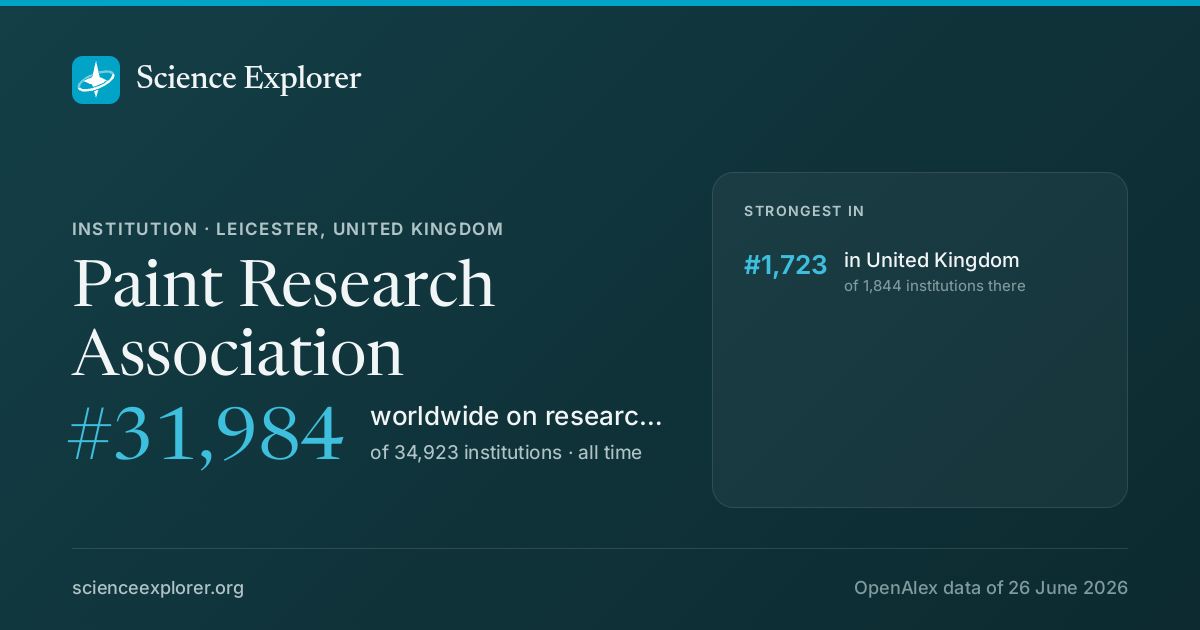
Paint Research Association on Science Explorer

A card with Paint Research Association's standing and the fields it leads in, for a post or a slide. A link to this page previews as the same card.

Download the card

1200 × 630 PNG, sized for social posts, drawn from the latest snapshot.

Badges for a website1Each links back here and updates with every snapshot

Research measures only: rankings here say nothing about teaching, admissions or student experience. Comparable institutions and collaboration partners have tabs of their own, above.

Discussion

Ask a question or share a note about Paint Research Association. Posts are plain text and can be reported.