Science Explorer Back to mapMap
Discussion
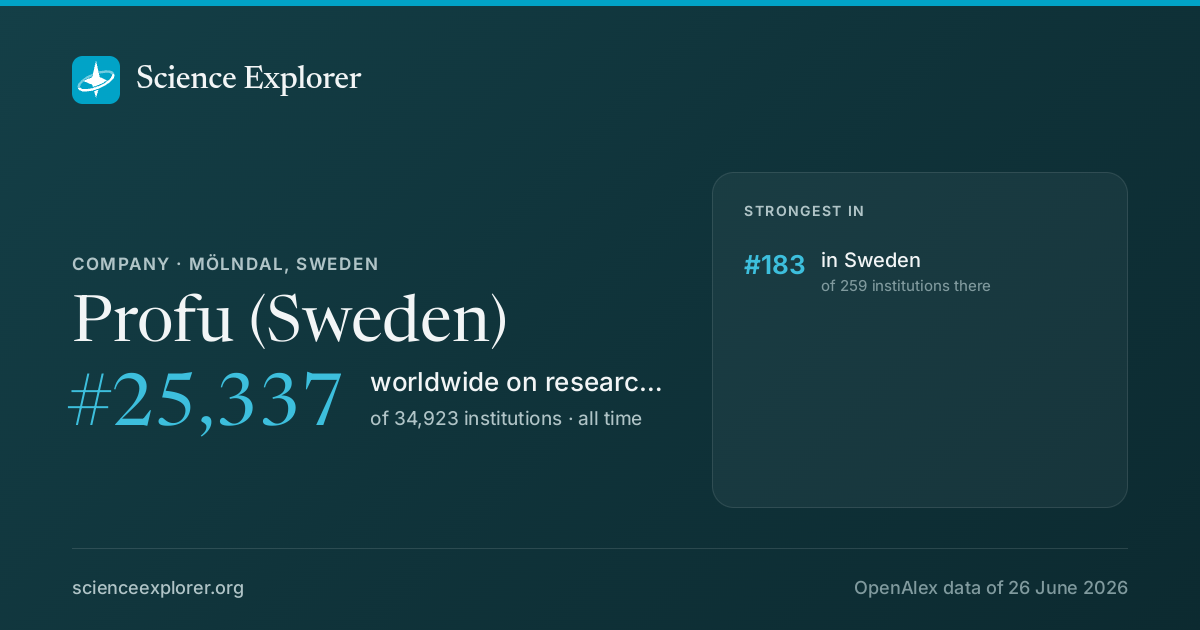
Company · Mölndal · Sweden

Profu (Sweden)

World rank, all time
#25,337
of 34,923
Rank in Sweden
#183
of 259
Research works
181
▲ 452% vs 2018-21
Citations
7k
38.7 per fractional work
Top-10% rate
6.8%
all institutions 10.0%
vs its own fields
1.04×
1.00× is exactly expected
Open access
22%
world 40%
International
26%
world 18%

Which fields of science does Profu (Sweden) work in?

In 2022-now, 56% of research at Profu (Sweden) is in Health Sciences, 23% in Physical Sciences. Its largest fields are Medicine (53%), Engineering (13%), Neuroscience (8%). It does 1.9× the world's share of Health Sciences.

Health Sciences: 13 fractional works · 55.5% of its workMedicine: 12 fractional works · 53.4% of its workPhysiology: 2 fractional works · 8.8% of its workCardiology and Cardiovascular Medicine: 2 fractional works · 8.5% of its workSurgery: 2 fractional works · 7.6% of its workPsychiatry and Mental health: 2 fractional works · 7.1% of its workPulmonary and Respiratory Medicine: 1 fractional works · 3.9% of its workRadiology, Nuclear Medicine and Imaging: 1 fractional works · 3.6% of its workEpidemiology: 1 fractional works · 2.6% of its workPublic Health, Environmental and Occupational Health: 1 fractional works · 2.5% of its workOncology: 0 fractional works · 1.2% of its workHematology: 0 fractional works · 1.0% of its workOrthopedics and Sports Medicine: 0 fractional works · 0.8% of its workInternal Medicine: 0 fractional works · 0.8% of its workEndocrinology, Diabetes and Metabolism: 0 fractional works · 0.7% of its workRehabilitation: 0 fractional works · 0.7% of its workAnesthesiology and Pain Medicine: 0 fractional works · 0.6% of its workNeurology: 0 fractional works · 0.6% of its workBiochemistry: 0 fractional works · 0.5% of its workComplementary and alternative medicine: 0 fractional works · 0.5% of its workCritical Care and Intensive Care Medicine: 0 fractional works · 0.3% of its workHepatology: 0 fractional works · 0.3% of its workOphthalmology: 0 fractional works · 0.3% of its workPediatrics, Perinatology and Child Health: 0 fractional works · 0.3% of its workPharmacology: 0 fractional works · 0.3% of its workRheumatology: 0 fractional works · 0.3% of its workHealth Professions: 0 fractional works · 2.1% of its workGeneral Health Professions: 0 fractional works · 1.2% of its workHealth Information Management: 0 fractional works · 0.9% of its workPhysical Sciences: 5 fractional works · 22.5% of its workEngineering: 3 fractional works · 13.4% of its workBiomedical Engineering: 1 fractional works · 4.0% of its workElectrical and Electronic Engineering: 1 fractional works · 2.4% of its workMechanics of Materials: 1 fractional works · 2.3% of its workSafety, Risk, Reliability and Quality: 0 fractional works · 1.7% of its workOcean Engineering: 0 fractional works · 1.2% of its workCivil and Structural Engineering: 0 fractional works · 1.0% of its workMechanical Engineering: 0 fractional works · 0.7% of its workEnvironmental Science: 1 fractional works · 3.9% of its workPollution: 0 fractional works · 1.4% of its workIndustrial and Manufacturing Engineering: 0 fractional works · 1.2% of its workWater Science and Technology: 0 fractional works · 1.0% of its workGlobal and Planetary Change: 0 fractional works · 0.3% of its workChemistry: 0 fractional works · 1.7% of its workSpectroscopy: 0 fractional works · 1.0% of its workInorganic Chemistry: 0 fractional works · 0.7% of its workEnergy: 0 fractional works · 1.6% of its workEnergy Engineering and Power Technology: 0 fractional works · 0.7% of its workRenewable Energy, Sustainability and the Environment: 0 fractional works · 0.7% of its workSmaller subfields together: 0 fractional works · 0.1% of its workChemical Engineering: 0 fractional works · 0.7% of its workCatalysis: 0 fractional works · 0.7% of its workMathematics: 0 fractional works · 0.7% of its workMathematical Physics: 0 fractional works · 0.5% of its workStatistics and Probability: 0 fractional works · 0.2% of its workMaterials Science: 0 fractional works · 0.5% of its workMaterials Chemistry: 0 fractional works · 0.5% of its workLife Sciences: 4 fractional works · 17.0% of its workNeuroscience: 2 fractional works · 7.9% of its workCellular and Molecular Neuroscience: 1 fractional works · 3.1% of its workNeurology: 1 fractional works · 3.0% of its workDevelopmental Neuroscience: 0 fractional works · 0.8% of its workCognitive Neuroscience: 0 fractional works · 0.6% of its workBiological Psychiatry: 0 fractional works · 0.3% of its workBiochemistry, Genetics and Molecular Biology: 2 fractional works · 7.4% of its workMolecular Biology: 1 fractional works · 5.4% of its workGenetics: 0 fractional works · 1.1% of its workCancer Research: 0 fractional works · 0.7% of its workCell Biology: 0 fractional works · 0.2% of its workImmunology and Microbiology: 0 fractional works · 1.7% of its workImmunology: 0 fractional works · 1.7% of its workSocial Sciences: 1 fractional works · 4.9% of its workPsychology: 1 fractional works · 2.5% of its workClinical Psychology: 0 fractional works · 2.2% of its workExperimental and Cognitive Psychology: 0 fractional works · 0.3% of its workSocial Sciences: 0 fractional works · 2.1% of its workSociology and Political Science: 0 fractional works · 1.9% of its workSmaller subfields together: 0 fractional works · 0.2% of its workBusiness, Management and Accounting: 0 fractional works · 0.2% of its workDecision Sciences: 0 fractional works · 0.2% of its workALL ITS WORKProfu (Sweden)23fractional works, 2022-now
Life Sciences17%Physical Sciences23%Health Sciences56%Social Sciences5%

Each ring splits the one inside it: the four domains of science, their fields, their subfields. Size is fractional works in 2022-now. Every slice is a page; the interactive view zooms down to single topics and colours each by how much more of it this institution does than the world.

Its 4 domains and 16 fields, with their numbers
    1. Medicine1253.4%
    2. Health Professions02.1%
    1. Engineering313.4%
    2. Environmental Science13.9%
    3. Chemistry01.7%
    4. Energy01.6%
    5. Chemical Engineering00.7%
    6. Mathematics00.7%
    7. Materials Science00.5%
    1. Neuroscience27.9%
    2. Biochemistry, Genetics and Molecular Biology27.4%
    3. Immunology and Microbiology01.7%
    1. Psychology12.5%
    2. Social Sciences02.1%
    3. Business, Management and Accounting00.2%
    4. Decision Sciences00.2%
All of science, and how each field's share has moved since 1950: the Science domain explorer

Field profile

Location quotient across every field it publishes in: outside the ring is more than an institution of this size would be expected to publish, inside it is less.

Biochemistry, Genetics and Molecular Biology: 1.39× its world share, 2 worksBiochemistry, Geneti…Immunology and Microbiology: 1.72× its world share, 0 worksImmunology and Micro…Neuroscience: 4.85× its world share, 2 worksNeuroscienceChemical Engineering: 2.08× its world share, 0 worksChemical EngineeringChemistry: 1.11× its world share, 0 worksChemistryEnergy: 1.76× its world share, 0 worksEnergyEngineering: 0.89× its world share, 3 worksEngineeringEnvironmental Science: 0.78× its world share, 1 worksEnvironmental ScienceMaterials Science: 0.14× its world share, 0 worksMaterials ScienceMathematics: 0.59× its world share, 0 worksMathematicsHealth Professions: 0.81× its world share, 0 worksHealth ProfessionsMedicine: 2.78× its world share, 12 worksMedicineBusiness, Management and Accounting: 0.06× its world share, 0 worksBusiness, Management…Decision Sciences: 0.17× its world share, 0 worksDecision SciencesPsychology: 0.81× its world share, 1 worksPsychologySocial Sciences: 0.17× its world share, 0 worksSocial Sciences1×world share
more than its size predictsabout as predictedless

Rings at 0.5×, 1× and 2×. Widest outward: Neuroscience, 4.8×. Every wedge is a field page.

All 16 fields, with their numbers
  1. Neuroscience4.85×2 works
  2. Medicine2.78×12 works
  3. Chemical Engineering2.08×0 works
  4. Energy1.76×0 works
  5. Immunology and Microbiology1.72×0 works
  6. Biochemistry, Genetics and Molecular Biology1.39×2 works
  7. Chemistry1.11×0 works
  8. Engineering0.89×3 works
  9. Health Professions0.81×0 works
  10. Psychology0.81×1 works
  11. Environmental Science0.78×1 works
  12. Mathematics0.59×0 works
  13. Decision Sciences0.17×0 works
  14. Social Sciences0.17×0 works
  15. Materials Science0.14×0 works
  16. Business, Management and Accounting0.06×0 works

Who are the top researchers at Profu (Sweden)?

Ranked on the quality score, Mattias Bisaillon lead among researchers whose main affiliation is Profu (Sweden).

  1. 1 Mattias Bisaillon Sweden · #3,796,794 worldwide 416 citations · 25 works
All ranked researchers at Profu (Sweden)

What are the most cited papers from Profu (Sweden)?

The most cited paper from Profu (Sweden) is "Osseointegrated Titanium Implants: Requirements for Ensuring a Long-Lasting, Direct Bone-to-Implant Anchorage in Man" (Tomas O. Albrektsson, Per‐Ingvar Brånemark, Hans‐Arne Hansson et al., 1981), with 2,698 citations. Next come "Technologies for chemical recycling of household plastics – A technical review and TRL assessment" (447) and "Identifying breast cancer patients at risk for Central Nervous System (CNS) metastases in trials of the International Breast Cancer Study Group (IBCSG)" (413).

Most cited papers
#PaperReleasedCitations
1 Osseointegrated Titanium Implants: Requirements for Ensuring a Long-Lasting, Direct Bone-to-Implant Anchorage in Man Tomas O. Albrektsson, Per‐Ingvar Brånemark, Hans‐Arne Hansson et al. · Acta Orthopaedica Scandinavica 1981 2,698
2 Technologies for chemical recycling of household plastics – A technical review and TRL assessment Martyna Solis, Semida Silveira · Waste Management Open access 12 Feb 2020 447
3 Identifying breast cancer patients at risk for Central Nervous System (CNS) metastases in trials of the International Breast Cancer Study Group (IBCSG) Bernhard C. Pestalozzi, David Zahrieh, Karen N. Price et al. · Annals of Oncology Open access 8 Apr 2006 413
4 Malignant and benign tumors in patients with neurofibromatosis type 1 in a defined Swedish population M. Z�ller, Birgitta Rembeck, Anders Od�n et al. · Cancer Open access Jun 1997 383
5 White Matter Changes on CT and MRI: An Overview of Visual Rating Scales Philip Scheltens, Timo Erkinjunti, Didier Leys et al. · European Neurology 1998 307
All 60 most cited papers, with filters and sorting

Which keywords describe research at Profu (Sweden)?

By fractional works in 2022-now, weighted toward what it does more of than the world: Oxidative Stress, Neurodegeneration, Neuroinflammation, Alzheimer's Disease, Heart Failure, Biomarkers, Amyloid Hypothesis and Tau Pathology.

▲ more of its work than of the world's◆ about the world's share▼ less than the world's

Size is fractional works in 2022-now in the topics tagged with each word; colour is the word's share of this institution's work against its share of the world's. The 21 words are chosen for being large and distinctive. Each links to the topic it comes from most.

All 21 words, with their numbers
  1. Oxidative Stress2▲ 6.7×7 topics
  2. Neurodegeneration2▲ 32×5 topics
  3. Neuroinflammation2▲ 34×4 topics
  4. Alzheimer's Disease2▲ 32×4 topics
  5. Heart Failure2▲ 19×7 topics
  6. Amyloid Hypothesis2▲ 136×1 topic
  7. Biomarkers2▲ 12×6 topics
  8. Tau Pathology2▲ 136×1 topic
  9. Neuroimaging2▲ 28×4 topics
  10. Renewable Energy2▲ 5.4×9 topics
  11. Aging2▲ 14×4 topics
  12. Caregiver Burden2▲ 64×2 topics
  13. Dementia2▲ 73×1 topic
  14. Mild Cognitive Impairment2▲ 81×1 topic
  15. Obesity1▲ 7.1×5 topics
  16. Diagnosis1▲ 5.7×7 topics
  17. Echocardiography1▲ 19×3 topics
  18. Cardiovascular Risk1▲ 15×2 topics
  19. Epidemiology1▲ 1.25×11 topics
  20. Chamber Quantification1▲ 55×1 topic
  21. Diastolic Function1▲ 55×1 topic

Which research topics does Profu (Sweden) publish most on?

By volume in 2022-now: Alzheimer's disease research and treatments, Dementia and Cognitive Impairment Research, Cardiovascular Function and Risk Factors and Cerebrospinal fluid and hydrocephalus.

  1. 1 Alzheimer's disease research and treatments Physiology 2 works
  2. 2 Dementia and Cognitive Impairment Research Psychiatry and Mental health 2 works
  3. 3 Cardiovascular Function and Risk Factors Cardiology and Cardiovascular Medicine 1 works
  4. 4 Cerebrospinal fluid and hydrocephalus Cellular and Molecular Neuroscience 1 works
  5. 5 Shoulder Injury and Treatment Surgery 0 works
  6. 6 Neurological Disorders and Treatments Neurology 0 works
  7. 7 Chronic Obstructive Pulmonary Disease (COPD) Research Pulmonary and Respiratory Medicine 0 works
  8. 8 Radiomics and Machine Learning in Medical Imaging Radiology, Nuclear Medicine and Imaging 0 works
  9. 9 Smart Grid Energy Management Electrical and Electronic Engineering 0 works
  10. 10 Energy and Environment Impacts Pollution 0 works

How open and international is its research?

Against the world's own shares: the tick on each track. Both are shares of its output, so they sit on one scale and can be read against each other as well as against the world.

openly available22.3%not open77.7%

World: 40% of research is openly available.

with international co-authors25.5%domestic only74.5%

World: 18% is written across borders.

How has Profu (Sweden)'s research output changed?

Output in 2022-2025 was 452% higher than in 2018-2021.

still counting1990200020102020
grewheldshrank

The same series as a ribbon: one cell per year, darker for more. The line above answers how much; this answers when.

Its share of all research

Growing output can still be a shrinking share: all of science grows. This is Profu (Sweden) as a percentage of every work published that year, 0.00011% in 2024.

still counting0.0010%0.0020%Profu (Sweden)0.00022% in 202519801990200020102020

Fractional works of Profu (Sweden) over all fractional works that year. How the balance of science has shifted.

Other research institutions in Mölndal

All research institutions in Mölndal

Share Profu (Sweden)'s ranking

Profu (Sweden) on Science Explorer

A card with Profu (Sweden)'s standing and the fields it leads in, for a post or a slide. A link to this page previews as the same card.

Download the card

1200 × 630 PNG, sized for social posts, drawn from the latest snapshot.

Badges for a website1Each links back here and updates with every snapshot

Research measures only: rankings here say nothing about teaching, admissions or student experience. Comparable institutions and collaboration partners have tabs of their own, above.

Discussion

Ask a question or share a note about Profu (Sweden). Keep it to the research: no personal attacks, advertising or links. Any reader can report a post, which collapses it for everyone until it is opened.