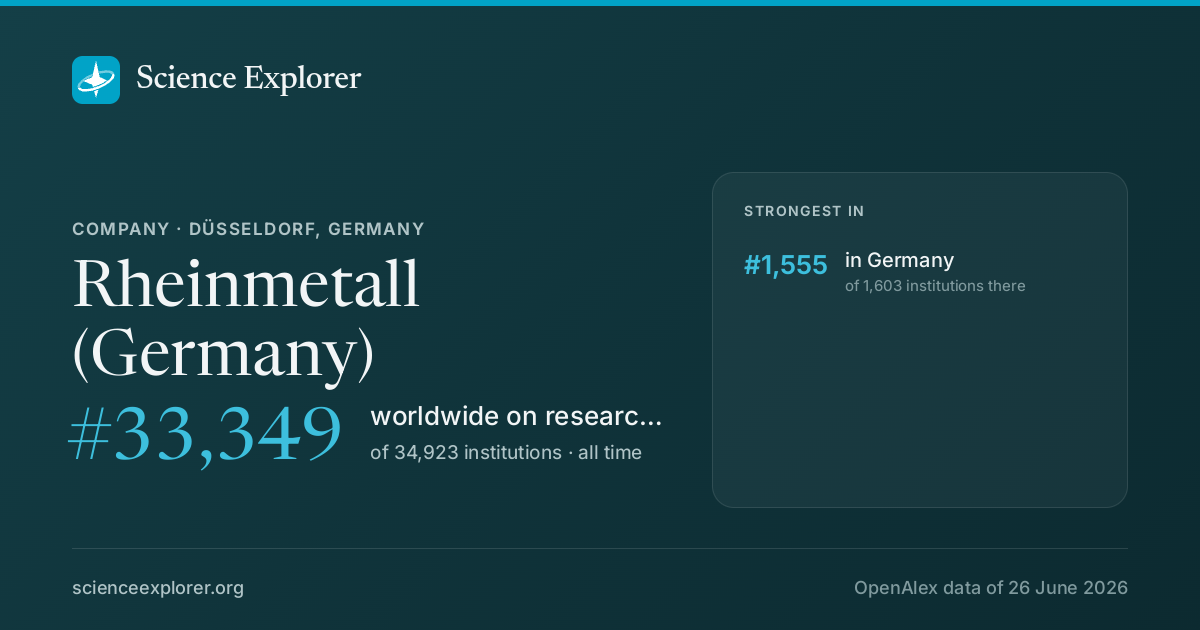
Rheinmetall (Germany)
- World rank, all time
- #33,349 of 34,923
- Rank in Germany
- #1,555 of 1,603
- Research works
- 122 ▼ 26% vs 2018-21
- Citations
- 1.7k 14.0 per fractional work
- Top-10% rate
- 10.2% all institutions 10.0%
- vs its own fields
- 0.96× 1.00× is exactly expected
- Open access
- 14% world 40%
- International
- 21% world 18%
Which fields of science does Rheinmetall (Germany) work in?
In all years, 85% of research at Rheinmetall (Germany) is in Physical Sciences, 12% in Social Sciences. Its largest fields are Engineering (61%), Materials Science (7%), Physics and Astronomy (7%). It does 2.0× the world's share of Physical Sciences.
Each ring splits the one inside it: the four domains of science, their fields, their subfields. Size is fractional works in all years. Every slice is a page; the interactive view zooms down to single topics and colours each by how much more of it this institution does than the world.
Its 4 domains and 21 fields, with their numbers
- Physical Sciences10384.5%
- Engineering7461.0%
- Materials Science97.2%
- Physics and Astronomy86.6%
- Environmental Science43.4%
- Computer Science43.1%
- Mathematics11.1%
- Chemistry11.0%
- Earth and Planetary Sciences10.7%
- Chemical Engineering00.4%
- Social Sciences1512.3%
- Health Sciences21.9%
- Medicine21.5%
- Health Professions10.5%
- Life Sciences21.3%
Field profile
Location quotient across every field it publishes in: outside the ring is more than an institution of this size would be expected to publish, inside it is less.
Rings at 0.5×, 1× and 2×. Widest outward: Pharmacology, Toxicology and Pharmaceutics, 5.4×. Every wedge is a field page.
All 13 fields, with their numbers
- Pharmacology, Toxicology and Pharmaceutics5.41×0 works
- Economics, Econometrics and Finance3.86×1 works
- Engineering3.00×8 works
- Physics and Astronomy3.00×1 works
- Mathematics2.43×0 works
- Business, Management and Accounting2.37×1 works
- Materials Science1.61×1 works
- Computer Science1.20×2 works
- Decision Sciences0.99×0 works
- Psychology0.94×0 works
- Social Sciences0.48×1 works
- Environmental Science0.19×0 works
- Medicine0.10×0 works
- Pharmacology, Toxicology and Pharmaceutics 5.4×
- Economics, Econometrics and Finance 3.9×
- Engineering 3.0×
- Physics and Astronomy 3.0×
- Mathematics 2.4×
- Business, Management and Accounting 2.4×
- Materials Science 1.6×
- Computer Science 1.2×
- Decision Sciences 1.0×
- Psychology 0.9×
- Social Sciences 0.5×
- Environmental Science 0.2×
- Medicine 0.1×
Who are the top researchers at Rheinmetall (Germany)?
Ranked on the quality score, Ernst Damerow, Markus Jung and Otto Niezoldi lead among researchers whose main affiliation is Rheinmetall (Germany).
- 1
Ernst Damerow
 Germany · #2,161,027 worldwide
11 citations · 65 works
- 2
Markus Jung
Germany · #2,663,904 worldwide
1k citations · 93 works
- 3
Otto Niezoldi
Germany · #2,754,210 worldwide
14 citations · 19 works
- 4
Hartmut Schilling
Germany · #3,173,765 worldwide
61 citations · 21 works
- 5
Kai Olaf Ketelhut
Germany · #4,058,555 worldwide
0 citations · 161 works
- 6
T.H.G.G. Weise
Germany · #5,583,312 worldwide
235 citations · 38 works
Which keywords describe research at Rheinmetall (Germany)?
By fractional works in all years, weighted toward what it does more of than the world: Pulsed Power, Electromagnetic Launch, Railgun, Ionic Liquids, Metal Nanoparticles, Molecular Dynamics Simulations, Energetic Salts and ReaxFF.
- Business Models
- Vacuum Electronics
- Optimal Control
- Grain Refinement
- Nonlinear Optics
- Control
- Regulatory Competition
- Plasma Etching
- Hybrid Rocket Propulsion
- Thin Films
- Combustion Instabilities
- High Strain Rate
- High Current
- Remote Sensing
- Ballistic Impact
- Mechanical Properties
- ReaxFF
- Molecular Dynamics Simulations
- Ionic Liquids
- Electromagnetic Launch
- Pulsed Power
- Railgun
- Metal Nanoparticles
- Energetic Salts
- Microstructural Evolution
- Constitutive Modeling
- Surface Modification
- Electron Beam
- Dynamic Deformation
- Large-Eddy Simulation
- CMOS
- European Company Law
- Integrated Circuits
- Regression Rate Behavior
- Semiconductor Industry
- Frequency Conversion
- Turbulent Flow
- High Power Terahertz Sources
- Time-of-Flight
- Millimeter-Wave
Size is fractional works in all years in the topics tagged with each word; colour is the word's share of this institution's work against its share of the world's. The 40 words are chosen for being large and distinctive. Each links to the topic it comes from most.
All 40 words, with their numbers
- Pulsed Power11▲ 358×2 topics
- Electromagnetic Launch8▲ 413×1 topic
- Railgun8▲ 413×1 topic
- Ionic Liquids6▲ 16×3 topics
- Metal Nanoparticles6▲ 33×2 topics
- Molecular Dynamics Simulations6▲ 91×2 topics
- Energetic Salts6▲ 182×1 topic
- ReaxFF6▲ 182×1 topic
- Microstructural Evolution4▲ 20×3 topics
- Mechanical Properties4▲ 3.4×16 topics
- Constitutive Modeling4▲ 34×2 topics
- Ballistic Impact4▲ 41×2 topics
- Surface Modification4▲ 18×2 topics
- Remote Sensing4▲ 2.6×7 topics
- Electron Beam3▲ 275×1 topic
- High Current3▲ 275×1 topic
- Dynamic Deformation3▲ 85×1 topic
- High Strain Rate3▲ 85×1 topic
- Large-Eddy Simulation2▲ 8.4×4 topics
- Combustion Instabilities2▲ 25×2 topics
- CMOS2▲ 23×2 topics
- Thin Films2▲ 6.7×2 topics
- European Company Law2▲ 73×1 topic
- Hybrid Rocket Propulsion2▲ 61×1 topic
- Integrated Circuits2▲ 7.1×2 topics
- Plasma Etching2▲ 36×1 topic
- Regression Rate Behavior2▲ 61×1 topic
- Regulatory Competition2▲ 73×1 topic
- Semiconductor Industry2▲ 36×1 topic
- Control2▲ 12×3 topics
- Frequency Conversion2▲ 16×2 topics
- Nonlinear Optics2▲ 8.9×3 topics
- Turbulent Flow2▲ 12×3 topics
- Grain Refinement2▲ 9.8×4 topics
- High Power Terahertz Sources2▲ 48×1 topic
- Optimal Control2▲ 18×2 topics
- Time-of-Flight2▲ 21×2 topics
- Vacuum Electronics2▲ 48×1 topic
- Millimeter-Wave2▲ 25×2 topics
- Business Models2▲ 16×2 topics
Which research topics does Rheinmetall (Germany) publish most on?
By volume in 2022-now: European Socioeconomic and Political Studies, Elasticity and Material Modeling, Morphological variations and asymmetry and Quasicrystal Structures and Properties.
Area is fractional works; colour is the subfield each topic belongs to.
- 1 European Socioeconomic and Political Studies Economics and Econometrics 1 works
- 2 Elasticity and Material Modeling Biomedical Engineering 1 works
- 3 Morphological variations and asymmetry Geometry and Topology 0 works
- 4 Quasicrystal Structures and Properties Materials Chemistry 0 works
- 5 Rocket and propulsion systems research Aerospace Engineering 0 works
- 6 Organizational Change and Leadership Organizational Behavior and Human Resource Management 0 works
- 7 Organizational Learning and Leadership Organizational Behavior and Human Resource Management 0 works
- 8 Traumatic Ocular and Foreign Body Injuries Ophthalmology 0 works
- 9 Laser-Plasma Interactions and Diagnostics Nuclear and High Energy Physics 0 works
- 10 Human auditory perception and evaluation Aerospace Engineering 0 works
How open and international is its research?
Against the world's own shares: the tick on each track. Both are shares of its output, so they sit on one scale and can be read against each other as well as against the world.
World: 40% of research is openly available.
World: 18% is written across borders.
How has Rheinmetall (Germany)'s research output changed?
Output in 2022-2025 was 26% lower than in 2018-2021.
The same series as a ribbon: one cell per year, darker for more. The line above answers how much; this answers when.
Its share of all research
Growing output can still be a shrinking share: all of science grows. This is Rheinmetall (Germany) as a percentage of every work published that year, 0.000024% in 2024.
Fractional works of Rheinmetall (Germany) over all fractional works that year. How the balance of science has shifted.
Other research institutions in Düsseldorf
- Heinrich Heine University Düsseldorf
- Hochschule Düsseldorf University of Applied Sciences
- Henkel (Germany)
- Nippon Steel (Germany)
- Mitsui Chemicals (Germany)
- Huawei Technologies (Germany)
- Asahi Kasei (Germany)
- Vodafone (Germany)
Share Rheinmetall (Germany)'s ranking
Badges for a website1Each links back here and updates with every snapshot

Research measures only: rankings here say nothing about teaching, admissions or student experience. Comparable institutions and collaboration partners have tabs of their own, above.
Discussion
Ask a question or share a note about Rheinmetall (Germany). Posts are plain text and can be reported.